A variable in a mathematical formula can take different values depending on the situation. Sometimes, one of these values is zero. When a variable is equal to zero, the formula does not automatically become meaningless or stop working. Instead, the effect depends on where that variable appears and how it is used in the expression. In some cases, a term becomes zero and disappears from the calculation. In other cases, a variable equal to zero can make a formula undefined, especially when it appears in a denominator. Understanding what happens when a variable is zero is an important part of working with algebraic expressions, equations, formulas, and mathematical models.
What Does It Mean When a Variable Is Equal to Zero?
A variable is a symbol used to represent a value that can change. Common variables include x, y, a, b, and t. If we are told that a variable is equal to zero, we simply replace that variable with 0 in the formula.
For example, consider the formula:
x + 5
If x = 0, substitute 0 for x:
0 + 5 = 5
Therefore, the value of the expression is 5.
The important point is that setting a variable equal to zero means substituting zero wherever that variable occurs in the formula. What happens next depends on the mathematical operation involving that variable.
When a Variable Is Multiplied by Another Number
One of the simplest cases occurs when a variable is multiplied by a constant or another expression.
Consider:
5x
If x = 0:
5 × 0 = 0
Therefore:
5x = 0
The entire term becomes zero.
This follows from the basic multiplication rule that any number multiplied by zero is zero.
For example:
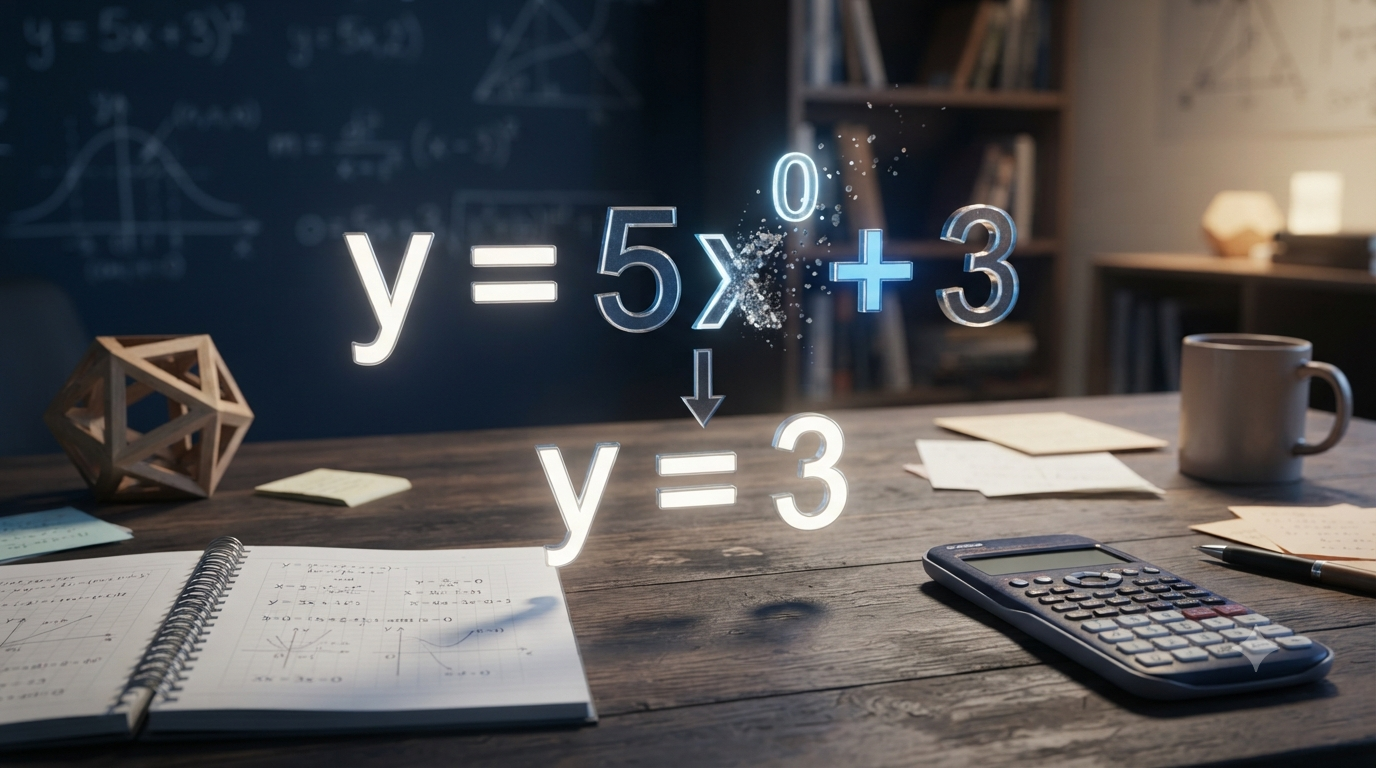
7x + 3 = 7(0) + 3 = 3
The term 7x disappears because its value is zero.
Similarly:
12x² = 12(0)² = 12 × 0 = 0
So, whenever a variable is multiplied by something and the variable itself becomes zero, that multiplication term becomes zero.
When a Variable Is Added to a Formula
When zero is added to another number, the number remains unchanged.
For example:
x + 8
If x = 0:
0 + 8 = 8
The result is simply 8.
This is because zero is the additive identity. Adding zero to a number does not change its value.
For example:
25 + 0 = 25
Therefore, if a formula contains a term such as x and x becomes zero, that term contributes nothing to the final value.
Consider:
A = x + 15
When x = 0:
A = 0 + 15
A = 15
The formula is still perfectly valid.
When a Variable Is Subtracted
The same idea applies when zero is involved in subtraction.
Suppose:
y – 10
If y = 0:
0 – 10 = -10
The result is negative 10.
However, if the zero-valued variable is being subtracted from another number:
10 – y
and y = 0, then:
10 – 0 = 10
So, the position of the variable matters.
Compare:
0 – 10 = -10
with:
10 – 0 = 10
Both expressions contain zero, but they produce different results because subtraction is not commutative.
What Happens to a Variable Raised to a Power?
A variable equal to zero can also appear as a base with an exponent.
For positive powers:
0¹ = 0
0² = 0
0³ = 0
and so on.
Therefore, for any positive integer n:
0ⁿ = 0
For example:
x² + 4x + 6
If x = 0:
0² + 4(0) + 6 = 6
Both x² and 4x become zero.
However, zero raised to the power of zero is a special case. The expression 0⁰ does not have the same straightforward interpretation as positive powers of zero. Its treatment depends on the mathematical context. In elementary algebra, it is generally treated as undefined or left unspecified, while in some areas of mathematics it is assigned a value of 1 for particular purposes. Therefore, 0⁰ should not be handled automatically as ordinary multiplication.
What Happens When Zero Is in the Denominator?
This is one of the most important cases to understand.
A variable equal to zero can make a formula undefined if that variable appears in a denominator.
Consider:
y = 10/x
If x = 0:
y = 10/0
Division by zero is undefined.
There is no ordinary real number that can be assigned to 10/0. Therefore, the formula cannot produce a valid numerical result for x = 0.
This is different from multiplication by zero.
For example:
10 × 0 = 0
but:
10 ÷ 0
is undefined.
This distinction is extremely important when substituting values into formulas.
Why Can’t We Divide by Zero?
Division can be understood as asking how many times one number fits into another or, equivalently, as finding a number that satisfies a multiplication relationship.
Suppose:
10 ÷ 2 = 5
because:
2 × 5 = 10
Now consider:
10 ÷ 0 = ?
This would require a number k such that:
0 × k = 10
But zero multiplied by any finite number is always zero. It can never produce 10.
Therefore, there is no number that satisfies the required relationship. This is why division by zero is undefined.
What Happens When a Variable Is in a Fraction?
Consider a formula such as:
y = x/5
If x = 0:
y = 0/5 = 0
This is completely valid because the denominator is 5, not zero.
Now consider:
y = 5/x
If x = 0:
y = 5/0
This is undefined.
Therefore, simply seeing a zero in a fraction does not mean that the expression is invalid. You must check whether zero is in the numerator or the denominator.
A zero numerator with a nonzero denominator is valid:
0/5 = 0
A nonzero numerator with a zero denominator is undefined:
5/0 = undefined
What Happens When Both the Numerator and Denominator Become Zero?
An especially important situation occurs when substitution produces:
0/0
For example:
f(x) = x/x
If x = 0:
f(0) = 0/0
The expression is undefined at x = 0.
However, 0/0 is different from an ordinary undefined fraction such as 5/0. In calculus and higher mathematics, 0/0 is called an indeterminate form when it appears as a limiting expression. It does not tell us the final value by itself.
For example, the expressions:
x/x
and:
2x/x
both produce 0/0 when x = 0, but for nonzero x they simplify differently:
x/x = 1
2x/x = 2
This shows why you cannot simply decide that 0/0 equals a particular number.
What Happens in an Equation?
Setting a variable equal to zero can also help solve or understand equations.
Consider:
3x + 9 = 9
If x = 0:
3(0) + 9 = 9
9 = 9
The equation is true.
Now consider:
3x + 9 = 12
If x = 0:
3(0) + 9 = 12
9 = 12
This is false.
So, substituting zero into an equation can tell us whether zero is a solution.
For example:
x² – 4x = 0
If x = 0:
0² – 4(0) = 0
0 = 0
Therefore, x = 0 is one solution of the equation.
Zero Can Make Some Terms Disappear
A useful way to think about zero in formulas is that it can remove certain terms.
Consider the quadratic expression:
ax² + bx + c
If x = 0:
a(0)² + b(0) + c = c
The first two terms become zero, leaving only c.
This is why evaluating a polynomial at x = 0 gives its constant term.
For example:
f(x) = 4x³ + 7x² – 2x + 11
At x = 0:
f(0) = 4(0)³ + 7(0)² – 2(0) + 11
f(0) = 11
The value of the function at zero is therefore 11.
What Happens When a Variable Represents a Physical Quantity?
Variables in science often represent measurable quantities such as distance, time, velocity, mass, or temperature. Setting one of these variables to zero can describe a meaningful physical condition.
For example, the distance formula for an object moving at constant speed is:
d = vt
If time t = 0:
d = v(0) = 0
This means that, if the distance is measured from the starting point, the object has traveled zero distance at the initial moment.
Similarly, consider:
v = u + at
If t = 0:
v = u + a(0)
v = u
This means that at the initial time, the final velocity in this equation equals the initial velocity.
The mathematical substitution is simple, but the physical interpretation depends on what the variables represent.
Zero Does Not Always Mean the Formula Is Useless
A common misunderstanding is that a variable becoming zero makes the entire formula zero. This is not true.
Consider:
A = 5x + 20
If x = 0:
A = 5(0) + 20
A = 20
Only the term containing x becomes zero. The constant 20 remains.
Likewise:
P = xy + 10
If x = 0:
P = 0(y) + 10
P = 10
The whole expression becomes zero only when every contributing term becomes zero, or when the structure of the formula causes the final result to be zero.
Zero Can Simplify a Formula
Substituting zero can make a complicated formula much easier to evaluate.
Consider:
F = ma + bx + c
If x = 0:
F = ma + b(0) + c
F = ma + c
The bx term disappears.
If both x and a are zero:
F = m(0) + b(0) + c
F = c
This type of simplification is widely used in algebra, physics, engineering, statistics, and other areas of mathematics.
The Position of Zero Matters
The effect of setting a variable to zero depends heavily on its position in the formula.
For example:
x + 5 = 5
5 – x = 5
5x = 0
x/5 = 0
But:
5/x
is undefined when x = 0.
Similarly, an expression such as:
1/x²
is undefined at x = 0 because the denominator becomes zero.
Therefore, whenever a variable is assigned the value zero, the first step should be to substitute zero carefully. The next step is to simplify the expression and check whether any prohibited operation, such as division by zero, has occurred.
How to Evaluate a Formula When a Variable Is Zero
A simple process can be followed for almost any formula.
Step 1: Identify the Variable
Determine which variable is equal to zero.
For example:
x = 0
Step 2: Substitute Zero
Replace every occurrence of x with 0.
For example:
y = 3x² + 5x + 2
becomes:
y = 3(0)² + 5(0) + 2
Step 3: Simplify
Calculate each term:
y = 0 + 0 + 2
Therefore:
y = 2
Step 4: Check for Division by Zero
If the variable appears in a denominator, pay special attention.
For example:
y = 8/x
When x = 0:
y = 8/0
The expression is undefined.
Step 5: Consider the Meaning
If the formula represents something physical or practical, interpret what the zero value means.
For example, t = 0 may represent the starting instant, while distance equal to zero may represent an initial position.
Common Mistakes When a Variable Is Zero
Several mistakes occur frequently when substituting zero into formulas.
One common mistake is assuming that every expression becomes zero. A formula such as x + 10 does not become zero when x = 0; it becomes 10.
Another mistake is confusing zero divided by a number with a number divided by zero. The expression 0/10 equals zero, while 10/0 is undefined.
A third mistake is forgetting that powers also need to be evaluated. If x = 0, then x², x³, and other positive powers of x become zero.
Finally, it is important not to cancel a variable carelessly when its value is zero. For example, x/x can simplify to 1 only when x is nonzero. At x = 0, the original expression is 0/0 and is undefined.
Conclusion
When a variable is equal to zero, the effect on a formula depends on how that variable appears in the expression. Terms multiplied by the variable usually become zero, while adding zero leaves another number unchanged. Positive powers of zero are also zero. However, if the variable appears in a denominator, substituting zero can make the formula undefined. The special case 0/0 requires additional mathematical analysis and cannot simply be assigned a value. The safest approach is to substitute zero carefully, simplify each term, check for division by zero, and then interpret the result in the context of the formula. Understanding these basic rules makes algebraic formulas much easier to evaluate and use correctly.
FAQs
1. What happens to a formula when a variable is equal to zero?
When a variable is equal to zero, replace the variable with 0 everywhere it appears in the formula and simplify the expression. The result depends on the operation involving that variable. For example, if the formula is y = 5x + 3 and x = 0, then y = 5(0) + 3 = 3. A term multiplied by the variable becomes zero, while a constant term remains unchanged. However, if the variable appears in a denominator, substituting zero may make the expression undefined. Therefore, zero does not automatically make an entire formula equal to zero.
2. Does a term containing a variable always become zero when the variable is zero?
A term containing a variable does not always become zero simply because the variable is zero. It depends on how the variable appears in the term. For example, 5x becomes zero when x = 0, and x² also becomes zero. However, x + 5 becomes 5, not zero. Similarly, 5/x becomes undefined when x = 0 because division by zero is not allowed. The correct method is to substitute zero into the complete term and then simplify it. Looking at the operation involving the variable helps determine exactly what happens when its value becomes zero.
3. What happens when zero is multiplied by a number in a formula?
When zero is multiplied by any finite number, the result is zero. This rule applies directly when a variable has a value of zero. For example, if x = 0, then 8x = 8 × 0 = 0. Similarly, 25x² becomes 25 × 0² = 0. This means terms containing multiplication by a zero-valued variable often disappear from a formula. For example, in y = 8x + 12, setting x = 0 gives y = 0 + 12 = 12. Only the term involving x becomes zero; the constant 12 remains unchanged. This principle is widely used in algebra and science formulas.
4. What happens when a variable equal to zero is added to a number?
When zero is added to a number, the number remains unchanged. This is because zero is the additive identity. For example, if x = 0, then x + 15 becomes 0 + 15 = 15. Similarly, 20 + x becomes 20 + 0 = 20. Therefore, a variable becoming zero does not necessarily make the whole formula zero. It only removes the contribution of that variable when it is being added or subtracted in a suitable position. When evaluating a formula, substitute zero carefully and consider the operation being performed. This helps prevent mistakes when simplifying algebraic expressions and equations.
5. Is a formula undefined when a variable is zero?
A formula is not automatically undefined when a variable is zero. It depends on where the variable appears. For example, y = 4x + 7 is perfectly valid when x = 0, giving y = 7. Similarly, y = x/5 gives y = 0. However, y = 4/x becomes undefined when x = 0 because it requires division by zero. Therefore, the important question is whether setting the variable to zero creates an invalid mathematical operation. Always substitute the value first and then check the resulting expression. Zero is a valid value for many formulas, but it cannot be used as a denominator.
6. Why is division by zero undefined in a formula?
Division by zero is undefined because there is no number that can be multiplied by zero to produce a nonzero result. For example, 10 ÷ 2 = 5 because 2 × 5 = 10. But for 10 ÷ 0, we would need a number that satisfies 0 × number = 10. No such number exists because zero multiplied by any finite number is zero. Therefore, an expression such as 10/x becomes undefined when x = 0. This is an important rule when substituting values into formulas. A zero numerator can be valid, but a zero denominator makes ordinary division undefined.
7. What happens when both the numerator and denominator become zero?
When both the numerator and denominator become zero, the expression takes the form 0/0. In ordinary arithmetic, 0/0 is undefined. In calculus, however, 0/0 is known as an indeterminate form when it appears while evaluating a limit. It does not tell us the final value by itself. For example, x/x gives 0/0 when x = 0, but for nonzero x it simplifies to 1. Another expression, 2x/x, simplifies to 2 for nonzero x. Therefore, 0/0 cannot simply be treated as zero or one. Additional mathematical analysis is needed to determine the behavior of the expression.
8. What happens to powers of a variable when the variable is zero?
Positive powers of a variable become zero when the variable itself is zero. For example, if x = 0, then x² = 0, x³ = 0, and x⁴ = 0. More generally, zero raised to any positive integer power is zero. Consider the expression y = 3x² + 4x + 8. When x = 0, it becomes y = 3(0)² + 4(0) + 8 = 8. Both variable terms become zero, leaving the constant term. However, zero raised to the zero power, written as 0⁰, is a special case and should not be treated as an ordinary positive power of zero.
9. Can setting a variable to zero simplify a complicated formula?
Yes. Setting a variable to zero can greatly simplify a formula because terms containing that variable may become zero. For example, consider F = ma + bx + c. If x = 0, the expression becomes F = ma + c because bx becomes zero. If both a and x are zero, then F = c. This type of simplification is useful in algebra, physics, engineering, and mathematical modeling. It can also help identify the role of different terms in a formula. When evaluating an expression, substitute the zero value carefully into every occurrence of the variable before simplifying the remaining terms.
10. How should you evaluate a formula when a variable is equal to zero?
To evaluate a formula when a variable equals zero, first identify the variable and then replace every occurrence of it with 0. Next, simplify the expression according to the normal rules of arithmetic. For example, if y = 3x² + 5x + 4 and x = 0, substitute zero to get y = 3(0)² + 5(0) + 4, which simplifies to y = 4. Finally, check whether the substitution creates division by zero or another special case. If the variable occurs in a denominator, the expression may be undefined. Always evaluate the complete formula rather than assuming the answer is zero.