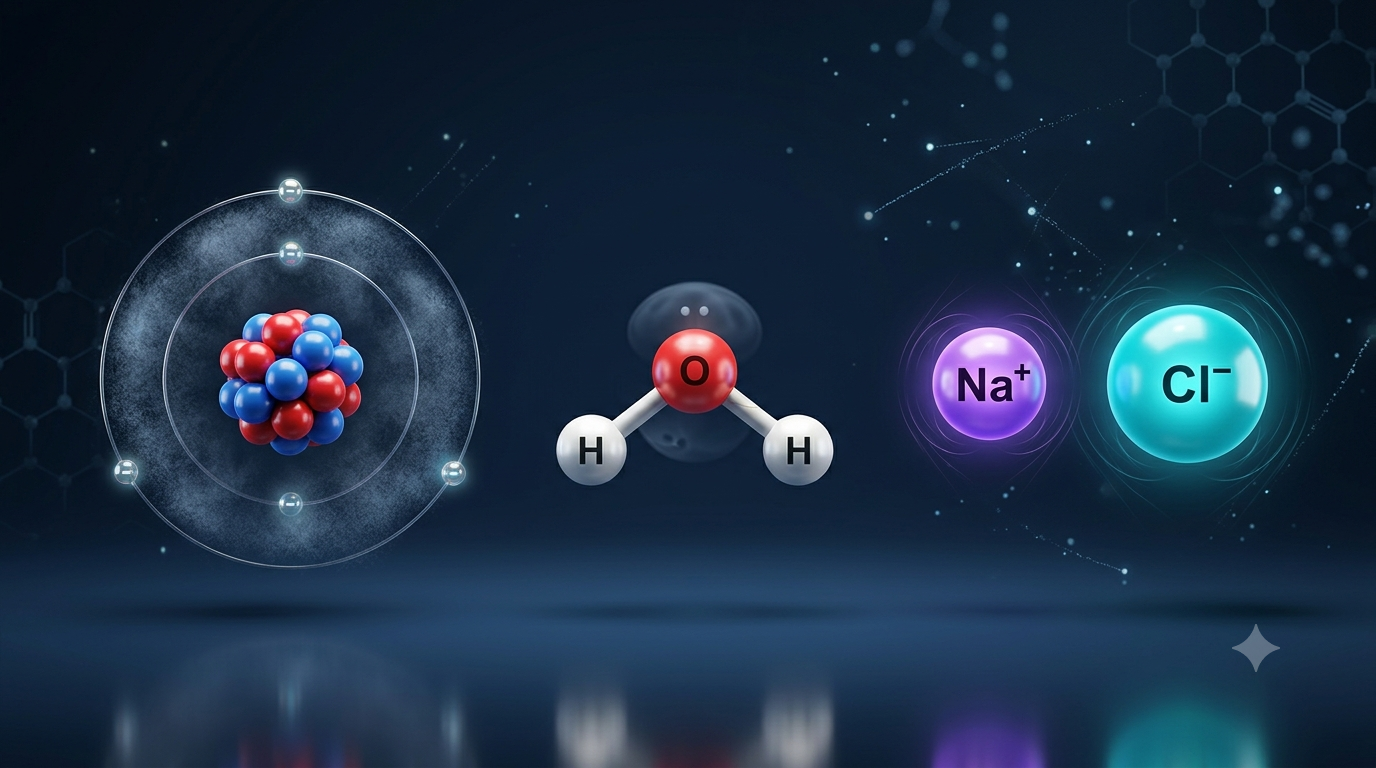
A chemical formula is a short way of representing a chemical substance using symbols and numbers. Instead of writing the names of all the elements present in a substance and explaining how many atoms of each element are involved, chemists use a compact combination of chemical symbols and subscripts. For example, H₂O represents water, while CO₂ represents carbon dioxide. These formulas provide important information about the composition of substances and help scientists communicate chemical information clearly.
Chemical formulas are used throughout chemistry. They appear on laboratory labels, medicine packages, chemical equations, scientific papers, textbooks, and industrial processes. Learning to read a chemical formula is therefore one of the first important steps in understanding chemistry.
But a chemical formula is more than a collection of letters and numbers. Each symbol and number has a specific meaning. The symbols identify elements, while subscripts indicate how many atoms of each element are represented. Some formulas can also tell us about the ratio of elements in a compound and help us understand how substances participate in chemical reactions.
What Is a Chemical Formula?
A chemical formula is a symbolic representation that shows which elements are present in a chemical substance and, in many cases, the relative number of atoms of each element.
For example, consider water:
H₂O
The symbol H represents hydrogen, and O represents oxygen. The subscript ₂ after H means that two hydrogen atoms are represented. There is no subscript after O, which means that one oxygen atom is represented.
Therefore, H₂O represents a substance containing hydrogen and oxygen in a 2:1 ratio.
Similarly:
CO₂
Here, C represents carbon and O represents oxygen. The subscript ₂ tells us that two oxygen atoms are associated with one carbon atom.
A chemical formula therefore communicates information in a very compact form.
Why Do Chemists Use Chemical Formulas?
Chemical substances can have complicated names and compositions. Writing a full description every time would make chemical communication slow and difficult.
Chemical formulas solve this problem by providing a standard symbolic language.
For example, instead of repeatedly writing “one molecule containing two hydrogen atoms and one oxygen atom,” a chemist can simply write:
H₂O
This makes scientific communication faster and easier to understand.
Chemical formulas are useful for several important reasons:
They identify the elements present in a substance.
They show the relative number of atoms of each element.
They represent compounds in chemical equations.
They help calculate molecular or formula mass.
They help determine the composition of substances.
They are used when writing chemical reactions.
They help chemists communicate information internationally.
Because chemical symbols are internationally recognized, chemical formulas can usually be understood regardless of the language spoken by the scientist.
What Do the Symbols in a Chemical Formula Mean?
The letters in a chemical formula are chemical symbols. Each chemical symbol represents a particular element.
For example:
H = hydrogen
O = oxygen
C = carbon
N = nitrogen
Na = sodium
Cl = chlorine
Ca = calcium
Fe = iron
The first letter of an element symbol is always capitalized. If an element symbol contains a second letter, that letter is lowercase.
For example:
Na is the symbol for sodium.
It is written as Na, not NA or na.
Similarly:
Cl represents chlorine.
The correct capitalization is important because changing the capitalization can change the meaning of a chemical symbol.
What Does a Subscript Mean?
A subscript is a small number written at the lower right of a chemical symbol.
For example:
H₂O
The subscript ₂ belongs to hydrogen. It tells us that two hydrogen atoms are represented.
Consider another example:
NH₃
The formula contains nitrogen and hydrogen. There is no subscript after N, so one nitrogen atom is represented. The subscript ₃ after H means that three hydrogen atoms are represented.
Therefore, NH₃ contains:
1 nitrogen atom
3 hydrogen atoms
The absence of a subscript means one atom.
This is an important rule when reading chemical formulas.
What Does a Chemical Formula Tell Us?
A chemical formula can provide several pieces of information.
First, it tells us which elements are present. For example:
CO₂
shows that carbon and oxygen are present.
Second, it can tell us the relative number of atoms represented by the formula. In CO₂, there is one carbon atom for every two oxygen atoms.
Third, a formula can help identify a particular compound. Water is represented by H₂O, carbon dioxide by CO₂, and ammonia by NH₃.
Fourth, formulas can be used to determine the composition of a substance mathematically.
For example, the formula H₂O shows a ratio of hydrogen to oxygen atoms of 2:1.
Examples of Simple Chemical Formulas
Many familiar substances can be represented using relatively simple chemical formulas.
Water
H₂O
Water contains hydrogen and oxygen. Two hydrogen atoms are represented for every one oxygen atom.
Carbon Dioxide
CO₂
Carbon dioxide contains one carbon atom and two oxygen atoms.
Oxygen
O₂
Oxygen gas consists of molecules containing two oxygen atoms.
Hydrogen
H₂
Hydrogen gas consists of molecules containing two hydrogen atoms.
Ammonia
NH₃
Ammonia contains one nitrogen atom and three hydrogen atoms.
Methane
CH₄
Methane contains one carbon atom and four hydrogen atoms.
These examples show why the symbols and subscripts in formulas must be read carefully.
Chemical Formula and Chemical Name Are Different
A chemical name and a chemical formula provide related but different information.
For example:
Water → H₂O
The word “water” is the name of the substance, while H₂O is its chemical formula.
Similarly:
Carbon dioxide → CO₂
The name tells us what the substance is called, while the formula gives symbolic information about its composition.
Chemists use both names and formulas, depending on the situation.
Chemical Formula vs Molecular Formula
The term “chemical formula” can be used broadly, but different types of formulas provide different kinds of information.
A molecular formula shows the actual number of atoms of each element in one molecule.
For example:
H₂O
represents one water molecule containing two hydrogen atoms and one oxygen atom.
Another example is glucose:
C₆H₁₂O₆
This molecular formula shows that one glucose molecule contains six carbon atoms, twelve hydrogen atoms, and six oxygen atoms.
Molecular formulas are particularly useful for substances that exist as distinct molecules.
What Is an Empirical Formula?
An empirical formula gives the simplest whole-number ratio of the elements in a compound.
For example, glucose has the molecular formula:
C₆H₁₂O₆
The subscripts can all be divided by 6, giving:
CH₂O
Therefore, CH₂O is the empirical formula of glucose.
The molecular formula tells us the actual number of atoms in one molecule, while the empirical formula gives the simplest ratio between the elements.
This distinction becomes important when studying chemical composition and determining formulas from experimental data.
Chemical Formulas of Ionic Compounds
Chemical formulas are also used for ionic compounds.
For example:
NaCl
represents sodium chloride.
The formula contains sodium (Na) and chlorine (Cl) in a 1:1 ratio.
Another example is calcium chloride:
CaCl₂
The subscript ₂ indicates that two chloride ions are present for each calcium ion in the formula unit.
Ionic compounds do not consist of separate molecules in the same way that many covalent substances do. Their formulas represent the simplest whole-number ratio of the ions in the compound.
Why Are Subscripts Important?
A small subscript can completely change the identity or composition of a substance.
For example:
CO
and
CO₂
are different compounds.
CO contains one carbon atom and one oxygen atom per molecule, while CO₂ contains one carbon atom and two oxygen atoms.
Changing the number of oxygen atoms changes the substance.
This is why chemical formulas must be written accurately. A missing or incorrect subscript can change the meaning of the formula.
What Is the Difference Between a Subscript and a Coefficient?
Subscripts and coefficients both involve numbers, but they have different meanings.
Consider:
2H₂O
The coefficient 2 means there are two water molecules.
Each H₂O molecule contains two hydrogen atoms and one oxygen atom.
Therefore, two H₂O molecules contain:
4 hydrogen atoms
2 oxygen atoms
The subscript ₂ in H₂O is part of the chemical formula. The coefficient 2 in front of H₂O tells us how many units or molecules are present.
This distinction becomes especially important when balancing chemical equations.
Parentheses in Chemical Formulas
Some chemical formulas contain parentheses.
For example:
Ca(OH)₂
The subscript ₂ outside the parentheses applies to everything inside the parentheses.
Therefore, Ca(OH)₂ contains:
1 calcium atom
2 oxygen atoms
2 hydrogen atoms
The parentheses group the OH unit together, while the subscript ₂ indicates that the entire group occurs twice.
Parentheses are commonly used when a compound contains more than one copy of a polyatomic ion or group.
Chemical Formulas in Chemical Equations
Chemical formulas are essential for writing chemical equations.
For example, hydrogen reacts with oxygen to form water:
2H₂ + O₂ → 2H₂O
Each formula represents a substance involved in the reaction.
H₂ represents hydrogen gas.
O₂ represents oxygen gas.
H₂O represents water.
The numbers in front of the formulas are coefficients. They are used to balance the equation so that the number of atoms of each element is the same on both sides.
This demonstrates how chemical formulas form the foundation of chemical equations.
Can a Chemical Formula Show the Structure of a Substance?
A basic chemical formula mainly communicates composition rather than the complete arrangement of atoms.
For example:
C₂H₆O
tells us that a substance contains two carbon atoms, six hydrogen atoms, and one oxygen atom. However, this formula alone does not necessarily show how those atoms are connected.
Different substances can sometimes have the same molecular formula but different arrangements of atoms. Such substances are called isomers.
To show how atoms are connected, chemists may use structural formulas, displayed formulas, or other representations.
Therefore, a chemical formula gives important information, but it does not always provide a complete picture of molecular structure.
How to Read a Chemical Formula Step by Step
Reading a chemical formula becomes easier when you follow a consistent method.
Suppose we have:
Al₂(SO₄)₃
Start by identifying the elements:
Al = aluminium
S = sulfur
O = oxygen
Next, look at the subscripts.
There are two aluminium atoms because of the subscript ₂.
The sulfate group SO₄ occurs three times because of the subscript ₃ outside the parentheses.
Therefore:
Aluminium = 2 atoms
Sulfur = 3 atoms
Oxygen = 12 atoms
The oxygen count is 12 because each SO₄ group contains four oxygen atoms and there are three groups:
4 × 3 = 12
This method can be applied to many chemical formulas.
Why Learning Chemical Formulas Matters
Understanding chemical formulas is important because formulas appear throughout chemistry.
They are used when studying:
Once you understand what symbols, subscripts, coefficients, and parentheses mean, many other chemistry concepts become easier to follow.
Chemical formulas also provide a foundation for stoichiometry, where formulas are used to calculate the amounts of reactants and products involved in chemical reactions.
Common Mistakes When Reading Chemical Formulas
Beginners often make a few common mistakes when interpreting formulas.
One mistake is ignoring the absence of a subscript. If no subscript appears, the number is one.
Another mistake is confusing a coefficient with a subscript. In 3H₂O, the coefficient 3 represents three water molecules, while the subscript 2 represents two hydrogen atoms in each molecule.
A third mistake is failing to apply a subscript outside parentheses to the entire group.
For example:
Ca(OH)₂
does not mean Ca₁O₁H₂. The ₂ applies to both O and H inside the parentheses.
Carefully identifying what each number refers to helps prevent these errors.
Chemical Formulas Are a Language of Chemistry
Chemical formulas can be thought of as a compact language used by chemists. Just as words and sentences communicate ideas in everyday language, chemical symbols and formulas communicate information about substances and reactions.
A formula such as H₂O can immediately tell a chemist which elements are present and their relative atomic proportions. More complex formulas can communicate information about larger molecules, ionic compounds, or groups of atoms.
Learning this symbolic language takes practice, but the basic rules are straightforward.
First identify the element symbols. Then examine the subscripts. If parentheses are present, determine what the outside subscript applies to. Finally, distinguish subscripts from coefficients when formulas appear in equations.
Conclusion
A chemical formula is a concise symbolic representation of a chemical substance. It uses chemical symbols to identify the elements present and subscripts to show their relative numbers or ratios. Depending on the type of formula, it can provide information about the composition of a molecule or the simplest ratio of elements in a compound.
Formulas such as H₂O, CO₂, NH₃, and NaCl may look simple, but each symbol and number carries specific information. Understanding these details is essential for reading chemical equations, calculating chemical quantities, studying compounds, and learning more advanced chemistry.
Once the basic meaning of chemical formulas becomes clear, chemistry becomes easier to read because complex chemical information can be expressed in a compact and universally recognized form.