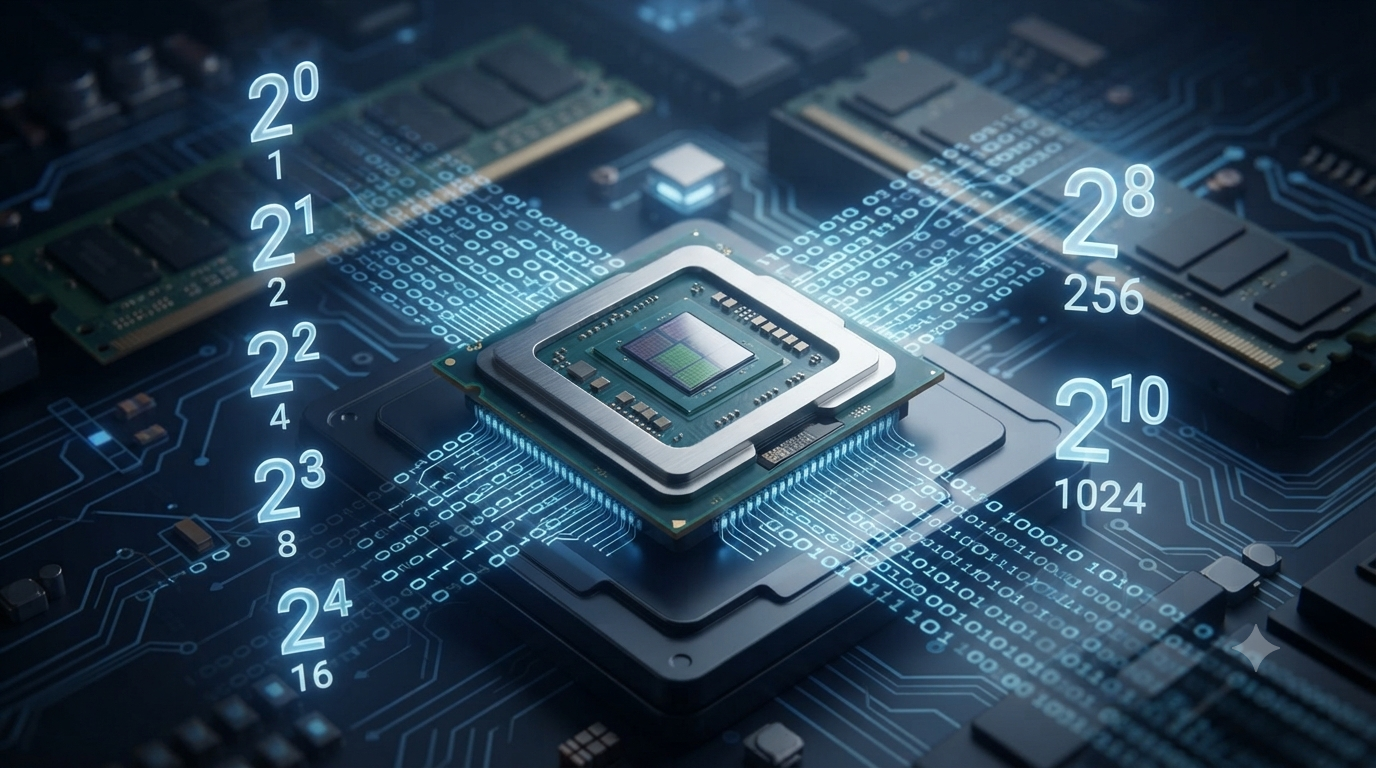
Powers of two are among the most important mathematical ideas in computer science. They appear whenever computers store information, represent numbers, organize memory, process data, or work with binary systems. Although expressions such as 2², 2⁵, and 2¹⁰ may look like simple mathematics, they describe many of the fundamental limits and structures used by computers.
The reason powers of two are so important is closely connected to the binary number system. Unlike humans, who commonly use the decimal system with ten digits from 0 to 9, computers fundamentally work with two states, represented as 0 and 1. Each binary position represents a different power of two. As the number of binary digits increases, the number of possible combinations doubles.
Understanding powers of two therefore provides a foundation for understanding bits, bytes, memory capacity, data representation, addressing, algorithms, and digital systems. This article explains what powers of two are, how they work, and why they are so important in computer science.
What Are Powers of Two?
A power of two is a number obtained by multiplying 2 by itself a certain number of times. It is written using an exponent.
The general form is:
2ⁿ
Here, 2 is the base and n is the exponent.
For example:
2⁰ = 1
2¹ = 2
2² = 4
2³ = 8
2⁴ = 16
2⁵ = 32
2⁶ = 64
2⁷ = 128
2⁸ = 256
2⁹ = 512
2¹⁰ = 1,024
The exponent tells us how many times 2 is used as a factor. For example, 2⁵ means:
2 × 2 × 2 × 2 × 2 = 32
The special case 2⁰ equals 1. This follows the general rule that any nonzero number raised to the power of zero equals 1.
Powers of Two and the Binary Number System
The strongest connection between powers of two and computer science comes from binary numbers.
Binary uses only two digits:
0 and 1
Each position in a binary number represents a power of two. Starting from the rightmost position, the values are:
1, 2, 4, 8, 16, 32, 64, 128, …
These correspond to:
2⁰, 2¹, 2², 2³, 2⁴, 2⁵, 2⁶, 2⁷, …
For example, consider the binary number 1011.
Its positions represent:
1 × 2³ = 8
0 × 2² = 0
1 × 2¹ = 2
1 × 2⁰ = 1
Adding these values gives:
8 + 0 + 2 + 1 = 11
Therefore, binary 1011 represents decimal 11.
This relationship explains why powers of two are so common in computing. Every additional binary digit creates another position with a value twice as large as the previous one.
Why Does Each Additional Bit Double the Possibilities?
A bit can have one of two possible values:
0 or 1
With one bit, there are two possible combinations:
0, 1
With two bits, there are four:
00, 01, 10, 11
With three bits, there are eight:
000, 001, 010, 011, 100, 101, 110, 111
The number of possible combinations for n bits is:
2ⁿ
This is one of the most useful powers-of-two relationships in computer science.
For example:
1 bit → 2 possibilities
2 bits → 4 possibilities
3 bits → 8 possibilities
4 bits → 16 possibilities
8 bits → 256 possibilities
16 bits → 65,536 possibilities
32 bits → 4,294,967,296 possibilities
This principle is used whenever a computer needs to represent a fixed number of different states.
Powers of Two in Bits and Bytes
Computer memory and data are commonly described using bits and bytes.
A bit is the smallest basic unit of digital information and can represent either 0 or 1.
A byte traditionally contains 8 bits.
Because each bit has two possible states, 8 bits can represent:
2⁸ = 256
different combinations.
These combinations can be used to represent numbers, characters, colors, instructions, and other forms of information depending on the encoding system.
For example, an unsigned 8-bit value can represent numbers from:
0 to 255
because there are 256 possible combinations in total.
This is why values such as 8, 16, 32, and 64 bits appear so frequently in computing.
Powers of Two in Computer Memory
Powers of two are especially important when discussing computer memory.
Computer memory is organized using addresses. Each address identifies a particular location where data can be stored. The number of available addresses depends on the number of address bits.
If a system uses n address bits, it can theoretically identify:
2ⁿ addresses
For example, a system with 8 address bits can identify:
2⁸ = 256
different addresses.
A system with 16 address bits can identify:
2¹⁶ = 65,536
different addresses.
As the number of address bits increases, the number of possible addresses increases exponentially.
This is one reason why moving from a 32-bit architecture to a 64-bit architecture represents a major increase in the theoretical address space.
Powers of Two and Storage Capacity
You may have seen storage capacities such as 1 KB, 1 MB, or 1 GB. In computing, powers of two have traditionally played an important role in describing binary-based quantities.
Some commonly encountered binary values include:
2¹⁰ = 1,024
2²⁰ = 1,048,576
2³⁰ = 1,073,741,824
2⁴⁰ = 1,099,511,627,776
The value 1,024 is particularly important because it is 2¹⁰.
However, it is important to distinguish between decimal and binary storage units. Modern standards use KiB, MiB, GiB, and TiB for binary quantities, where:
1 KiB = 2¹⁰ bytes
1 MiB = 2²⁰ bytes
1 GiB = 2³⁰ bytes
1 TiB = 2⁴⁰ bytes
Decimal units such as kB, MB, GB, and TB are based on powers of 10 under the SI system.
Understanding this distinction helps avoid confusion when comparing advertised storage capacity with the capacity reported by an operating system.
Powers of Two in Data Representation
Computers use binary patterns to represent many different types of information.
A collection of bits can represent:
Whole numbers
Characters
Boolean values
Colors
Memory addresses
Instructions
File information
Network data
The number of possible values depends on the number of available bits.
For example, an 8-bit pattern provides 256 possible combinations. A 16-bit pattern provides 65,536 combinations.
This relationship is important when choosing how many bits should be used to store a particular type of information.
If a program needs to represent 1,000 different states, for example, 8 bits are insufficient because 8 bits provide only 256 combinations. At least 10 bits are needed because:
2⁹ = 512
but
2¹⁰ = 1,024
Therefore, 10 bits provide enough combinations.
Powers of Two in Character Encoding
Text stored in a computer is also represented using numerical codes.
Character encoding systems assign numerical values to characters. The number of available characters depends partly on the number of bits used.
An 8-bit system can provide up to:
2⁸ = 256
different combinations.
Larger character systems can provide vastly more possibilities. Unicode, for example, supports a very large collection of characters and uses encoding schemes designed to represent text from many writing systems.
The basic mathematical idea remains the same: increasing the number of available binary bits increases the number of possible patterns according to 2ⁿ.
Powers of Two in Color Representation
Digital images provide another practical example.
In many common color systems, each color channel is represented using 8 bits. An 8-bit channel has:
2⁸ = 256
possible intensity levels.
For a simple RGB image, red, green, and blue channels can each have 256 possible values.
The total number of possible RGB combinations is therefore:
256 × 256 × 256 = 256³ = 16,777,216
This is why a standard 24-bit RGB color system can represent more than 16 million different color combinations.
The calculation is another direct application of powers of two.
Powers of Two in Algorithms
Powers of two also appear frequently in algorithms and data structures.
Many algorithms repeatedly divide a problem into two parts. When this happens, powers of two naturally appear in the analysis.
For example, binary search repeatedly divides a sorted collection approximately in half. After several divisions, the remaining search space becomes much smaller.
The number of times a value can be repeatedly divided by two is related to logarithms:
log₂ n
This is why logarithms with base 2 are particularly important in computer science.
For example, if there are 1,024 items:
log₂ 1,024 = 10
because:
2¹⁰ = 1,024
This means a process that repeatedly halves a set of 1,024 items can reach a single item after about 10 divisions.
Powers of Two in Binary Search
Binary search is a classic example of the relationship between powers of two and algorithms.
Suppose a sorted list contains 16 items. Binary search can divide the search space approximately in half at each step.
The sequence looks roughly like:
16 → 8 → 4 → 2 → 1
Each step reduces the remaining possibilities by about half.
Since:
2⁴ = 16
the number of halving steps is related to 4.
For a much larger list, the same principle applies. This is why binary search has logarithmic time complexity, commonly expressed as O(log₂ n).
The base of the logarithm is often omitted in Big-O notation because changing the logarithm’s base only changes the result by a constant factor, but base 2 is especially natural for binary processes.
Powers of Two in Data Structures
Several important data structures and computing techniques are designed around binary organization.
Examples include:
Binary trees
Binary search trees
Heaps
Hash tables
Bit arrays
Bit masks
Binary heaps
Trie structures
Binary trees are particularly connected to powers of two.
A complete binary tree can have approximately:
2ⁿ
nodes at a particular level, depending on how the levels are counted.
For example, the number of positions at successive levels can grow as:
1, 2, 4, 8, 16, …
This doubling pattern is a direct sequence of powers of two.
Powers of Two in Bitwise Operations
Programming languages often provide bitwise operations that work directly with binary representations.
Common bitwise operations include:
AND
OR
XOR
NOT
Left shift
Right shift
Bit shifting is particularly closely related to powers of two.
For a positive integer, shifting its binary representation one position to the left is equivalent to multiplying by 2, provided overflow and representation limits are not an issue.
For example:
5 × 2 = 10
In binary:
101 → 1010
Similarly, shifting right by one position is generally equivalent to integer division by 2 for nonnegative integers, with details depending on the programming language and whether the value is signed.
These operations are useful in low-level programming, embedded systems, graphics, cryptography, networking, and performance-sensitive applications.
Powers of Two in Networking
Computer networks also use powers of two extensively.
IP addresses are represented using binary bits. IPv4 addresses contain 32 bits, providing:
2³²
possible bit patterns.
That equals:
4,294,967,296
possible combinations.
Subnetting and network addressing depend heavily on binary boundaries and powers of two. Understanding how many addresses are associated with a particular number of host bits is therefore essential in networking.
For example, if a portion of an address provides 8 host bits, there are:
2⁸ = 256
possible combinations for those bits.
Networking professionals use these relationships when designing networks, calculating address ranges, and understanding subnet masks.
Powers of Two in Cryptography
Cryptography also relies on the mathematics of binary systems.
A cryptographic key consists of a certain number of bits. The number of possible keys depends on the key length.
A key with n bits can theoretically have:
2ⁿ
different combinations.
For example, a 128-bit key has:
2¹²⁸
possible combinations.
This number is extraordinarily large. Increasing the key length dramatically increases the number of possible combinations that a brute-force attacker would need to consider.
This illustrates an important principle in computer security: even a relatively small increase in the number of bits can create an enormous increase in the number of possible states.
Powers of Two and Digital Hardware
At the hardware level, computers are built from digital circuits that work with two-state logic.
Electronic components can be designed to distinguish between two logical states, commonly represented as:
0 and 1
Because digital systems are based on these two states, binary arithmetic and powers of two naturally become fundamental to computer hardware.
Registers, memory locations, instruction formats, buses, counters, and digital circuits often use widths such as 4, 8, 16, 32, or 64 bits.
These sizes are convenient because each additional bit doubles the number of possible binary patterns.
A Useful Table of Powers of Two
The following values are useful to remember when studying computer science:
| Exponent | Power of Two | Value |
|---|---|---|
| 2⁰ | 1 | 1 |
| 2¹ | 2 | 2 |
| 2² | 4 | 4 |
| 2³ | 8 | 8 |
| 2⁴ | 16 | 16 |
| 2⁵ | 32 | 32 |
| 2⁶ | 64 | 64 |
| 2⁷ | 128 | 128 |
| 2⁸ | 256 | 256 |
| 2⁹ | 512 | 512 |
| 2¹⁰ | 1,024 | 1,024 |
| 2¹⁶ | 65,536 | 65,536 |
| 2²⁰ | 1,048,576 | 1,048,576 |
| 2³² | 4,294,967,296 | 4,294,967,296 |
| 2⁶⁴ | 18,446,744,073,709,551,616 | 18,446,744,073,709,551,616 |
Knowing the smaller powers of two by memory can make many computer science calculations much faster.
Why Learning Powers of Two Matters
Powers of two are not simply a mathematical topic to memorize. They provide a way to understand how computers organize information.
When you understand 2ⁿ, you can more easily understand:
How many values a certain number of bits can represent
Why binary numbers work the way they do
How computer memory is organized
How address spaces are calculated
Why storage sizes often involve binary quantities
How color depth works
Why binary search is efficient
How bitwise operations work
How networking addresses are structured
Why cryptographic key lengths matter
How digital hardware handles information
The same mathematical pattern appears across many different areas of computing.
Conclusion
Powers of two form a mathematical foundation for much of computer science because computers fundamentally operate using binary states. The simple expression 2ⁿ describes the number of possible combinations that can be created with n binary bits.
From bits and bytes to memory addresses, algorithms, networking, digital images, hardware, and cryptography, powers of two appear repeatedly. Understanding their pattern makes many computer science concepts easier to understand rather than treating each one as an unrelated rule.
For anyone learning computer science, it is useful to become comfortable with the common powers of two, especially 2⁰ through 2¹⁰ and larger values such as 2¹⁶, 2²⁰, 2³², and 2⁶⁴. Once this pattern becomes familiar, many calculations involving binary data and computer systems become much more intuitive.
In short, powers of two connect simple mathematics with the way digital computers store, process, and communicate information. They are one of the essential mathematical ideas behind modern computing.
FAQs
1. What are powers of two in computer science?
Powers of two are numbers produced by multiplying 2 by itself a specific number of times. They are written as 2ⁿ, where n is a non-negative integer. Common examples include 2⁰ = 1, 2¹ = 2, 2² = 4, 2³ = 8, and 2¹⁰ = 1,024. Powers of two are especially important in computer science because computers use the binary number system, which has only two possible digits: 0 and 1. Each binary position represents a power of two. Powers of two therefore help explain how computers represent numbers, store information, organize memory, process data, and perform many computational operations.
2. Why are powers of two important in computer science?
Powers of two are important because computers fundamentally use binary, a number system based on two states: 0 and 1. When a computer uses n bits, it can represent 2ⁿ different combinations. This relationship appears in memory capacity, data representation, addressing, algorithms, networking, digital images, and hardware. For example, 8 bits can produce 2⁸, or 256, different combinations. Similarly, 32 bits provide 2³² possible combinations. Understanding powers of two makes it easier to understand why computer systems use bit sizes such as 8, 16, 32, and 64 and how the amount of information a system can represent increases as more bits are added.
3. How are powers of two related to binary numbers?
Powers of two are directly connected to binary numbers because every position in a binary number represents a power of two. Starting from the right, the positions represent 2⁰, 2¹, 2², 2³, and so on. For example, the binary number 1011 represents 11 in decimal. Its calculation is 1 × 2³ + 0 × 2² + 1 × 2¹ + 1 × 2⁰, which equals 8 + 0 + 2 + 1 = 11. This positional system allows computers to represent numerical information using only two symbols. Learning powers of two therefore makes binary conversion and digital number representation much easier to understand.
4. How many values can n bits represent?
A collection of n bits can represent 2ⁿ different combinations. This is because every individual bit has two possible states, either 0 or 1. For example, one bit can represent 2¹ = 2 combinations, while two bits can represent 2² = 4 combinations. Eight bits can represent 2⁸ = 256 combinations. Sixteen bits can represent 2¹⁶ = 65,536 combinations. If the values are unsigned integers, these combinations normally represent numbers from 0 through 2ⁿ − 1. This principle is fundamental to computer science because it determines how many different numbers, characters, states, addresses, or other values can be represented using a fixed number of bits.
5. Why is 2¹⁰ equal to 1,024 important in computing?
The value 2¹⁰ = 1,024 is important because many binary-based computer systems naturally work with quantities that are powers of two. Ten binary bits provide 1,024 different combinations. Historically, computer memory quantities were often expressed using kilobyte-related terminology based on 1,024 bytes. Modern terminology distinguishes binary units from decimal units: 1 KiB is exactly 1,024 bytes, while 1 kB is 1,000 bytes under the SI system. The value 1,024 also appears frequently in programming, memory allocation, addressing, and data structures. Knowing 2¹⁰ helps learners quickly understand many common calculations involving computer memory and binary quantities.
6. How are powers of two used in computer memory?
Powers of two are used to determine how many different memory addresses a computer can represent. If a system has n address bits, it can theoretically identify 2ⁿ different addresses. For example, 8 address bits provide 2⁸ = 256 possible addresses, while 16 address bits provide 2¹⁶ = 65,536 possible addresses. Larger address sizes provide dramatically larger address spaces. This relationship is important when understanding computer architecture and memory organization. Powers of two also appear in memory sizes because digital memory is built from binary components. Understanding this connection helps explain concepts such as address spaces, memory limits, and different computer architectures.
7. What is the connection between powers of two and binary search?
Powers of two are closely connected to binary search because binary search repeatedly divides a search space into approximately two equal parts. If a sorted collection contains a number of elements related to a power of two, the division pattern becomes particularly easy to visualize. For example, a search space can progress roughly as 16 → 8 → 4 → 2 → 1. Since 16 is 2⁴, approximately four divisions are needed to reach a single item. This repeated halving is described using a logarithm, commonly written as log₂ n. As a result, binary search has logarithmic time complexity, making it much more efficient than checking every item individually in many situations.
8. How are powers of two used in networking?
Powers of two are fundamental to computer networking because IP addresses and subnetting use binary bits. IPv4 addresses contain 32 bits, giving 2³² possible bit patterns. Network and host portions of an address determine how many addresses are available within a network. If a portion contains n host bits, the number of possible combinations is based on 2ⁿ, although practical usable-host calculations depend on the addressing scheme and subnet size. Understanding powers of two helps network administrators calculate address ranges, subnet sizes, and network capacity. It also makes concepts such as subnet masks, CIDR notation, and binary IP addressing easier to understand.
9. Why do computer systems commonly use 8, 16, 32, and 64 bits?
Computer systems commonly use 8, 16, 32, and 64-bit sizes because binary hardware naturally works with groups of bits, and powers of two provide convenient structures for processing and storing information. Eight bits form a byte and provide 2⁸ = 256 possible combinations. Larger groups provide increasingly more combinations: 16 bits provide 2¹⁶, 32 bits provide 2³², and 64 bits provide 2⁶⁴. These sizes have been widely used for data types, processors, memory addresses, instructions, and registers. The exact meaning of a particular bit width depends on the architecture and application, but the underlying mathematical relationship remains the same.
10. Why should computer science students learn powers of two?
Computer science students should learn powers of two because the concept appears throughout computing. It helps explain binary numbers, bits, bytes, memory, data representation, algorithms, networking, digital electronics, and computer architecture. Knowing common powers such as 2⁰ through 2¹⁰ allows students to perform many calculations quickly without repeatedly using a calculator. The idea that n bits create 2ⁿ possible combinations is especially important because it appears in many different topics. Once students understand this relationship, concepts such as binary search, memory addressing, color representation, bitwise operations, and cryptographic key spaces become easier to understand and connect to one another.