A physics formula is more than a collection of symbols and numbers. It represents a relationship between physical quantities and helps us describe how nature behaves. But when solving a physics problem, it is important to know whether a formula is correct before using it. A wrong formula can lead to a wrong answer even if every calculation is performed perfectly.
Fortunately, physicists have several simple ways to check a formula. These include checking units, dimensions, mathematical structure, limiting cases, known relationships, and physical meaning. These methods do not always prove that a formula is completely correct, but they can quickly reveal many mistakes. Learning how to check formulas is therefore an important part of developing strong physics problem-solving skills.
Check the Units of Both Sides
One of the simplest ways to test a physics formula is to compare the units on both sides of the equation.
Consider the formula:
s = ut + ½at²
Here, s represents displacement, u represents initial velocity, a represents acceleration, and t represents time.
The unit of displacement is metre (m).
For the first term:
ut = (m/s)(s) = m
For the second term:
at² = (m/s²)(s²) = m
Both terms have the unit metre, so the right side has the same unit as displacement. This gives us a strong indication that the equation is dimensionally consistent.
If the two sides have different units, the formula cannot be correct.
For example, if someone proposed:
s = u + at²
the terms on the right would have different units. Velocity has units of m/s, while at² has units of m. These cannot be directly added. Therefore, the formula is incorrect.
Use Dimensional Analysis
Checking units and checking dimensions are closely related, but dimensional analysis gives a more general test.
Physical quantities can be represented using fundamental dimensions such as mass [M], length [L], and time [T].
For example:
Velocity = [LT⁻¹]
Acceleration = [LT⁻²]
Force = [MLT⁻²]
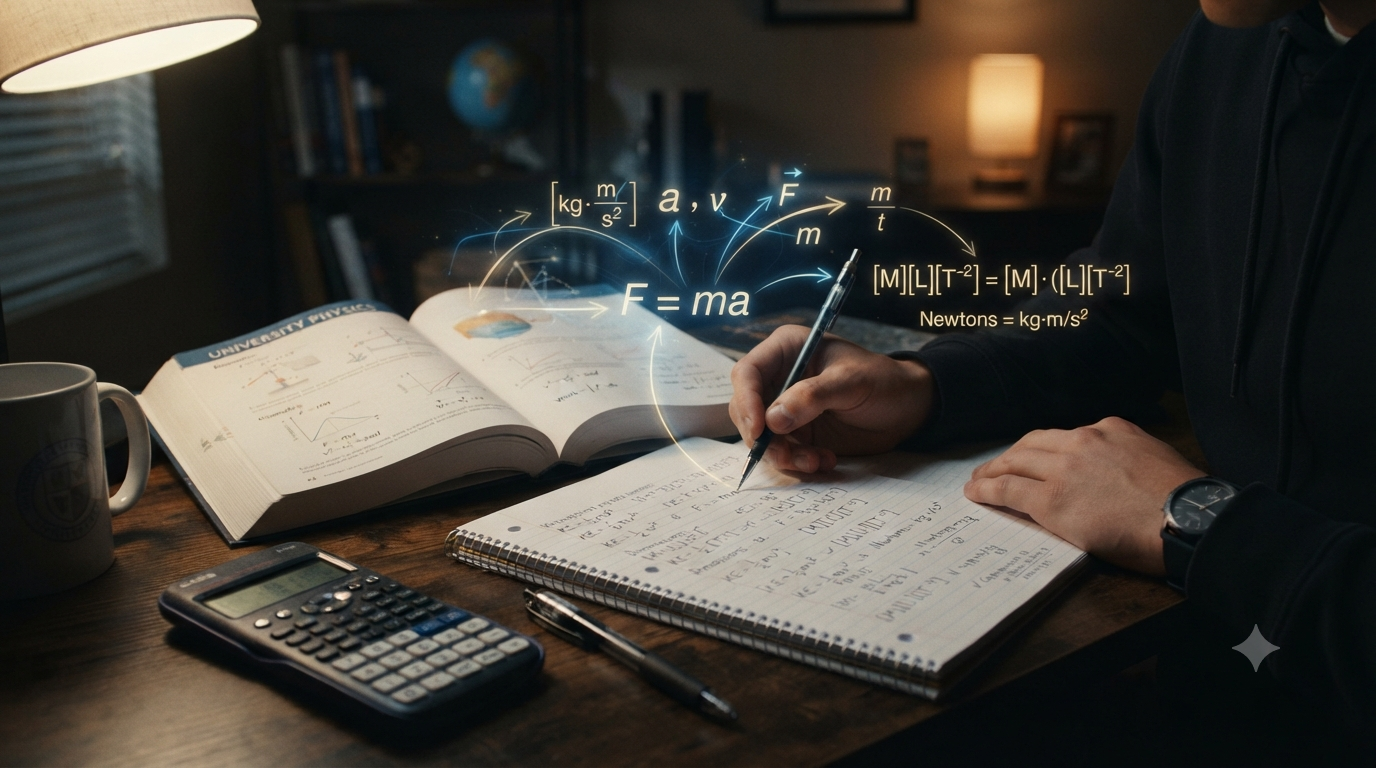
Consider Newton’s second law:
F = ma
The dimensions of the right side are:
[M][LT⁻²] = [MLT⁻²]
Force also has the dimension:
[MLT⁻²]
Therefore, the equation is dimensionally consistent.
Dimensional analysis is particularly useful when you are unsure whether powers, variables, or factors in a formula have been written correctly. However, it has a limitation: a dimensionally correct formula is not necessarily physically correct. Some different formulas can have exactly the same dimensions.
Check Whether Quantities Can Be Added
Another useful test is to examine whether the terms being added or subtracted have the same dimensions.
For example:
v = u + at
Initial velocity u has dimensions [LT⁻¹].
Acceleration multiplied by time gives:
at = [LT⁻²][T] = [LT⁻¹]
Both terms therefore represent velocity and can be added.
Now imagine a formula such as:
v = u + at²
The term at² has dimensions [L], not [LT⁻¹]. Therefore, it cannot be added to velocity.
This simple check can identify many incorrect equations immediately.
Check the Mathematical Structure
A formula may have correct dimensions but still contain a mathematical mistake. Therefore, it is useful to examine how the variables are arranged.
Suppose an object moves with constant acceleration. One familiar relationship is:
v = u + at
If the acceleration is zero, the formula becomes:
v = u
This makes sense because without acceleration, the velocity remains constant.
Now consider another equation:
s = ut + ½at²
The first term depends linearly on time, while the acceleration term depends on the square of time. This structure reflects how displacement changes under constant acceleration.
Understanding the mathematical structure helps you recognize whether the formula behaves in a physically reasonable way.
Test a Formula With a Simple Case
A powerful method is to substitute simple values into the formula.
Suppose you want to check:
v = u + at
Take u = 10 m/s, a = 2 m/s², and t = 5 s.
Then:
v = 10 + (2)(5)
v = 20 m/s
The result is reasonable because positive acceleration over time should increase the velocity.
You can also test special values such as zero. These simple cases often reveal errors that are difficult to notice when looking only at symbols.
Check the Zero Case
Setting a variable to zero is one of the easiest ways to test a formula.
Consider:
K = ½mv²
If v = 0, then:
K = 0
This makes physical sense. An object at rest has no kinetic energy.
Similarly, consider:
p = mv
If m = 0, then p = 0 according to the classical formula. The result follows directly from the mathematical relationship.
Zero-value tests are especially useful because many physical quantities have predictable behavior when a particular variable becomes zero.
Check the Limiting Case
A limiting case examines what happens when a variable becomes extremely small or extremely large.
For example, consider:
F = ma
If acceleration approaches zero, the force also approaches zero for a fixed mass. This agrees with the relationship described by Newton’s second law.
Another example comes from relativistic physics. At speeds much smaller than the speed of light, relativistic equations should approach the familiar classical results. This type of comparison is called checking the classical limit.
Limiting cases are especially important in advanced physics because many complicated formulas are expected to reduce to simpler, well-established formulas under particular conditions.
Compare With a Known Formula
If a formula is supposed to describe a familiar physical situation, compare it with an established relationship.
For example, the formula for momentum is:
p = mv
If a new expression claims to represent momentum, its dimensions should agree with [MLT⁻¹], and its behavior should be consistent with known momentum relationships.
Similarly, if a formula describes gravitational force, it can be compared with Newton’s law of universal gravitation:
F = Gm₁m₂/r²
A new equation should agree with established results when it is intended to describe the same physical situation and conditions.
Check the Physical Meaning
Mathematics alone cannot tell the whole story. A formula must also make physical sense.
Suppose a formula predicts that increasing the mass of an object causes its acceleration to increase under a fixed applied force. Newton’s second law gives:
a = F/m
For a fixed force, increasing mass actually decreases acceleration.
Therefore, if a proposed formula predicts the opposite relationship under the same conditions, something is wrong.
Ask questions such as:
Does increasing a quantity produce the expected effect?
Does decreasing a quantity produce a reasonable result?
Are the variables related in a physically meaningful way?
Are the assumptions of the formula being satisfied?
These questions connect the mathematics of a formula with the physical situation it describes.
Check the Conditions of the Formula
Many physics formulas are valid only under specific conditions.
For example, the equation:
s = ut + ½at²
assumes constant acceleration.
If acceleration changes significantly with time, this equation cannot generally be used in its basic form.
Similarly, simple equations in mechanics, thermodynamics, electricity, and other areas often depend on particular assumptions.
Therefore, a formula should never be checked only by looking at its symbols. You should also ask: under what conditions is this formula supposed to work?
Use Graphs and Experimental Data
For some formulas, graphs can provide another way to test correctness.
Suppose a formula predicts that one quantity is directly proportional to another:
y = kx
If experimental measurements are plotted on a graph of y against x, the points should approximately follow a straight-line relationship passing through the origin, assuming the model and experimental conditions are appropriate.
Experimental data cannot always prove a formula completely, but agreement between predictions and measurements provides important evidence.
This is one of the ways physics connects mathematical equations with observations of the real world.
Remember the Difference Between Checking and Proving
It is important to understand that checking a formula is not always the same as proving it.
Dimensional analysis can show that an equation is dimensionally consistent, but it cannot establish every numerical factor or physical assumption. A formula can have correct dimensions and still be wrong.
A complete derivation may require mathematical reasoning, physical laws, experiments, or a combination of these.
For example, dimensional analysis may tell us that a quantity depends on certain variables, but it may not tell us whether the numerical coefficient is 1, ½, 2, or another value.
Therefore, formula checking should be viewed as a collection of useful tests rather than a single final proof.
A Simple Formula Checking Method
When you encounter a physics formula that you are unsure about, use this sequence:
Check the units on both sides.
Compare the dimensions of both sides.
Make sure added or subtracted quantities have the same dimensions.
Test simple numerical values.
Try setting important variables to zero.
Examine limiting cases.
Compare the result with known formulas.
Check whether the physical behavior makes sense.
Identify the conditions and assumptions.
Compare predictions with experimental evidence when available.
Using several of these tests together gives you much more confidence than relying on a single check.
Conclusion
Checking whether a physics formula is correct is an important skill that goes beyond memorizing equations. Units and dimensional analysis can reveal many basic errors, while simple values, zero cases, limiting cases, and known relationships provide additional tests. It is also essential to understand the physical meaning and conditions behind an equation.
A formula that passes one test is not automatically proven correct. However, by combining mathematical checks with physical reasoning and experimental evidence, you can identify mistakes and develop a deeper understanding of how physics describes the natural world. The more regularly you practice checking formulas, the easier it becomes to recognize whether an equation is sensible before using it.
FAQs
1. How can you check whether a physics formula is correct?
You can check a physics formula using several methods. First, compare the units on both sides of the equation. Both sides must represent the same physical quantity and therefore have compatible units. You can also use dimensional analysis to compare fundamental dimensions such as mass, length, and time. Try substituting simple values, including zero, and see whether the result makes physical sense. Checking limiting cases and comparing the formula with known physical relationships can also help. Finally, consider the conditions under which the formula is supposed to work. These methods can reveal many common mistakes.
2. Why is dimensional analysis useful for checking a formula?
Dimensional analysis helps determine whether the quantities in a physics equation are dimensionally consistent. Physical quantities can be expressed using fundamental dimensions such as mass [M], length [L], and time [T]. For example, velocity has the dimension [LT⁻¹], while acceleration has the dimension [LT⁻²]. In a correct equation, both sides must have the same dimensions. Dimensional analysis can quickly identify errors involving multiplication, division, or powers of quantities. However, it cannot prove that a formula is completely correct because different formulas can have the same dimensions. It is therefore a useful check, not complete proof.
3. Can units prove that a physics formula is correct?
Units cannot completely prove that a physics formula is correct, but they can show that a formula is dimensionally consistent. For example, in s = ut + ½at², both terms on the right have units of length, matching the unit of displacement. If the units do not match, the formula must be incorrect. However, a formula may have matching units and still contain an incorrect numerical factor or physical relationship. Therefore, unit checking should be combined with other methods such as dimensional analysis, limiting cases, physical reasoning, mathematical derivation, and experimental evidence.
4. What happens if the units on both sides of a formula are different?
If the units on both sides of a physics equation are different, the equation cannot be physically correct as written. For example, velocity has units of metres per second, while distance has units of metres. These quantities cannot normally be equated directly. Similarly, quantities being added or subtracted must have compatible units. If a proposed formula contains terms with incompatible units, it indicates an error in the equation. Checking units is therefore one of the fastest ways to detect mistakes before performing lengthy calculations or using the formula to solve a physics problem.
5. Why should you test a formula using zero values?
Testing a formula with zero values can reveal whether it behaves sensibly under simple physical conditions. For example, kinetic energy is given by K = ½mv². If velocity becomes zero, the kinetic energy also becomes zero, which agrees with the physical meaning of kinetic energy. Similarly, setting acceleration to zero in v = u + at gives v = u, meaning velocity remains constant when acceleration is absent. These simple tests do not prove a formula completely, but they can expose obvious errors and help you understand how different variables affect the physical quantity represented by the equation.
6. What is a limiting case in physics?
A limiting case examines how a formula behaves when one or more variables become very small, very large, or approach a particular value. This provides a useful way to test whether an equation behaves consistently with known physics. For example, many advanced physical theories should reduce to simpler theories under appropriate limiting conditions. A formula may also be checked by seeing what happens when a variable approaches zero. If the result contradicts established physical behavior, the formula may contain an error or may only be valid under certain conditions. Limiting-case analysis is especially useful in advanced physics.
7. Can a dimensionally correct formula still be wrong?
Yes. Dimensional consistency is necessary for many physical equations, but it is not sufficient to establish that a formula is completely correct. For example, dimensional analysis may show that two possible expressions have exactly the same dimensions even though only one correctly describes the physical relationship. It may also fail to determine numerical constants such as ½, 2, or π. A dimensionally correct formula can therefore still have an incorrect mathematical structure or physical assumption. To gain greater confidence, combine dimensional analysis with derivation, experimental evidence, limiting cases, and comparison with established physical laws.
8. How does physical meaning help check a formula?
Physical meaning helps determine whether a formula behaves as expected when its variables change. Consider a = F/m. For a fixed force, increasing mass decreases acceleration. This agrees with Newton’s second law. If a proposed equation predicted the opposite relationship under the same conditions, it would require careful examination. Asking how each variable should affect the result provides an important conceptual check. You should consider whether increasing or decreasing a quantity produces a reasonable outcome and whether the relationship matches observations. This approach connects mathematical equations with the actual physical behavior of objects and systems.
9. Why are the conditions of a formula important?
Many physics formulas are valid only under specific conditions or assumptions. For example, the equation s = ut + ½at² assumes constant acceleration. It cannot automatically be applied to every situation where acceleration changes with time. Other formulas may depend on assumptions about temperature, pressure, speed, resistance, friction, or idealized systems. Therefore, checking a formula also means understanding where and when it applies. A formula may be mathematically correct but inappropriate for a particular problem because its required conditions are not satisfied. Always identify the assumptions before applying an equation to a physical situation.
10. Does checking a formula mean that it is completely proven?
No. Checking a formula and proving a formula are different processes. Unit checks, dimensional analysis, numerical tests, limiting cases, and physical reasoning can provide strong evidence that an equation is reasonable and can identify many errors. However, they do not necessarily establish every part of the equation. A complete justification may require a mathematical derivation from established physical laws or agreement with carefully designed experiments. Therefore, formula checking should be viewed as a collection of tests. When several independent checks agree with theoretical reasoning and experimental evidence, confidence in the formula becomes much stronger.
Related Posts
What Do Coefficients Mean in Chemistry Formulas?
When you look at a chemical equation, you may notice numbers written before chemical formulas. These numbers are called coefficients. […]
Read MoreHow to Read Subscripts in Chemical Formulas
Chemical formulas are a simple way to represent substances using symbols and numbers. When you look at a formula such […]
Read MoreHow to Identify Elements in a Chemical Formula
Chemical formulas provide a simple way to describe the substances that make up the world around us. A formula may […]
Read MoreHow Elements Are Represented in Chemical Formulas
Chemistry deals with many different substances, from the oxygen we breathe to the water we drink and the minerals found […]
Read MoreChemical Symbols and Their Role in Chemistry Formulas
Chemistry is often described as the science of matter, but understanding chemistry also means learning how scientists communicate information about […]
Read MoreHow Chemical Formulas Represent Substances
Chemical formulas are one of the simplest ways scientists communicate information about matter. A substance may contain millions or billions […]
Read MoreWhat Is a Chemical Formula in Chemistry?
Chemistry is the study of substances, their properties, and the changes they undergo. To describe these substances clearly, chemists need […]
Read MoreBasic Types of Chemistry Formulas Explained
Chemistry formulas are one of the simplest ways scientists describe substances, reactions, and relationships between different particles. A formula can […]
Read MoreHow to Read and Understand Chemistry Formulas
Chemistry formulas may look like a collection of letters, numbers, and symbols, but they are actually a simple language used […]
Read MoreWhat Are Chemistry Formulas and Why Are They Important?
Chemistry is the science of substances, their properties, and the changes they undergo. To describe these substances clearly, chemists use […]
Read MoreHow to Verify an Answer Using Units
In physics, getting a numerical answer is only part of solving a problem. The next question is whether that answer […]
Read MoreHow to Check Whether a Physics Formula Is Correct
A physics formula is more than a collection of symbols and numbers. It represents a relationship between physical quantities and […]
Read MoreHow to Avoid Unit Conversion Mistakes in Physics
Unit conversion is one of the most common sources of mistakes in physics. A formula may be correct, the calculation […]
Read MoreHow to Avoid Sign Errors in Physics Calculations
Physics calculations are not only about choosing the correct formula and putting numbers into it. The signs of physical quantities […]

Read MoreCommon Mistakes When Using Physics Formulas
Physics formulas help us describe motion, forces, energy, electricity, heat, waves, and many other phenomena using mathematical relationships. A formula […]
Read MoreHow to Study Physics Formulas Step by Step
Physics formulas are an important part of learning physics, but simply memorizing them is not enough. A formula represents a […]
Read MoreHow to Organize Physics Formulas for Easy Revision
Physics becomes much easier when formulas are organized in a clear and meaningful way. Many learners struggle not because they […]
Read MoreHow to Build a Physics Formula Sheet
Physics involves many formulas, and remembering all of them can become difficult as you move from basic concepts to more […]
Read More