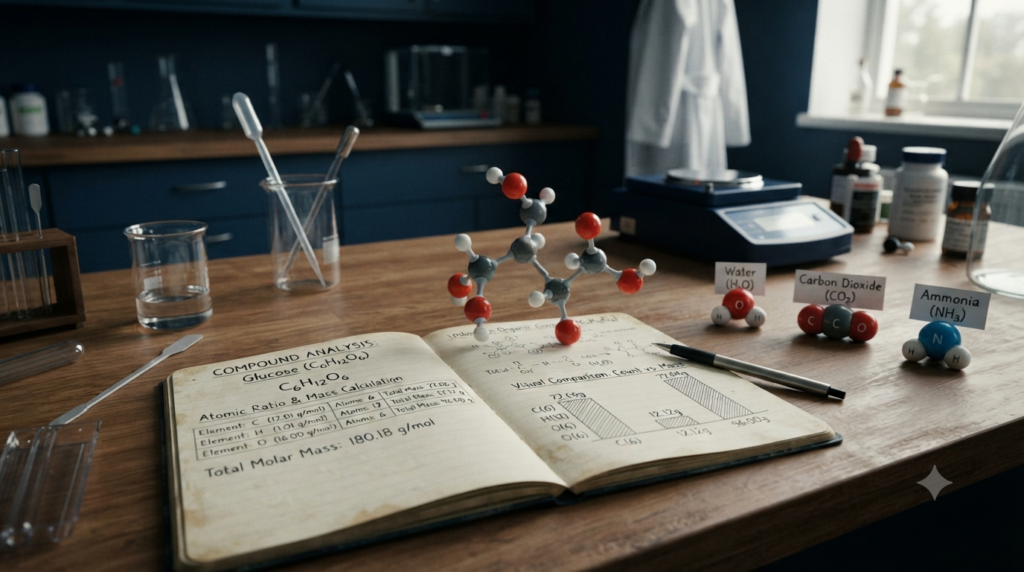

Every chemical compound is made from two or more elements combined in definite proportions. Knowing which elements are present and how much of each element is present is an important part of understanding a compound. This information is called its elemental composition.
Elemental composition can be expressed in different ways. We may simply identify the elements present in a compound, determine their relative amounts, or calculate the percentage by mass of each element. These calculations are useful in chemistry because they connect a compound’s chemical formula with measurable quantities.
For example, water has the formula H₂O. It contains hydrogen and oxygen, but the two elements do not contribute equally to its mass. Oxygen has a much greater atomic mass than hydrogen, so most of the mass of water comes from oxygen. By using atomic masses and the chemical formula, we can calculate the exact percentage of each element.
What Is Elemental Composition?
Elemental composition describes the elements that make up a compound and their proportions.
Consider carbon dioxide, CO₂. The formula tells us that one molecule contains one carbon atom and two oxygen atoms. However, the ratio of atoms is not the same as the ratio of masses because carbon and oxygen have different atomic masses.
Elemental composition can therefore be discussed in terms of:
Elements present in the compound
Number of atoms of each element
Ratio of atoms
Relative mass of each element
Percentage by mass of each element
The percentage by mass is often called percentage composition or percent composition.
Why Is Elemental Composition Important?
Finding the elemental composition of a compound has many applications in chemistry. It helps scientists identify substances, verify chemical formulas, analyze unknown materials, and determine whether a sample has the expected composition.
In laboratory chemistry, the measured composition of a substance can be compared with its theoretical composition. If the values are significantly different, it may indicate impurities, experimental errors, or an incorrect chemical formula.
Elemental composition is also important in areas such as pharmaceutical chemistry, environmental analysis, materials science, food chemistry, and industrial quality control.
Start With the Chemical Formula
The first step is to write or identify the correct chemical formula of the compound.
The formula provides the basic information needed for the calculation. It tells us which elements are present and how many atoms of each element are represented in one formula unit.
For example:
H₂O contains hydrogen and oxygen.
CO₂ contains carbon and oxygen.
NH₃ contains nitrogen and hydrogen.
CaCO₃ contains calcium, carbon, and oxygen.
H₂SO₄ contains hydrogen, sulfur, and oxygen.
The small number written after an element symbol is called a subscript. It indicates the number of atoms of that element.
If there is no subscript, the number of atoms is understood to be one.
For example, in H₂SO₄:
Hydrogen = 2 atoms
Sulfur = 1 atom
Oxygen = 4 atoms
These numbers are essential for calculating elemental composition.
Identify the Elements Present
Once the formula is known, list every element present in the compound.
For example, consider calcium carbonate:
CaCO₃
The elements are:
Calcium (Ca)
Carbon (C)
Oxygen (O)
The formula contains one calcium atom, one carbon atom, and three oxygen atoms per formula unit.
At this stage, we know the elemental identity and atomic ratio, but we do not yet know the percentage by mass of each element.
Determine the Atomic Mass of Each Element
The next step is to find the atomic mass of each element from the periodic table.
For basic calculations, commonly used approximate atomic masses include:
H = 1.008
C = 12.011
N = 14.007
O = 15.999
S = 32.06
Ca = 40.078
Cl = 35.45
Na = 22.990
The exact values may vary slightly depending on the periodic table and the level of precision required.
Atomic mass represents the average mass of an atom of an element relative to the standard atomic mass scale.
Calculate the Contribution of Each Element
After identifying the atomic mass and number of atoms, multiply them together.
The mass contribution of an element can be calculated as:
Mass contribution = Number of atoms × Atomic mass
For example, consider water, H₂O.
Hydrogen has two atoms:
2 × 1.008 = 2.016
Oxygen has one atom:
1 × 15.999 = 15.999
Therefore, the total mass contributed by hydrogen is 2.016 atomic mass units, while oxygen contributes 15.999 atomic mass units.
Calculate the Formula Mass
The next step is to add the mass contributions of all the elements.
The formula mass can be calculated as:
Formula mass = Sum of the mass contributions of all elements
For water:
H₂O
Formula mass = (2 × 1.008) + (1 × 15.999)
Formula mass = 2.016 + 15.999
Formula mass = 18.015
Therefore, the formula mass of water is approximately 18.015 u.
For molecular compounds, this value is often called molecular mass. For ionic compounds, the term formula mass is commonly used.
Calculate the Percentage by Mass
Once the formula mass is known, the percentage by mass of each element can be calculated.
The general formula is:
Percentage of an element = (Mass contribution of the element ÷ Formula mass) × 100
This formula is the key to finding the elemental composition by mass.
For water, the percentage of hydrogen is:
(2.016 ÷ 18.015) × 100
≈ 11.19%
The percentage of oxygen is:
(15.999 ÷ 18.015) × 100
≈ 88.81%
Therefore, water contains approximately:
Hydrogen = 11.19% by mass
Oxygen = 88.81% by mass
Notice that the percentages add up to approximately 100%.
Worked Example With Carbon Dioxide
Let us calculate the elemental composition of carbon dioxide, CO₂.
Step 1: Identify the Elements
CO₂ contains:
Carbon = 1 atom
Oxygen = 2 atoms
Step 2: Use Atomic Masses
Carbon = 12.011
Oxygen = 15.999
Step 3: Calculate Mass Contributions
Carbon:
1 × 12.011 = 12.011
Oxygen:
2 × 15.999 = 31.998
Step 4: Calculate Formula Mass
Formula mass = 12.011 + 31.998
Formula mass = 44.009
Step 5: Calculate Percentages
Carbon:
(12.011 ÷ 44.009) × 100 ≈ 27.29%
Oxygen:
(31.998 ÷ 44.009) × 100 ≈ 72.71%
Therefore, the elemental composition of carbon dioxide is approximately:
Carbon = 27.29%
Oxygen = 72.71%
The two percentages total approximately 100%.
Worked Example With Calcium Carbonate
Now consider calcium carbonate, CaCO₃.
It contains:
1 calcium atom
1 carbon atom
3 oxygen atoms
Using approximate atomic masses:
Ca = 40.078
C = 12.011
O = 15.999
The mass contribution of calcium is:
1 × 40.078 = 40.078
The mass contribution of carbon is:
1 × 12.011 = 12.011
The mass contribution of oxygen is:
3 × 15.999 = 47.997
The formula mass is:
40.078 + 12.011 + 47.997 = 100.086
Now calculate each percentage.
Calcium:
(40.078 ÷ 100.086) × 100 ≈ 40.04%
Carbon:
(12.011 ÷ 100.086) × 100 ≈ 12.00%
Oxygen:
(47.997 ÷ 100.086) × 100 ≈ 47.96%
So calcium carbonate is approximately:
Calcium = 40.04%
Carbon = 12.00%
Oxygen = 47.96%
These values add up to approximately 100%.
Elemental Composition From Experimental Data
Elemental composition can also be determined experimentally.
In a laboratory, an unknown compound may be analyzed to determine the percentage of carbon, hydrogen, nitrogen, sulfur, or other elements. The measured values can then be compared with theoretical values calculated from possible chemical formulas.
For example, suppose an experiment shows that a compound contains approximately 40% carbon and 6.7% hydrogen, with the remainder being oxygen. These percentages can be used as clues for determining the compound’s empirical formula.
This process is different from simply calculating composition from a known formula. In the calculation method, the formula is already known. In experimental analysis, the composition may be used to help determine the formula.
Percentage Composition and Empirical Formula
Percentage composition is closely connected to the empirical formula of a compound.
The empirical formula gives the simplest whole-number ratio of the elements in a compound. If the percentage composition is known, the empirical formula can often be determined through a series of calculations.
The basic procedure is:
Assume a 100 g sample.
Treat each percentage as the number of grams of that element.
Convert grams into moles using atomic masses.
Divide all mole values by the smallest mole value.
Convert the resulting ratios into small whole numbers.
Use those whole numbers to write the empirical formula.
For example, if an element represents 40% of a 100 g sample, its mass would be treated as 40 g for the calculation.
This demonstrates how experimental measurements can be connected to chemical formulas.
Watch for Parentheses in Chemical Formulas
Chemical formulas containing parentheses require extra attention.
Consider calcium hydroxide:
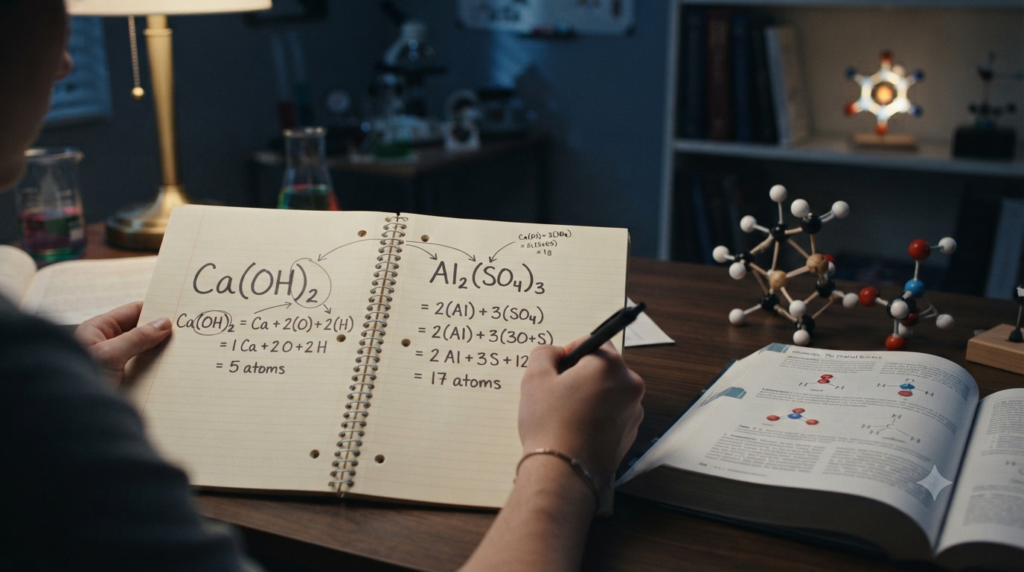
Ca(OH)₂
The subscript ₂ outside the parentheses applies to both oxygen and hydrogen.
Therefore, Ca(OH)₂ contains:
Calcium = 1 atom
Oxygen = 2 atoms
Hydrogen = 2 atoms
A common mistake is to count only one oxygen and one hydrogen. The parentheses indicate that the entire OH group occurs twice.
The same idea applies to compounds such as Al₂(SO₄)₃. The subscript 3 applies to the entire sulfate group.
Thus:
Aluminum = 2 atoms
Sulfur = 3 atoms
Oxygen = 12 atoms
Correctly counting atoms is essential for obtaining the correct elemental composition.
Common Mistakes to Avoid
Several simple errors can lead to incorrect results.
Ignoring Subscripts
A subscript tells you how many atoms of an element are present. Forgetting it changes the mass contribution and produces an incorrect answer.
Misreading Parentheses
A subscript outside parentheses applies to every element inside the parentheses.
Using the Number of Atoms as the Percentage
The percentage by mass is not based simply on the number of atoms. Different elements have different atomic masses.
Forgetting to Multiply
The atomic mass must be multiplied by the number of atoms represented in the formula.
Rounding Too Early
Rounding atomic masses or intermediate results too early can slightly affect the final percentages. It is generally better to keep a few extra decimal places during calculations and round the final answer.
Not Checking the Total
The elemental percentages of a pure compound should add up to approximately 100%. A significantly different total suggests that a calculation should be checked.
A Simple General Method
The entire process can be summarized in a few steps:
Write the chemical formula.
Identify every element present.
Count the atoms of each element.
Find the atomic mass of each element.
Multiply each atomic mass by the number of atoms.
Add all contributions to obtain the formula mass.
Divide each element’s mass contribution by the total formula mass.
Multiply by 100 to obtain the percentage by mass.
Check that the percentages add up to approximately 100%.
This method works for many common chemical compounds.
Why the Formula Matters More Than It First Appears
A chemical formula is more than a collection of element symbols. It contains quantitative information about the composition of a substance.
The formula H₂O tells us not only that water contains hydrogen and oxygen, but also that its atoms occur in a 2:1 ratio. When atomic masses are introduced, this simple ratio becomes a mass relationship. That relationship allows us to determine how much each element contributes to the total mass.
This connection between symbols, atoms, mass, and measurable percentages is one of the foundations of quantitative chemistry.
Conclusion
Finding the elemental composition of a compound is a straightforward process when the chemical formula is known. First, identify the elements and count their atoms from the formula. Then use their atomic masses to calculate the contribution of each element and add these values to obtain the total formula mass. Finally, divide each element’s contribution by the total mass and multiply by 100 to find its percentage by mass.
Understanding this method makes it easier to interpret chemical formulas, compare compounds, check experimental results, and work with empirical and molecular formulas. Once the relationship between a chemical formula and mass is clear, elemental composition becomes a practical calculation rather than a difficult chemistry problem.
FAQs
1. What is the elemental composition of a compound?
Elemental composition describes the elements present in a compound and the proportion of each element. It can be expressed as the number of atoms, the ratio of atoms, or the percentage by mass of each element. For example, water, H₂O, contains hydrogen and oxygen. Its formula shows that there are two hydrogen atoms for every oxygen atom. However, the mass contribution of oxygen is much greater because oxygen has a higher atomic mass. Calculating elemental composition involves identifying the elements, using their atomic masses, calculating the total formula mass, and determining the percentage contribution of each element.
2. How do you find the elemental composition of a compound?
To find the elemental composition, first identify the chemical formula of the compound. Then count the atoms of each element using the subscripts in the formula. Find the atomic mass of every element from the periodic table and multiply each atomic mass by its number of atoms. Add these values to obtain the formula mass. Finally, divide the mass contribution of each element by the total formula mass and multiply by 100. This gives the percentage by mass of each element. The calculated percentages should normally add up to approximately 100% for a pure compound.
3. What formula is used to calculate percentage composition?
The standard formula for calculating the percentage composition of an element is: Percentage of element = (Mass contribution of the element ÷ Formula mass of the compound) × 100. The mass contribution is found by multiplying the number of atoms of that element by its atomic mass. The formula mass is the total of the mass contributions of all elements in the compound. For example, after calculating the contribution of oxygen in a compound, divide it by the compound’s total formula mass and multiply the result by 100. This provides the percentage of the compound’s mass contributed by oxygen.
4. Why are atomic masses needed to find elemental composition?
Atomic masses are needed because elemental composition by mass depends on the mass of the atoms, not simply their number. Different elements have different atomic masses. For example, oxygen atoms are much heavier than hydrogen atoms. Therefore, even when a compound contains more hydrogen atoms than oxygen atoms, oxygen can contribute a larger percentage of the total mass. Atomic masses allow each element’s contribution to be calculated quantitatively. By multiplying atomic mass by the number of atoms and comparing the result with the total formula mass, the percentage by mass of each element can be determined accurately.
5. How do subscripts affect elemental composition?
Subscripts show how many atoms of an element are present in a chemical formula, so they directly affect elemental composition calculations. For example, CO₂ contains one carbon atom and two oxygen atoms. The oxygen contribution must therefore be calculated using two oxygen atoms. A missing or incorrectly interpreted subscript can produce an incorrect formula mass and incorrect percentages. Subscripts outside parentheses apply to the entire group inside them. For example, Ca(OH)₂ contains one calcium atom, two oxygen atoms, and two hydrogen atoms. Correctly reading subscripts is therefore an essential step when calculating elemental composition.
6. What is the difference between elemental composition and percentage composition?
Elemental composition is a broad description of the elements that make up a compound and their proportions. Percentage composition is a specific numerical way of expressing that composition, usually as the percentage by mass of each element. For example, saying that water contains hydrogen and oxygen describes its elemental composition. Saying that water is approximately 11.19% hydrogen and 88.81% oxygen by mass gives its percentage composition. Therefore, percentage composition is one way of representing elemental composition quantitatively. Both concepts are closely related and are commonly used when studying chemical formulas and compound analysis.
7. Why should the elemental percentages add up to 100%?
For a pure compound, the percentage by mass of all its constituent elements should add up to approximately 100%. This is because the entire mass of the compound must be accounted for by its constituent elements. Small differences may occur because of rounding atomic masses or intermediate calculations. However, if the total is significantly higher or lower than 100%, there is probably an error in the calculation. Common causes include misreading subscripts, forgetting parentheses, using an incorrect atomic mass, or making an arithmetic mistake. Checking the final total is therefore a useful way to verify the calculation.
8. Can elemental composition help determine an empirical formula?
Yes. Experimental elemental composition can be used to determine the empirical formula of a compound. The percentage values are first treated as masses in a hypothetical 100 g sample. Each mass is then converted into moles using the appropriate atomic mass. The mole values are divided by the smallest value to obtain relative ratios. These ratios are then converted into simple whole numbers when necessary. The resulting whole-number ratio gives the empirical formula. Therefore, percentage composition provides a bridge between experimental measurements and chemical formulas, allowing scientists to determine the simplest atomic ratio present in an unknown compound.
9. What happens if a compound contains parentheses in its formula?
Parentheses indicate that a group of atoms occurs more than once. The subscript outside the parentheses applies to every element inside the group. For example, in Al₂(SO₄)₃, the subscript 3 applies to the entire SO₄ group. Therefore, the formula contains two aluminum atoms, three sulfur atoms, and twelve oxygen atoms. These correct atom counts must be used when calculating mass contributions and percentage composition. Misreading the parentheses can significantly change the formula mass and produce incorrect elemental percentages. Always multiply every element inside a parenthetical group by the subscript outside the parentheses.
10. What is the easiest way to check an elemental composition calculation?
The easiest check is to add all the calculated elemental percentages. For a pure compound, the result should be approximately 100%. You can also check whether every element in the chemical formula was included and whether its subscript was interpreted correctly. Verify the atomic masses used from the periodic table and make sure each atomic mass was multiplied by the correct number of atoms. If parentheses are present, check that their subscripts were applied to the entire group. These simple checks can catch many common mistakes before the final elemental composition is reported.
Related Posts
How to Determine Atomic Ratios From Chemical Formulas
Chemical formulas provide much more information than simply telling us which elements are present in a substance. The symbols and […]
Read MoreHow Atomic Ratios Differ From Mass Ratios in Compounds
When we study chemical compounds, we often use ratios to describe how their elements are combined. Two important types of […]
Read MoreWhy Chemical Formulas Use Whole Number Subscripts
Chemical formulas are one of the simplest ways scientists communicate information about substances. A formula such as H₂O tells us […]
Read MoreHow Whole Number Ratios Are Used in Chemical Formulas
Chemical formulas are a simple way of showing what a substance is made of. A formula tells us which elements […]
Read MoreHow to Identify the Simplest Ratio in a Chemical Formula
Chemical formulas do more than identify substances. They also show how atoms of different elements are combined. By looking carefully […]
Read MoreFormula Units vs Molecules in Chemistry
Chemistry uses formulas to describe the substances that make up the world around us. When we see formulas such as […]
Read MoreWhat Is the Meaning of Formula Units in Chemistry?
In chemistry, substances are often represented using chemical formulas. A chemical formula tells us which elements are present and, in […]
Read MoreHow Chemical Formulas Represent Fixed Composition
A chemical formula is much more than a short name for a substance. It gives important information about what a […]
Read MoreHow to Interpret the Ratio of Elements in a Compound
When a chemical compound is represented by a chemical formula, the symbols and numbers in that formula contain important information […]
Read MoreHow Chemical Formula Ratios Describe Compound Composition
A chemical formula is much more than a short way of naming a compound. It provides important information about what […]
Read MoreHow are chemical formulas used in stoichiometric calculations?
Chemical formulas are one of the most important tools used in chemistry. They tell us which elements are present in […]
Read MoreHow can chemical formulas be used to understand chemical reactions?
Chemical reactions are processes in which substances change into new substances. We can observe some reactions through changes in color, […]
Read MoreWhy do some substances have simple formulas while others have complex formulas?
Chemical formulas are one of the simplest ways to describe what a substance is made of. A formula such as […]
Read MoreHow can beginners memorize important chemical formulas without confusion?
Learning chemical formulas can feel confusing when you are just starting chemistry. There may be many formulas to remember, different […]
Read MoreWhich chemistry formulas are essential for beginners to learn first?
Chemistry becomes much easier when you understand the formulas used to represent substances, reactions, quantities, and relationships between different chemical […]
Read MoreHow should a student organize chemistry formulas for easy revision?
Chemistry involves many formulas, symbols, equations, ions, compounds, and numerical relationships. As the syllabus grows, simply memorizing formulas one after […]
Read MoreWhat is the difference between molecular and empirical formulas?
Chemical formulas give us a compact way to describe the composition of substances. Instead of writing the names and numbers […]
Read MoreWhy can different compounds have the same empirical formula?
An empirical formula gives the simplest whole-number ratio of atoms present in a compound. It is useful because it tells […]
Read MoreHow do parentheses affect the number of atoms in a formula?
Chemical formulas tell us which elements are present in a substance and how many atoms of each element are included. […]
Read MoreHow can you count atoms from a chemical formula?
A chemical formula tells us much more than the name of a substance. It also gives information about the types […]
Read MoreWhy is a subscript different from a coefficient?
When learning chemical formulas, two small numbers can appear next to chemical symbols and look surprisingly similar. One is called […]
Read MoreWhat does a coefficient mean in a chemical equation?
A chemical equation is a compact way of representing a chemical reaction. It tells us which substances take part in […]
Read MoreWhat does a subscript mean in a chemical formula?
A chemical formula is a short way of showing what a substance is made of. Instead of writing the names […]
Read MoreHow can you identify the elements present in a formula?
A chemical formula is a short way of showing what a substance is made of. Instead of writing the complete […]
Read MoreHow are element symbols used to write chemical formulas?
Chemical formulas are one of the simplest and most useful ways to represent substances in chemistry. Instead of writing the […]
Read MoreWhat is the difference between a chemical symbol and a chemical formula?
Chemistry uses a special language to describe elements, atoms, compounds, and chemical substances. Two of the most basic parts of […]
Read MoreWhat information can be obtained from a chemical formula?
A chemical formula is a short and powerful way of representing a substance. It uses chemical symbols and numbers to […]
Read MoreHow does a chemical formula represent a substance?
A chemical formula is a short and precise way of representing a substance using chemical symbols and numbers. Instead of […]
Read MoreWhy are chemical formulas important in chemistry?
Chemistry is the study of matter, its properties, composition, and the changes it undergoes. To understand and communicate these ideas […]
Read MoreWhat exactly is a chemical formula?
A chemical formula is a short way of representing a chemical substance using symbols and numbers. Instead of writing the […]
Read More