Science depends on measurement. Whether scientists are studying the motion of a spacecraft, the temperature of a material, the mass of an object, or the flow of electric current, they need a reliable way to describe their observations. This is why units are so important in physics and other sciences.
The International System of Units, commonly called the SI system, provides a globally accepted framework for measurement. At the foundation of this system are seven SI base units. Each base unit represents a fundamental physical quantity and has an internationally agreed symbol. Other units, known as derived units, are built from these seven base units.
Understanding SI base units and their symbols is essential for reading scientific formulas, solving numerical problems, performing experiments, and communicating measurements accurately.
What Are SI Base Units?
SI base units are the fundamental units of measurement defined within the International System of Units. They correspond to seven fundamental physical quantities: time, length, mass, electric current, thermodynamic temperature, amount of substance, and luminous intensity.
These units are called “base” units because they are not expressed in terms of other SI units. Instead, they provide the foundation from which many other units can be constructed.
For example, the unit of speed is metre per second, written as m/s. It is a derived unit because it combines the base unit of length, metre, with the base unit of time, second.
The seven SI base units are the second, metre, kilogram, ampere, kelvin, mole, and candela.
The Seven SI Base Units
1. Second Symbol s
The second (s) is the SI base unit of time. Time tells us how long an event or process lasts.
For example, the duration of a race, the time taken by a planet to orbit a star, and the period of an oscillating object can all be measured in seconds.
Larger or smaller amounts of time can be expressed using SI prefixes. For example, a millisecond is one-thousandth of a second, while a microsecond is one-millionth of a second.
The second is particularly important because time appears in many physical quantities, including speed, acceleration, frequency, and energy-related measurements.
2. Metre Symbol m
The metre (m) is the SI base unit of length. It is used to measure distance, height, width, depth, and other dimensions.
For example, the length of a table might be 1.5 m, while the distance between two cities may be expressed in kilometres.
The metre is widely used in mechanics, astronomy, engineering, construction, and everyday measurements.
Units such as kilometre, centimetre, and millimetre are related to the metre through SI prefixes or decimal relationships.
3. Kilogram Symbol kg
The kilogram (kg) is the SI base unit of mass. Mass describes the amount of matter in an object and is different from weight, which depends on gravitational effects.
For example, a bag of material may have a mass of 5 kg.
One important feature of the SI system is that the kilogram is the only base unit whose name already includes an SI prefix. Because of this, multiples and submultiples of the kilogram are normally formed using the gram. For example, 1 gram is written as g, while 1 milligram is written as mg.
The kilogram is used in physics, chemistry, engineering, medicine, and many other scientific fields.
4. Ampere Symbol A
The ampere (A) is the SI base unit of electric current. Electric current describes the flow of electric charge through a conductor.
For example, electrical devices may operate with currents measured in amperes or smaller units such as milliamperes.
The ampere is fundamental to the study of electricity and magnetism. It is used when describing electric circuits, electrical appliances, motors, generators, and electronic systems.
Current is closely related to other electrical quantities such as voltage, resistance, and electric charge.
5. Kelvin Symbol K
The kelvin (K) is the SI base unit of thermodynamic temperature. Temperature describes the thermal state of a system.
Unlike degrees Celsius, the kelvin is written without a degree symbol. For example, a temperature is written as 300 K, not 300°K.
The kelvin scale is particularly important in scientific work because its zero point corresponds to absolute zero, the theoretical lowest possible temperature.
Kelvin is commonly used in thermodynamics, physics, chemistry, astronomy, and materials science.
Temperature differences can also be expressed in kelvins. A change of 1 K has the same size as a change of 1 °C, although the two scales have different zero points.
6. Mole Symbol mol
The mole (mol) is the SI base unit of amount of substance. It is especially important in chemistry because scientists often work with extremely large numbers of atoms, molecules, ions, and other microscopic particles.
One mole contains exactly 6.02214076 × 10²³ specified entities. This number is known as the Avogadro constant when expressed as a quantity per mole.
For example, chemists can use moles to relate the microscopic world of atoms and molecules to measurable quantities such as mass.
The mole is therefore essential for chemical equations, reactions, concentrations, and calculations involving particles.
7. Candela Symbol cd
The candela (cd) is the SI base unit of luminous intensity. It measures the intensity of visible light emitted in a particular direction by a source.
Luminous intensity is different from the total amount of light emitted by a source. It focuses on the strength of light in a specified direction.
The candela is used in fields such as lighting technology, optics, photography, display technology, and vision science.
Although it may seem less familiar than metres or seconds, the candela is important for creating standardized measurements of light.
SI Base Units at a Glance
| Physical Quantity | SI Base Unit | Symbol |
|---|---|---|
| Time | second | s |
| Length | metre | m |
| Mass | kilogram | kg |
| Electric current | ampere | A |
| Thermodynamic temperature | kelvin | K |
| Amount of substance | mole | mol |
| Luminous intensity | candela | cd |
These seven units form the foundation of the SI system.
How SI Base Units Create Derived Units
Many physical quantities cannot be measured directly using only one base unit. Instead, their units are constructed from combinations of base units. These are called derived units.
For example, speed is calculated by dividing distance by time:
Speed = distance ÷ time
Since distance is measured in metres and time is measured in seconds, the SI unit of speed is metre per second (m/s).
Similarly, acceleration has the unit m/s² because it describes the change in velocity per unit time.
The SI unit of force is the newton (N). In terms of base units:
1 N = 1 kg·m/s²
This shows how the seven base units provide the foundation for a much larger system of scientific measurements.
Why Are SI Symbols Important?
SI symbols make scientific communication shorter and more consistent. Instead of repeatedly writing the full name of a unit, scientists can use its internationally recognized symbol.
For example, instead of writing “five metres,” a scientific expression can be written as 5 m.
However, SI symbols follow specific conventions. Unit symbols are generally not followed by a full stop unless they occur at the end of a sentence. Symbols are also case-sensitive.
For example, m represents metre, while M is not the symbol for metre. Similarly, s represents second, whereas S represents siemens, a derived SI unit.
The correct use of symbols prevents confusion and helps scientists around the world communicate measurements consistently.
Base Units and Measurement in Science
SI base units are used far beyond physics classrooms. Scientists, engineers, doctors, researchers, and technicians rely on them when recording and comparing measurements.
A laboratory experiment may involve measuring mass in kilograms, time in seconds, temperature in kelvins, and electric current in amperes. Because these measurements use a common international system, results can be understood and compared across different countries and scientific disciplines.
The SI system also supports modern technology. Precision instruments, industrial machines, satellites, medical equipment, and computer-controlled systems all depend on accurate measurement.
Conclusion
The seven SI base units form the foundation of modern scientific measurement. They are the second (s) for time, metre (m) for length, kilogram (kg) for mass, ampere (A) for electric current, kelvin (K) for thermodynamic temperature, mole (mol) for amount of substance, and candela (cd) for luminous intensity.
These units are more than simple labels. They provide a common language that allows scientists and engineers to measure, calculate, compare, and communicate physical quantities accurately. By combining SI base units, scientists can also create derived units for quantities such as speed, force, energy, pressure, and power.
Learning these seven units and their symbols is therefore one of the most useful foundations for understanding physics and the wider world of science.
FAQs
SI base units are the seven fundamental units used as the foundation of the International System of Units. They correspond to seven basic physical quantities: time, length, mass, electric current, thermodynamic temperature, amount of substance, and luminous intensity. The SI base units are the second, metre, kilogram, ampere, kelvin, mole, and candela. Each has an internationally recognized symbol. These units are called base units because many other scientific units can be formed by combining them. For example, metres and seconds combine to form the unit of speed, metre per second. SI base units provide a consistent language for measurements worldwide.
The seven SI base units are second (s), metre (m), kilogram (kg), ampere (A), kelvin (K), mole (mol), and candela (cd). The second measures time, while the metre measures length. The kilogram measures mass, and the ampere measures electric current. The kelvin is used for thermodynamic temperature, the mole measures amount of substance, and the candela measures luminous intensity. These seven units form the foundation of the SI system. Their symbols are internationally standardized, which allows scientists, engineers, students, and researchers to communicate measurements clearly regardless of language or country.
SI base units are important because they provide a standardized system for expressing measurements. Physics involves many quantities, such as velocity, acceleration, force, energy, pressure, and power. Using common units allows scientists to compare experimental results and perform calculations consistently. Without standardized units, measurements could easily become confusing or produce errors when results are shared between countries or scientific fields. SI base units also provide the foundation for derived units. For example, force is measured in newtons, which can be expressed using kilograms, metres, and seconds. Therefore, understanding SI base units makes many physics concepts easier to understand.
The metre (m) is the SI base unit of length. It is used to measure distances, dimensions, heights, widths, and depths. Scientists and engineers use metres in many areas, including mechanics, astronomy, construction, and laboratory experiments. Smaller and larger lengths can be expressed using appropriate SI prefixes. For example, a kilometre represents 1,000 metres, while a millimetre represents one-thousandth of a metre. The metre is one of the seven SI base units and is also used to construct derived units. For example, speed uses metres per second, while acceleration uses metres per second squared.
The kilogram (kg) is the SI base unit of mass. Unlike many other SI base units, its name already contains a prefix, “kilo.” The kilogram is used to measure the mass of objects and substances. It is different from weight, which is a force caused by gravity. In the modern SI system, the kilogram is defined using a fundamental constant of nature called the Planck constant. This allows the unit to be realized with extremely high precision. Smaller masses can be expressed using grams and milligrams, while larger masses can be represented using tonnes or other appropriate units.
The ampere (A) is the SI base unit of electric current. Electric current describes the flow of electric charge through a circuit or conducting material. The ampere is widely used in electrical engineering, electronics, physics, and everyday electrical applications. For smaller currents, units such as the milliampere (mA) and microampere (µA) are commonly used. Electric current is closely connected with other electrical quantities, including voltage, resistance, and electric charge. The ampere is one of the seven SI base units and also contributes to the formation of several derived electrical units used to describe electrical and electromagnetic phenomena.
The kelvin (K) is the SI base unit of thermodynamic temperature, while the degree Celsius (°C) is another commonly used temperature unit. The two scales have the same size for each degree of temperature difference, but their zero points are different. Absolute zero is defined as 0 K, which corresponds to −273.15 °C. Celsius is commonly used in everyday life, while kelvin is particularly important in scientific calculations involving thermodynamics, gases, and physical processes. When writing kelvin measurements, the degree symbol is not used. For example, the correct form is 300 K rather than 300°K.
The mole (mol) is the SI base unit for amount of substance. It allows scientists to count extremely large numbers of microscopic entities, such as atoms, molecules, ions, or other specified particles. One mole contains exactly 6.02214076 × 10²³ specified entities. This number is called the Avogadro constant when expressed per mole. The mole is particularly important in chemistry because chemical reactions involve particles that are far too small to count individually. By using moles, scientists can connect microscopic particles with measurable quantities such as mass, concentration, and volume.
The candela (cd) is the SI base unit of luminous intensity. Luminous intensity describes the strength of visible light emitted by a source in a particular direction. It is different from measuring the total amount of light produced by a source. The candela is important in lighting, optics, display technology, and photometry. For example, lighting engineers can use standardized measurements of luminous intensity when designing lamps and other lighting systems. Although the candela may be less familiar than units such as metres or seconds, it is one of the seven fundamental SI base units and plays an important role in standardized light measurement.
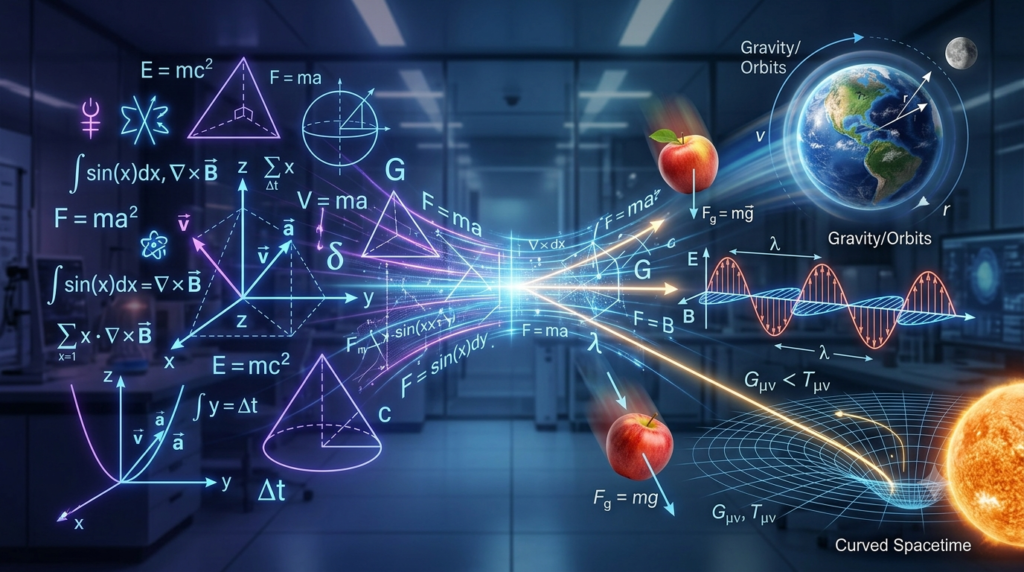
SI derived units are formed by combining SI base units according to mathematical relationships between physical quantities. For example, speed is distance divided by time, so its SI unit is metre per second (m/s). Acceleration has the unit metre per second squared (m/s²). Force is another example. Its SI unit, the newton, can be expressed as kilogram metre per second squared (kg·m/s²). Many derived units have special names and symbols, such as joule, watt, pascal, and volt. Understanding their relationship with base units helps students see how different physical quantities are connected mathematically.
Related Post
Formula for Solving a Simple Algebraic Equation
Algebraic equations are an important part of mathematics because they provide a way to find an unknown value from known […]
Read MoreLinear Equation Formulas for Beginners
Linear equations are one of the most important foundations of algebra. They help us describe relationships between quantities, find unknown […]
Read MoreFactorization Formulas and Basic Algebraic Identities
Algebraic expressions can often look complicated when several numbers, variables, and operations appear together. Factorization provides a systematic way to […]
Read MoreAlgebraic Identities and Their Standard Formulas
Algebra is an important part of mathematics because it helps us work with unknown values, patterns, and relationships using numbers […]
Read MoreSquare Root and Cube Root Formulas Explained
Square roots and cube roots are fundamental concepts in mathematics. They are used to reverse the operations of squaring and […]
Read MoreSquare and Cube Formulas in Mathematics
Square and cube formulas are basic algebraic identities that make many mathematical calculations easier and faster. They are especially useful […]
Read MoreRules of Exponents and Their Mathematical Formulas
Exponents are one of the most useful ideas in mathematics. They provide a short and efficient way to represent repeated […]
Read MorePowers and Exponents Formulas for Beginners
Powers and exponents are a simple way to write repeated multiplication in a shorter form. Instead of writing the same […]
Read MoreDecimal Calculation Formulas and Rules
Decimals are an important part of mathematics and are used whenever a number needs to represent a whole quantity together […]
Read MoreFraction Formulas and Basic Fraction Operations
Fractions are one of the most important parts of mathematics because they allow us to represent parts of a whole, […]
Read MoreRatio and Proportion Formulas Explained
Ratio and proportion are basic mathematical concepts used to compare quantities and understand how different values are related to each […]
Read MorePercentage Formulas and Basic Percentage Calculations
Percentages are one of the most useful parts of mathematics in everyday life. We use percentages when comparing prices, calculating […]
Read MoreFormula for Finding the Average of Numbers
The average is one of the most commonly used mathematical ideas in everyday life. We use averages to understand test […]
Read MoreBasic Formulas for Addition Subtraction Multiplication and Division
Addition, subtraction, multiplication, and division are the four basic arithmetic operations used throughout mathematics. Almost every mathematical calculation, from simple […]
Read MoreArithmetic Formulas for Basic Mathematical Calculations
Arithmetic is one of the most fundamental parts of mathematics. It deals with the basic operations we use to work […]
Read MoreAlgebraic Formulas Every Beginner Should Know
Algebra is one of the most useful parts of mathematics because it gives us a way to represent unknown quantities, […]
Read MoreTypes of Mathematical Formulas and Their Uses
Mathematical formulas are compact ways of expressing relationships between numbers, quantities, shapes, and mathematical ideas. Instead of explaining a relationship […]
Read MoreHow Mathematical Formulas Represent Relationships
Mathematics is often used to describe how different quantities are connected. In everyday situations, we may say that the cost […]
Read More