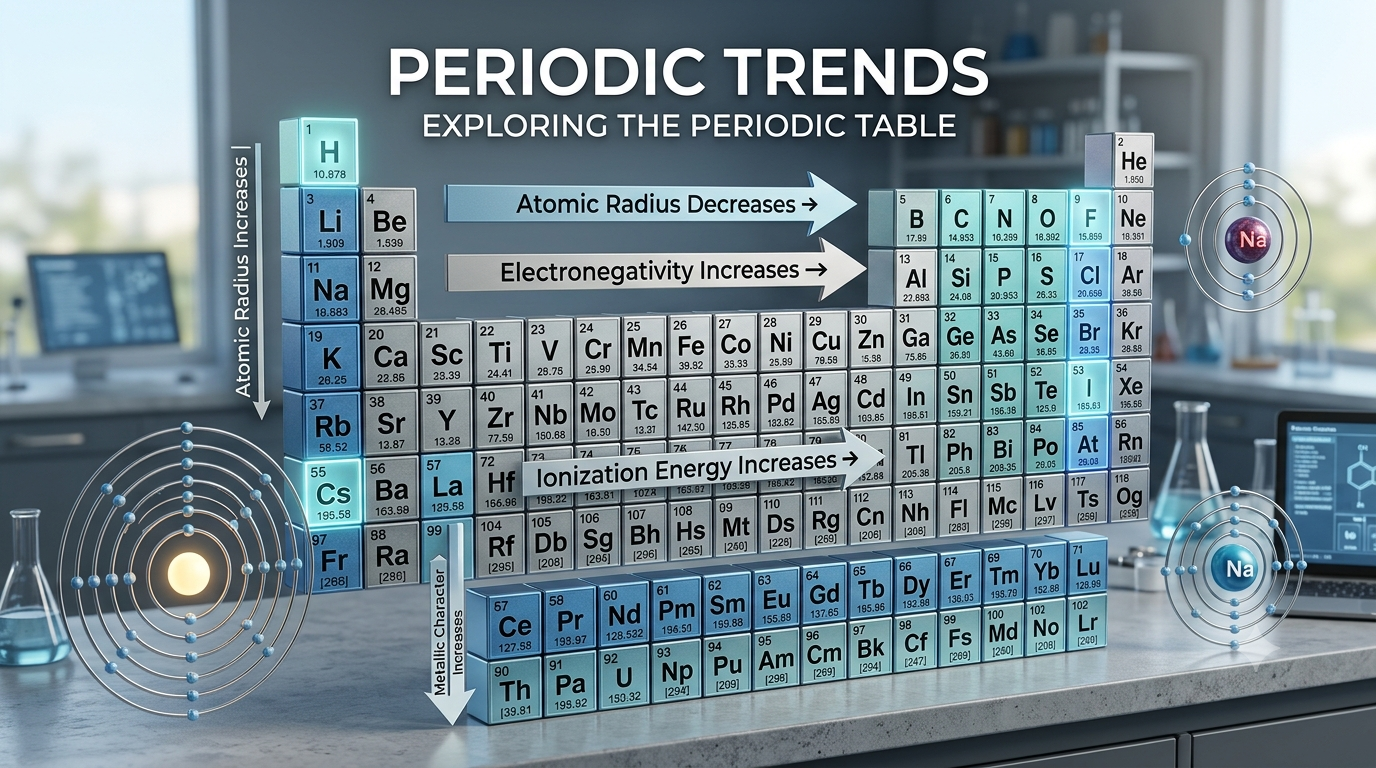
The periodic table is one of the most important tools in chemistry. It organizes all known chemical elements according to their atomic numbers and electron configurations. However, the periodic table does more than simply arrange elements into rows and columns. It also helps us understand and predict how elements behave during chemical reactions.
When we move from left to right across a period or from top to bottom down a group, several properties of elements change in predictable ways. These regular patterns are known as periodic trends.
Periodic trends explain why some atoms are larger than others, why certain elements lose electrons more easily, and why some elements attract electrons more strongly. They also help us understand differences in metallic character, chemical reactivity, and the formation of chemical bonds.
Learning about periodic trends provides a strong foundation for understanding chemical bonding, atomic structure, chemical reactions, and the properties of elements. In this article, we will explore what periodic trends are, why they occur, and the major trends observed in the periodic table.
What Are Periodic Trends?
Periodic trends are the regular patterns in the physical and chemical properties of elements that occur across periods and down groups in the periodic table.
These patterns are mainly related to changes in atomic structure, particularly:
Atomic number
Number of electron shells
Electron configuration
Effective nuclear charge
Shielding effect
Attraction between the nucleus and electrons
As the atomic number increases, the number of protons in the nucleus also increases. At the same time, electrons are added to different energy levels and orbitals. These changes influence the size of atoms and their ability to gain, lose, or attract electrons.
For example, atomic radius generally decreases from left to right across a period. In contrast, it generally increases from top to bottom down a group.
Similarly, first ionization energy and electronegativity generally increase across a period and decrease down a group.
These predictable changes make it possible to compare elements and estimate their properties without studying every element individually.
Why Do Periodic Trends Occur?
To understand periodic trends, it is important to first understand the basic structure of an atom and the forces acting on its electrons.
An atom contains a positively charged nucleus surrounded by negatively charged electrons. The nucleus contains protons and neutrons, while electrons occupy different energy levels around it.
The behavior of these electrons determines many of the chemical properties of an element.
Three important factors explain most periodic trends.
1. Nuclear Charge
Nuclear charge refers to the total positive charge of an atom’s nucleus. It depends on the number of protons present in the nucleus.
As the atomic number increases, the number of protons increases. A greater number of protons produces a stronger positive charge in the nucleus.
This stronger positive charge increases the attraction between the nucleus and negatively charged electrons.
For example, when moving across a period from sodium (Na) to chlorine (Cl), the number of protons increases. Electrons are added to the same principal energy level, so the stronger nuclear attraction generally pulls the electron cloud closer to the nucleus.
2. Shielding Effect
The shielding effect, also called the screening effect, occurs when inner-shell electrons reduce the attractive force exerted by the nucleus on outer-shell electrons.
Electrons have negative charges and repel one another. Inner electrons partially shield the outer electrons from the positive charge of the nucleus.
As a result, outer electrons do not experience the full nuclear charge.
The shielding effect becomes more significant when additional electron shells are present.
For example, potassium (K) has more occupied electron shells than sodium (Na). Its outermost electron is farther from the nucleus and is shielded by more inner electrons. Therefore, it experiences less effective attraction from the nucleus.
3. Effective Nuclear Charge
Effective nuclear charge is the net positive charge experienced by an electron in an atom after accounting for the shielding effect of other electrons.
It is commonly represented by the symbol Zₑff.
A simplified relationship is:
Zₑff = Z − S
Where:
Zₑff = Effective nuclear charge
Z = Actual nuclear charge or atomic number
S = Shielding constant
This simplified expression helps explain the concept. In more advanced calculations, the shielding constant depends on the electron configuration and the method used.
Across a period, the number of protons increases while electrons are generally added to the same principal energy level. Shielding does not increase enough to completely balance the increasing nuclear charge. Therefore, effective nuclear charge generally increases.
This is one of the main reasons atomic radius decreases across a period.
Major Periodic Trends in the Periodic Table
Several important properties of elements follow regular patterns in the periodic table. The major periodic trends include atomic radius, ionic radius, ionization energy, electron affinity, electronegativity, metallic character, and non-metallic character.
1. Atomic Radius
Atomic radius is a measure of the size of an atom. Since the electron cloud does not have a sharply defined outer boundary, atomic radius is measured using different methods, such as covalent radius and metallic radius.
Atomic radius generally follows two important patterns.
Across a period:
Atomic radius generally decreases from left to right.
This happens because the number of protons increases as we move across a period. The added electrons enter the same principal energy level, and the increasing effective nuclear charge pulls the electrons closer to the nucleus.
For example, sodium (Na) has a larger atomic radius than chlorine (Cl).
Down a group:
Atomic radius generally increases from top to bottom.
This happens because each successive element has an additional occupied electron shell. The outermost electrons are located farther from the nucleus, increasing the overall atomic size.
For example, lithium (Li) has a smaller atomic radius than potassium (K).
General trend:
Across a period: Decreases →
Down a group: Increases ↓
Atomic radius is useful for understanding chemical bonding, molecular structure, and the reactivity of elements.
2. Ionic Radius
Ionic radius refers to the size of an ion. An ion is an electrically charged particle formed when an atom gains or loses electrons.
Atoms can form two main types of ions:
Cations: Positively charged ions formed by losing electrons.
Anions: Negatively charged ions formed by gaining electrons.
The ionic radius changes when an atom gains or loses electrons.
Cations:
Cations are generally smaller than their parent neutral atoms.
When an atom loses electrons, electron-electron repulsion decreases. In some cases, the entire outermost electron shell is removed. The remaining electrons experience a stronger effective attraction from the nucleus.
For example:
Na → Na⁺ + e⁻
The sodium ion (Na⁺) is significantly smaller than a neutral sodium atom.
Anions:
Anions are generally larger than their parent neutral atoms.
When an atom gains electrons, electron-electron repulsion increases. The added electrons spread through the electron cloud, generally increasing its size.
For example:
Cl + e⁻ → Cl⁻
The chloride ion (Cl⁻) is larger than a neutral chlorine atom.
Ionic radius is important for understanding ionic compounds, crystal structures, and the properties of salts.
3. Ionization Energy
Ionization energy is the minimum energy required to remove an electron from an isolated gaseous atom in its ground state.
The first ionization energy refers to the energy needed to remove the first electron.
The process can be represented as:
X(g) → X⁺(g) + e⁻
Where X represents an element in its gaseous atomic state.
Across a period:
First ionization energy generally increases from left to right.
As effective nuclear charge increases, electrons are attracted more strongly to the nucleus. Therefore, more energy is usually required to remove an electron.
For example, sodium has a relatively low first ionization energy compared with chlorine.
Down a group:
First ionization energy generally decreases from top to bottom.
As the number of electron shells increases, the outermost electron becomes farther from the nucleus. Increased shielding also reduces the attraction experienced by the outer electron.
Consequently, less energy is generally needed to remove it.
For example, lithium has a higher first ionization energy than potassium.
General trend:
Across a period: Generally increases →
Down a group: Generally decreases ↓
There are some exceptions to this pattern because of electron configurations and the stability of particular subshells.
Ionization energy helps explain why alkali metals readily lose electrons and form positive ions.
4. Electron Affinity
Electron affinity refers to the energy change that occurs when an isolated gaseous atom gains an electron to form a negative ion.
The process can be represented as:
X(g) + e⁻ → X⁻(g)
Electron affinity provides information about how favorable it is for an atom to accept an additional electron.
For many elements, particularly halogens, energy is released when an electron is added.
Across a period:
Electron affinity generally becomes more negative from left to right, meaning that gaining an electron becomes more energetically favorable in many cases.
This is mainly associated with increasing effective nuclear charge and the stronger attraction between the nucleus and an added electron.
Down a group:
Electron affinity generally becomes less negative down a group, although there are important exceptions.
As atomic size increases, the added electron generally enters an orbital farther from the nucleus. The attraction between the nucleus and the added electron becomes weaker.
Halogens have relatively favorable electron affinities because gaining one electron completes their outermost p subshell.
However, electron affinity does not follow a perfectly regular pattern. The electron configurations of atoms and electron-electron repulsion can produce exceptions.
5. Electronegativity
Electronegativity is the ability of an atom to attract shared electrons toward itself when it forms a chemical bond.
Unlike ionization energy and electron affinity, electronegativity is not measured for an isolated atom in the same way. It is a relative property used to compare atoms in chemical bonds.
The Pauling scale is one of the most commonly used electronegativity scales.
Across a period:
Electronegativity generally increases from left to right.
This occurs because effective nuclear charge increases and atomic radius generally decreases. As a result, atoms tend to attract shared bonding electrons more strongly.
Down a group:
Electronegativity generally decreases from top to bottom.
The atomic radius increases, and the bonding electrons are generally farther from the nucleus. Therefore, the attraction for shared electrons usually becomes weaker.
Fluorine (F) is the most electronegative element on the Pauling scale.
General trend:
Across a period: Increases →
Down a group: Decreases ↓
Electronegativity is especially important for understanding chemical bonds.
For example, the difference in electronegativity between two bonded atoms helps explain whether a bond is non-polar covalent, polar covalent, or strongly ionic in character.
6. Metallic Character
Metallic character describes how strongly an element displays the typical properties of metals.
Metals generally have properties such as:
Good electrical conductivity
Good thermal conductivity
Metallic lustre
Malleability
Ductility
A tendency to lose electrons and form positive ions
Metallic character is closely related to how easily an atom can lose electrons.
Across a period:
Metallic character generally decreases from left to right.
As effective nuclear charge increases, electrons are held more strongly by the nucleus. Therefore, elements become less likely to lose electrons.
For example, sodium is a metal, while chlorine is a non-metal.
Down a group:
Metallic character generally increases from top to bottom.
Atomic size increases and the outermost electrons become farther from the nucleus. These electrons can generally be removed more easily.
For example, lithium is less metallic in character than cesium.
Metallic character is generally highest toward the bottom-left region of the periodic table.
7. Non-Metallic Character
Non-metallic character refers to the tendency of an element to display the properties of non-metals.
Non-metals generally have properties such as:
Poor electrical conductivity, with some exceptions
Relatively high electronegativity
A tendency to gain or share electrons
Formation of negative ions in many ionic compounds
Across a period:
Non-metallic character generally increases from left to right.
This is because atoms generally become smaller and attract electrons more strongly as effective nuclear charge increases.
Down a group:
Non-metallic character generally decreases from top to bottom.
The increasing atomic size generally reduces the attraction for additional or shared electrons.
Non-metallic character is generally highest toward the upper-right region of the periodic table, excluding noble gases when considering their usual chemical behavior.
Summary of Major Periodic Trends
The following table provides a quick comparison of the major periodic trends.
| Property | Across a Period (Left to Right) | Down a Group (Top to Bottom) |
|---|---|---|
| Atomic radius | Generally decreases | Generally increases |
| Ionic radius | No single simple trend | Generally increases for comparable ions |
| First ionization energy | Generally increases | Generally decreases |
| Electron affinity | Generally becomes more negative | Generally becomes less negative |
| Electronegativity | Generally increases | Generally decreases |
| Metallic character | Generally decreases | Generally increases |
| Non-metallic character | Generally increases | Generally decreases |
These are general patterns rather than strict rules. Electron configurations, subshell stability, and other atomic factors can cause exceptions.
Periodic Trends Across Periods and Down Groups
Understanding the direction of periodic trends makes it easier to compare different elements.
Trends Across a Period
When moving from left to right across a period:
Atomic number increases.
Nuclear charge increases.
Effective nuclear charge generally increases.
Atomic radius generally decreases.
First ionization energy generally increases.
Electronegativity generally increases.
Metallic character generally decreases.
Non-metallic character generally increases.
These changes occur mainly because electrons are added to the same principal energy level while nuclear charge increases.
Trends Down a Group
When moving from top to bottom down a group:
Atomic number increases.
The number of occupied electron shells increases.
Atomic radius generally increases.
Shielding effect generally increases.
First ionization energy generally decreases.
Electronegativity generally decreases.
Metallic character generally increases.
Non-metallic character generally decreases.
These changes occur mainly because the outermost electrons are located in higher energy levels and experience greater shielding from inner electrons.
Why Are Periodic Trends Important?
Periodic trends are not simply patterns that students need to memorize. They are useful tools for understanding and predicting chemical behavior.
Some important applications include:
1. Predicting Atomic Size
Periodic trends help compare the sizes of different atoms and ions. This information is useful for understanding molecular structures and the arrangement of atoms in compounds.
2. Understanding Chemical Reactivity
The tendency of an element to lose, gain, or share electrons influences its chemical reactivity.
For example, alkali metals generally become more reactive down the group because their outermost electron becomes easier to remove.
3. Understanding Chemical Bonding
Electronegativity helps explain how electrons are distributed between bonded atoms. It is useful for predicting bond polarity and understanding the nature of chemical bonds.
4. Comparing Elements
Periodic trends allow chemists to compare elements without examining every property individually.
For example, the general trends can help predict which of two elements has a larger atomic radius or higher first ionization energy.
5. Predicting Chemical Properties
Elements in the same group often have similar chemical properties because they have similar outer electron configurations.
Periodic trends help explain these similarities and differences.
Exceptions to Periodic Trends
Although periodic trends provide useful general rules, not every element follows them perfectly.
Some properties show unexpected changes because of electron configurations, orbital arrangements, and electron-electron repulsion.
For example, the first ionization energy of boron is lower than that of beryllium, even though boron comes after beryllium in the same period.
This happens because the electron removed from boron occupies a higher-energy 2p orbital, while the electron removed from beryllium comes from the more stable 2s subshell.
Another example is the first ionization energy of oxygen, which is lower than that of nitrogen. Nitrogen has a relatively stable half-filled 2p subshell, while oxygen has one pair of electrons in a 2p orbital. The repulsion between paired electrons makes removing one electron from oxygen comparatively easier.
Electron affinity also shows exceptions. For example, chlorine has a more negative electron affinity than fluorine, even though fluorine is located above chlorine in the same group. The very small 2p orbital in fluorine produces greater electron-electron repulsion when an additional electron enters it.
These examples show why it is important to understand the reasons behind periodic trends instead of memorizing only their directions.
Conclusion
Periodic trends are regular patterns in the physical and chemical properties of elements across periods and down groups in the periodic table. They are mainly influenced by nuclear charge, shielding effect, effective nuclear charge, electron configuration, and atomic size.
The major periodic trends include atomic radius, ionic radius, ionization energy, electron affinity, electronegativity, metallic character, and non-metallic character. Each property follows a general pattern that helps explain how elements behave and interact with one another.
Understanding these trends makes it easier to compare elements, predict their chemical behavior, and understand the principles behind chemical bonding and reactions. Periodic trends are therefore an essential part of chemistry and provide a foundation for studying more advanced topics in atomic structure and chemical properties.
FAQs
1. What are periodic trends in the periodic table?
Periodic trends are the regular patterns in the physical and chemical properties of elements across periods and down groups in the periodic table. These trends help explain how properties such as atomic radius, ionization energy, electron affinity, electronegativity, and metallic character change with atomic number. They occur mainly because of differences in nuclear charge, shielding effect, effective nuclear charge, and electron configuration. Understanding periodic trends makes it easier to compare elements, predict their chemical behavior, and understand why elements in different positions of the periodic table have different properties.
2. What causes periodic trends in the periodic table?
Periodic trends are mainly caused by changes in nuclear charge, shielding effect, effective nuclear charge, and the number of occupied electron shells. As we move across a period, the number of protons increases, resulting in stronger nuclear attraction. Down a group, additional electron shells increase atomic size and shielding. These changes influence how strongly atoms hold their electrons and how they interact with other atoms. As a result, properties such as atomic radius, ionization energy, and electronegativity follow predictable patterns throughout the periodic table.
3. What are the main types of periodic trends?
The main types of periodic trends include atomic radius, ionic radius, ionization energy, electron affinity, electronegativity, metallic character, and non-metallic character. Each trend describes how a particular atomic or chemical property changes across periods and down groups. For example, atomic radius generally decreases across a period and increases down a group. Ionization energy and electronegativity generally show the opposite pattern. These trends help chemists understand atomic structure, compare elements, predict chemical reactions, and explain the formation of different types of chemical bonds.
4. How does atomic radius change across a period and down a group?
Atomic radius generally decreases from left to right across a period because the number of protons increases while electrons are added to the same principal energy level. The increasing effective nuclear charge pulls the electron cloud closer to the nucleus. However, atomic radius increases from top to bottom down a group because each successive element has an additional occupied electron shell. This places the outermost electrons farther from the nucleus. These patterns help explain differences in atomic size and are important for understanding chemical bonding and the properties of elements.
5. Why does ionization energy increase across a period?
Ionization energy generally increases across a period because the effective nuclear charge increases as the number of protons increases. The outermost electrons experience stronger attraction from the nucleus, making them more difficult to remove. Consequently, more energy is usually required to remove an electron from an atom. However, this trend is not perfectly regular because certain electron configurations and subshell arrangements create exceptions. For example, the first ionization energy of boron is lower than that of beryllium. These exceptions are explained by differences in orbital energies and electron arrangements.
6. What is the difference between electron affinity and electronegativity?
Electron affinity and electronegativity both describe how atoms interact with electrons, but they represent different properties. Electron affinity refers to the energy change when an isolated gaseous atom gains an electron to form a negative ion. Electronegativity describes an atom’s ability to attract shared electrons toward itself in a chemical bond. Electron affinity is associated with an isolated atom, whereas electronegativity is a relative property of bonded atoms. Both concepts help explain why different elements attract electrons differently and are important for understanding chemical reactions and chemical bonding.
7. Why does atomic radius increase down a group?
Atomic radius generally increases down a group because each successive element contains an additional occupied electron shell. These additional shells place the outermost electrons farther from the nucleus. Inner-shell electrons also produce a shielding effect, reducing the effective attraction experienced by outer electrons. Although the nuclear charge increases down a group, the combined effects of additional shells and shielding generally result in a larger atomic radius. For example, potassium has a larger atomic radius than sodium because potassium has one more occupied electron shell.
8. What is the relationship between electronegativity and periodic trends?
Electronegativity follows a predictable pattern in the periodic table. It generally increases from left to right across a period because effective nuclear charge increases and atomic radius decreases. This allows atoms to attract shared bonding electrons more strongly. Electronegativity generally decreases from top to bottom down a group because atomic size and shielding increase. Fluorine is the most electronegative element on the Pauling scale. Electronegativity is useful for understanding how electrons are shared between atoms and for predicting whether chemical bonds have non-polar covalent, polar covalent, or ionic character.
9. Why do periodic trends have exceptions?
Periodic trends have exceptions because electron configurations, orbital energies, subshell stability, and electron-electron repulsion can influence atomic properties. For example, nitrogen has a relatively stable half-filled 2p subshell, giving it a higher first ionization energy than oxygen. Oxygen has a paired electron in one of its 2p orbitals, and the repulsion between paired electrons makes electron removal comparatively easier. Similarly, chlorine has a more negative electron affinity than fluorine because of differences in electron-electron repulsion. These exceptions demonstrate that periodic trends are general patterns rather than absolute rules.
10. Why are periodic trends important in chemistry?
Periodic trends are important because they help explain and predict the physical and chemical properties of elements. They allow chemists to compare atomic sizes, understand why certain elements lose or gain electrons, and predict how strongly atoms attract shared electrons. These patterns are also useful for understanding chemical bonding, ionic formation, metallic behavior, and chemical reactivity. For example, periodic trends help explain why alkali metals become more reactive down their group and why halogens generally attract electrons strongly. Learning periodic trends provides a foundation for understanding atomic structure and more advanced chemical concepts.