Measurement is one of the most important foundations of physics. Almost every idea in physics is connected to measurement in some way. When we say that a car travels at 60 kilometers per hour, a table is 1.5 meters long, or a body has a mass of 5 kilograms, we are describing physical quantities using measurements.
In simple terms, measurement is the process of comparing an unknown physical quantity with a known standard quantity of the same kind. This comparison gives a numerical value along with a unit. Measurement allows physicists to describe observations precisely, perform calculations, test theories, and communicate results clearly.
Without measurement, physics would mostly depend on vague descriptions such as “very long,” “quite fast,” or “extremely hot.” Measurement turns these observations into useful scientific information.
What Does Measurement Mean in Physics?
In physics, measurement means finding the value of a physical quantity by comparing it with an accepted standard.
For example, suppose you want to find the length of a pencil. You can compare it with a standard unit such as the meter. If the pencil is 15 centimeters long, the number 15 tells us how many units are present, while centimeter tells us the unit being used.
Therefore, a measurement generally consists of:
Measurement = Numerical value + Unit
For example:
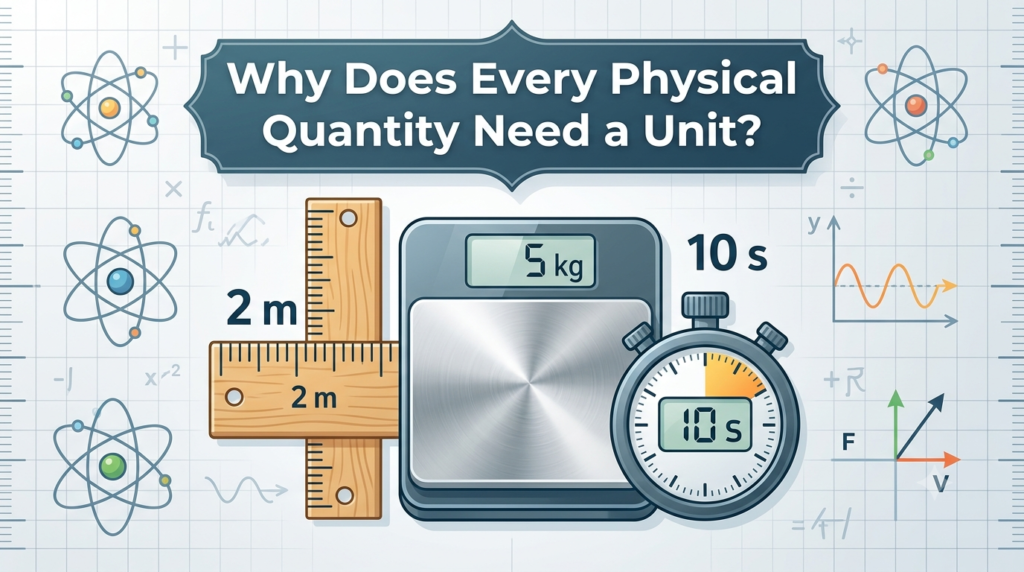
Both the number and the unit are important. Saying that an object has a length of “5” is incomplete because we do not know whether the length is 5 meters, 5 centimeters, or 5 kilometers.
Why Is Measurement Important in Physics?
Measurement allows physicists to study nature quantitatively. Instead of simply observing that one object moves faster than another, a physicist can measure their speeds and compare them numerically.
Measurements are important because they help us:
Describe physical quantities precisely
Compare different objects and events
Perform mathematical calculations
Test physical laws and theories
Conduct scientific experiments
Design machines and technologies
Identify changes in physical systems
Reproduce experimental results
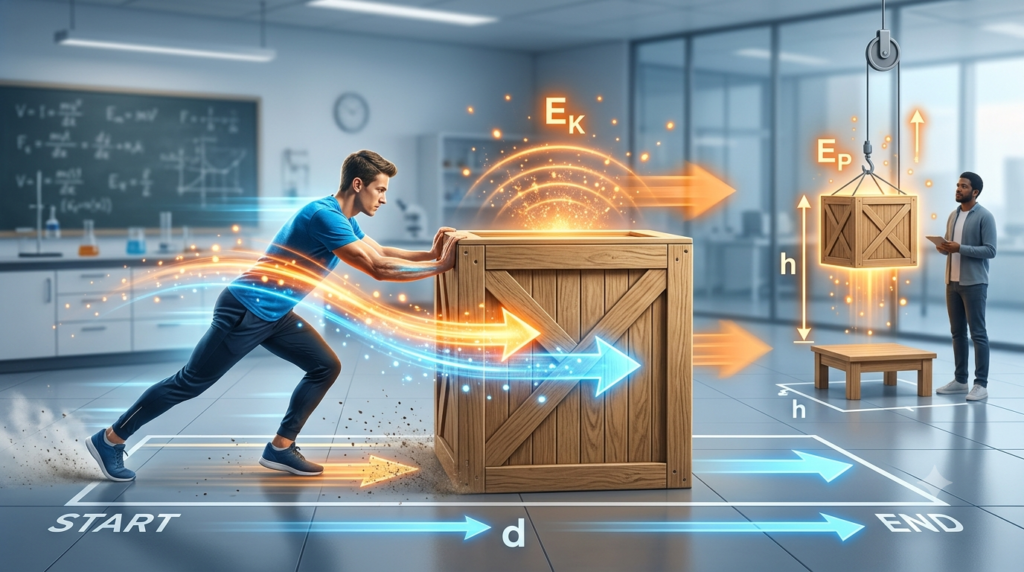
For example, Newton’s laws can be used to calculate the motion of objects, but measurements of mass, force, distance, and time are needed to apply those laws to real situations.
Measurement therefore connects physical ideas with the real world.
Physical Quantities and Measurement
A physical quantity is a property that can be measured and expressed using a number and a unit.
Examples include length, mass, time, temperature, electric current, speed, force, energy, and pressure.
Physical quantities are commonly divided into fundamental quantities and derived quantities.
Fundamental quantities are basic quantities that are defined independently. In the International System of Units, or SI system, there are seven base quantities:
Length — meter (m)
Mass — kilogram (kg)
Time — second (s)
Electric current — ampere (A)
Thermodynamic temperature — kelvin (K)
Amount of substance — mole (mol)
Luminous intensity — candela (cd)
Derived quantities are obtained by combining base quantities mathematically.
For example, speed is calculated as:
Speed = Distance ÷ Time
Its SI unit is meter per second (m/s).
Similarly, force is given by:
Force = Mass × Acceleration
Its SI unit is newton (N), which can also be expressed in terms of base units as kg·m/s².
Units Provide a Standard for Measurement
A unit is an agreed standard used to measure a physical quantity.
Imagine two people measuring the same table. If one person uses a handspan and another uses a footstep, they may obtain different numerical results because their standards are different. Scientific measurements require standardized units so that results can be understood and compared everywhere.
The SI system provides an internationally accepted system of units. It is widely used in science, engineering, medicine, industry, and technology.
Standard units make scientific communication much easier. A measurement of 10 meters has the same meaning regardless of who makes the measurement or where the measurement is made.
How Is a Measurement Made?
The basic process of measurement involves comparing an unknown quantity with a standard.
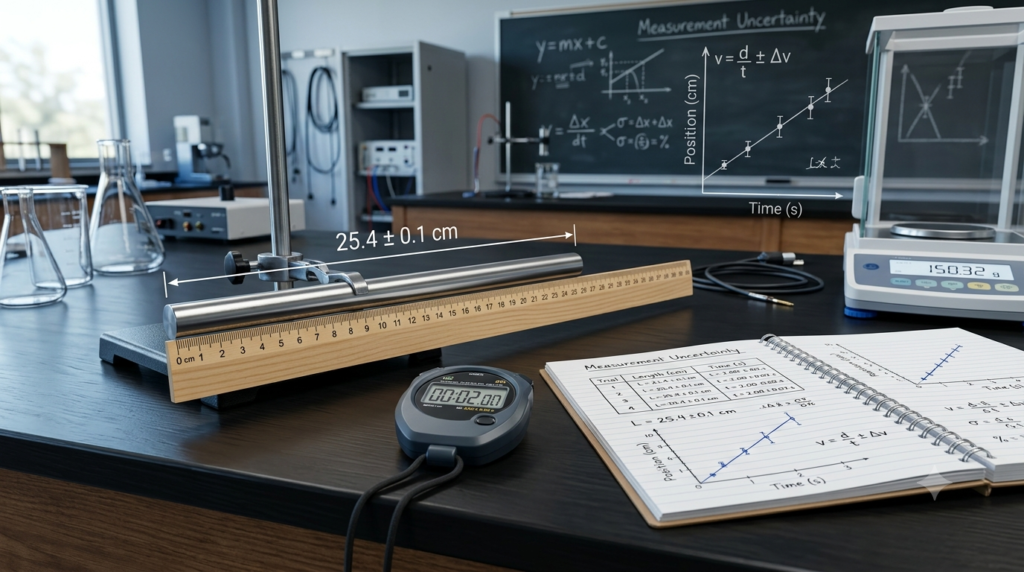
Suppose you want to measure the length of a book using a ruler. You place the ruler along the length of the book and compare the book’s length with the markings on the ruler.
If the end of the book reaches the 25-centimeter mark, its measured length is approximately 25 cm.
Different physical quantities require different measuring instruments.
Examples include:
Ruler or measuring tape for length
Balance for mass
Stopwatch or clock for time
Thermometer for temperature
Ammeter for electric current
Voltmeter for potential difference
Spring balance for force
The choice of instrument depends on what quantity is being measured and how accurately it needs to be measured.
Accuracy and Precision in Measurement
Measurements are never completely free from limitations. Two important ideas used to describe measurements are accuracy and precision.
Accuracy refers to how close a measured value is to the true or accepted value.
Precision refers to how closely repeated measurements agree with one another.
For example, suppose the accepted length of an object is 10.00 cm. If an instrument gives measurements of 9.99 cm, 10.00 cm, and 10.01 cm, the measurements are both highly accurate and precise.
However, repeated measurements can sometimes be very close to each other while still being away from the accepted value. Such measurements may be precise but not accurate.
Understanding accuracy and precision is essential when performing experiments because measurements help determine how reliable the results are.
Errors in Measurement
Every real measurement has some degree of uncertainty or error. This does not necessarily mean that the person made a mistake. Instruments have limitations, experimental conditions can change, and different observers may read instruments slightly differently.
Some common sources of measurement error include:
For example, when reading a ruler, viewing the scale from an angle can produce a different reading. This is known as parallax error.
Scientists try to reduce measurement errors by using better instruments, following careful procedures, taking repeated measurements, and estimating uncertainty.
Least Count and Measuring Instruments
The least count of an instrument is the smallest measurement that the instrument can reliably measure or display.
For example, if a ruler has markings separated by 1 millimeter, its smallest scale division is 1 mm.
More precise instruments can measure smaller differences. A vernier caliper can generally measure lengths more precisely than an ordinary ruler, while a micrometer screw gauge can provide even finer measurements for suitable objects.
The instrument chosen should match the required level of precision. There is no benefit in using an extremely precise instrument when rough measurement is sufficient, but high-precision experiments require instruments capable of detecting very small changes.
Significant Figures in Measurement
Measurements often contain a limited number of meaningful digits called significant figures.
For example, a measurement written as 5.20 cm contains three significant figures. The final zero is meaningful because it communicates information about the precision of the measurement.
Significant figures help scientists avoid giving a false impression of accuracy. If an instrument cannot measure beyond a certain level, the reported result should not contain meaningless extra digits.
For this reason, the way a measurement is written can communicate not only its value but also something about its precision.
Measurement in Everyday Life
Measurement is not limited to laboratories. It is part of everyday life.
We measure distance while traveling, time while following a schedule, temperature when checking the weather, mass while buying food, and electricity when monitoring energy consumption.
Modern technologies also depend heavily on precise measurements. Smartphones use sensors to measure acceleration, rotation, and location-related information. Medical devices measure quantities such as temperature, heart activity, and blood pressure. Engineers use measurements to design buildings, vehicles, machines, and electronic systems.
Thus, measurement is closely connected to both science and technology.
Measurement Helps Test Physical Laws
One of the most important roles of measurement is testing whether scientific ideas agree with nature.
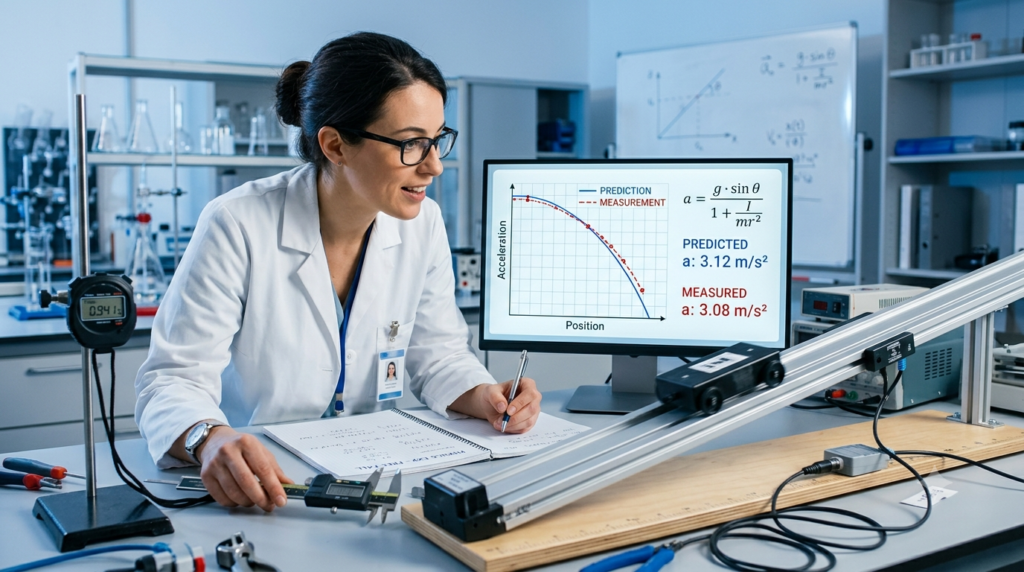
Suppose a physicist develops a theory predicting how an object should move. The prediction can be compared with experimental measurements. If the measurements consistently agree with the prediction, confidence in the theory increases. If they disagree, scientists investigate the reason.
This process makes physics an experimental science. Measurements provide the evidence needed to support, refine, or challenge scientific explanations.
Conclusion
Measurement is the foundation that allows physics to describe the natural world quantitatively. It involves comparing a physical quantity with a standard unit and expressing the result with a numerical value and unit. From length and time to force, energy, and electric current, measurements are essential throughout physics.
Accurate and reliable measurement allows scientists to perform experiments, test laws, reduce uncertainty, and develop technologies. Learning how measurement works also helps us understand why units, instruments, accuracy, precision, errors, and significant figures are important. In physics, measurement is more than simply obtaining a number; it is a way of turning observations of nature into meaningful scientific knowledge.