Imagine trying to measure the length of a table without using centimeters or meters. One person might say the table is five handspans long, while another might describe it as three feet long. Both measurements may describe the same table, but comparing them would be difficult. This is why science needs a common system of measurement. The International System of Units, commonly called the SI system, provides a worldwide standard for measuring physical quantities. SI units are used in physics, chemistry, engineering, medicine, technology, and everyday life. They allow scientists and people in different countries to communicate measurements clearly and accurately.
What Are SI Units?
SI units are internationally agreed-upon units used to measure physical quantities. The abbreviation SI comes from the French name Système International d’Unités, meaning International System of Units.
The SI system provides a consistent way to express measurements such as length, mass, time, temperature, and electric current. Instead of different countries or scientific fields using unrelated measurement systems, SI units provide a common language for measurement.
For example, the length of a laboratory table can be measured in meters, its mass in kilograms, and the time taken to move it in seconds. These units have the same meaning regardless of where the measurement is made.
The Seven SI Base Units
The SI system is built around seven fundamental units called SI base units. These units are the foundation for many other measurements used in science.
1. Metre for Length
The metre, symbol m, is the SI base unit of length. It is used to measure distances, heights, widths, and sizes.
For example, the height of a person, the length of a room, or the distance between two objects can be expressed in metres.
2. Kilogram for Mass
The kilogram, symbol kg, is the SI base unit of mass. It is used to describe the amount of matter in an object.
For example, a bag of rice may have a mass of 5 kilograms.
3. Second for Time
The second, symbol s, is the SI base unit of time. Time measurements are essential in almost every area of science.
Scientists use seconds to describe events ranging from extremely fast particle processes to long-lasting astronomical phenomena.
4. Ampere for Electric Current
The ampere, symbol A, is the SI base unit of electric current. It is used to measure the flow of electric charge through a circuit.
Electrical devices and systems are commonly described using current measurements in amperes.
5. Kelvin for Temperature
The kelvin, symbol K, is the SI base unit of thermodynamic temperature. Unlike degrees Celsius, kelvin is written without the degree symbol.
For scientific measurements, especially in physics and thermodynamics, temperature is often expressed in kelvins.
6. Mole for Amount of Substance
The mole, symbol mol, is the SI base unit for the amount of substance. It is particularly important in chemistry because it provides a way to count extremely large numbers of particles such as atoms, molecules, and ions.
7. Candela for Luminous Intensity
The candela, symbol cd, is the SI base unit of luminous intensity. It is used to describe the intensity of light emitted by a source in a particular direction.
These seven base units form the foundation of the SI system.
What Are Derived SI Units?
Not every physical quantity requires its own base unit. Many quantities can be expressed by combining SI base units. These are called derived units.
For example, speed is calculated by dividing distance by time:
Speed = Distance ÷ Time
Since distance is measured in metres and time in seconds, the SI unit of speed is metres per second, written as m/s.
Similarly, acceleration has the unit m/s², while area is measured in m² and volume in m³.
Some derived units have special names and symbols. Force, for example, is measured in newtons (N). One newton can be expressed in terms of base units as:
1 N = 1 kg·m/s²
Energy is measured in joules (J), and power is measured in watts (W). These units are derived from the SI base units.
Why Are SI Units Important?
SI units are important because they create consistency in scientific measurement. Without standardized units, scientific communication would be much more complicated.
They Create a Common Language
Scientists from different countries can use the same units to describe their observations and experimental results. A measurement expressed in metres or kilograms has the same meaning around the world.
This common language is especially important when researchers collaborate internationally.
They Improve Scientific Accuracy
Standardized units help scientists perform calculations and compare measurements reliably. If researchers used different definitions for the same unit, experimental results could become confusing or misleading.
SI units provide clearly defined standards that support accurate measurement.
They Make Calculations Easier
Physics and other sciences involve many mathematical relationships. Using a consistent system of units makes these calculations easier to perform and check.
For example, Newton’s second law is written as:
F = ma
When force is measured in newtons, mass in kilograms, and acceleration in metres per second squared, the units naturally fit together:
N = kg·m/s²
This consistency helps scientists identify errors in calculations.
They Support Technology and Engineering
Engineers use SI units when designing bridges, machines, electrical systems, vehicles, buildings, and spacecraft.
A small error in measurement can have serious consequences in engineering. Standard units help designers, manufacturers, and technicians work with the same measurements.
They Help International Trade
Products are manufactured and sold across national borders. Standardized measurements make it easier to describe product dimensions, mass, temperature, energy consumption, and other properties.
For example, industrial equipment can be designed using millimetres and kilograms and manufactured in one country for use in another.
SI Prefixes Make Measurements Convenient
Physical quantities can be extremely large or extremely small. SI prefixes make these measurements easier to express.
For example, kilo- means one thousand, so:
1 kilometre = 1,000 metres
Similarly, centi- means one hundredth:
1 centimetre = 0.01 metre
The prefix milli- represents one thousandth:
1 millimetre = 0.001 metre
For very small quantities, scientists may use prefixes such as micro-, nano-, and pico-. For very large quantities, prefixes such as mega-, giga-, and tera- are useful.
These prefixes allow scientists to write measurements in a practical and readable form.
SI Units in Everyday Life
Although SI units are strongly associated with science, they are also part of everyday life. We use metres to measure distance, kilograms to measure mass, seconds to measure time, and degrees Celsius for many ordinary temperature measurements.
Electricity bills, fuel consumption, medicine, construction, cooking, transportation, and sports all involve measurements that are connected to standardized units.
Even when people do not think about SI units directly, they often depend on them.
SI Units and Scientific Communication
Science depends on the ability to reproduce and compare measurements. If a scientist reports that an experiment produced a force of 20 newtons, another researcher can understand exactly what measurement is being described.
This is essential for experiments, research papers, laboratory work, international cooperation, and technological development.
Standard units also make scientific information easier to teach. Students around the world can learn the same fundamental measurement system and apply it to different scientific problems.
SI Units and Measurement Conversions
Sometimes measurements need to be converted from one unit to another. SI prefixes make many conversions straightforward.
For example:
1 km = 1,000 m
Therefore:
5 km = 5,000 m
Similarly:
1 kg = 1,000 g
Understanding SI units helps students and scientists perform these conversions correctly.
It is also important to distinguish between units and physical quantities. Length is a physical quantity, while metre is a unit used to measure length. Mass is a physical quantity, while kilogram is its SI base unit.
Conclusion
SI units provide a universal system for measuring physical quantities. The seven SI base units form the foundation of countless derived units used in physics, chemistry, engineering, and other sciences. By providing standardized measurements, SI units make scientific communication clearer, calculations more reliable, and international cooperation easier. They are also essential in technology, industry, trade, and everyday activities. Understanding SI units is therefore more than memorizing symbols and definitions. It is learning the common measurement language that allows people around the world to describe, compare, and understand the physical world accurately.
FAQs
SI units are internationally standardized units used to measure physical quantities. SI stands for Système International d’Unités, or International System of Units. The system provides a common measurement language for science, engineering, technology, industry, and everyday applications. It includes seven base units: metre for length, kilogram for mass, second for time, ampere for electric current, kelvin for temperature, mole for amount of substance, and candela for luminous intensity. Many other units, such as newton, joule, and watt, are derived from these base units. Using SI units makes measurements consistent, understandable, and comparable worldwide.
SI units are important because they provide a universal standard for measurement. Scientists around the world can use the same units to record, compare, and communicate experimental results. Without standardized units, measurements could be difficult to understand or reproduce because different regions might use different systems. SI units also make scientific calculations more consistent because relationships between physical quantities can be expressed using compatible units. They are widely used in physics, chemistry, biology, engineering, medicine, and astronomy. By providing a common measurement system, SI units help scientists collaborate internationally and communicate their findings accurately and efficiently.
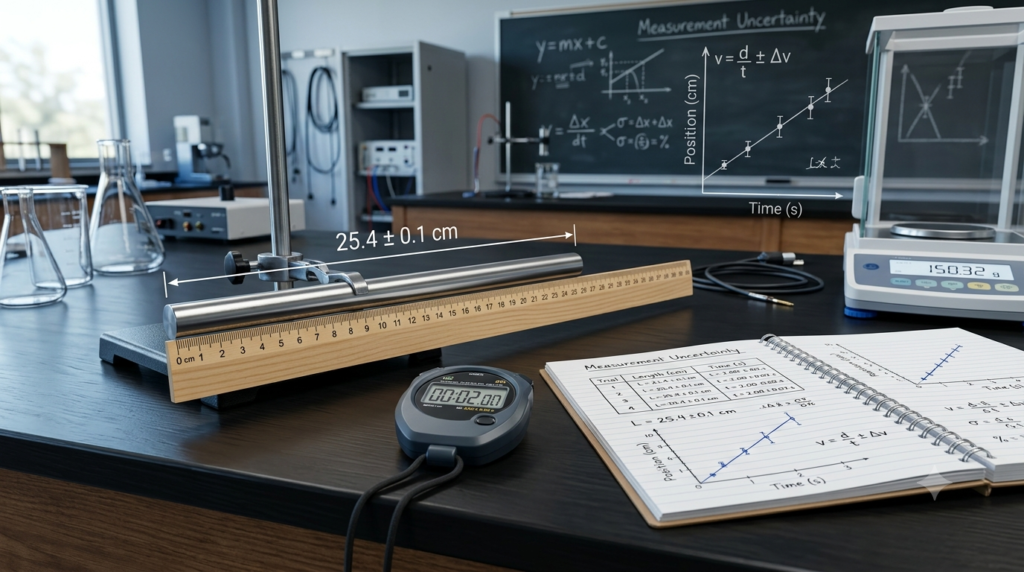
There are seven SI base units. They are the metre (m) for length, kilogram (kg) for mass, second (s) for time, ampere (A) for electric current, kelvin (K) for thermodynamic temperature, mole (mol) for amount of substance, and candela (cd) for luminous intensity. These seven units form the foundation of the entire SI system. Other SI units can be created by combining base units mathematically. For example, the newton, used for force, is equivalent to kilogram metre per second squared. Understanding the seven base units is therefore essential for learning measurement throughout science.
SI base units are the seven fundamental units that form the foundation of the International System of Units. Derived units are created by combining these base units according to mathematical relationships. For example, speed is measured in metres per second (m/s), which combines the metre and second. Force is measured in newtons (N), equivalent to kg·m/s². Energy is measured in joules, while power is measured in watts. Some derived units have special names and symbols, but they can still be expressed using SI base units. This structure keeps the measurement system organized and consistent.
Yes, the kilogram (kg) is the SI base unit of mass. This is different from many other SI quantities, whose base units do not contain prefixes. The kilogram is commonly used to measure the mass of objects, from everyday items to scientific equipment. Smaller or larger masses can be expressed conveniently using related units and prefixes, such as grams, milligrams, or tonnes, depending on the application. It is important to remember that mass and weight are not the same physical quantity. Mass describes an object’s amount of matter, while weight is a force caused by gravity.
SI prefixes are symbols placed before units to represent powers of ten. They make very large and very small measurements easier to express. For example, kilo means one thousand, so one kilometre equals 1,000 metres. Milli means one thousandth, so one millimetre equals 0.001 metre. Other commonly used prefixes include mega, giga, micro, nano, and pico. SI prefixes are particularly useful in science and technology because measurements can range from extremely tiny atomic scales to enormous astronomical distances. Instead of writing many zeros, scientists can use an appropriate prefix to make measurements shorter and easier to understand.
SI units are used extensively throughout the world and are the standard measurement system for most scientific and technical work. Many countries also use SI units in education, industry, manufacturing, medicine, and commerce. However, some non-SI units remain common in everyday life in certain countries or specific fields. For example, inches, feet, miles, and pounds may still be used for particular purposes. Even when non-SI units are used, SI units remain the primary international standard for scientific measurement. This widespread adoption allows researchers, engineers, and organizations from different countries to communicate measurements consistently.
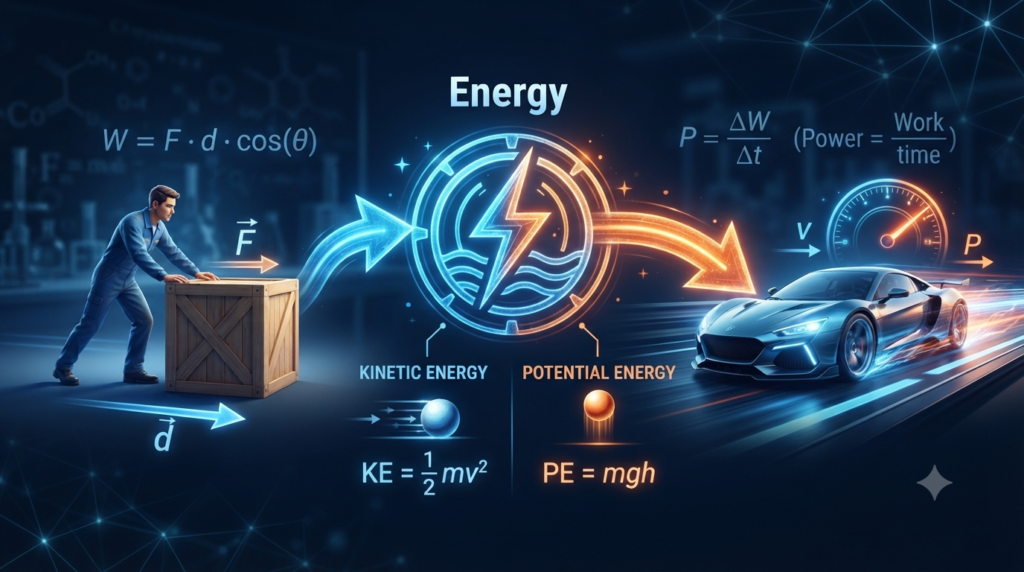
The SI system is especially useful in physics because physical laws connect different quantities through mathematical equations. Consistent units allow these equations to work correctly and make it easier to identify mistakes. For example, Newton’s second law is written as F = ma. When mass is measured in kilograms and acceleration in metres per second squared, force is obtained in newtons. Similarly, energy, pressure, power, and other quantities can be expressed using combinations of SI units. This consistency allows physicists to perform calculations, compare experimental results, and communicate scientific measurements clearly.
The kelvin (K) is the SI base unit of thermodynamic temperature. It is widely used in scientific fields such as physics, chemistry, thermodynamics, and astronomy. Unlike degrees Celsius, kelvin is written without a degree symbol. The Celsius and kelvin scales have the same size of temperature interval, but their zero points are different. A temperature expressed in kelvins can therefore be related to Celsius using a simple conversion. Kelvin is particularly important when scientists study absolute temperature, gas behaviour, thermal energy, and other physical processes where a consistent temperature scale is required.
SI units are part of many everyday activities, even when people do not consciously think about them. Metres and kilometres are used to describe distances, kilograms and grams measure mass, and seconds measure time. Electrical equipment involves measurements such as amperes, volts, and watts, while scientific and medical applications rely heavily on standardized measurements. Construction, transportation, manufacturing, cooking, sports, and technology also depend on accurate measurement. Because SI units provide common standards, products and measurements can be understood across different regions. They make everyday communication and technical work more reliable, consistent, and easier to compare.
Related Post
Formula for Solving a Simple Algebraic Equation
Algebraic equations are an important part of mathematics because they provide a way to find an unknown value from known […]
Read MoreLinear Equation Formulas for Beginners
Linear equations are one of the most important foundations of algebra. They help us describe relationships between quantities, find unknown […]
Read MoreFactorization Formulas and Basic Algebraic Identities
Algebraic expressions can often look complicated when several numbers, variables, and operations appear together. Factorization provides a systematic way to […]
Read MoreAlgebraic Identities and Their Standard Formulas
Algebra is an important part of mathematics because it helps us work with unknown values, patterns, and relationships using numbers […]
Read MoreSquare Root and Cube Root Formulas Explained
Square roots and cube roots are fundamental concepts in mathematics. They are used to reverse the operations of squaring and […]
Read MoreSquare and Cube Formulas in Mathematics
Square and cube formulas are basic algebraic identities that make many mathematical calculations easier and faster. They are especially useful […]
Read MoreRules of Exponents and Their Mathematical Formulas
Exponents are one of the most useful ideas in mathematics. They provide a short and efficient way to represent repeated […]
Read MorePowers and Exponents Formulas for Beginners
Powers and exponents are a simple way to write repeated multiplication in a shorter form. Instead of writing the same […]
Read MoreDecimal Calculation Formulas and Rules
Decimals are an important part of mathematics and are used whenever a number needs to represent a whole quantity together […]
Read MoreFraction Formulas and Basic Fraction Operations
Fractions are one of the most important parts of mathematics because they allow us to represent parts of a whole, […]
Read MoreRatio and Proportion Formulas Explained
Ratio and proportion are basic mathematical concepts used to compare quantities and understand how different values are related to each […]
Read MorePercentage Formulas and Basic Percentage Calculations
Percentages are one of the most useful parts of mathematics in everyday life. We use percentages when comparing prices, calculating […]
Read MoreFormula for Finding the Average of Numbers
The average is one of the most commonly used mathematical ideas in everyday life. We use averages to understand test […]
Read MoreBasic Formulas for Addition Subtraction Multiplication and Division
Addition, subtraction, multiplication, and division are the four basic arithmetic operations used throughout mathematics. Almost every mathematical calculation, from simple […]
Read MoreArithmetic Formulas for Basic Mathematical Calculations
Arithmetic is one of the most fundamental parts of mathematics. It deals with the basic operations we use to work […]
Read MoreAlgebraic Formulas Every Beginner Should Know
Algebra is one of the most useful parts of mathematics because it gives us a way to represent unknown quantities, […]
Read MoreTypes of Mathematical Formulas and Their Uses
Mathematical formulas are compact ways of expressing relationships between numbers, quantities, shapes, and mathematical ideas. Instead of explaining a relationship […]
Read MoreHow Mathematical Formulas Represent Relationships
Mathematics is often used to describe how different quantities are connected. In everyday situations, we may say that the cost […]
Read More