Electronegativity is one of the most important concepts in chemistry because it helps explain how atoms attract shared electrons when they form chemical bonds. When two different atoms combine to form a molecule, they do not always attract the shared electrons with equal strength. One atom may attract the electrons more strongly than the other, resulting in an unequal distribution of electrical charge within the bond. This difference plays an important role in determining the properties and behaviour of chemical compounds.
Electronegativity also helps us understand why some chemical bonds are polar while others are non-polar. It explains several important chemical properties, including bond polarity, molecular structure, chemical reactivity, and the nature of compounds.
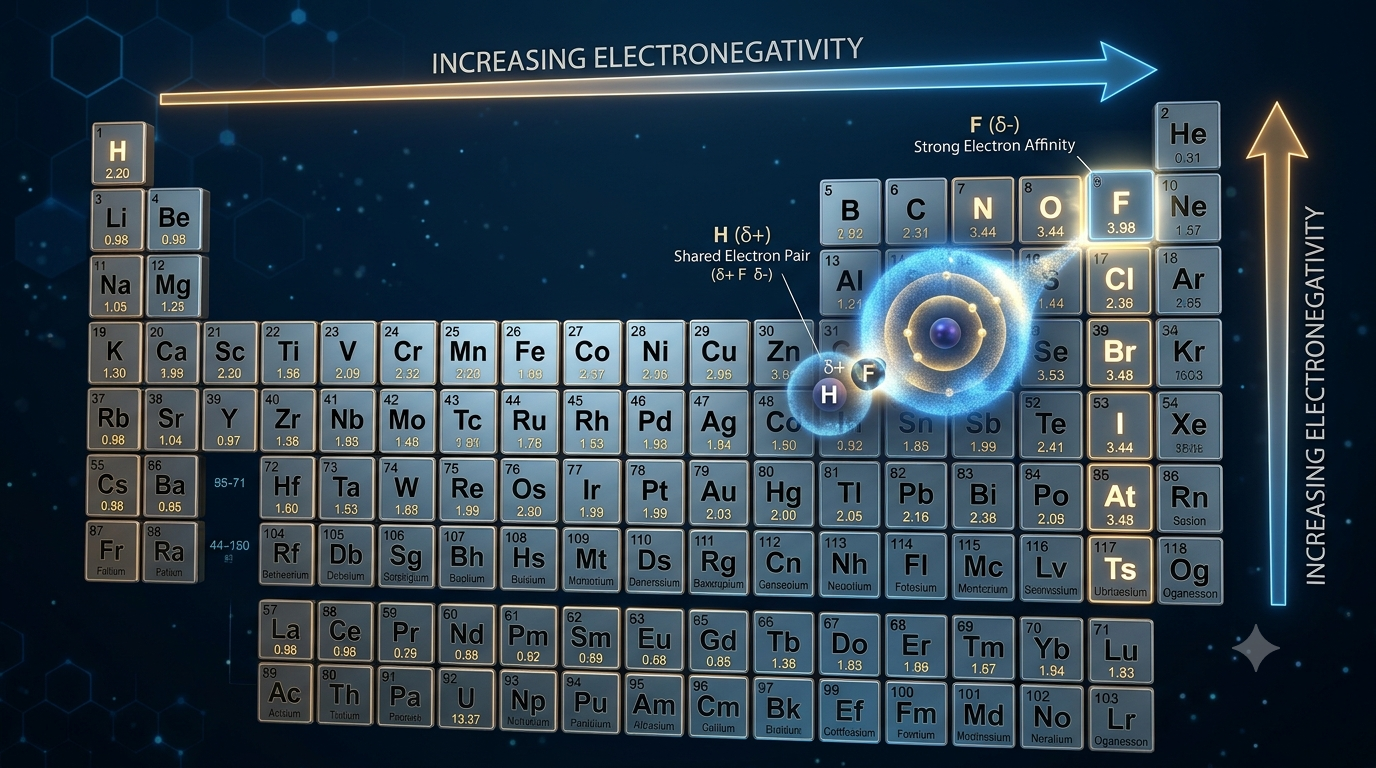
The electronegativity of elements is not random. It follows specific patterns in the periodic table. Generally, electronegativity increases from left to right across a period and decreases from top to bottom down a group. Understanding these periodic variations makes it easier to predict how different elements interact with one another.
What Is Electronegativity?
Electronegativity is defined as the tendency of an atom in a chemical bond to attract the shared pair of electrons towards itself.
In simple words, electronegativity describes how strongly an atom attracts bonding electrons when it combines with another atom.
For example, consider a hydrogen chloride (HCl) molecule. Hydrogen and chlorine share a pair of electrons to form a covalent bond. However, chlorine attracts the shared electrons more strongly than hydrogen because chlorine has a higher electronegativity.
As a result, the shared electron pair moves closer to the chlorine atom. This creates a partial negative charge on chlorine and a partial positive charge on hydrogen.
Electronegativity is therefore an important factor in understanding the distribution of electrons in chemical bonds.
Electronegativity Scale
Electronegativity is a relative property. It does not have a unit because it is expressed using a comparative scale rather than as an independently measured physical quantity.
Several scales have been developed to express the electronegativity of elements. The most widely used scale is the Pauling scale.
1. Pauling Scale
The Pauling scale was developed by American chemist Linus Pauling. It is one of the most commonly used methods for comparing the electronegativity of different elements.
On this scale, fluorine has the highest electronegativity, with a value of approximately 3.98. It attracts shared electrons more strongly than any other element.
Some important electronegativity values on the Pauling scale are:
| Element | Symbol | Electronegativity |
|---|---|---|
| Fluorine | F | 3.98 |
| Oxygen | O | 3.44 |
| Chlorine | Cl | 3.16 |
| Nitrogen | N | 3.04 |
| Bromine | Br | 2.96 |
| Carbon | C | 2.55 |
| Sulfur | S | 2.58 |
| Hydrogen | H | 2.20 |
| Phosphorus | P | 2.19 |
| Sodium | Na | 0.93 |
| Calcium | Ca | 1.00 |
| Potassium | K | 0.82 |
| Cesium | Cs | 0.79 |
These values help compare the ability of different atoms to attract shared electrons.
2. Other Electronegativity Scales
Apart from the Pauling scale, other methods are also used to describe electronegativity.
Mulliken Scale: Robert S. Mulliken proposed an electronegativity scale based on the average of an atom’s ionization energy and electron affinity.
Allred-Rochow Scale: This scale considers the electrostatic attraction between the effective nuclear charge and the electrons in the outer region of an atom.
Although these scales use different approaches, they all help explain the electron-attracting tendency of atoms.
Factors Affecting Electronegativity
The electronegativity of an element depends on several atomic properties. The most important factors are effective nuclear charge, atomic size, shielding effect, and electronic configuration.
1. Effective Nuclear Charge
Effective nuclear charge is the net positive charge experienced by an electron in an atom after considering the shielding effect of other electrons.
The nucleus contains positively charged protons that attract negatively charged electrons. When the effective nuclear charge increases, the attraction between the nucleus and electrons generally becomes stronger.
A stronger nuclear attraction makes an atom more capable of attracting shared electrons in a chemical bond.
Therefore, higher effective nuclear charge generally leads to higher electronegativity.
2. Atomic Size
Atomic size refers to the distance between the nucleus and the outermost electrons.
When an atom has a smaller atomic radius, the bonding electrons can be attracted more strongly by its nucleus because they are relatively closer to it.
In contrast, a larger atom has a greater distance between its nucleus and the bonding electrons. As a result, the attraction is generally weaker.
Therefore, electronegativity usually increases as atomic size decreases.
3. Shielding Effect
The shielding effect occurs when inner-shell electrons reduce the attractive force of the nucleus on the outer electrons.
In atoms with many electron shells, inner electrons partially shield the outer electrons from the positive charge of the nucleus.
Greater shielding generally reduces the effective nuclear attraction experienced by bonding electrons. This can lower the electronegativity of an atom.
4. Electronic Configuration
The electronic configuration of an atom also influences its electronegativity.
Atoms that need only a few additional electrons to achieve a stable noble gas configuration generally have a strong tendency to attract electrons in chemical bonding.
For example, halogens such as fluorine and chlorine have high electronegativity because they require only one additional electron to complete their outermost shell.
Noble gases generally have complete outer electron shells and do not commonly form ordinary chemical bonds. Therefore, electronegativity values for many noble gases are not usually assigned on the traditional Pauling scale.
Periodic Variation of Electronegativity
Electronegativity shows a regular trend in the periodic table. Its value generally increases across a period from left to right and decreases down a group from top to bottom.
These patterns are mainly related to changes in effective nuclear charge, atomic size, and shielding effect.
1. Variation Across a Period
Electronegativity generally increases from left to right across a period in the periodic table.
For example, consider the third period:
Na < Mg < Al < Si < P < S < Cl
The electronegativity increases as we move from sodium towards chlorine.
This happens mainly because the nuclear charge increases across a period as the number of protons increases. The added electrons enter the same principal electron shell, so shielding does not increase enough to cancel the increasing nuclear attraction.
Consequently, the effective nuclear charge generally increases, and the atomic size decreases.
As a result, atoms attract shared electrons more strongly, causing electronegativity to increase.
For example:
Sodium has a low electronegativity of approximately 0.93.
Magnesium has an electronegativity of approximately 1.31.
Silicon has an electronegativity of approximately 1.90.
Chlorine has an electronegativity of approximately 3.16.
Thus, electronegativity generally increases from left to right across a period.
2. Variation Down a Group
Electronegativity generally decreases as we move from top to bottom down a group.
For example, consider the halogen group:
F > Cl > Br > I
Fluorine has the highest electronegativity among these elements, while iodine has a lower value.
This decrease occurs because the number of electron shells increases down a group. As a result, atomic size increases and the shielding effect becomes stronger.
The bonding electrons are located farther from the nucleus and experience less effective attraction.
Therefore, the ability of an atom to attract shared electrons generally decreases down a group.
For example:
Fluorine: 3.98
Chlorine: 3.16
Bromine: 2.96
Iodine: 2.66
These values clearly show the decreasing trend in electronegativity.
3. Electronegativity in the Periodic Table
The general periodic trend can be understood through the following pattern:
Highest electronegativity: Upper-right region of the periodic table.
Lowest electronegativity: Lower-left region of the periodic table.
Across a period: Generally increases from left to right.
Down a group: Generally decreases from top to bottom.
Fluorine is the most electronegative element, while elements such as cesium and francium are among the least electronegative elements, depending on the scale and data used.
It is important to remember that these are general trends. Some elements show exceptions because of their electronic structures and bonding environments.
Why Does Fluorine Have the Highest Electronegativity?
Fluorine has the highest electronegativity on the Pauling scale, approximately 3.98.
There are several reasons for this:
Small Atomic Size: Fluorine has a very small atomic radius, so its nucleus can attract bonding electrons strongly.
High Effective Nuclear Charge: The nucleus has a strong attractive effect on electrons in its outermost shell.
Low Shielding: Fluorine has only two electron shells, so the shielding effect is relatively small compared with larger atoms.
Strong Attraction for Shared Electrons: Its atomic structure allows it to attract shared bonding electrons very strongly.
Because of these characteristics, fluorine is more electronegative than all other elements.
Electronegativity and Bond Polarity
Electronegativity plays an important role in determining whether a covalent bond is polar or non-polar.
When two atoms form a covalent bond, the difference between their electronegativity values determines how equally or unequally the shared electrons are distributed.
1. Non-Polar Covalent Bond
A non-polar covalent bond forms when two atoms attract the shared electrons equally or nearly equally.
This generally happens when the bonded atoms have the same or very similar electronegativity values.
For example, in a hydrogen molecule (H₂), both hydrogen atoms have the same electronegativity. Therefore, they share electrons equally.
Other examples include:
O₂
N₂
Cl₂
2. Polar Covalent Bond
A polar covalent bond forms when two atoms have different electronegativity values and attract the shared electrons unequally.
The more electronegative atom attracts the shared electrons more strongly and develops a partial negative charge (δ−). The other atom develops a partial positive charge (δ+).
For example, in an HCl molecule, chlorine attracts the shared electrons more strongly than hydrogen.
Therefore:
Hydrogen develops a partial positive charge (δ+).
Chlorine develops a partial negative charge (δ−).
This unequal distribution of electrons makes the HCl bond polar.
3. Ionic Bond
When the difference in electronegativity between two atoms is very large, electron transfer may occur, resulting in the formation of an ionic bond.
For example, sodium chloride (NaCl) is formed when sodium transfers an electron to chlorine.
Sodium loses an electron and becomes a positively charged sodium ion (Na⁺), while chlorine gains an electron and becomes a negatively charged chloride ion (Cl⁻).
The electrostatic attraction between these oppositely charged ions holds the compound together.
However, electronegativity difference alone does not provide an absolute boundary between ionic and covalent bonding. Bond character exists along a continuum.
Difference Between Electronegativity and Electron Affinity
Electronegativity and electron affinity are related concepts, but they do not have the same meaning.
| Electronegativity | Electron Affinity |
|---|---|
| It is the tendency of an atom to attract shared electrons in a chemical bond. | It is the energy change when an isolated gaseous atom gains an electron. |
| It is a relative property. | It is an energy-related property. |
| It has no unit on the Pauling scale. | It is generally expressed in kJ/mol or electron volts. |
| It applies to atoms involved in chemical bonding. | It describes the process of adding an electron to an isolated gaseous atom. |
| It is influenced by atomic size, nuclear charge, and shielding. | It depends on the stability of the resulting negative ion and electronic structure. |
For example, chlorine has a high electron affinity because it releases a significant amount of energy when it gains an electron. It also has high electronegativity because it strongly attracts shared electrons in chemical bonds.
Despite this relationship, the two properties should not be used interchangeably.
Difference Between Electronegativity and Ionization Energy
Electronegativity and ionization energy are also different atomic properties.
Electronegativity describes the attraction of an atom for shared bonding electrons, whereas ionization energy is the energy required to remove an electron from an isolated gaseous atom.
Both properties are influenced by effective nuclear charge and atomic size.
In general, elements with smaller atomic sizes and stronger nuclear attraction tend to have higher electronegativity and higher ionization energy.
However, their periodic trends are not identical in every case.
Importance of Electronegativity in Chemistry
Electronegativity is useful in understanding and predicting many chemical properties and reactions.
1. Predicting Bond Type
Electronegativity differences help us understand whether a bond is mainly non-polar covalent, polar covalent, or ionic in character.
For example, the bond between two chlorine atoms is non-polar, while the bond between hydrogen and chlorine is polar.
2. Understanding Bond Polarity
Electronegativity explains why electrons are not always shared equally between bonded atoms.
It helps identify partial positive and partial negative charges within molecules.
3. Predicting Chemical Reactivity
Electronegativity influences the way atoms attract electrons during chemical reactions.
It helps chemists understand electron distribution and the behaviour of different chemical substances.
4. Understanding Molecular Properties
Electronegativity differences help explain molecular polarity when considered along with molecular shape and bond orientation.
For example, water (H₂O) is a polar molecule because its O–H bonds are polar and its bent molecular shape prevents the bond dipoles from cancelling each other.
5. Understanding Oxidation States
Electronegativity helps determine how bonding electrons are assigned when calculating oxidation states.
In a bond between two different elements, the bonding electrons are assigned to the more electronegative element when calculating formal oxidation states.
This makes electronegativity useful in understanding oxidation-reduction reactions.
Exceptions and Limitations of Electronegativity Trends
Although electronegativity follows clear periodic trends, there are some exceptions and limitations.
Noble Gases: Electronegativity values are not commonly assigned to many noble gases on the traditional Pauling scale because they rarely form ordinary chemical bonds.
Transition Elements: Transition metals do not always show a simple and regular increase or decrease in electronegativity because of their complex electronic configurations.
Different Scales: Electronegativity values may vary depending on the scale used to calculate them.
Bonding Environment: The effective electronegativity of an atom can be influenced by its chemical environment and oxidation state.
No Absolute Boundary Between Bond Types: Electronegativity difference is useful for estimating bond character, but it does not create a perfectly sharp distinction between ionic and covalent bonds.
Therefore, periodic trends should be treated as general guidelines rather than strict rules that apply identically to every element.
Conclusion
Electronegativity is an important chemical property that describes the ability of an atom to attract shared electrons in a chemical bond. It helps explain how electrons are distributed between bonded atoms and why different types of chemical bonds are formed.
Electronegativity generally increases from left to right across a period because effective nuclear charge increases and atomic size decreases. It generally decreases from top to bottom down a group because atomic size and shielding effect increase.
Fluorine has the highest electronegativity on the Pauling scale, with a value of approximately 3.98. Understanding electronegativity and its periodic variation helps explain bond polarity, chemical reactivity, molecular properties, and many other important concepts in chemistry.
FAQs
1. What is electronegativity in chemistry?
Electronegativity is the tendency of an atom to attract the shared pair of electrons towards itself when it forms a chemical bond with another atom. It describes how strongly an atom attracts bonding electrons. For example, in a hydrogen chloride (HCl) molecule, chlorine attracts the shared electrons more strongly than hydrogen because it has higher electronegativity. As a result, chlorine develops a partial negative charge, while hydrogen develops a partial positive charge. Electronegativity helps explain bond polarity, chemical bonding, molecular properties, and the behaviour of different elements in chemical reactions.
2. Which element has the highest electronegativity?
Fluorine is the most electronegative element in the periodic table, with an electronegativity value of approximately 3.98 on the Pauling scale. Its very small atomic size and strong effective nuclear attraction allow it to attract shared bonding electrons more strongly than other elements. Fluorine requires only one additional electron to complete its outermost electron shell, which also contributes to its strong tendency to attract electrons. Because of its high electronegativity, fluorine forms highly polar bonds with many other elements and plays an important role in various chemical compounds and reactions.
3. How does electronegativity change across a period?
Electronegativity generally increases from left to right across a period in the periodic table. This happens because the number of protons in the nucleus increases while the additional electrons enter the same principal electron shell. Consequently, effective nuclear charge increases and atomic size generally decreases. The stronger nuclear attraction allows atoms to attract shared bonding electrons more effectively. For example, in the third period, electronegativity generally increases from sodium to chlorine. This trend helps explain why non-metals on the right side of the periodic table usually attract bonding electrons more strongly than metals on the left side.
4. How does electronegativity change down a group?
Electronegativity generally decreases from top to bottom down a group in the periodic table. As we move down a group, the number of electron shells increases, resulting in a larger atomic radius. Inner-shell electrons also create a stronger shielding effect, reducing the effective attraction experienced by bonding electrons. Consequently, the atom attracts shared electrons less strongly. For example, among the halogens, fluorine has higher electronegativity than chlorine, bromine, and iodine. This decreasing trend is useful for understanding periodic properties, chemical bonding, and the behaviour of elements belonging to the same group.
5. Why does fluorine have the highest electronegativity?
Fluorine has the highest electronegativity because of its small atomic size, high effective nuclear charge, and relatively low shielding effect. Its nucleus can attract shared bonding electrons strongly because they are relatively close to it. Fluorine also has seven electrons in its outermost shell and requires only one additional electron to complete its octet. These characteristics make it highly effective at attracting electrons during chemical bonding. Its electronegativity is approximately 3.98 on the Pauling scale, making it the most electronegative element among all known elements.
6. What factors affect the electronegativity of an element?
Several atomic properties influence the electronegativity of an element. The most important factors include effective nuclear charge, atomic size, shielding effect, and electronic configuration. A higher effective nuclear charge generally increases the attraction for shared electrons. Smaller atomic size also increases this attraction because bonding electrons remain closer to the nucleus. In contrast, greater shielding reduces the effective nuclear attraction experienced by bonding electrons. Electronic configuration influences how strongly an atom attracts electrons to achieve a stable arrangement. Together, these factors explain the general periodic variation of electronegativity across periods and down groups.
7. What is the difference between electronegativity and electron affinity?
Electronegativity and electron affinity are related but different chemical properties. Electronegativity describes the tendency of an atom to attract shared electrons when it forms a chemical bond. Electron affinity refers to the energy change that occurs when an isolated gaseous atom gains an electron. Electronegativity is a relative, dimensionless property on commonly used scales, whereas electron affinity is expressed in energy units such as kJ/mol or electron volts. Both properties are influenced by atomic structure and nuclear attraction. However, electronegativity describes electron attraction in chemical bonding, while electron affinity describes electron gain by an isolated gaseous atom.
8. How does electronegativity affect chemical bonding?
Electronegativity influences how electrons are distributed between two bonded atoms. When both atoms have the same or similar electronegativity values, they generally share electrons equally or nearly equally, forming a non-polar covalent bond. When their electronegativity values differ, the shared electrons are attracted more strongly towards the more electronegative atom, producing a polar covalent bond. A very large electronegativity difference can indicate significant ionic character, often involving electron transfer. For example, HCl has a polar covalent bond, whereas NaCl is predominantly ionic. Therefore, electronegativity helps explain the nature and polarity of chemical bonds.
9. Why do noble gases generally have no electronegativity values?
Noble gases generally have complete outermost electron shells, making them relatively stable and less likely to form ordinary chemical bonds. Since electronegativity describes the attraction of an atom for shared electrons in a chemical bond, assigning values to elements that rarely participate in such bonding can be difficult. Therefore, many noble gases do not have commonly accepted electronegativity values on the traditional Pauling scale. However, some heavier noble gases, such as xenon and krypton, can form chemical compounds under suitable conditions. Electronegativity values can be assigned to certain noble gases using particular scales or bonding environments.
10. Why is electronegativity important in chemistry?
Electronegativity is important because it helps explain chemical bonding, bond polarity, molecular properties, and the behaviour of elements during chemical reactions. By comparing the electronegativity values of two bonded atoms, chemists can estimate whether a bond has non-polar covalent, polar covalent, or significant ionic character. It also helps identify partial positive and partial negative charges within molecules. Additionally, electronegativity is useful for understanding oxidation states and the distribution of bonding electrons. Learning this concept makes it easier to understand why different elements combine in particular ways and how the properties of chemical compounds are determined.