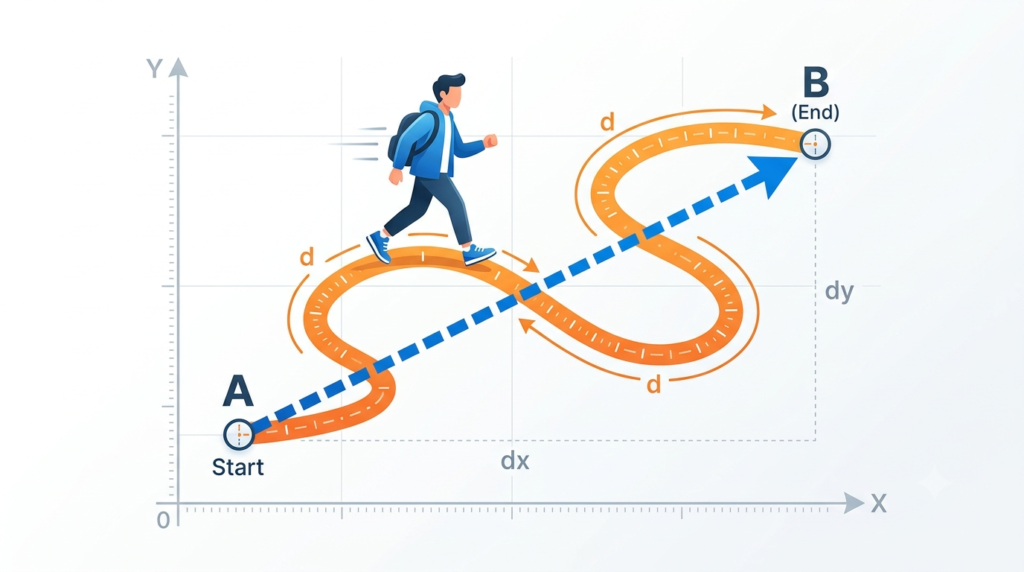
Every physics experiment involves measurement. We measure length, time, mass, temperature, voltage, current, speed, or other physical quantities to understand how nature behaves. However, no measurement is perfectly exact. Even with good instruments and careful techniques, the measured value may differ slightly from the true value. This limitation is described by measurement uncertainty.
Measurement uncertainty does not mean that an experiment has failed. Instead, it tells us how much confidence we should have in a measured result. Understanding uncertainty is an essential part of experimental physics because it helps scientists decide whether their results are reliable, whether two measurements agree, and whether an experimental conclusion is supported by evidence.
What Is Measurement Uncertainty?
Measurement uncertainty is an estimate of the range within which the true value of a quantity is expected to lie.
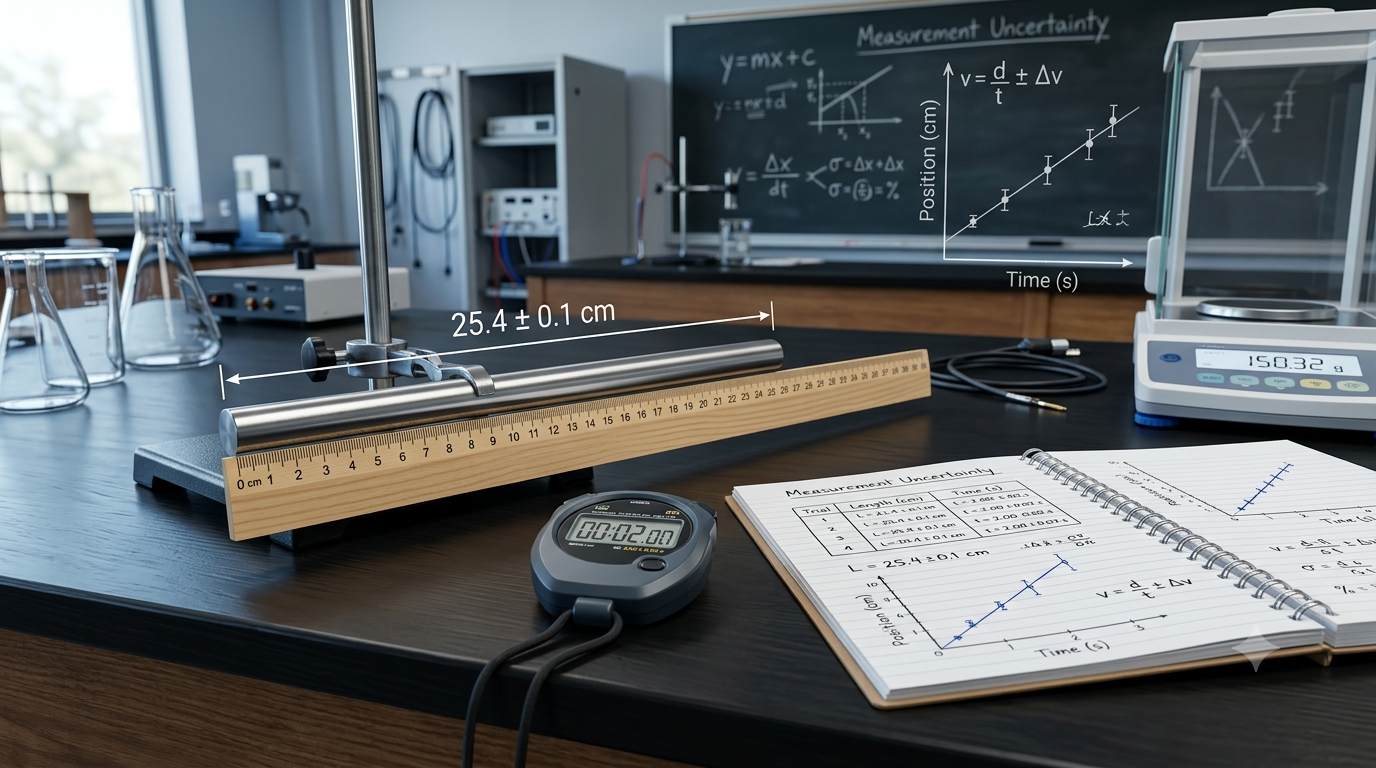
For example, suppose a student measures the length of a metal rod and obtains:
L = 25.4 ± 0.1 cm
The value 25.4 cm is the measured value, while 0.1 cm represents the uncertainty. The result suggests that the actual length is reasonably expected to be close to 25.4 cm, within the stated uncertainty.
Uncertainty can arise from many sources. The measuring instrument may have limited resolution, the experimental setup may introduce variations, or the person taking the measurement may have difficulty reading a scale precisely.
Therefore, a measurement should not always be treated as an exact number. A value such as 10.0 cm contains information about precision, but the uncertainty tells us how much that precision can actually be trusted.
Why Is Uncertainty Important in Physics?
Physics experiments are used to test ideas, discover relationships, and determine physical constants. If measurements contain uncertainty, that uncertainty can affect the conclusions drawn from the experiment.
Imagine an experiment designed to determine the acceleration due to gravity. A student obtains:
g = 9.7 ± 0.3 m/s²
The accepted value near Earth’s surface is approximately 9.8 m/s². Because 9.8 m/s² falls within the experimental uncertainty range, the result is consistent with the expected value.
Now suppose another experiment gives:
g = 8.2 ± 0.1 m/s²
This result is much farther from the expected value, and its small uncertainty means the difference cannot easily be explained by ordinary measurement variation. The experiment may contain a systematic error or some other problem.
Thus, uncertainty helps physicists judge whether an experimental result is reasonable.
Sources of Measurement Uncertainty
Measurement uncertainty can come from several sources.
Instrument Resolution
Every measuring instrument has a limited resolution. A ruler marked in millimetres cannot normally provide the same precision as an instrument capable of measuring micrometres.
Similarly, a digital stopwatch may display time to a certain number of decimal places, but that does not necessarily mean the entire measurement is accurate to that precision.
The smaller the instrument’s resolution, the more precisely a quantity may be measured, assuming other sources of uncertainty are controlled.
Random Variation
Repeated measurements of the same quantity may not produce exactly the same result. For example, measuring the period of a pendulum several times might produce values such as 1.98 s, 2.01 s, 2.00 s, and 1.99 s.
These small differences are examples of random variation. Taking several measurements and calculating their average can reduce the influence of random fluctuations.
Systematic Effects
A systematic error affects measurements in a consistent way. For example, if a balance has not been properly zeroed, every mass measurement may be slightly too high or too low.
Unlike random variation, repeating the measurement does not necessarily remove a systematic effect. Identifying and correcting the source is therefore important.
Uncertainty in Calculations
Measurement uncertainty does not disappear when measured values are used in calculations. It can propagate into the final result.
Suppose an experiment determines speed using:
v = d/t
where d is distance and t is time.
If both distance and time have uncertainties, the calculated speed will also have uncertainty. The final result therefore should not be reported as though it were perfectly exact.
For example, instead of simply writing:
v = 5.0 m/s
an experiment might produce:
v = 5.0 ± 0.2 m/s
The uncertainty gives important information about the reliability of the calculated speed.
The exact method used to calculate uncertainty depends on the mathematical relationship between the measured quantities. For simple experiments, approximate percentage or fractional uncertainty methods are often sufficient. More advanced experiments may use formal uncertainty propagation techniques.
Absolute and Percentage Uncertainty
Uncertainty can be expressed in different ways.
Absolute uncertainty gives the uncertainty in the same units as the measurement.
For example:
Length = 20.0 ± 0.2 cm
Here, 0.2 cm is the absolute uncertainty.
Percentage uncertainty compares the uncertainty with the measured value:
Percentage uncertainty = (uncertainty / measured value) × 100
For the example above:
Percentage uncertainty = (0.2 / 20.0) × 100 = 1%
Percentage uncertainty is useful when comparing the quality of different measurements.
A measurement of 0.2 cm uncertainty may seem small, but its significance depends on the size of the measured quantity. A 0.2 cm uncertainty in a 20 cm measurement represents 1%, while the same uncertainty in a 2 cm measurement represents 10%.
Uncertainty and Experimental Precision
Precision describes how closely repeated measurements agree with one another. An experiment can produce highly consistent measurements while still having a systematic error.
For example, imagine a faulty instrument consistently gives measurements that are 2% too high. Repeated measurements might be almost identical, making the experiment appear very precise. However, the results may still be inaccurate.
This distinction between precision and accuracy is important.
Accuracy refers to how close a measurement is to the accepted or true value, while precision refers to how closely repeated measurements agree.
A good physics experiment aims for both high accuracy and high precision.
How Scientists Reduce Uncertainty
Scientists use several strategies to reduce measurement uncertainty.
First, they select appropriate instruments. A more suitable instrument with better resolution can improve measurement precision.
Second, they repeat measurements. Repetition helps identify random variations and allows researchers to calculate a representative value.
Third, they carefully control experimental conditions. Temperature, air resistance, vibrations, electrical interference, and other environmental factors can influence measurements.
Fourth, scientists calibrate instruments against known standards. Calibration can reveal systematic differences and improve confidence in the results.
Finally, researchers clearly report uncertainty. Hiding uncertainty can make an experimental result appear more certain than it actually is.
Uncertainty When Comparing Results
Measurement uncertainty is especially useful when comparing two experimental results.
Suppose two groups measure the same quantity and obtain:
Group A: 12.4 ± 0.3 units
Group B: 12.6 ± 0.2 units
The central values are different, but their uncertainty ranges overlap. This suggests that the difference may not be statistically or experimentally significant.
In contrast, if one group obtains:
12.4 ± 0.1 units
and another obtains:
14.0 ± 0.1 units
the difference is much larger than the stated uncertainties. This could indicate a genuine difference or a problem with one of the experiments.
Uncertainty therefore provides a meaningful way to compare experimental evidence.
Uncertainty Does Not Mean Failure
Students sometimes think that uncertainty makes a physics experiment less useful. In reality, uncertainty is one of the things that makes experimental science trustworthy.
Science does not usually claim that measurements are perfectly exact. Instead, scientists quantify the limitations of their measurements and use those limitations when interpreting their results.
A result such as 50.0 ± 0.5 units can be more scientifically informative than simply reporting 50.0 units. The uncertainty tells the reader how much confidence to place in the number.
Conclusion
Measurement uncertainty is an unavoidable part of experimental physics. It arises because instruments have limitations, measurements can vary, and experimental conditions are never perfectly controlled. When measured quantities are used in calculations, their uncertainties can also affect the final result.
Rather than treating uncertainty as a weakness, physicists use it as essential information. It helps them evaluate experimental quality, compare results, identify possible errors, and determine whether observations support a physical theory.
The goal of a good experiment is therefore not to eliminate uncertainty completely, which is usually impossible, but to understand, reduce, estimate, and report it properly. Once uncertainty becomes part of the measurement process, experimental results become more meaningful, transparent, and scientifically useful.
FAQs
Measurement uncertainty is an estimate of how much a measured value may differ from the true value. No physical measurement is perfectly exact because every instrument and experimental method has limitations. For example, if the length of a rod is measured as 20.0 ± 0.2 cm, the 0.2 cm represents the uncertainty. It indicates the expected range of variation around the measured value. Uncertainty can result from instrument resolution, environmental conditions, random variations, or limitations in the measurement technique. In physics, reporting uncertainty makes experimental results more realistic, transparent, and useful for scientific comparison.
Measurement uncertainty is important because it shows how reliable an experimental result is. Without uncertainty, a measured number may appear more precise than it actually is. For example, reporting a speed as 25.0 m/s gives less information than reporting 25.0 ± 0.5 m/s. The uncertainty allows scientists to judge whether differences between experimental and accepted values are significant. It also helps researchers compare results from different experiments and identify possible problems. Understanding uncertainty is therefore essential for interpreting measurements correctly and deciding how much confidence should be placed in an experimental conclusion.
Measurement uncertainty can have several causes. Instrument limitations are one common source because every measuring device has a finite resolution. Random variations can also cause repeated measurements to differ slightly. Environmental conditions such as temperature, pressure, vibrations, or electrical interference may affect results. Human factors, including reaction time and difficulty reading a scale, can introduce additional uncertainty. Experimental design can also contribute to uncertainty if the measurement method is not ideal. Systematic effects, such as an incorrectly calibrated instrument, can shift measurements consistently. Identifying these sources helps scientists reduce uncertainty and improve experimental reliability.
Accuracy describes how close a measurement is to the accepted or true value, while precision describes how closely repeated measurements agree with one another. An experiment can be precise but inaccurate if it produces nearly identical results that are consistently different from the accepted value. For example, a faulty balance might repeatedly measure a mass as 105 g when the actual mass is 100 g. The measurements are precise but inaccurate. A good experiment aims to achieve both high accuracy and high precision. Measurement uncertainty mainly helps describe the expected variation and reliability associated with experimental measurements.
Uncertainty affects how confidently an experimental result can be interpreted. A large uncertainty means the measured value has a wider possible range, making precise conclusions more difficult. A small uncertainty generally indicates greater measurement precision. Uncertainty can also affect calculated quantities because uncertainties in the original measurements may propagate through mathematical calculations. For example, uncertainties in distance and time will affect a calculated speed. When comparing an experimental result with an accepted value, the uncertainty helps determine whether the difference is meaningful or could reasonably result from measurement variation.
Scientists can reduce measurement uncertainty by using suitable and well-calibrated instruments, repeating measurements, and carefully controlling experimental conditions. Taking multiple readings can reduce the effect of random variations when an average is calculated. Using an instrument with better resolution can also improve precision. Researchers should minimize environmental disturbances such as vibrations, temperature changes, and electrical interference whenever possible. Careful experimental procedures and consistent measurement techniques are equally important. However, uncertainty can rarely be eliminated completely. The goal is to understand its sources, reduce them where possible, and estimate the remaining uncertainty accurately.
Percentage uncertainty expresses the uncertainty relative to the measured value. It is useful when comparing measurements of different sizes. The basic calculation is:
Percentage uncertainty = (Absolute uncertainty ÷ Measured value) × 100
For example, if a length is measured as 20.0 ± 0.2 cm, the percentage uncertainty is 1%. This tells us that the uncertainty represents 1% of the measured value. Percentage uncertainty can make it easier to compare the quality of measurements. A smaller percentage uncertainty generally indicates that the measurement is more precise relative to the size of the quantity being measured.
Uncertainty propagation describes how uncertainties in measured quantities affect a calculated result. When measurements are combined using mathematical equations, their uncertainties can influence the uncertainty of the final value. For example, speed is calculated using v = d/t. If both distance and time have uncertainties, the calculated speed will also have uncertainty. The method used to determine the final uncertainty depends on the mathematical relationship between the measured quantities. Simple experiments may use approximate percentage uncertainty rules, while advanced experiments may use formal statistical methods to calculate propagated uncertainty.
No, measurement uncertainty generally cannot be completely eliminated. Every physical measurement has limitations because instruments have finite resolution and experimental conditions cannot be controlled perfectly. Even highly advanced scientific equipment produces measurements with some degree of uncertainty. Scientists instead try to reduce uncertainty as much as reasonably possible. They use better instruments, repeat measurements, calibrate equipment, control environmental conditions, and improve experimental procedures. Most importantly, they estimate and report the remaining uncertainty. Recognizing unavoidable uncertainty is not a weakness of science; it is an important part of making experimental results honest and scientifically meaningful.
Physicists report measurement uncertainty so that other scientists can understand the reliability and limitations of an experimental result. A number without uncertainty can give a misleading impression of exactness. For example, 9.8 m/s² and 9.80 ± 0.05 m/s² provide different levels of information about the measurement. Reporting uncertainty allows researchers to compare experimental results, evaluate agreement with theoretical or accepted values, and determine whether observed differences are significant. It also makes experiments easier to reproduce and evaluate. Therefore, uncertainty is an essential part of scientific communication and responsible experimental physics.
Related Posts
How can the number of possible combinations be estimated before designing a digital system?
Before designing a digital system, engineers need to understand how many possible states, inputs, outputs, or arrangements the system may […]
Read MoreWhy does the number of possible states increase exponentially with the number of bits?
Computers represent information using bits, the smallest units of digital data. A bit can have one of two possible values: […]
Read MoreWhen is De Morgan’s law useful when working with logical expressions?
Logical expressions are used in mathematics, computer science, digital electronics, programming, and many other technical fields. They help us describe […]
Read MoreHow can a truth table reveal whether two Boolean expressions are equivalent?
Boolean algebra is an important part of computer science, digital electronics, programming, and logic design. It deals with values that […]
Read MoreWhy does XOR behave differently from OR when both inputs are true?
Logical operators are essential in computer science because they help computers make decisions, compare conditions, and process information. Among the […]
Read MoreHow are Boolean algebra and digital logic gates related?
Boolean algebra and digital logic gates are two fundamental concepts in computer science and digital electronics. They work together to […]
Read MoreWhy can Boolean expressions be simplified without changing their logical result?
Boolean expressions are an essential part of computer science, digital electronics, programming, and information technology. They are used to represent […]
Read MoreHow does Boolean algebra simplify decisions made by computer programs?
Every computer program makes decisions. A website decides whether to allow a user to log in, a mobile application checks […]
Read MoreWhy does character encoding affect the amount of storage required for text?
Text may look simple when we read it on a screen, but computers must represent every character using numerical data. […]
Read MoreHow can the size of a file be estimated from the number of stored bytes?
Every digital file occupies a certain amount of storage space on a computer, smartphone, or other digital device. Whether it […]
Read MoreWhy are storage measurements sometimes calculated differently using decimal and binary units?
Have you ever purchased a 500 GB hard drive and noticed that your computer reports a slightly different storage capacity? […]
Read MoreWhat happens when a numerical value exceeds the range available in its data representation?
Computers store numerical values using a limited number of bits. Every data type, such as an 8-bit integer, a 32-bit […]
Read MoreWhy does the maximum value of a fixed-width integer depend on its number of bits?
Computers store and process information using binary digits, commonly called bits. Each bit can hold one of two values: 0 […]
Read MoreHow does a signed number differ from an unsigned number at a fundamental level?
Computers use binary numbers to represent and process information. Every number stored in a computer occupies a certain number of […]
Read MoreWhy are powers of two so common in computer memory and digital systems?
Computers store, process, and transmit information using binary digits, commonly known as bits. Unlike the decimal number system, which uses […]
Read MoreHow can the same number of bits represent different types of information?
Computers process many different types of information, including numbers, letters, images, sounds, videos, and instructions. Although these forms of information […]
Read MoreWhy does one additional bit double the number of possible binary combinations?
Computers use binary numbers to store, process, and communicate information. Unlike the decimal system, which uses ten digits from 0 […]
Read MoreHow does increasing the number of binary digits affect the range of representable values?
Binary is the number system used by digital computers to represent and process information. It uses only two digits, 0 […]
Read More