Every element in the periodic table has its own chemical properties and behaviour. Some elements combine easily with other elements, while others are less reactive or do not form compounds under ordinary conditions. But why do elements combine with one another? Why does hydrogen combine with oxygen to form water, and why does sodium combine with chlorine to form sodium chloride? One important concept that helps explain these reactions is valency.
Valency is a fundamental concept in chemistry that describes the combining capacity of an atom. It helps us understand how atoms join together to form molecules and chemical compounds. By studying valency, we can predict how many atoms of one element can combine with atoms of another element and understand the basic structure of many chemical substances.
Valency also helps explain the relationship between the electronic structure of an atom and its chemical behaviour. It provides a simple way to understand why certain elements form particular compounds and how chemical formulas are written.
What Is Valency?
Valency is the combining capacity of an atom of an element. It represents the number of electrons that an atom loses, gains, or shares while forming a chemical bond to achieve a more stable electronic configuration.
In simple words, valency tells us how many chemical bonds an atom can generally form based on its combining capacity.
For example:
Hydrogen has a valency of 1.
Oxygen has a valency of 2.
Nitrogen commonly has a valency of 3.
Carbon has a valency of 4.
Sodium has a valency of 1.
Magnesium has a valency of 2.
These values help us understand how different elements combine to form compounds.
Consider water, which has the chemical formula H₂O. One oxygen atom combines with two hydrogen atoms. Hydrogen has a valency of 1, while oxygen has a valency of 2. Therefore, two hydrogen atoms are required to satisfy the combining capacity of one oxygen atom.
Similarly, in methane (CH₄), one carbon atom combines with four hydrogen atoms because carbon has a valency of 4 and hydrogen has a valency of 1.
How Is Valency Related to the Electronic Configuration of an Atom?
To understand valency properly, it is important to know how electrons are arranged inside an atom.
An atom consists of a central nucleus containing protons and neutrons, surrounded by electrons arranged in different energy levels or shells. These shells are commonly represented by the letters K, L, M, and N.
Electrons present in the outermost shell of an atom are called valence electrons. These electrons play an important role in chemical bonding because they are involved in the formation of chemical bonds.
Atoms generally tend to achieve a stable electronic configuration. For many main-group elements, this means obtaining a completely filled outermost shell, usually resembling the electronic configuration of a noble gas.
For example:
Hydrogen has 1 electron. It can achieve a stable configuration by gaining or sharing 1 electron.
Sodium has 11 electrons, with the electronic configuration 2, 8, 1. It can lose 1 electron to achieve a stable configuration of 2, 8.
Oxygen has 8 electrons, with the electronic configuration 2, 6. It commonly gains or shares 2 electrons to complete its outermost shell.
Magnesium has 12 electrons, with the electronic configuration 2, 8, 2. It commonly loses 2 electrons to achieve a stable configuration of 2, 8.
Thus, the electronic configuration of an element helps us understand its usual valency.
Difference Between Valence Electrons and Valency
Valence electrons and valency are closely related terms, but they do not mean the same thing.
Valence electrons are the electrons present in the outermost shell of an atom. On the other hand, valency is the combining capacity of an atom.
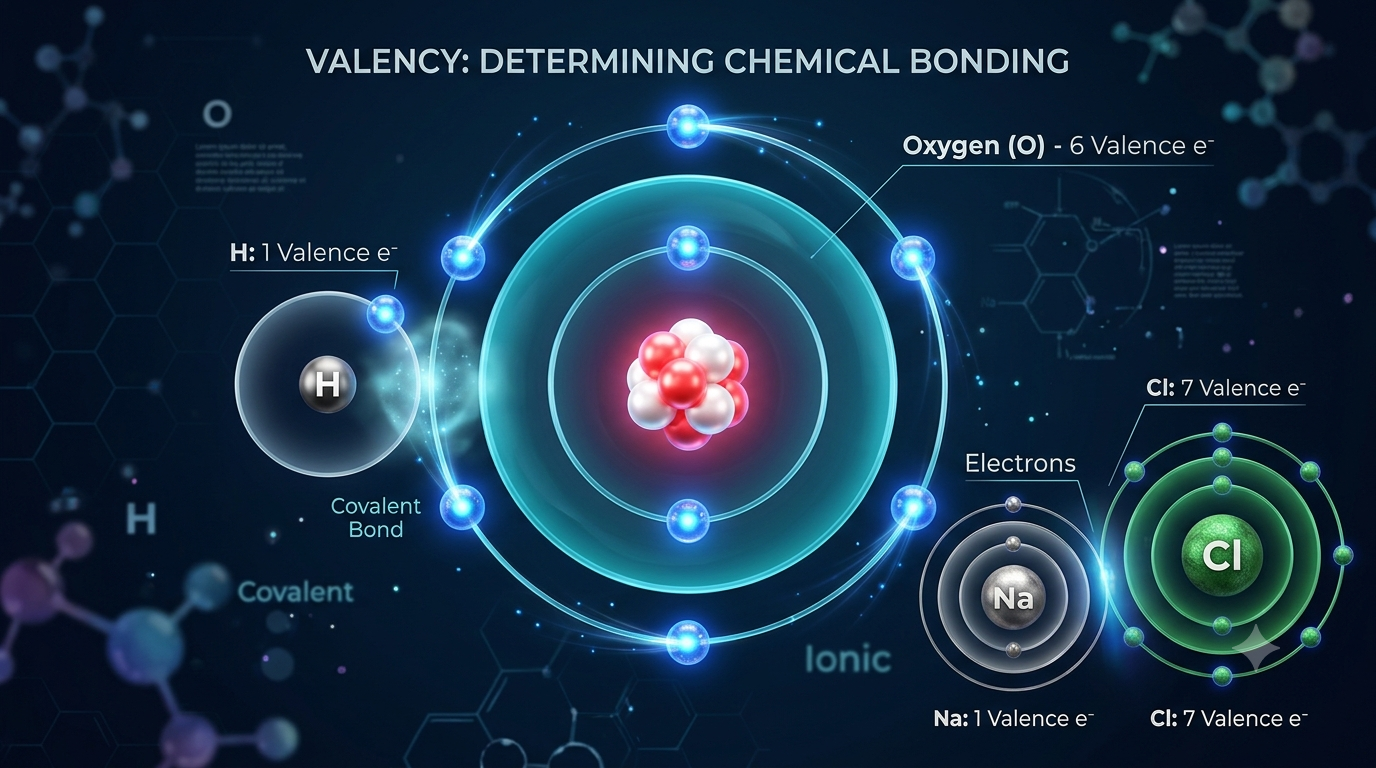
For example, oxygen has six valence electrons in its outermost shell. However, its common valency is 2 because it generally needs two additional electrons or equivalent shared bonding contributions to complete its outer shell.
Similarly, sodium has one valence electron and a common valency of 1 because it generally loses one electron while forming ionic compounds.
The following table shows the difference:
| Basis | Valence Electrons | Valency |
|---|---|---|
| Meaning | Electrons in the outermost shell | Combining capacity of an atom |
| Nature | Number of electrons | Number representing combining capacity |
| Purpose | Helps explain chemical bonding | Helps understand how atoms combine |
| Example | Oxygen has 6 | Oxygen commonly has 2 |
Understanding this difference is essential because the number of valence electrons does not always equal the valency.
How Do Elements Determine Their Valency?
For many main-group elements, valency can be predicted from the number of electrons in their outermost shell.
Atoms often achieve a stable outer shell by losing, gaining, or sharing electrons. The number of electrons involved in this process helps determine their common valency.
A simple method is:
If an atom has 1, 2, or 3 valence electrons, it commonly loses these electrons. Its usual valency is 1, 2, or 3, respectively.
If an atom has 5, 6, or 7 valence electrons, it commonly gains or shares 3, 2, or 1 electrons, respectively.
If an atom has 4 valence electrons, it commonly shares 4 electrons in covalent bonding.
Noble gases generally have a valency of 0 because their outermost electron shells are already stable.
For example:
Sodium (Na):
Electronic configuration = 2, 8, 1
Sodium has one electron in its outermost shell. It generally loses this electron to form a positively charged sodium ion (Na⁺).
Therefore, its common valency is 1.
Magnesium (Mg):
Electronic configuration = 2, 8, 2
Magnesium has two electrons in its outermost shell. It commonly loses both electrons to form Mg²⁺.
Therefore, its common valency is 2.
Chlorine (Cl):
Electronic configuration = 2, 8, 7
Chlorine has seven electrons in its outermost shell. It commonly gains one electron to form Cl⁻.
Therefore, its common valency is 1.
This method is useful for understanding the common valencies of many elements. However, some elements, particularly transition metals, can show different valencies depending on the compound in which they are present.
Types of Valency
Valency is commonly discussed in relation to the way atoms combine with other atoms. Two important situations involve fixed valency and variable valency.
1. Fixed Valency
Some elements generally show the same valency in their common compounds. This is known as fixed valency.
For example:
Hydrogen: 1
Sodium: 1
Magnesium: 2
Calcium: 2
Aluminium: 3
Oxygen: 2
These elements are commonly associated with particular combining capacities in basic chemical compounds.
2. Variable Valency
Some elements can show more than one valency in different compounds. This property is known as variable valency.
It is commonly observed in transition metals and certain other elements.
For example:
Iron can show valencies of 2 and 3.
Copper can show valencies of 1 and 2.
Tin can show valencies of 2 and 4.
Lead can show valencies of 2 and 4.
Sulfur can show valencies of 2, 4, and 6 in different compounds.
Consider iron:
In iron(II) chloride (FeCl₂), iron has a valency of 2.
In iron(III) chloride (FeCl₃), iron has a valency of 3.
This means that the same element can combine with other elements in different ways depending on the chemical compound.
Variable valency is important because it helps explain why certain elements form several different compounds.
Common Valencies of Important Elements
Learning the common valencies of frequently used elements makes it easier to understand chemical formulas and chemical reactions.
| Element | Symbol | Common Valency |
|---|---|---|
| Hydrogen | H | 1 |
| Helium | He | 0 |
| Lithium | Li | 1 |
| Carbon | C | 4 |
| Nitrogen | N | 3 |
| Oxygen | O | 2 |
| Fluorine | F | 1 |
| Neon | Ne | 0 |
| Sodium | Na | 1 |
| Magnesium | Mg | 2 |
| Aluminium | Al | 3 |
| Silicon | Si | 4 |
| Phosphorus | P | 3, 5 |
| Sulfur | S | 2, 4, 6 |
| Chlorine | Cl | 1, 3, 5, 7 |
| Potassium | K | 1 |
| Calcium | Ca | 2 |
| Iron | Fe | 2, 3 |
| Copper | Cu | 1, 2 |
| Zinc | Zn | 2 |
| Silver | Ag | 1 |
| Gold | Au | 1, 3 |
These are common textbook valencies. Actual bonding behaviour can be more complex, particularly for transition elements and compounds involving different oxidation states.
Role of Valency in Understanding the Periodic Table
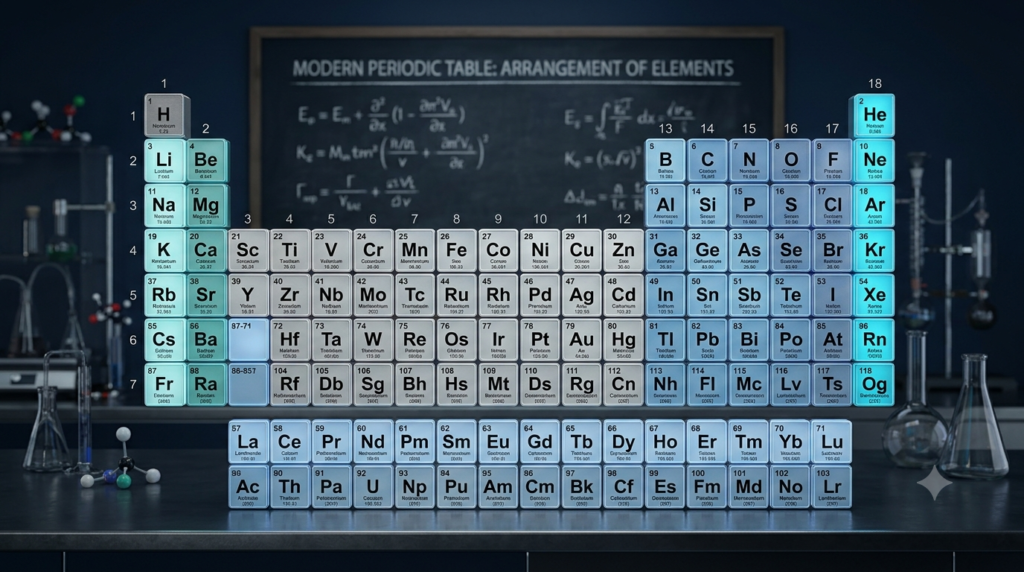
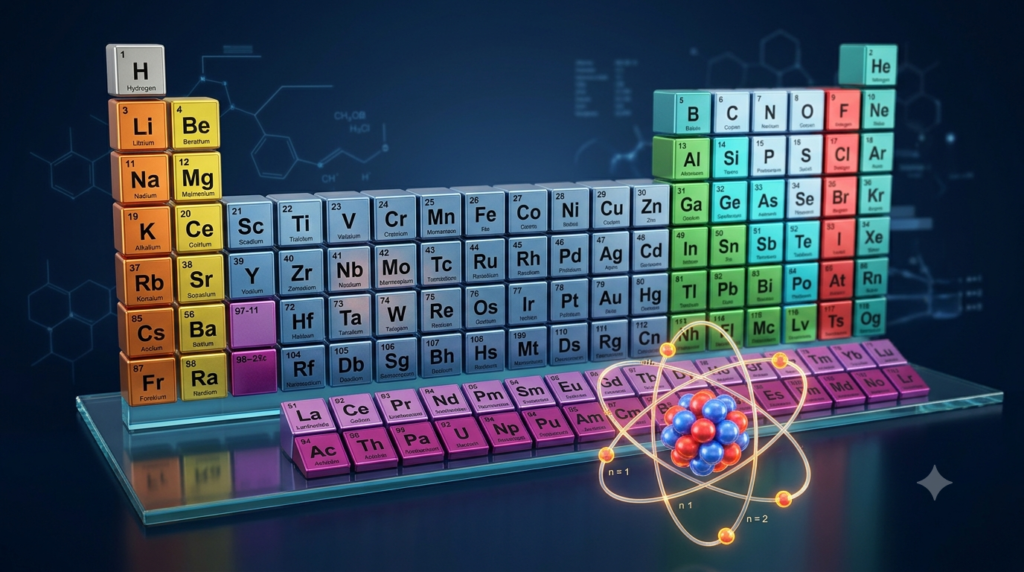
The periodic table arranges elements according to their atomic numbers and recurring chemical properties. Valency helps explain some of these recurring patterns.
Elements belonging to the same main-group column often have similar numbers of valence electrons. As a result, they frequently show similar common valencies and chemical behaviour.
For example:
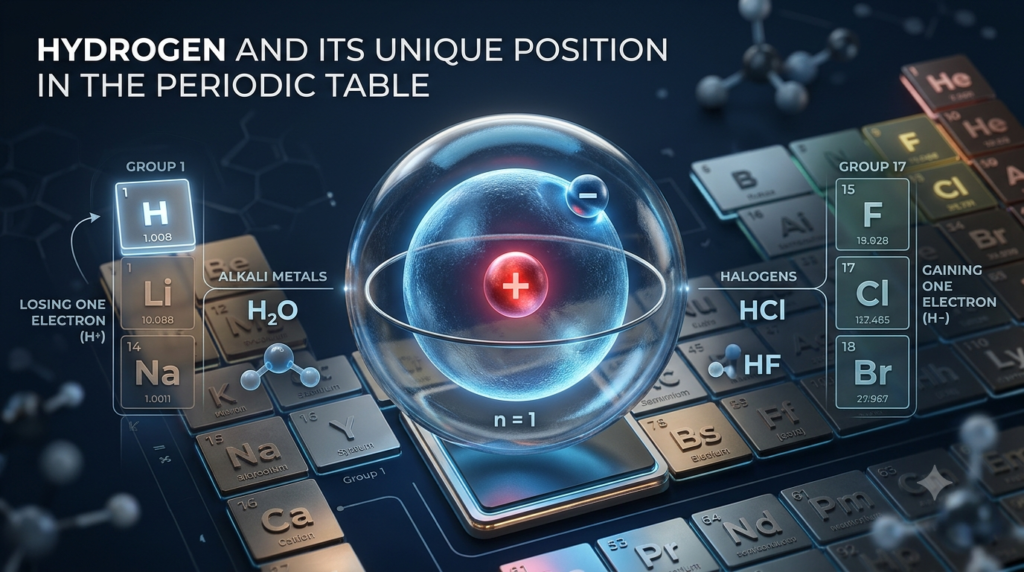
Group 1 elements commonly have a valency of 1.
Group 2 elements commonly have a valency of 2.
Group 13 elements commonly have a valency of 3.
Group 14 elements commonly show a valency of 4.
Group 15 elements commonly show a valency of 3.
Group 16 elements commonly show a valency of 2.
Group 17 elements commonly show a valency of 1.
Group 18 elements generally have a valency of 0.
These are useful general patterns for understanding the main-group elements.
For example, sodium and potassium belong to Group 1. Both have one valence electron and commonly show a valency of 1.
Similarly, oxygen and sulfur belong to Group 16. Both commonly show a valency of 2 in many simple compounds.
However, these patterns are general rather than universal. Some elements show additional bonding behaviour and variable valencies.
How Does Valency Help in Writing Chemical Formulas?
One of the most important applications of valency is writing chemical formulas.
A chemical formula represents the elements present in a compound and the number of atoms of each element. Valency helps determine the simplest whole-number ratio in which atoms combine.
A commonly taught method is the criss-cross method. In this method, the numerical values of the valencies are exchanged and written as subscripts.
Example 1: Formation of Water (H₂O)
Hydrogen has a valency of 1, while oxygen has a valency of 2.
Step 1: Write the symbols of the elements.
H and O
Step 2: Write their valencies.
H = 1
O = 2
Step 3: Exchange the valencies and write them as subscripts.
H₂O₁
Step 4: Remove the subscript 1 because it is not written in chemical formulas.
Final formula = H₂O
Therefore, the chemical formula of water is H₂O.
Example 2: Formation of Magnesium Chloride (MgCl₂)
Magnesium has a valency of 2, while chlorine has a valency of 1.
Mg = 2
Cl = 1
After exchanging the valencies:
Mg₁Cl₂
Removing the subscript 1 gives:
Final formula = MgCl₂
Therefore, one magnesium atom combines with two chlorine atoms in the formula of magnesium chloride.
Example 3: Formation of Aluminium Oxide (Al₂O₃)
Aluminium has a valency of 3, while oxygen has a valency of 2.
Al = 3
O = 2
After exchanging the valencies:
Al₂O₃
Therefore, the chemical formula of aluminium oxide is Al₂O₃.
These examples show how valency helps determine the correct chemical formula of a compound.
The criss-cross method is a useful shortcut, but the resulting subscripts must be reduced to the simplest whole-number ratio where possible. The method is most straightforward for simple binary compounds.
Valency in Ionic and Covalent Compounds
Valency also helps us understand two major types of chemical bonding: ionic bonding and covalent bonding.
Valency in Ionic Compounds
Ionic compounds are formed through the attraction between positively and negatively charged ions.
During ionic bonding, one or more electrons are transferred from one atom to another.
For example, sodium chloride (NaCl) is formed when sodium transfers one electron to chlorine.
Sodium loses one electron and becomes a positively charged sodium ion (Na⁺).
Chlorine gains one electron and becomes a negatively charged chloride ion (Cl⁻).
These oppositely charged ions attract each other through electrostatic forces, forming an ionic compound.
The common valency of sodium and chlorine is 1.
Another example is magnesium oxide (MgO). Magnesium loses two electrons to form Mg²⁺, while oxygen gains two electrons to form O²⁻.
The opposite charges attract and form magnesium oxide.
Valency in Covalent Compounds
Covalent compounds are formed when atoms share pairs of electrons.
In covalent bonding, atoms share electrons to achieve more stable electronic arrangements.
For example, in a water molecule (H₂O), oxygen shares electrons with two hydrogen atoms.
Oxygen commonly forms two covalent bonds, while each hydrogen atom forms one covalent bond.
Similarly, in methane (CH₄), carbon shares electrons with four hydrogen atoms.
Carbon forms four covalent bonds, giving it a common valency of 4.
Therefore, valency helps explain the number of bonds commonly formed by atoms in both ionic and covalent compounds.
Valency and the Octet Rule
The octet rule is a basic chemical principle stating that many atoms tend to achieve eight electrons in their outermost shell when forming chemical bonds.
This arrangement is similar to that of noble gases, which generally have stable outer electron configurations.
For example, sodium has one valence electron. It can lose this electron to achieve an electronic configuration similar to neon.
Chlorine has seven valence electrons. It can gain one electron to achieve an electronic configuration similar to argon.
Similarly, oxygen has six valence electrons and commonly shares or gains two electrons to complete its outer shell.
Valency is closely related to this concept because it describes the combining capacity associated with achieving a more stable electronic arrangement.
However, the octet rule has exceptions. Hydrogen follows the duet rule because its first shell is stable with two electrons. Some elements also form compounds with incomplete or expanded valence shells.
Therefore, the octet rule is useful for understanding many basic chemical compounds, but it does not explain every type of chemical bonding.
Why Is Valency Important in Chemistry?
Valency is an important concept because it connects the electronic structure of atoms with their chemical behaviour.
Its importance can be understood through several applications.
1. Understanding Chemical Bond Formation
Valency helps explain how atoms combine through ionic and covalent bonding. It gives a basic idea of the combining capacity of different elements.
2. Writing Chemical Formulas
Valency makes it easier to determine the correct ratios of atoms in simple chemical compounds. It is especially useful when learning chemical formulas.
3. Understanding the Periodic Table
Valency helps identify similarities between elements belonging to the same main-group family. It also explains several periodic trends in chemical behaviour.
4. Predicting the Formation of Compounds
Knowing the common valencies of elements helps us predict possible combinations and understand the formulas of many familiar substances.
5. Learning Chemical Reactions
A basic understanding of valency makes it easier to understand how elements combine and how chemical compounds are formed during chemical reactions.
6. Understanding the Properties of Elements
Valency provides useful information about the chemical behaviour and bonding tendencies of elements.
Difference Between Valency and Oxidation State
Valency and oxidation state are related concepts, but they are not identical.
Valency describes the combining capacity of an atom, whereas oxidation state represents the hypothetical charge assigned to an atom in a compound or ion according to a set of chemical rules.
For example, iron commonly shows valencies of 2 and 3. Its oxidation states in many compounds include +2 and +3.
However, oxidation state can also be zero, negative, or positive, depending on the chemical environment.
The following table explains their differences:
| Basis | Valency | Oxidation State |
|---|---|---|
| Meaning | Combining capacity of an atom | Assigned charge of an atom |
| Sign | Usually written without a positive or negative sign | Can be positive, negative, or zero |
| Nature | Describes bonding capacity | Describes electron distribution using formal rules |
| Example | Valency of oxygen is commonly 2 | Oxidation state of oxygen is usually −2 in many compounds |
For example, oxygen has a common valency of 2, but its oxidation state is usually −2 in water (H₂O).
This distinction is important when studying more advanced chemical concepts.
Limitations of Valency
Although valency is useful for learning basic chemistry, it cannot explain every aspect of chemical bonding.
Some important limitations include:
Variable bonding behaviour: Certain elements show different valencies in different compounds.
Complex bonding: Valency alone cannot fully explain the structure and geometry of complex molecules.
Transition elements: Many transition metals have complicated bonding behaviour and multiple oxidation states.
Oxidation states: Valency does not always provide information about the actual or formal charge of an atom.
Advanced bonding theories: Concepts such as molecular orbital theory and coordination chemistry require more detailed explanations than basic valency.
For these reasons, valency is considered a foundation for understanding chemical bonding rather than a complete explanation of all chemical behaviour.
Conclusion
Valency is one of the fundamental concepts in chemistry that explains the combining capacity of atoms. It helps us understand why elements combine in particular ratios to form chemical compounds. By studying valency, we can connect the electronic configuration of an atom with its chemical bonding behaviour.
It also makes writing chemical formulas easier and provides a basic understanding of ionic and covalent compounds. Furthermore, valency helps explain several patterns in the periodic table and the similarities between elements belonging to the same group.
Although valency cannot explain every detail of modern chemical bonding, it provides an essential foundation for learning more advanced topics in chemistry. Understanding this concept makes it easier to explore how elements interact, form compounds, and create the wide variety of substances found in nature.
FAQs
1. What is valency in chemistry?
Valency is the combining capacity of an atom of an element. It indicates how many electrons an atom commonly loses, gains, or shares when forming chemical bonds. Atoms generally form bonds to achieve a more stable electronic configuration. For example, hydrogen has a valency of 1, oxygen has a valency of 2, and carbon has a valency of 4. Valency helps explain how different elements combine to form chemical compounds. It is also useful for understanding chemical bonding, predicting simple compound formulas, and studying the chemical properties of elements in the periodic table.
2. What is the difference between valency and valence electrons?
Valency and valence electrons are related but have different meanings. Valence electrons are the electrons present in the outermost shell of an atom, whereas valency represents the combining capacity of that atom. For example, oxygen has six valence electrons but commonly has a valency of 2 because it generally needs two additional electrons or equivalent shared bonding contributions to complete its outer shell. Similarly, sodium has one valence electron and a common valency of 1. Valence electrons help explain chemical bonding, while valency helps describe how atoms combine with other atoms to form compounds.
3. How can we calculate the valency of an element?
The valency of many main-group elements can be determined by examining the number of electrons in their outermost shell. Elements with 1, 2, or 3 valence electrons commonly have valencies of 1, 2, or 3, respectively. Elements with 5, 6, or 7 valence electrons commonly have valencies of 3, 2, or 1, respectively. Elements with 4 valence electrons commonly show a valency of 4. Noble gases generally have a valency of 0. However, some elements, especially transition metals, show variable valencies and require additional consideration.
4. Why does oxygen have a valency of 2?
Oxygen has an atomic number of 8 and an electronic configuration of 2, 6. This means that it has six electrons in its outermost shell. It commonly needs two additional electrons or equivalent shared bonding contributions to achieve a stable electronic arrangement. Therefore, oxygen generally has a valency of 2. For example, in water (H₂O), one oxygen atom forms bonds with two hydrogen atoms. Similarly, in magnesium oxide (MgO), oxygen combines with magnesium through ionic bonding. Its common valency of 2 makes oxygen an important element in many chemical compounds.
5. What is variable valency? Give examples.
Variable valency is the property of certain elements to exhibit different combining capacities in different chemical compounds. It is commonly observed in transition metals and some other elements. For example, iron shows valencies of 2 and 3 in different compounds. In iron(II) chloride (FeCl₂), iron has a valency of 2, while in iron(III) chloride (FeCl₃), it has a valency of 3. Similarly, copper commonly shows valencies of 1 and 2. Variable valency helps explain why some elements can form different compounds with different chemical properties and compositions.
6. What is the relationship between valency and the periodic table?
Valency helps explain several patterns in the periodic table. Elements belonging to the same main-group column often have similar numbers of valence electrons and therefore show similar common valencies. For example, Group 1 elements generally have a valency of 1, while Group 2 elements commonly have a valency of 2. Group 17 elements generally have a valency of 1, and Group 18 elements usually have a valency of 0. These patterns help us understand the chemical behaviour of elements and make it easier to predict their combining capacities and the formation of simple compounds.
7. How does valency help in writing chemical formulas?
Valency helps determine the simplest whole-number ratio in which atoms combine to form chemical compounds. A commonly used technique is the criss-cross method, in which the numerical values of the valencies are exchanged and written as subscripts. For example, magnesium has a valency of 2, while chlorine has a valency of 1. Exchanging their valencies gives MgCl₂. Similarly, aluminium has a valency of 3 and oxygen has a valency of 2, producing Al₂O₃. This method makes writing simple chemical formulas easier, although the resulting subscripts must be reduced when necessary.
8. What is the valency of noble gases?
Noble gases generally have a valency of 0 because their outermost electron shells are already stable. Helium has two electrons in its first shell, while other commonly studied noble gases, such as neon and argon, have eight electrons in their outermost shells. Because of these stable electronic configurations, noble gases generally do not need to gain, lose, or share electrons to achieve stability. This makes them relatively unreactive compared with many other elements. However, some heavier noble gases, particularly xenon, can form chemical compounds under suitable conditions.
9. What is the difference between valency and oxidation state?
Valency and oxidation state are related chemical concepts, but they describe different properties. Valency represents the combining capacity of an atom, whereas oxidation state is the hypothetical charge assigned to an atom in a compound or ion according to specific chemical rules. Valency is generally expressed as a non-negative whole number, while oxidation states can be positive, negative, or zero. For example, oxygen commonly has a valency of 2, but its oxidation state is usually −2 in water. Understanding this difference is important for studying chemical bonding, ionic compounds, redox reactions, and advanced chemistry.
10. Why is valency important in chemistry?
Valency is important because it provides a basic understanding of how atoms combine to form chemical compounds. It helps explain chemical bonding, determine the formulas of simple compounds, and understand the chemical behaviour of different elements. It is also useful for identifying similarities between elements in the same group of the periodic table. For example, knowing the valencies of hydrogen and oxygen helps explain the formula of water (H₂O). Similarly, valency helps us understand the formation of sodium chloride (NaCl) and magnesium oxide (MgO). Therefore, learning valency builds a strong foundation for studying chemical reactions and bonding.