Atoms are made up of protons, neutrons, and electrons. When an atom gains or loses electrons, it becomes an electrically charged particle called an ion. These ions are important in chemical reactions, ionic compounds, and many other chemical processes. One of the important properties used to understand the behaviour of ions is their ionic radius.
Ionic radius refers to the distance from the centre of an ion’s nucleus to the outermost region of its electron cloud. It provides information about the relative size of positive and negative ions. Ionic radius is an important concept in chemistry because it helps explain the formation of ionic bonds, the structure of ionic crystals, and the physical and chemical properties of ionic compounds.
The ionic radius is not constant for all elements. It changes depending on the charge of the ion, the number of electron shells, and the effective nuclear charge. It also shows predictable variations across periods and down groups in the periodic table. Understanding these trends makes it easier to compare the sizes of different ions and predict their chemical behaviour.
What Is Ionic Radius?
Ionic radius is the effective size of an ion, usually expressed as the distance from the centre of its nucleus to the boundary of its electron cloud.
An ion forms when an atom gains or loses one or more electrons.
There are two main types of ions:
Cations: Positively charged ions formed when atoms lose electrons.
Anions: Negatively charged ions formed when atoms gain electrons.
The size of an ion depends on how many electrons it contains and how strongly the nucleus attracts those electrons.
For example:
A sodium atom loses one electron to form Na⁺.
A chlorine atom gains one electron to form Cl⁻.
The resulting ions have different sizes from their original neutral atoms.
Ionic radius is generally measured in picometres (pm), where:
1 pm = 10⁻¹² metres
It may also be expressed in angstroms (Å).
1 Å = 100 pm
Since the electron cloud does not have a sharply defined outer boundary, ionic radius is not measured in exactly the same way as the radius of a solid sphere. Instead, it is generally determined using distances between ions in crystalline structures.
How Are Ions Formed?
To understand ionic radius, it is important to understand how atoms form ions.
Atoms contain positively charged protons and negatively charged electrons. In a neutral atom, the number of protons is equal to the number of electrons.
However, some atoms lose electrons during chemical reactions, while others gain electrons. This changes the electrical charge and size of the atom.
Formation of Cations
A cation forms when an atom loses one or more electrons.
For example, a sodium atom has 11 protons and 11 electrons. Its electronic configuration is:
Na = 2, 8, 1
When sodium loses its outermost electron, it forms a positively charged sodium ion.
Na → Na⁺ + e⁻
The electronic configuration of Na⁺ becomes:
Na⁺ = 2, 8
The sodium ion has one fewer electron shell than the neutral sodium atom. Therefore, its radius becomes smaller.
Formation of Anions
An anion forms when an atom gains one or more electrons.
For example, a chlorine atom has 17 protons and 17 electrons. Its electronic configuration is:
Cl = 2, 8, 7
When chlorine gains one electron, it forms a negatively charged chloride ion.
Cl + e⁻ → Cl⁻
The electronic configuration of Cl⁻ becomes:
Cl⁻ = 2, 8, 8
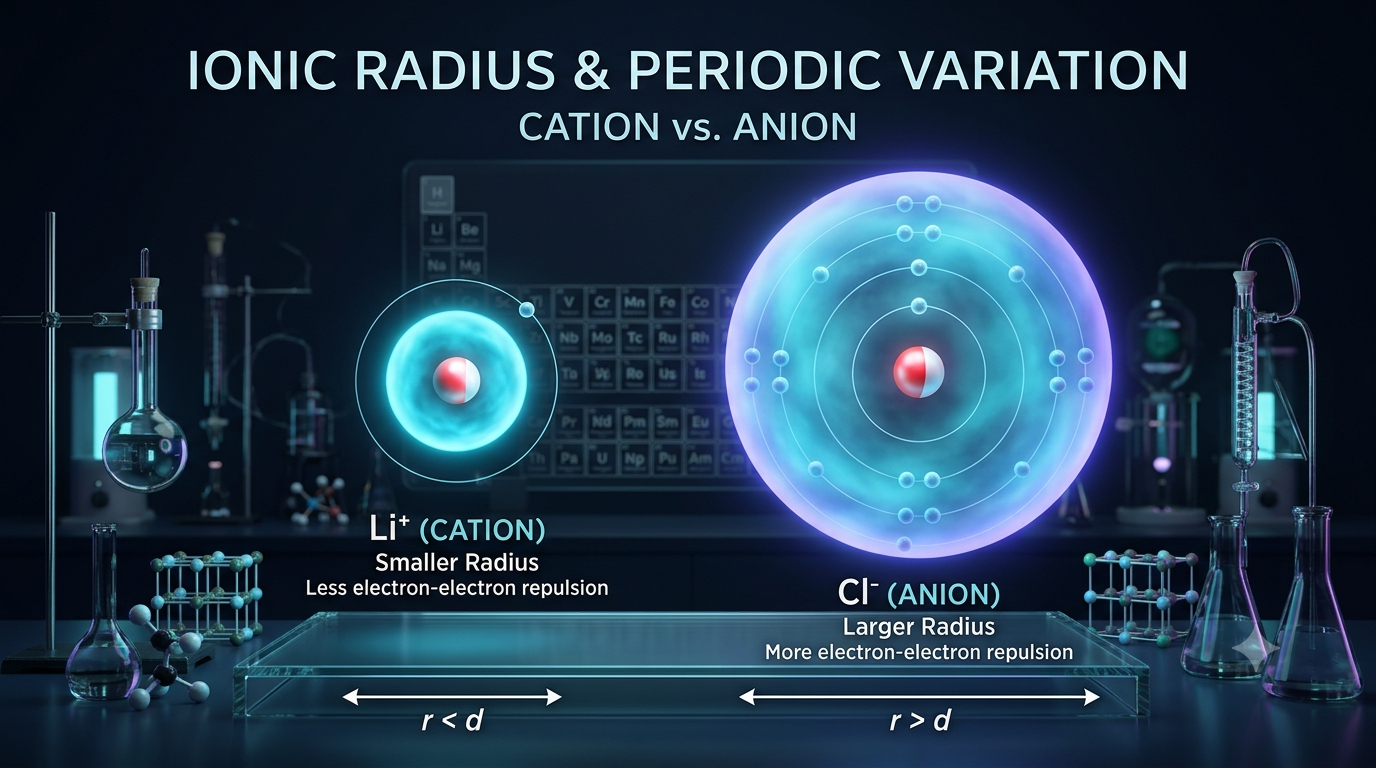
The additional electron increases electron–electron repulsion in the outermost shell. As a result, the electron cloud expands and the ionic radius becomes larger.
Difference Between Atomic Radius and Ionic Radius
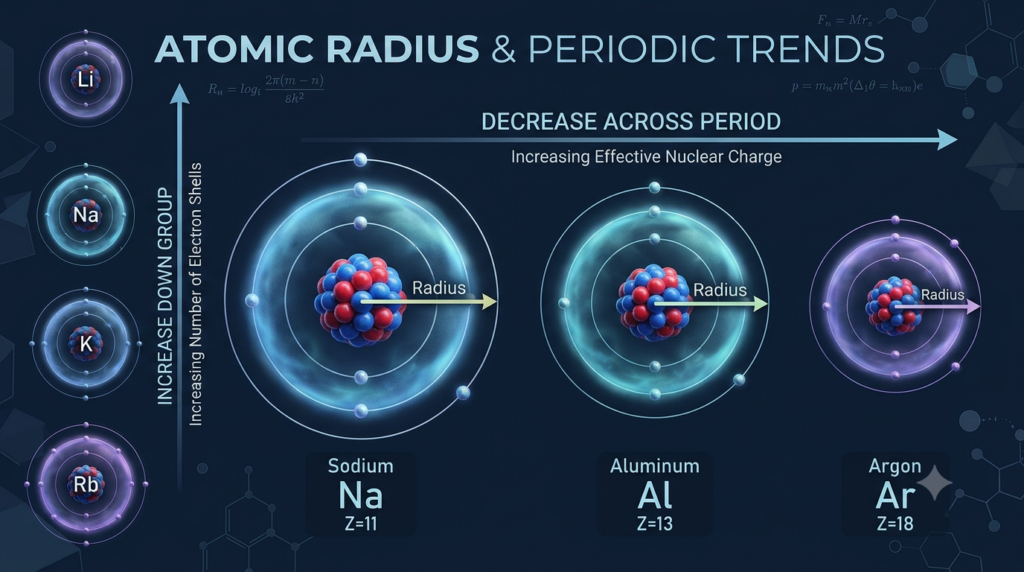
Atomic radius and ionic radius both describe the size of atoms or ions, but they are not the same.
Atomic radius refers to the effective size of a neutral atom, whereas ionic radius refers to the effective size of an electrically charged ion.
The main differences are:
| Atomic Radius | Ionic Radius |
|---|---|
| It represents the size of a neutral atom. | It represents the size of an ion. |
| It is associated with neutral atoms. | It is associated with cations and anions. |
| It depends on the nuclear charge and electron arrangement of the atom. | It also depends on the charge of the ion and electron configuration. |
| It may be measured using different atomic radius definitions. | It is commonly determined from interionic distances in crystals. |
An atom generally becomes smaller when it loses electrons and becomes a cation. It generally becomes larger when it gains electrons and becomes an anion.
For example:
Na⁺ is smaller than Na.
Cl⁻ is larger than Cl.
Why Do Cations Have Smaller Radii Than Their Parent Atoms?
Cations are generally smaller than their corresponding neutral atoms because the loss of electrons reduces the size of the electron cloud.
There are several reasons for this decrease.
1. Loss of the Outermost Electron Shell
In many cases, an atom loses all the electrons from its outermost shell when it forms a cation.
For example:
Na = 2, 8, 1
Na⁺ = 2, 8
The neutral sodium atom has three occupied electron shells, whereas the sodium ion has only two. The loss of the third shell significantly reduces its radius.
2. Decrease in Electron–Electron Repulsion
Electrons repel one another because they have the same negative electrical charge.
When an atom loses electrons, the repulsion between the remaining electrons decreases. This allows the nucleus to attract the electron cloud more effectively.
Consequently, the radius becomes smaller.
3. Increased Effective Nuclear Attraction
When electrons are removed, the number of protons in the nucleus remains unchanged.
The same positive nuclear charge now attracts a smaller number of electrons. In addition, the remaining electrons may experience a greater effective nuclear attraction.
This pulls the electron cloud closer to the nucleus and reduces the ionic radius.
Therefore, cations are generally smaller than their parent atoms.
Why Do Anions Have Larger Radii Than Their Parent Atoms?
Anions are generally larger than their corresponding neutral atoms because they gain additional electrons.
The increase in electron number affects the size of the electron cloud.
1. Increase in Electron–Electron Repulsion
When an atom gains electrons, the number of negatively charged particles increases.
The additional electrons increase repulsion within the electron cloud. This causes the electron cloud to expand.
2. Greater Electron Cloud Expansion
The nuclear charge remains unchanged when an atom gains electrons. However, the same nuclear charge must attract a larger number of electrons.
As a result, the effective attraction experienced by individual electrons may decrease, allowing the electron cloud to expand.
3. Increased Ionic Size
The combined effect of increased electron–electron repulsion and reduced effective attraction generally increases the size of the ion.
For example:
Cl has an ionic radius smaller than Cl⁻.
Therefore, anions are generally larger than their parent atoms.
Factors Affecting Ionic Radius
The ionic radius of an element depends on several factors. These factors explain why different ions have different sizes and why ionic radius changes throughout the periodic table.
1. Nuclear Charge
Nuclear charge is the total positive charge of the nucleus, determined by the number of protons.
A greater effective nuclear charge generally attracts electrons more strongly and reduces the ionic radius.
For example, among certain isoelectronic ions, the ion with more protons has a smaller radius.
2. Number of Electron Shells
The number of occupied electron shells has a significant effect on ionic size.
When the number of electron shells increases, the outermost electrons are generally located farther from the nucleus.
Therefore, ions with more occupied shells generally have larger radii when other factors are comparable.
3. Ionic Charge
The charge of an ion also affects its radius.
For the same element, a more positively charged ion is generally smaller because it has lost more electrons.
For example:
Fe³⁺ is smaller than Fe²⁺.
Similarly, a more negatively charged ion is generally larger because it contains additional electrons.
4. Electron–Electron Repulsion
Electrons repel one another due to their negative charges.
When an atom gains electrons, electron–electron repulsion generally increases. This can expand the electron cloud and increase the ionic radius.
When an atom loses electrons, this repulsion generally decreases.
5. Effective Nuclear Charge
Effective nuclear charge is the net positive charge experienced by an electron after considering the shielding effect of other electrons.
A higher effective nuclear charge pulls electrons closer to the nucleus.
Therefore, an increase in effective nuclear charge generally decreases ionic radius.
Periodic Variation of Ionic Radius
Ionic radius shows predictable trends in the periodic table. These trends are mainly influenced by changes in nuclear charge, electron shells, and electron–electron repulsion.
The two major periodic trends are:
Variation of ionic radius across a period.
Variation of ionic radius down a group.
Variation of Ionic Radius Across a Period
When moving from left to right across a period, the ionic radius generally decreases among ions of the same type and comparable electronic structure.
This happens because the nuclear charge increases as the atomic number increases.
At the same time, electrons are added to the same principal electron shell in a given period. The increasing effective nuclear charge attracts the electrons more strongly towards the nucleus.
As a result, the ionic radius generally decreases.
However, it is important to understand that ionic radii across a period do not follow one continuous decreasing trend for all ions.
This is because metals generally form cations, whereas non-metals generally form anions. Cations are smaller than their parent atoms, while anions are larger than their parent atoms.
Therefore, there is often a significant increase in ionic radius when moving from the cation-forming region to the anion-forming region.
For example, consider the ions formed by elements in the third period:
Na⁺, Mg²⁺, Al³⁺, P³⁻, S²⁻, Cl⁻
The first three ions are cations, while the last three are anions.
Within the cation series:
Na⁺ > Mg²⁺ > Al³⁺
Within the anion series:
P³⁻ > S²⁻ > Cl⁻
The ionic radius decreases from left to right within each of these groups because the nuclear charge increases while the number of electrons remains the same.
However, the ionic radius of Al³⁺ is much smaller than that of P³⁻. This is because the transition from a highly charged cation to an anion involves a substantial change in electron number and electron repulsion.
Variation of Ionic Radius Down a Group
When moving down a group in the periodic table, the ionic radius generally increases.
This happens because each successive element has an additional occupied electron shell.
The addition of electron shells increases the distance between the nucleus and the outermost electrons.
Although nuclear charge also increases down a group, the effect of additional electron shells and shielding generally results in a larger ionic radius.
For example, consider the alkali metal ions:
Li⁺ < Na⁺ < K⁺ < Rb⁺ < Cs⁺
The ionic radius increases from lithium ion to caesium ion because the number of occupied electron shells increases.
Similarly, the halide ions follow this trend:
F⁻ < Cl⁻ < Br⁻ < I⁻
The iodide ion is larger than the fluoride ion because it contains more occupied electron shells.
Therefore, ionic radius generally increases down a group.
Ionic Radius in Isoelectronic Species
Isoelectronic species are atoms or ions that contain the same number of electrons but have different nuclear charges.
Comparing their ionic radii provides a clear example of how nuclear charge affects ionic size.
For isoelectronic species, the number of electrons remains constant. Therefore, the species with the greater number of protons generally has the smaller radius.
Consider the following isoelectronic ions:
O²⁻, F⁻, Na⁺, Mg²⁺, Al³⁺
All these ions contain 10 electrons.
Their numbers of protons are:
O²⁻ = 8 protons
F⁻ = 9 protons
Na⁺ = 11 protons
Mg²⁺ = 12 protons
Al³⁺ = 13 protons
As the nuclear charge increases, the attraction between the nucleus and the electron cloud becomes stronger.
Therefore, the ionic radius decreases in the following order:
O²⁻ > F⁻ > Na⁺ > Mg²⁺ > Al³⁺
This is an important rule for comparing the sizes of isoelectronic ions.
Comparison of Ionic Radii of Common Ions
The following table shows approximate ionic radii of some common ions. The values are illustrative and may vary depending on the coordination number and the radius convention used.
| Ion | Approximate Ionic Radius (pm) |
|---|---|
| Li⁺ | 76 |
| Na⁺ | 102 |
| K⁺ | 138 |
| Mg²⁺ | 72 |
| Ca²⁺ | 100 |
| Al³⁺ | 54 |
| F⁻ | 133 |
| Cl⁻ | 181 |
| Br⁻ | 196 |
| I⁻ | 220 |
| O²⁻ | 140 |
These values help demonstrate that ionic size depends on the charge, electron configuration, and nuclear attraction of an ion.
For example, the ionic radius of K⁺ is greater than that of Na⁺ because potassium has an additional occupied electron shell.
Similarly, Cl⁻ is larger than F⁻ because chlorine has more electron shells.
Relationship Between Ionic Radius and Ionic Charge
Ionic charge has an important influence on the size of an ion.
For a particular element, increasing the positive charge generally decreases the ionic radius.
For example:
Fe²⁺ is larger than Fe³⁺.
This is because Fe³⁺ has lost one more electron than Fe²⁺. The greater positive charge results in stronger attraction between the nucleus and the remaining electrons.
Similarly, increasing the negative charge generally increases the ionic radius.
For example:
O²⁻ is generally larger than O⁻.
The additional negative charge is associated with more electrons and greater electron–electron repulsion.
However, when comparing ions of different elements, ionic charge alone is not sufficient. Nuclear charge, electron shells, and electron configuration must also be considered.
Applications and Importance of Ionic Radius
Ionic radius is not just a theoretical concept. It plays an important role in understanding the structures and properties of many chemical substances.
1. Understanding Ionic Bonding
Ionic radius helps explain how positively and negatively charged ions attract one another to form ionic compounds.
The relative sizes of ions influence the distance between their nuclei and the strength of electrostatic attraction.
2. Structure of Ionic Crystals
Ionic compounds often form regular three-dimensional crystal structures.
The relative sizes of cations and anions influence how ions are arranged in these structures.
For example, sodium chloride forms a crystal structure in which sodium and chloride ions are arranged in an ordered pattern.
3. Lattice Energy
Lattice energy is related to the strength of attraction between oppositely charged ions in an ionic crystal.
For ions with the same charges, smaller ionic radii generally result in stronger electrostatic attraction because the distance between the ion centres is smaller.
Therefore, ionic radius helps explain differences in lattice energy.
4. Solubility of Ionic Compounds
Ionic radius influences the hydration of ions when an ionic compound dissolves in water.
Smaller ions often have higher charge densities and can interact strongly with polar water molecules.
However, the solubility of an ionic compound depends on several factors, including lattice energy and hydration energy. Ionic radius alone cannot determine solubility.
5. Stability of Ionic Compounds
The sizes of cations and anions influence the arrangement and stability of ionic crystal structures.
The relative sizes of ions help determine the coordination number and the type of crystal structure formed by an ionic compound.
6. Biological and Chemical Processes
Ions such as Na⁺, K⁺, Ca²⁺, and Mg²⁺ are important in biological systems.
Their sizes, charges, and interactions influence processes such as nerve signalling, muscle contraction, enzyme activity, and the movement of substances across cell membranes.
Understanding ionic radius helps explain some of the differences in how these ions interact with biological molecules.
How to Compare the Ionic Radii of Different Ions
The following rules can be used to compare ionic radii in chemistry problems.
Rule 1: Compare the charges of ions formed by the same element.
A more positively charged ion is generally smaller.
Example:
Fe³⁺ < Fe²⁺
Rule 2: Compare ions with the same electronic configuration.
The ion with more protons has the smaller ionic radius.
Example:
O²⁻ > F⁻ > Na⁺ > Mg²⁺ > Al³⁺
Rule 3: Compare ions belonging to the same group.
Ionic radius generally increases down the group.
Example:
Li⁺ < Na⁺ < K⁺
Rule 4: Compare ions with similar charges and electronic structures across a period.
Ionic radius generally decreases as effective nuclear charge increases.
Rule 5: Remember the difference between cations and anions.
Cations are generally smaller than their parent atoms, whereas anions are generally larger than their parent atoms.
These rules provide a useful method for solving most basic ionic radius comparison questions.
Conclusion
Ionic radius is an important periodic property that describes the effective size of an ion. It depends on several factors, including nuclear charge, electron configuration, ionic charge, electron shells, and electron–electron repulsion.
Cations are generally smaller than their parent atoms because they lose electrons, while anions are generally larger because they gain electrons. Across a period, ionic radius generally decreases within comparable series of ions, while down a group it generally increases due to the addition of electron shells.
The concept of ionic radius is useful for understanding ionic bonding, crystal structures, lattice energy, and the chemical behaviour of ionic compounds. By learning the factors that influence ionic size and the periodic trends associated with it, we can better understand the behaviour of elements and their ions in chemical reactions.
FAQs
1. What is ionic radius?
Ionic radius is the effective distance from the centre of an ion’s nucleus to the outer boundary of its electron cloud. It represents the size of a positively or negatively charged ion. Ionic radius is generally expressed in picometres (pm) or angstroms (Å). It depends on several factors, including nuclear charge, electron configuration, ionic charge, and the number of occupied electron shells. Ionic radius is an important periodic property because it helps explain ionic bonding, crystal structures, lattice energy, and the chemical behaviour of ionic compounds.
2. What is the difference between atomic radius and ionic radius?
Atomic radius represents the effective size of a neutral atom, whereas ionic radius represents the effective size of an electrically charged ion. Atomic radius is associated with atoms containing equal numbers of protons and electrons. Ionic radius is associated with atoms that have gained or lost electrons. When an atom loses electrons, it generally becomes smaller and forms a cation. When it gains electrons, it generally becomes larger and forms an anion. Both properties depend on nuclear attraction and electron configuration, but ionic radius is also influenced by the charge of the ion.
3. Why is the ionic radius of a cation smaller than its parent atom?
A cation has a smaller radius than its parent atom because it forms when an atom loses one or more electrons. This reduces electron–electron repulsion and may remove the outermost electron shell completely. The same nuclear charge now attracts fewer electrons, often resulting in a stronger effective attraction on the remaining electron cloud. Consequently, the electron cloud contracts and the ionic radius decreases. For example, a neutral sodium atom has three occupied electron shells, whereas the sodium ion (Na⁺) has only two occupied shells, making Na⁺ considerably smaller than Na.
4. Why is the ionic radius of an anion larger than its parent atom?
An anion generally has a larger radius than its parent atom because it forms when an atom gains one or more electrons. The additional electrons increase electron–electron repulsion within the electron cloud. Since the number of protons remains unchanged, the nuclear charge must attract a greater number of electrons. This generally causes the electron cloud to expand. For example, a chlorine atom gains one electron to form a chloride ion (Cl⁻). The chloride ion has a larger radius than the neutral chlorine atom.
5. How does ionic radius change down a group in the periodic table?
Ionic radius generally increases when moving down a group in the periodic table. This happens because each successive element has an additional occupied electron shell. The outermost electrons are located farther from the nucleus, increasing the overall size of the electron cloud. Although nuclear charge also increases down a group, the effects of additional electron shells and electron shielding generally result in a larger ionic radius. For example, the ionic radius increases in the following order: Li⁺ < Na⁺ < K⁺ < Rb⁺ < Cs⁺.
6. How does ionic radius change across a period?
Ionic radius generally decreases from left to right across a period when comparing ions with similar electronic structures. This happens because nuclear charge increases as the atomic number increases. The increasing effective nuclear charge attracts electrons more strongly towards the nucleus, reducing ionic size. However, the trend is not continuous across an entire period because metals generally form cations, while non-metals generally form anions. This change from cations to anions can produce a significant increase in ionic radius. Therefore, ions should be compared in appropriate groups with similar electronic configurations.
7. What are isoelectronic ions, and how does ionic radius vary among them?
Isoelectronic ions are ions or atoms that contain the same number of electrons but have different numbers of protons. Their ionic radii depend mainly on nuclear charge. When the number of electrons remains constant, a greater number of protons produces stronger attraction between the nucleus and the electron cloud. Consequently, the ionic radius decreases as nuclear charge increases. For example, O²⁻, F⁻, Na⁺, Mg²⁺, and Al³⁺ all contain 10 electrons. Their decreasing size follows this order: O²⁻ > F⁻ > Na⁺ > Mg²⁺ > Al³⁺.
8. What factors affect ionic radius?
Several factors influence the ionic radius of an element. These include nuclear charge, effective nuclear charge, the number of occupied electron shells, ionic charge, and electron–electron repulsion. A greater effective nuclear charge generally pulls electrons closer to the nucleus, reducing ionic size. Additional electron shells generally increase ionic radius. Losing electrons usually decreases electron repulsion and produces smaller cations, while gaining electrons generally increases repulsion and produces larger anions. The combined effects of these factors determine the actual ionic radius and explain why different ions have different sizes.
9. What is the relationship between ionic radius and ionic charge?
Ionic radius is closely related to the charge of an ion. For ions formed by the same element, increasing the positive charge generally decreases ionic radius because more electrons are removed, reducing electron–electron repulsion and increasing the attraction experienced by the remaining electrons. For example, Fe³⁺ is smaller than Fe²⁺. Similarly, gaining additional electrons generally increases negative charge and electron–electron repulsion, producing a larger ion. However, when comparing ions of different elements, nuclear charge and electron configuration must also be considered.
10. Why is ionic radius important in chemistry?
Ionic radius is important because it helps explain several chemical properties and behaviours of ions. It influences the arrangement of ions in crystal structures, the strength of electrostatic attraction, and the lattice energy of ionic compounds. It also affects interactions between ions and water molecules during dissolution. Furthermore, ionic radius helps scientists understand coordination numbers and the stability of ionic structures. In biological systems, ions such as sodium, potassium, calcium, and magnesium participate in important processes. Understanding their sizes helps explain some of their interactions with biological molecules and cellular structures.