Every atom consists of three main subatomic particles: protons, neutrons, and electrons. While protons determine the identity of an element, electrons play an important role in its chemical properties and behavior. The arrangement of electrons around the nucleus helps explain why different elements react in different ways and why certain elements share similar characteristics.
This arrangement of electrons is known as electron configuration. It describes how electrons are distributed among the different energy levels, subshells, and orbitals of an atom.
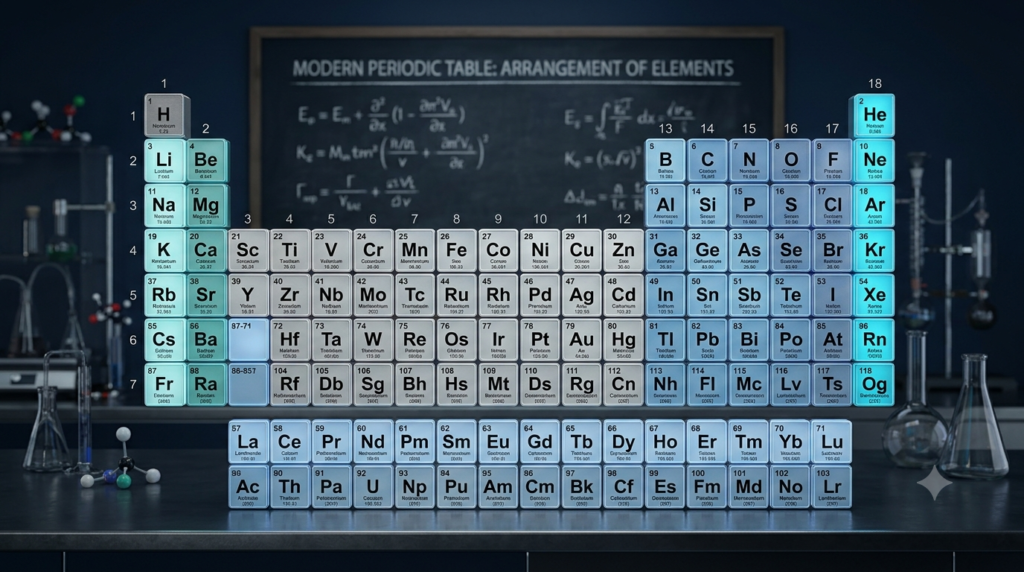
Electron configuration is closely connected to the periodic table. The position of an element in the periodic table can help us understand its electron arrangement, while its electron configuration can help us identify its period, group, and block. This relationship makes electron configuration an important concept in chemistry.
In this article, we will explore what electron configuration is, how electrons are arranged in atoms, the rules governing electron filling, and how electron configuration explains the structure and organization of the periodic table.
What Is Electron Configuration?
Electron configuration is the arrangement of electrons in the different energy levels and orbitals surrounding the nucleus of an atom.
Electrons occupy specific regions around the nucleus according to their energy. They do not move randomly between these regions. Instead, they follow particular rules that determine how they are distributed.
For example, a hydrogen atom has one electron, which occupies the lowest available energy orbital. A helium atom has two electrons, both occupying the same orbital.
The electron configurations of these elements are:
Hydrogen (H): 1s¹
Helium (He): 1s²
Lithium (Li): 1s² 2s¹
Carbon (C): 1s² 2s² 2p²
Oxygen (O): 1s² 2s² 2p⁴
These configurations show the number of electrons present in each occupied subshell.
Understanding electron configuration helps explain chemical bonding, reactivity, atomic properties, and the arrangement of elements in the periodic table.
Understanding Energy Levels in an Atom
Electrons are arranged in different energy levels around the nucleus. These energy levels are also called electron shells.
Each shell represents a particular energy region available to electrons. The shells are commonly identified by the principal quantum number (n), beginning with 1.
The main energy levels are:
| Shell | Principal quantum number | Maximum electrons |
|---|---|---|
| K | 1 | 2 |
| L | 2 | 8 |
| M | 3 | 18 |
| N | 4 | 32 |
| O | 5 | 50 |
| P | 6 | 72 |
| Q | 7 | 98 |
The maximum number of electrons in a principal energy level is calculated using the formula:
Maximum electrons = 2n²
Here, n represents the principal quantum number.
For example:
First shell: 2 × 1² = 2 electrons
Second shell: 2 × 2² = 8 electrons
Third shell: 2 × 3² = 18 electrons
Fourth shell: 2 × 4² = 32 electrons
However, electrons do not necessarily fill shells one after another in a simple sequence. Their actual arrangement depends on the relative energies of orbitals within different shells.
This is why the electron configuration of an atom requires an understanding of subshells and orbitals.
What Are Subshells in Electron Configuration?
Each principal energy level contains one or more subshells. These subshells are identified by the letters s, p, d, and f.
Each type of subshell has a different number of orbitals and a different maximum electron capacity.
The four types of subshells are:
| Subshell | Number of orbitals | Maximum electrons |
|---|---|---|
| s | 1 | 2 |
| p | 3 | 6 |
| d | 5 | 10 |
| f | 7 | 14 |
An orbital is a region around the nucleus where there is a high probability of finding an electron.
The subshells have different shapes and energy characteristics.
s Subshell
The s subshell contains one orbital and can hold a maximum of two electrons.
It is present in every principal energy level.
Examples:
1s²
2s²
3s²
4s²
p Subshell
The p subshell contains three orbitals and can hold a maximum of six electrons.
It begins from the second principal energy level.
Examples:
2p⁶
3p⁶
4p⁶
d Subshell
The d subshell contains five orbitals and can hold a maximum of ten electrons.
It generally becomes important in the transition elements.
Examples:
3d¹⁰
4d¹⁰
5d¹⁰
f Subshell
The f subshell contains seven orbitals and can hold a maximum of fourteen electrons.
It is mainly associated with the lanthanide and actinide series.
Examples:
4f¹⁴
5f¹⁴
These subshells form the foundation of the electron configuration system and explain the division of the periodic table into different blocks.
Rules for Writing Electron Configuration
Electrons follow specific principles when occupying atomic orbitals. Three important rules determine their arrangement.
1. Aufbau Principle
The Aufbau principle states that electrons occupy the lowest-energy available orbitals before filling higher-energy orbitals.
The word Aufbau comes from a German term meaning building up.
According to this principle, electrons fill orbitals in the following commonly used order:
1s → 2s → 2p → 3s → 3p → 4s → 3d → 4p → 5s → 4d → 5p → 6s → 4f → 5d → 6p → 7s → 5f → 6d → 7p
For example, the electron configuration of sodium (atomic number 11) is:
Na = 1s² 2s² 2p⁶ 3s¹
The first ten electrons occupy the lower-energy orbitals, while the eleventh electron enters the 3s orbital.
2. Pauli Exclusion Principle
The Pauli exclusion principle states that no two electrons in the same atom can have identical values for all four quantum numbers.
In simpler terms, one orbital can hold a maximum of two electrons, and those electrons must have opposite spins.
For example, the electron arrangement of helium is:
He = 1s²
Both electrons occupy the 1s orbital but have opposite spins.
3. Hund’s Rule
Hund’s rule states that electrons occupy orbitals of the same energy individually before pairing begins.
This means that when electrons enter the three orbitals of a p subshell, they first occupy separate orbitals with parallel spins.
For example, nitrogen has the electron configuration:
N = 1s² 2s² 2p³
Its three 2p electrons occupy the three available p orbitals individually.
These three rules explain how electrons are distributed throughout an atom.
What Is the Relationship Between Electron Configuration and the Periodic Table?
The periodic table is arranged according to the increasing atomic numbers of elements. However, its structure also reflects the electron configurations of atoms.
The position of an element in the periodic table is closely related to its electron arrangement.
Electron configuration helps determine three important features of an element’s position:
Period number
Group number
Block
Each of these features provides information about the electrons present in an atom.
1. Relationship Between Electron Configuration and Period Number
The period number of an element indicates the highest principal energy level occupied by electrons in its ground-state atom.
The periodic table contains seven periods, corresponding to the seven principal energy levels.
For example:
Lithium (Li)
Electron configuration: 1s² 2s¹
The highest occupied principal energy level is 2. Therefore, lithium belongs to Period 2.
Sodium (Na)
Electron configuration: 1s² 2s² 2p⁶ 3s¹
The highest occupied principal energy level is 3. Therefore, sodium belongs to Period 3.
Potassium (K)
Electron configuration: 1s² 2s² 2p⁶ 3s² 3p⁶ 4s¹
The highest occupied principal energy level is 4. Therefore, potassium belongs to Period 4.
This relationship makes it possible to identify the period of an element by examining its electron configuration.
2. Relationship Between Electron Configuration and Group Number
The group number of an element is closely related to the number and arrangement of electrons in its outermost shell.
The outermost electrons are called valence electrons. They play a major role in chemical bonding and reactions.
For many main-group elements, the number of valence electrons helps determine their group.
For example:
| Element | Electron configuration | Valence electrons | Group |
|---|---|---|---|
| Lithium | 1s² 2s¹ | 1 | 1 |
| Beryllium | 1s² 2s² | 2 | 2 |
| Boron | 1s² 2s² 2p¹ | 3 | 13 |
| Carbon | 1s² 2s² 2p² | 4 | 14 |
| Nitrogen | 1s² 2s² 2p³ | 5 | 15 |
| Oxygen | 1s² 2s² 2p⁴ | 6 | 16 |
| Fluorine | 1s² 2s² 2p⁵ | 7 | 17 |
| Neon | 1s² 2s² 2p⁶ | 8 | 18 |
For Groups 13–18, the number of valence electrons is generally the group number minus 10.
For example, oxygen belongs to Group 16 and has six valence electrons.
Transition elements require a more detailed approach because electrons from both the outermost s subshell and the preceding d subshell can participate in chemical bonding.
Therefore, the group number of transition elements is commonly related to the total number of electrons in their outer ns and (n−1)d subshells, with some configurations requiring special consideration.
3. Relationship Between Electron Configuration and Periodic Table Blocks
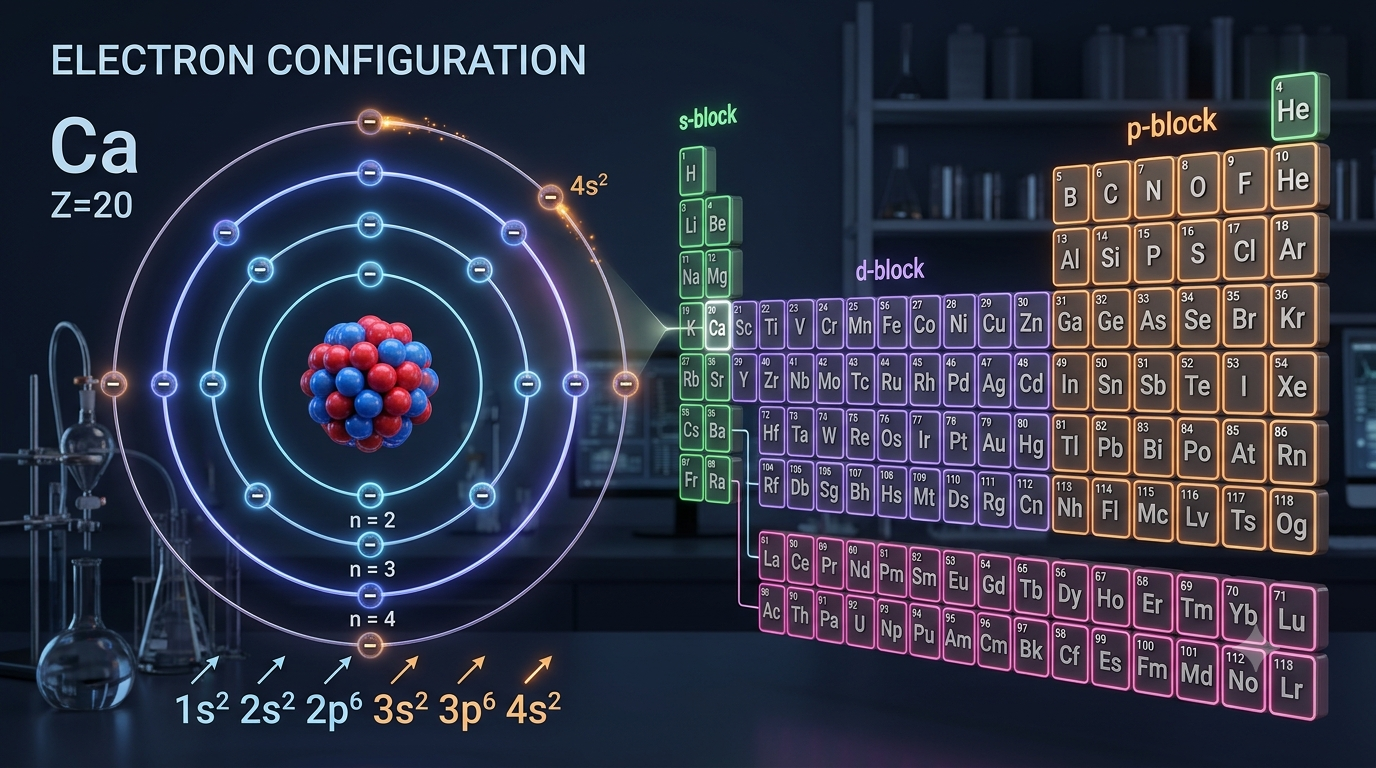
One of the clearest connections between electron configuration and the periodic table is the division of elements into four blocks.
These blocks are named according to the subshell into which the last electron enters.
The four blocks are:
s-block
p-block
d-block
f-block
s-Block Elements
The s-block contains elements in Groups 1 and 2, along with helium based on its electron configuration.
The last electron enters an s subshell.
General outer electron configurations:
Group 1: ns¹
Group 2: ns²
Examples:
Hydrogen: 1s¹
Lithium: 2s¹
Sodium: 3s¹
Magnesium: 3s²
Calcium: 4s²
The s-block is located on the left side of the periodic table, with helium positioned separately on the right because of its chemical properties.
p-Block Elements
The p-block contains elements in Groups 13 to 18, except helium.
The last electron enters a p subshell.
Their general outer electron configuration is:
ns² np¹ to ns² np⁶
Examples:
Boron: 1s² 2s² 2p¹
Carbon: 1s² 2s² 2p²
Nitrogen: 1s² 2s² 2p³
Oxygen: 1s² 2s² 2p⁴
Fluorine: 1s² 2s² 2p⁵
Neon: 1s² 2s² 2p⁶
The p-block is located on the right side of the periodic table.
It includes metals, nonmetals, and metalloids, making it one of the most chemically diverse sections.
d-Block Elements
The d-block contains the elements generally found in Groups 3 to 12.
These elements are commonly known as transition elements.
The last electron generally enters a d subshell of the preceding principal energy level.
Their general configuration is:
(n−1)d¹–¹⁰ ns⁰–²
Examples:
Scandium: [Ar] 3d¹ 4s²
Titanium: [Ar] 3d² 4s²
Iron: [Ar] 3d⁶ 4s²
Nickel: [Ar] 3d⁸ 4s²
Some transition elements have exceptional electron configurations because half-filled and fully filled d subshells can provide additional stability.
The d-block is located in the middle of the periodic table.
f-Block Elements
The f-block contains the lanthanide and actinide series.
The last electron generally enters an f subshell.
Their general configuration involves:
(n−2)f¹–¹⁴
Examples include:
Cerium (Ce)
Neodymium (Nd)
Europium (Eu)
Uranium (U)
Plutonium (Pu)
The f-block is displayed in two separate rows below the main body of the periodic table to keep its overall structure compact.
How to Write Electron Configuration Using the Periodic Table
The periodic table can make writing electron configurations easier because its arrangement follows the filling of electron subshells.
Each block represents a particular type of subshell.
A simple method is to follow the atomic number of an element and distribute its electrons according to the orbital filling order.
Let’s understand this with examples.
Example 1: Electron Configuration of Carbon
Atomic number of carbon = 6
A neutral carbon atom contains six electrons.
Filling the orbitals in the correct order:
1s receives 2 electrons.
2s receives 2 electrons.
2p receives the remaining 2 electrons.
Therefore:
Carbon = 1s² 2s² 2p²
Its highest occupied energy level is 2, so it belongs to Period 2.
Its outer shell contains four electrons, so it belongs to Group 14.
Its last electron enters a p subshell, so it belongs to the p-block.
Example 2: Electron Configuration of Chlorine
Atomic number of chlorine = 17
A neutral chlorine atom contains seventeen electrons.
The electrons are distributed as follows:
1s² = 2 electrons
2s² = 2 electrons
2p⁶ = 6 electrons
3s² = 2 electrons
3p⁵ = 5 electrons
Therefore:
Chlorine = 1s² 2s² 2p⁶ 3s² 3p⁵
Its highest occupied energy level is 3, so it belongs to Period 3.
It has seven valence electrons, so it belongs to Group 17.
Its last electron enters a p subshell, so it belongs to the p-block.
Example 3: Electron Configuration of Calcium
Atomic number of calcium = 20
A neutral calcium atom contains twenty electrons.
Its electron configuration is:
Calcium = 1s² 2s² 2p⁶ 3s² 3p⁶ 4s²
Its highest occupied energy level is 4, so it belongs to Period 4.
It has two outermost electrons, so it belongs to Group 2.
Its last electron enters an s subshell, so it belongs to the s-block.
What Is the Noble Gas Notation of Electron Configuration?
Writing the complete electron configuration of heavier elements can become lengthy. To make it shorter, chemists use noble gas notation, also called abbreviated electron configuration.
In this method, the electron configuration of the nearest preceding noble gas is represented by its chemical symbol inside square brackets.
The remaining electrons are then written after the noble gas symbol.
For example, the complete electron configuration of sodium is:
Na = 1s² 2s² 2p⁶ 3s¹
Since neon has the configuration 1s² 2s² 2p⁶, sodium can be written as:
Na = [Ne] 3s¹
Similarly:
Magnesium: [Ne] 3s²
Aluminium: [Ne] 3s² 3p¹
Chlorine: [Ne] 3s² 3p⁵
Calcium: [Ar] 4s²
Iron: [Ar] 3d⁶ 4s²
Noble gas notation saves space and makes it easier to understand the outer electron arrangement of elements.
Why Do Elements in the Same Group Have Similar Chemical Properties?
Elements in the same group of the periodic table often have similar chemical properties because they generally have similar outer electron configurations.
The outermost electrons are responsible for many chemical interactions, including the formation of chemical bonds.
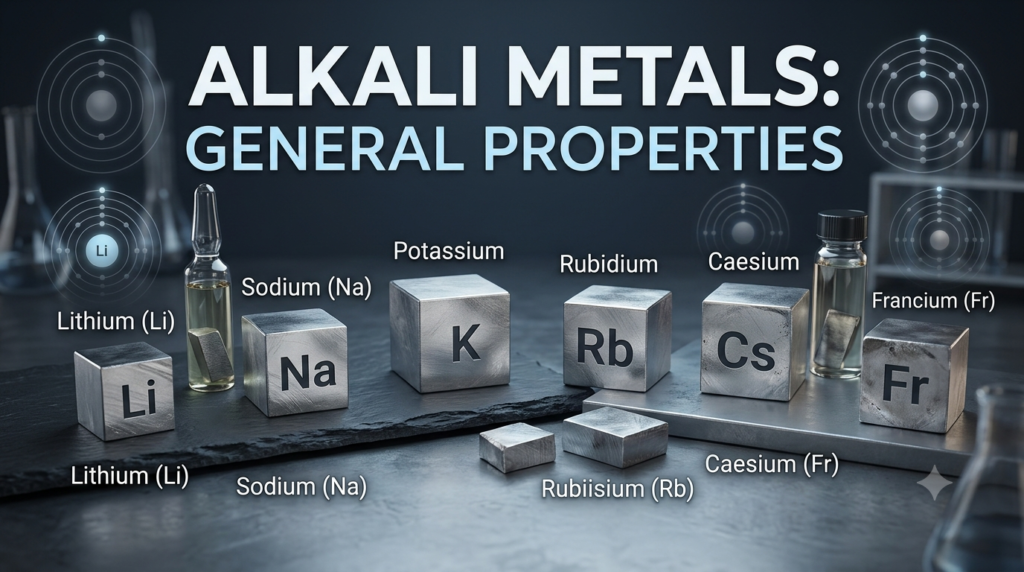
For example, lithium, sodium, and potassium belong to Group 1.
Their outer electron configurations are:
Lithium: 2s¹
Sodium: 3s¹
Potassium: 4s¹
Each element has one electron in its outermost s subshell.
These elements tend to lose this electron during chemical reactions and form positively charged ions.
Similarly, fluorine, chlorine, and bromine belong to Group 17.
Their outer electron configurations are:
Fluorine: 2s² 2p⁵
Chlorine: 3s² 3p⁵
Bromine: 4s² 4p⁵
Each has seven valence electrons and tends to gain one electron or share electrons during chemical bonding.
This similarity in outer electron configuration explains many of the recurring chemical properties observed within periodic groups.
Electron Configuration and Periodic Trends
Electron configuration also helps explain several important periodic trends.
Periodic trends are regular patterns in the physical and chemical properties of elements across periods and down groups.
Atomic Radius
Atomic radius generally decreases from left to right across a period because the nuclear charge increases while electrons are added to the same principal energy level.
As a result, the nucleus attracts the electrons more strongly.
Atomic radius generally increases down a group because additional electron shells are occupied.
Ionization Energy
Ionization energy is the energy required to remove an electron from an isolated gaseous atom.
It generally increases across a period because the attraction between the nucleus and outer electrons becomes stronger.
It generally decreases down a group because the outermost electrons are farther from the nucleus and experience greater shielding from inner electrons.
Electronegativity
Electronegativity describes the ability of an atom to attract shared electrons in a chemical bond.
It generally increases across a period and decreases down a group.
Fluorine is the most electronegative element.
Metallic and Nonmetallic Character
Metallic character generally decreases from left to right across a period and increases down a group.
This is related to how easily atoms lose electrons.
Nonmetallic character generally increases from left to right across a period and decreases down a group.
These trends are connected to the number of occupied energy levels, effective nuclear charge, shielding, and valence electron arrangement.
Exceptions in Electron Configuration
Although the Aufbau principle provides a useful guide for writing electron configurations, some elements have configurations that differ from the expected filling order.
These exceptions occur because the energies of certain orbitals are very close, and alternative arrangements can provide additional stability.
Two commonly discussed examples are chromium and copper.
Chromium (Cr)
Chromium has an atomic number of 24.
Its commonly expected configuration would be:
[Ar] 3d⁴ 4s²
However, its actual ground-state electron configuration is:
Chromium = [Ar] 3d⁵ 4s¹
This arrangement gives chromium a half-filled 3d subshell.
Copper (Cu)
Copper has an atomic number of 29.
Its commonly expected configuration would be:
[Ar] 3d⁹ 4s²
However, its actual ground-state electron configuration is:
Copper = [Ar] 3d¹⁰ 4s¹
This arrangement gives copper a completely filled 3d subshell.
These examples demonstrate that electron configurations must be based on the actual ground-state arrangement rather than applying the filling sequence mechanically.
Importance of Understanding Electron Configuration
Electron configuration is useful for understanding many concepts in chemistry.
Some of its major applications include:
1. Predicting Chemical Properties
The arrangement of valence electrons helps explain how elements react and why elements in the same group often behave similarly.
2. Understanding Chemical Bonding
Electron configurations help explain how atoms lose, gain, or share electrons to form ionic and covalent bonds.
3. Identifying Periodic Table Positions
The electron configuration of an element helps determine its period, group, and block.
4. Understanding Ion Formation
Electron arrangements explain why atoms form positive or negative ions and why many ions achieve stable electron configurations.
5. Explaining Periodic Trends
Properties such as atomic radius, ionization energy, and electronegativity can be understood by examining electron arrangements.
6. Studying Transition Elements
The electron configurations of d-block elements help explain their variable oxidation states, magnetic properties, and the formation of colored compounds.
7. Understanding Chemical Reactivity
The number and arrangement of valence electrons influence how readily an element participates in chemical reactions.
Conclusion
Electron configuration describes how electrons are distributed among the energy levels, subshells, and orbitals of an atom. It is one of the most important concepts for understanding atomic structure and chemical behavior.
Its relationship with the periodic table explains why elements are organized into different periods, groups, and blocks. The highest occupied energy level helps identify the period, the outer electron arrangement helps determine the group for many elements, and the subshell receiving the last electron determines the block.
Electron configuration also explains why elements in the same group often have similar chemical properties and helps us understand periodic trends, chemical bonding, and ion formation.
By learning the principles of electron configuration and its connection to the periodic table, we can develop a clearer understanding of how the elements are organized and why they behave differently during chemical reactions.
FAQs
1. What is electron configuration?
Electron configuration is the arrangement of electrons in the energy levels, subshells, and orbitals of an atom. It describes how electrons are distributed around the nucleus according to their energy. For example, the electron configuration of oxygen is 1s² 2s² 2p⁴. Understanding electron configuration helps explain the chemical properties of elements, their bonding behavior, and their positions in the periodic table. It also provides information about the number of valence electrons and how atoms interact with other atoms during chemical reactions.
2. How is electron configuration related to the periodic table?
Electron configuration is closely related to the arrangement of elements in the periodic table. It helps determine the period, group, and block of an element. The highest occupied principal energy level generally identifies the period, while the outer electron arrangement helps determine the group. The subshell receiving the last electron identifies the block. For example, sodium has the electron configuration 1s² 2s² 2p⁶ 3s¹. It belongs to Period 3, Group 1, and the s-block.
3. What are the four types of subshells in electron configuration?
The four types of subshells are s, p, d, and f. Each subshell contains a different number of orbitals and can accommodate a specific maximum number of electrons. The s subshell holds 2 electrons, the p subshell holds 6, the d subshell holds 10, and the f subshell holds 14 electrons. These subshells are important because they determine how electrons are arranged in atoms and explain the division of the periodic table into s-block, p-block, d-block, and f-block elements.
4. What are the three main rules of electron configuration?
The three main rules are the Aufbau principle, Pauli exclusion principle, and Hund’s rule. The Aufbau principle states that electrons fill lower-energy orbitals before higher-energy orbitals. The Pauli exclusion principle states that an orbital can contain a maximum of two electrons with opposite spins. Hund’s rule explains that electrons occupy orbitals of equal energy individually before pairing begins. Together, these rules determine the correct arrangement of electrons in an atom and help chemists write accurate electron configurations.
5. How can electron configuration determine the period of an element?
The period of an element can generally be identified by finding the highest principal energy level occupied by its electrons in the ground state. The periodic table contains seven periods corresponding to the principal energy levels from 1 to 7. For example, calcium has the electron configuration [Ar] 4s². Its highest occupied energy level is 4, so calcium belongs to Period 4. This relationship makes electron configuration a useful method for identifying the position of an element in the periodic table.
6. How do valence electrons determine the group of an element?
Valence electrons are the electrons present in the outermost occupied shell of an atom. For main-group elements, their number helps identify the group in the periodic table. For example, sodium has one valence electron and belongs to Group 1, while magnesium has two valence electrons and belongs to Group 2. Similarly, chlorine has seven valence electrons and belongs to Group 17. Transition elements require additional consideration because electrons in the d subshell can also contribute to their chemical properties and bonding.
7. What are the s-block, p-block, d-block, and f-block elements?
The periodic table is divided into four blocks according to the subshell into which the last electron generally enters. The s-block includes elements in Groups 1 and 2, along with helium. The p-block contains elements in Groups 13 to 18, except helium. The d-block consists mainly of transition elements in Groups 3 to 12. The f-block includes lanthanides and actinides. This classification is based on electron configuration and helps explain the organization and chemical characteristics of different elements.
8. Why do elements in the same group have similar chemical properties?
Elements in the same group generally have similar outer electron configurations and the same number of valence electrons. Since valence electrons play a major role in chemical bonding and reactions, these elements often show similar chemical behavior. For example, lithium, sodium, and potassium belong to Group 1 and each has one valence electron. They commonly lose this electron to form positively charged ions. Similarly, fluorine and chlorine belong to Group 17 and have seven valence electrons, making their chemical behavior comparable.
9. What is noble gas notation in electron configuration?
Noble gas notation is a shortened method of writing electron configurations. Instead of writing the complete arrangement, the electron configuration of the nearest preceding noble gas is represented by its chemical symbol inside square brackets. The remaining electrons are then written after that symbol. For example, the complete electron configuration of sodium is 1s² 2s² 2p⁶ 3s¹. Using noble gas notation, it becomes [Ne] 3s¹. This method saves time and makes electron configurations easier to read, especially for elements with higher atomic numbers.
10. Why do chromium and copper have exceptional electron configurations?
Chromium and copper have exceptional electron configurations because the energies of their 3d and 4s orbitals are very close. Their actual ground-state arrangements are more stable than the configurations predicted by a simple application of the Aufbau filling order. Chromium has the configuration [Ar] 3d⁵ 4s¹ instead of [Ar] 3d⁴ 4s². Copper has [Ar] 3d¹⁰ 4s¹ instead of [Ar] 3d⁹ 4s². These arrangements produce half-filled and completely filled d subshells, respectively, which contribute to their stability.