Atomic radius is an important concept in chemistry that helps us understand the size of atoms and how their sizes change across the periodic table. Although atoms are extremely small and cannot be observed directly with the naked eye, scientists have developed methods to estimate their dimensions using experimental measurements and theoretical calculations.
The size of an atom plays an important role in determining its chemical and physical properties. It influences how atoms form chemical bonds, how strongly they attract electrons, how easily they lose or gain electrons, and how they interact with other atoms. Atomic radius is therefore closely related to several important periodic properties, including ionization energy, electron affinity, and electronegativity.
Atomic radius is not constant for all elements. It changes regularly as we move across a period or down a group in the periodic table. These changes follow predictable patterns known as periodic trends. Understanding these trends makes it easier to compare elements and explain their chemical behaviour.
In this article, we will learn what atomic radius means, how it is measured, its different types, and why it increases or decreases across the periodic table.
What Is Atomic Radius?
Atomic radius is generally defined as the distance from the centre of an atom’s nucleus to the outermost region of its electron cloud.
However, an atom does not have a clearly defined outer boundary. Its electron cloud gradually becomes less dense with increasing distance from the nucleus. Therefore, the exact radius of an isolated atom cannot be measured in the same way as the radius of a solid sphere.
To overcome this difficulty, scientists use the distance between the nuclei of two bonded or neighbouring atoms to estimate atomic size.
For two identical atoms bonded together, the atomic radius is commonly taken as half the distance between their nuclei.
Formula:
Atomic Radius = Distance Between Two Identical Atomic Nuclei ÷ 2
For example, if the distance between the nuclei of two identical bonded atoms is 200 pm, their atomic radius is approximately 100 pm.
Here, pm stands for picometre.
1 pm = 10⁻¹² m
Atomic radius is usually expressed in picometres (pm) or sometimes in angstroms (Å).
1 Å = 100 pm
Why Is Atomic Radius Important?
Atomic radius is more than just a measurement of atomic size. It helps explain many chemical properties and reactions.
Some important applications of atomic radius include:
Understanding chemical bonding: Atomic size influences the distance between bonded atoms and the strength and length of chemical bonds.
Explaining ion formation: The size of an atom affects how easily it can lose or gain electrons.
Predicting reactivity: Atomic radius helps explain why certain elements are more reactive than others.
Understanding periodic trends: It helps identify how atomic properties change across periods and down groups.
Comparing elements: Scientists use atomic radius to compare the relative sizes of different atoms.
Explaining metallic properties: Atomic size influences the attraction between the nucleus and outermost electrons, affecting the behaviour of metals.
Types of Atomic Radius
Atomic radius can be measured in different ways depending on how atoms are arranged or bonded. The three commonly discussed types are covalent radius, metallic radius, and van der Waals radius.
1. Covalent Radius
Covalent radius is defined as half the distance between the nuclei of two identical atoms joined together by a single covalent bond.
When two atoms share electrons to form a covalent bond, their nuclei remain at a particular distance from each other. Half of this internuclear distance gives the covalent radius of each atom.
Formula:
Covalent Radius = Bond Length ÷ 2
For example, the distance between the nuclei of two hydrogen atoms in a hydrogen molecule (H₂) is approximately 74 pm.
Therefore:
Covalent Radius of Hydrogen = 74 ÷ 2 = 37 pm
Covalent radius is particularly useful for studying non-metallic elements that form covalent bonds.
2. Metallic Radius
Metallic radius is defined as half the distance between the nuclei of two nearest neighbouring metal atoms in a metallic crystal.
In metals, atoms are arranged in a regular three-dimensional structure. Their outer electrons are often delocalised, meaning they are not restricted to individual atoms.
The metallic radius helps describe the size of metal atoms within this arrangement.
For example, metallic radius is used when comparing elements such as sodium, magnesium, iron, and copper.
Metallic radius is generally different from covalent radius because metallic and covalent bonding involve different atomic arrangements and electron interactions.
3. Van der Waals Radius
Van der Waals radius is defined as half the distance between the nuclei of two nearest non-bonded identical atoms.
When two atoms are not chemically bonded but come close to each other, their electron clouds repel one another. The distance between their nuclei can be used to estimate their van der Waals radius.
This radius is especially useful for studying noble gases and molecular structures in which atoms are close together without forming a covalent bond.
For example, the van der Waals radius helps describe the effective size of atoms in noble gases such as helium, neon, and argon.
Difference Between the Types of Atomic Radius
The three types of atomic radius are based on different atomic arrangements.
Covalent radius is measured using atoms connected by covalent bonds.
Metallic radius is measured using neighbouring metal atoms in a metallic crystal.
Van der Waals radius is measured using neighbouring non-bonded atoms.
These values are not necessarily equal because the distances between atoms depend on their bonding conditions and surrounding environments.
Periodic Variation of Atomic Radius
Atomic radius does not change randomly in the periodic table. It follows a systematic pattern known as periodic variation.
There are two major trends:
Variation of atomic radius across a period.
Variation of atomic radius down a group.
These trends are mainly explained by the effective nuclear charge, the number of occupied electron shells, and the shielding effect.
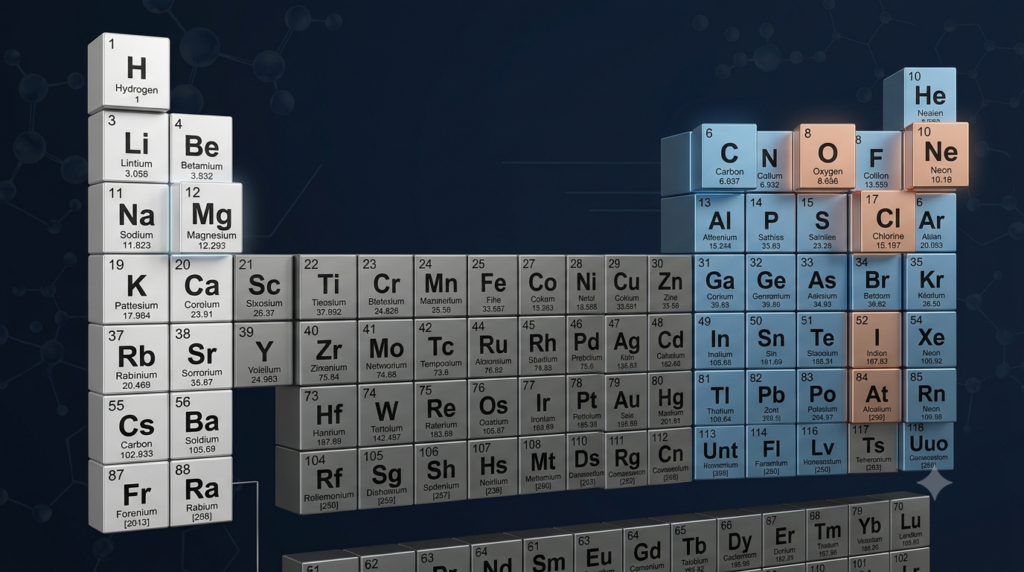
1. Variation of Atomic Radius Across a Period
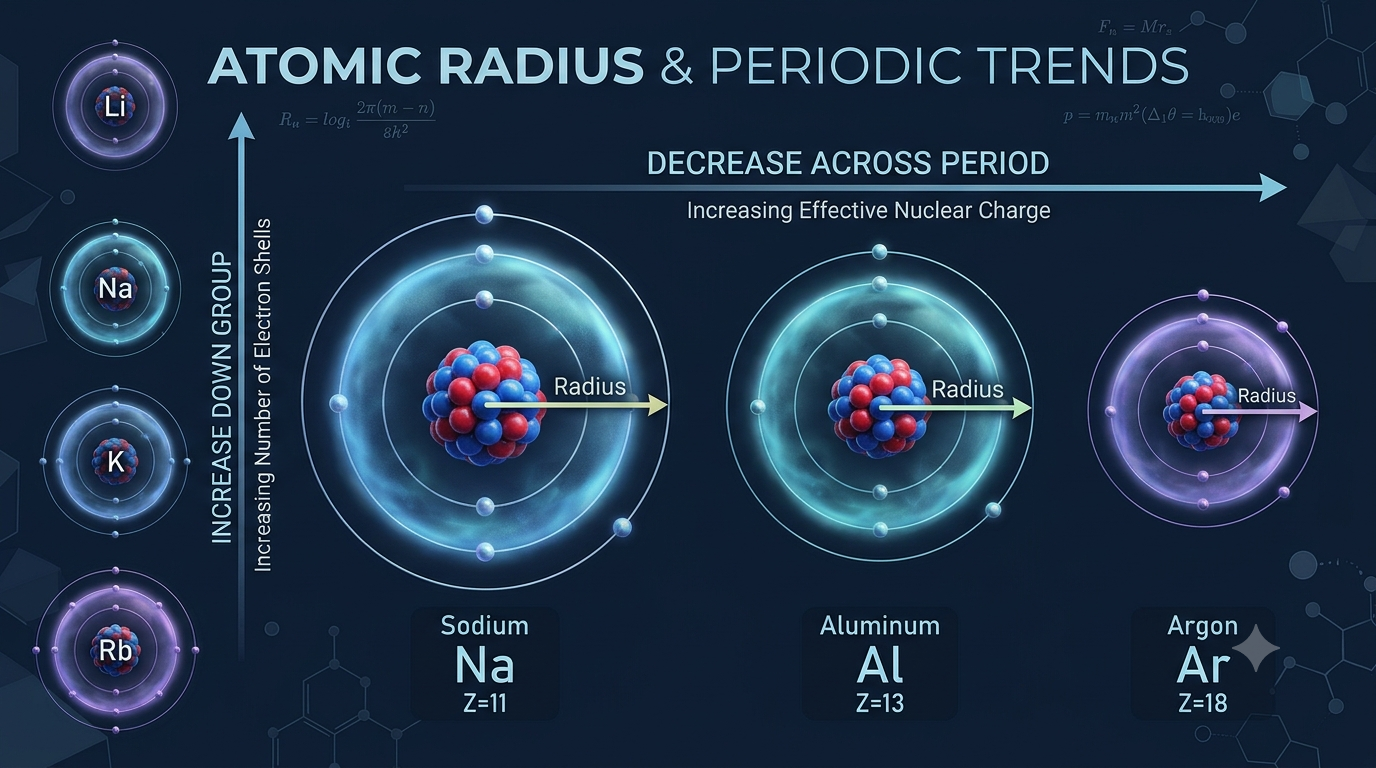
As we move from left to right across a period in the periodic table, the atomic radius generally decreases.
For example, consider the third period:
Na > Mg > Al > Si > P > S > Cl
This means sodium has a larger atomic radius than magnesium, while chlorine has a smaller atomic radius than the other elements listed.
Why Does Atomic Radius Decrease Across a Period?
The decrease in atomic radius across a period occurs mainly because of an increase in effective nuclear charge.
1. Increase in Nuclear Charge
As we move from left to right across a period, the atomic number increases. This means the number of protons in the nucleus also increases.
The additional protons create a stronger positive charge in the nucleus.
2. Electrons Are Added to the Same Shell
Across a period, electrons are generally added to the same principal electron shell.
For example, the elements of the second period fill the second electron shell as we move from lithium to neon.
Because the added electrons enter the same main shell, the shielding effect does not increase significantly compared with the increase in nuclear charge.
3. Increase in Effective Nuclear Charge
Effective nuclear charge is the net positive charge experienced by an electron after considering the shielding effect of other electrons.
As nuclear charge increases across a period, the effective nuclear charge generally increases.
The stronger nuclear attraction pulls the electron cloud closer to the nucleus.
4. Decrease in Atomic Radius
As the electron cloud is pulled closer to the nucleus, the overall atomic size decreases.
Therefore, atomic radius generally decreases from left to right across a period.
Example: Atomic Radius Across the Second Period
Consider the following elements:
Lithium (Li), Beryllium (Be), Boron (B), Carbon (C), Nitrogen (N), Oxygen (O), Fluorine (F), and Neon (Ne).
The atomic radius generally decreases across these elements when compared using a consistent radius definition.
Lithium has a relatively large atomic radius because its outermost electron experiences a weaker effective nuclear attraction.
As we move towards neon, the increasing nuclear charge pulls the electrons closer to the nucleus.
This explains the general decrease in atomic size across the second period.
Important Note: The exact numerical values and comparisons depend on the type of atomic radius being used. Noble gases are often compared using van der Waals radii, while other elements are commonly compared using covalent radii. Therefore, direct numerical comparisons should use a consistent measurement method.
2. Variation of Atomic Radius Down a Group
As we move from top to bottom in a group of the periodic table, atomic radius generally increases.
For example, consider Group 1:
Li < Na < K < Rb < Cs
Lithium has the smallest atomic radius among these elements, while caesium has the largest.
Why Does Atomic Radius Increase Down a Group?
The increase in atomic radius down a group is mainly due to the addition of new electron shells.
1. Addition of New Electron Shells
As we move down a group, each successive element has an additional occupied principal electron shell.
For example:
Lithium has 2 occupied electron shells.
Sodium has 3 occupied electron shells.
Potassium has 4 occupied electron shells.
Rubidium has 5 occupied electron shells.
Caesium has 6 occupied electron shells.
The addition of electron shells increases the distance between the nucleus and the outermost electrons.
2. Increase in Shielding Effect
As the number of electron shells increases, the inner electrons provide greater shielding.
The inner electrons partially block the attraction of the positively charged nucleus for the outermost electrons.
As a result, the outer electrons experience a reduced effective nuclear attraction compared with what they would experience without shielding.
3. Increase in Atomic Size
Although the nuclear charge increases down a group, the addition of new electron shells and increased shielding generally have a greater influence on the size of the atom.
The outermost electrons occupy shells that are farther from the nucleus.
Therefore, atomic radius increases down a group.
Example: Atomic Radius in Group 17
Consider the halogens:
Fluorine (F) < Chlorine (Cl) < Bromine (Br) < Iodine (I)
Fluorine has a relatively small atomic radius because its outermost electrons are located in the second electron shell.
As we move down the group, additional electron shells are added. This increases the distance of the outermost electrons from the nucleus.
Consequently, iodine has a larger atomic radius than fluorine.
Factors Affecting Atomic Radius
Several factors influence the size of an atom. The most important factors are nuclear charge, number of electron shells, shielding effect, and effective nuclear charge.
1. Nuclear Charge
Nuclear charge refers to the total positive charge of the nucleus, which depends on the number of protons.
A higher nuclear charge generally produces a stronger attraction between the nucleus and electrons.
When other factors remain relatively similar, an increase in nuclear charge tends to decrease atomic radius.
This is one of the main reasons why atomic radius decreases across a period.
2. Number of Electron Shells
The number of occupied electron shells strongly affects atomic size.
When an additional electron shell is added, the outermost electrons are generally located farther from the nucleus.
Therefore, atomic radius usually increases down a group.
3. Shielding Effect
The shielding effect occurs when inner electrons reduce the attractive force exerted by the nucleus on outer electrons.
Electrons in inner shells partially screen outer electrons from the full positive charge of the nucleus.
Greater shielding generally reduces the effective nuclear attraction experienced by the outermost electrons.
This allows the electron cloud to extend farther from the nucleus.
4. Effective Nuclear Charge
Effective nuclear charge is the net positive charge experienced by an electron in an atom.
It depends mainly on the actual nuclear charge and the shielding produced by other electrons.
A simplified relationship is:
Effective Nuclear Charge = Nuclear Charge − Shielding Effect
It is commonly represented by the symbol Zₑff.
A greater effective nuclear charge generally pulls electrons closer to the nucleus, resulting in a smaller atomic radius.
Atomic Radius of Representative Elements
The following table shows approximate covalent radii of selected elements. Values are expressed in picometres (pm).
| Element | Symbol | Approximate Covalent Radius |
|---|---|---|
| Hydrogen | H | 31 pm |
| Lithium | Li | 128 pm |
| Beryllium | Be | 96 pm |
| Boron | B | 84 pm |
| Carbon | C | 76 pm |
| Nitrogen | N | 71 pm |
| Oxygen | O | 66 pm |
| Fluorine | F | 57 pm |
| Sodium | Na | 166 pm |
| Magnesium | Mg | 141 pm |
| Aluminium | Al | 121 pm |
| Silicon | Si | 111 pm |
| Phosphorus | P | 107 pm |
| Sulfur | S | 105 pm |
| Chlorine | Cl | 102 pm |
These are approximate values. Different reference sources and measurement methods may report slightly different radii.
The table illustrates the general decrease in covalent radius across the second and third periods.
Exceptions and Special Cases in Atomic Radius Trends
Although atomic radius follows predictable periodic trends, some elements do not show perfectly regular changes.
These variations occur because atomic structure, electron configuration, and the type of radius measurement can influence the observed values.
1. Transition Elements
Transition elements generally show a relatively small change in atomic radius across a series compared with the strong decrease observed among many main-group elements.
As electrons are added to the inner d subshell, the increasing nuclear charge is partly balanced by shielding from the added electrons.
Therefore, the atomic radii of transition elements often decrease only slightly across a series, although the exact pattern depends on the elements and measurement method.
2. Lanthanide Contraction
Lanthanide contraction refers to the gradual decrease in the atomic and ionic radii of lanthanide elements as atomic number increases.
This happens because electrons are added to the 4f subshell. These electrons shield the outer electrons relatively poorly from the increasing nuclear charge.
Consequently, the effective nuclear attraction increases, pulling the electron cloud closer to the nucleus.
Lanthanide contraction also affects the properties and sizes of elements that follow the lanthanide series.
3. Differences in Radius Measurement
Atomic radius is not a single fixed measurement for every situation.
Covalent, metallic, and van der Waals radii can give different values for the same element.
For example, a van der Waals radius is generally larger than the covalent radius because non-bonded atoms are usually farther apart than atoms joined by a covalent bond.
Therefore, apparent exceptions in numerical comparisons may sometimes result from using different definitions of atomic radius.
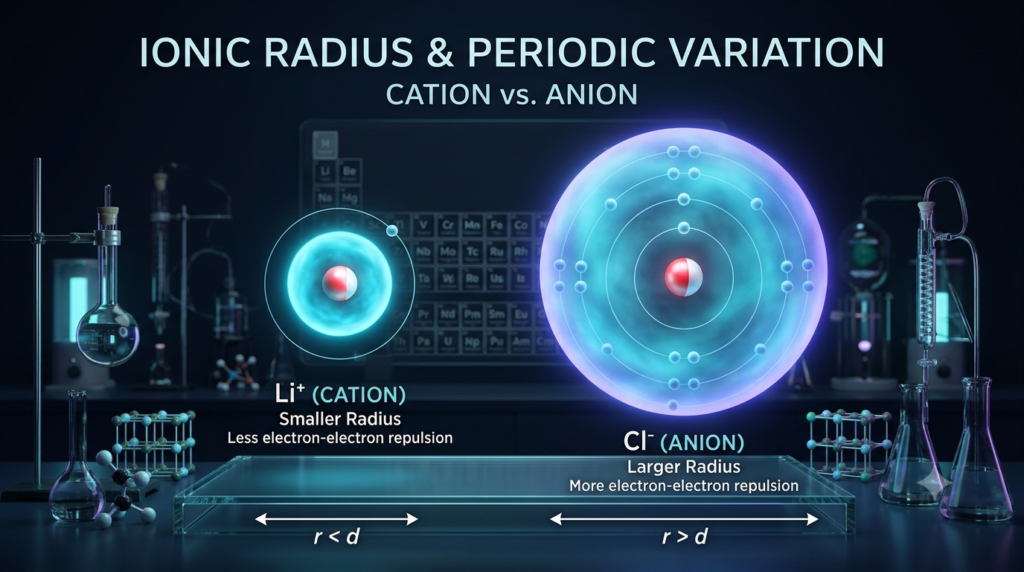
Atomic Radius and Ionic Radius
Atomic radius and ionic radius are related concepts, but they describe different things.
Atomic radius refers to the size of a neutral atom, whereas ionic radius refers to the size of an ion formed when an atom gains or loses electrons.
The size of an atom usually changes when it forms an ion.
1. Cations Are Smaller Than Their Parent Atoms
A cation is a positively charged ion formed when an atom loses one or more electrons.
For example:
Na → Na⁺ + e⁻
When sodium loses its outermost electron, it forms a sodium ion.
The sodium ion is smaller than the neutral sodium atom because it loses its outer electron shell. The remaining electrons also experience a stronger effective nuclear attraction.
Therefore:
Na⁺ < Na
2. Anions Are Larger Than Their Parent Atoms
An anion is a negatively charged ion formed when an atom gains one or more electrons.
For example:
Cl + e⁻ → Cl⁻
When chlorine gains an electron, electron-electron repulsion increases within its outer shell.
The effective attraction per electron generally decreases, causing the electron cloud to expand.
Therefore:
Cl⁻ > Cl
Understanding the difference between atomic radius and ionic radius is important when studying ionic compounds and chemical bonding.
Comparison of Atomic Radius Trends
The major periodic trends can be summarised as follows:
| Direction in Periodic Table | Atomic Radius Trend | Main Reason |
|---|---|---|
| Left to right across a period | Generally decreases | Increasing effective nuclear charge |
| Top to bottom down a group | Generally increases | Addition of electron shells |
| Across a transition series | Generally decreases slightly | Increasing nuclear charge and d-electron shielding |
| Across the lanthanide series | Generally decreases | Poor shielding by 4f electrons |
These trends provide a useful foundation for understanding the structure and properties of elements.
Relationship Between Atomic Radius and Other Periodic Properties
Atomic radius is closely connected with other periodic properties. Changes in atomic size influence how atoms attract, lose, or gain electrons.
1. Atomic Radius and Ionization Energy
Ionization energy is the minimum energy required to remove an electron from an isolated gaseous atom.
Generally, atoms with smaller atomic radii hold their outermost electrons more strongly because these electrons are closer to the nucleus.
Therefore, more energy is usually required to remove an electron.
This means ionization energy generally increases as atomic radius decreases.
2. Atomic Radius and Electronegativity
Electronegativity describes the ability of an atom to attract shared electrons in a chemical bond.
Atoms with smaller atomic radii generally attract shared electrons more strongly because the bonding electrons are closer to the nucleus.
Therefore, electronegativity generally increases as atomic radius decreases across a period.
3. Atomic Radius and Electron Affinity
Electron affinity refers to the energy change associated with adding an electron to an isolated gaseous atom.
Atomic size influences how strongly an atom attracts an additional electron.
However, electron affinity does not follow a perfectly simple relationship with atomic radius because electron configuration, electron-electron repulsion, and subshell stability also play important roles.
Thus, atomic radius is one of several factors that influence electron affinity.
Conclusion
Atomic radius is an important periodic property that describes the relative size of an atom. Since the electron cloud does not have a sharp outer boundary, atomic radius is estimated using distances between the nuclei of bonded or neighbouring atoms.
The two major periodic trends are that atomic radius generally decreases from left to right across a period and increases from top to bottom down a group. These changes are mainly explained by nuclear charge, effective nuclear charge, shielding effect, and the number of occupied electron shells.
Atomic radius also helps explain other important chemical properties, including ionization energy, electronegativity, and ionic size. By understanding these relationships, we can better understand the periodic behaviour of elements and predict many of their chemical properties.
FAQs
1. What is atomic radius?
Atomic radius is the measurement used to describe the size of an atom. It is generally defined as the distance from the centre of the nucleus to the outer region of the electron cloud. Since an atom does not have a clearly defined outer boundary, its radius is usually estimated using the distance between the nuclei of two bonded or neighbouring atoms. Atomic radius is commonly expressed in picometres (pm) or angstroms (Å). It is an important periodic property that helps explain chemical bonding, atomic structure, and the behaviour of elements.
2. Why does atomic radius decrease across a period?
Atomic radius generally decreases from left to right across a period because the nuclear charge increases as the number of protons increases. At the same time, the additional electrons enter the same principal electron shell, so shielding does not increase significantly. As a result, effective nuclear charge increases, producing a stronger attraction between the nucleus and the electrons. This stronger attraction pulls the electron cloud closer to the nucleus, reducing the overall atomic size. This trend can be observed in elements such as lithium, beryllium, boron, carbon, nitrogen, oxygen, and fluorine.
3. Why does atomic radius increase down a group?
Atomic radius generally increases down a group because each successive element contains an additional occupied electron shell. These additional shells place the outermost electrons farther from the nucleus. The number of inner electrons also increases, producing a greater shielding effect. Although nuclear charge increases down a group, the addition of electron shells generally has a stronger influence on atomic size. Consequently, the outermost electrons are located farther from the nucleus. For example, atomic radius increases from lithium to sodium, potassium, rubidium, and caesium in Group 1 of the periodic table.
4. What are the three main types of atomic radius?
The three main types of atomic radius are covalent radius, metallic radius, and van der Waals radius. Covalent radius is half the distance between the nuclei of two identical atoms joined by a covalent bond. Metallic radius is half the distance between neighbouring metal atoms in a metallic crystal structure. Van der Waals radius is half the distance between the nuclei of two nearest non-bonded identical atoms. These measurements describe atomic size under different conditions. The values can differ because the distances between atoms depend on their bonding arrangements and surrounding environments.
5. What is the difference between atomic radius and ionic radius?
Atomic radius describes the relative size of a neutral atom, whereas ionic radius describes the size of an electrically charged atom called an ion. When an atom loses electrons, it forms a positively charged ion or cation, which is generally smaller than its neutral atom. When an atom gains electrons, it forms a negatively charged ion or anion, which is generally larger than its neutral atom. For example, sodium ion (Na⁺) is smaller than sodium atom (Na), while chloride ion (Cl⁻) is larger than chlorine atom (Cl).
6. What is effective nuclear charge, and how does it affect atomic radius?
Effective nuclear charge is the net positive charge experienced by an electron after considering the shielding effect of other electrons. It determines how strongly the nucleus attracts the electrons surrounding it. When effective nuclear charge increases, the attraction between the nucleus and the electron cloud generally becomes stronger. This pulls the electrons closer to the nucleus and decreases atomic radius. Effective nuclear charge is particularly important for explaining why atomic radius decreases from left to right across a period, even though the number of electrons also increases.
7. What is the shielding effect in an atom?
The shielding effect occurs when inner-shell electrons reduce the attractive force of the positively charged nucleus on outer-shell electrons. These inner electrons partially screen the outer electrons from the full nuclear charge. As the number of occupied electron shells increases, shielding generally becomes greater. This reduces the effective nuclear attraction experienced by the outermost electrons. The shielding effect helps explain why atomic radius generally increases down a group. It also influences other periodic properties, including ionization energy and electron affinity.
8. Which element has the largest and smallest atomic radius?
The answer depends on the type of atomic radius and the measurement method being used. Among commonly compared elements, caesium and francium are often identified as having some of the largest atomic sizes, while helium is among the smallest. However, exact comparisons can vary depending on whether covalent, metallic, or van der Waals radii are considered. For example, noble gases are commonly assigned van der Waals radii because they generally do not form ordinary covalent bonds. Therefore, the definition of atomic radius must be considered when comparing elements.
9. How is atomic radius related to ionization energy?
Atomic radius and ionization energy generally show an inverse relationship. Ionization energy is the minimum energy required to remove an electron from an isolated gaseous atom. In smaller atoms, the outermost electrons are generally closer to the nucleus and experience stronger nuclear attraction. Therefore, more energy is usually required to remove them. In larger atoms, the outermost electrons are farther from the nucleus and experience greater shielding, making electron removal generally easier. Consequently, ionization energy usually increases when atomic radius decreases, although electron configuration also affects this relationship.
10. What are the main factors affecting atomic radius?
Atomic radius is influenced by several factors, including nuclear charge, effective nuclear charge, shielding effect, and the number of occupied electron shells. A higher effective nuclear charge generally pulls electrons closer to the nucleus, decreasing atomic size. An increase in the number of electron shells generally increases atomic radius because the outermost electrons occupy regions farther from the nucleus. Shielding reduces the attraction experienced by outer electrons, which can allow the electron cloud to expand. Together, these factors explain the major periodic trends in atomic radius across periods and down groups.