Oxidation state is an important concept in chemistry that helps us understand how atoms behave when they form chemical compounds and participate in chemical reactions. It represents the apparent charge assigned to an atom in a substance by following a specific set of chemical rules. Oxidation states help identify whether an element has lost, gained, or shared electrons during a chemical process.
Every element in the periodic table has its own chemical properties and electron configuration. These properties influence the oxidation states that an element can exhibit. Some elements commonly show only one oxidation state, while others can have several different oxidation states depending on the compound in which they are present.
For example, sodium generally shows an oxidation state of +1, while iron commonly exhibits +2 and +3. Similarly, oxygen usually has an oxidation state of −2, but it can show different values in certain compounds.
Understanding oxidation states is essential for studying chemical bonding, chemical formulas, redox reactions, inorganic chemistry, and the behaviour of elements in different compounds.
What Is an Oxidation State?
The oxidation state, also called the oxidation number, is the hypothetical charge assigned to an atom in a molecule or compound according to a standard set of rules.
It indicates the degree of oxidation of an atom in a chemical substance. A positive oxidation state generally represents electron loss or a formal assignment of electron deficiency, while a negative oxidation state represents electron gain or a formal assignment of electron excess.
For example:
Sodium in NaCl has an oxidation state of +1.
Chlorine in NaCl has an oxidation state of −1.
Magnesium in MgO has an oxidation state of +2.
Oxygen in MgO has an oxidation state of −2.
An oxidation state is not always the actual electrical charge on an atom. In covalent compounds, it is calculated by assigning bonding electrons to the more electronegative atom.
Oxidation States of Elements in the Periodic Table
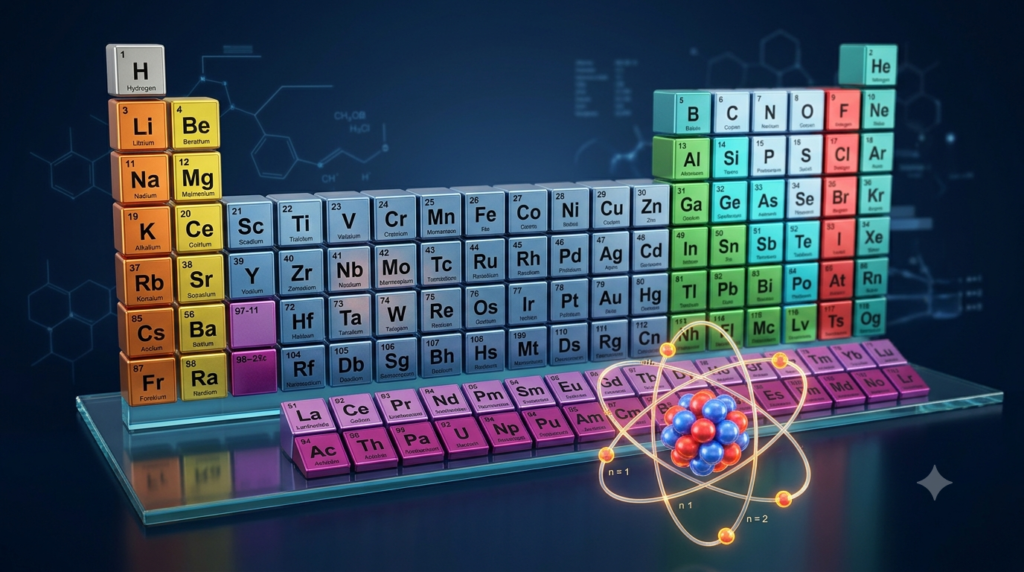
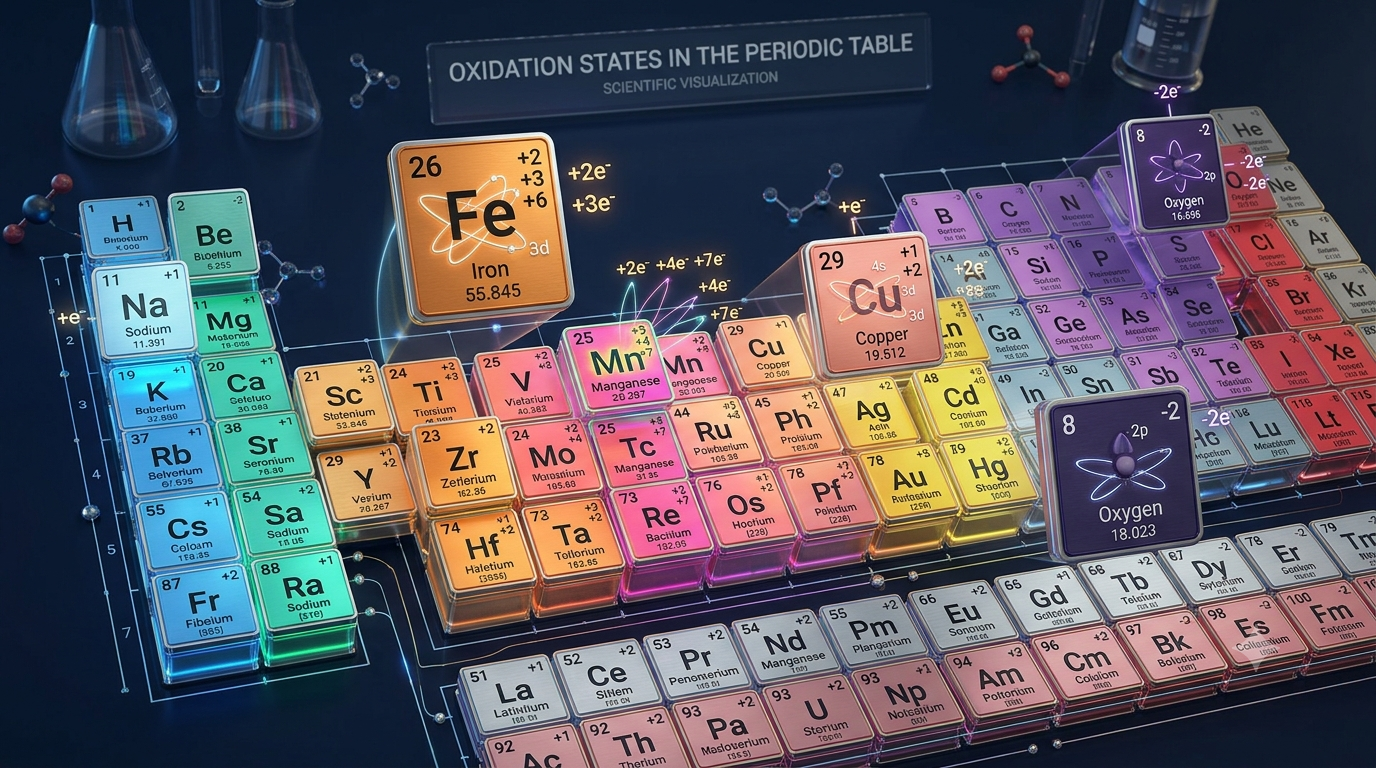
The oxidation states of elements vary across the periodic table. Their positions, electron configurations, electronegativities, and chemical environments influence the oxidation states they commonly exhibit.
The following sections provide an overview of the common oxidation states of elements belonging to different groups of the periodic table.
Oxidation States of Group 1 Elements
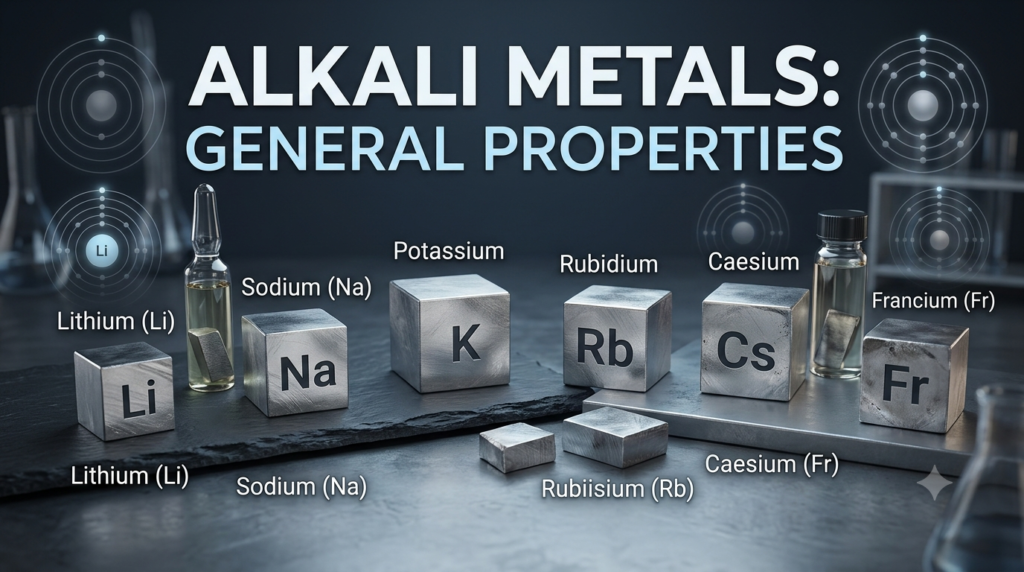
Group 1 elements are known as alkali metals. They include lithium, sodium, potassium, rubidium, caesium, and francium.
These elements have one electron in their outermost shell. They generally lose this electron when forming compounds and exhibit an oxidation state of +1.
Common oxidation states:
Lithium (Li): +1
Sodium (Na): +1
Potassium (K): +1
Rubidium (Rb): +1
Caesium (Cs): +1
Francium (Fr): +1
For example, sodium forms sodium chloride (NaCl), in which sodium has an oxidation state of +1.
Group 1 elements generally show a single common oxidation state because losing one outermost electron gives them a more stable electron configuration.
Oxidation States of Group 2 Elements
Group 2 elements are called alkaline earth metals. They include beryllium, magnesium, calcium, strontium, barium, and radium.
These elements have two electrons in their outermost shell. They generally lose both electrons and exhibit an oxidation state of +2.
Common oxidation states:
Beryllium (Be): +2
Magnesium (Mg): +2
Calcium (Ca): +2
Strontium (Sr): +2
Barium (Ba): +2
Radium (Ra): +2
For example, magnesium forms magnesium oxide (MgO), where magnesium has an oxidation state of +2.
Although +2 is the usual oxidation state of these elements, their chemical behaviour can differ because of variations in atomic size, ionisation energy, and bonding properties.
Oxidation States of Group 13 Elements
Group 13 elements include boron, aluminium, gallium, indium, thallium, and nihonium.
They generally have three electrons in their outermost shell. Their common oxidation states include +3 and, for some heavier elements, +1.
Common oxidation states:
Boron (B): +3
Aluminium (Al): +3
Gallium (Ga): +1, +3
Indium (In): +1, +3
Thallium (Tl): +1, +3
Nihonium (Nh): +1, +3 (predicted)
The +3 oxidation state is common among the lighter elements of this group. In heavier elements, the +1 oxidation state becomes increasingly stable.
This behaviour is associated with the inert pair effect, in which the outermost s-electron pair becomes less available for bonding.
For example, aluminium has an oxidation state of +3 in aluminium oxide (Al₂O₃).
Oxidation States of Group 14 Elements
Group 14 elements include carbon, silicon, germanium, tin, lead, and flerovium.
These elements have four valence electrons and can exhibit different oxidation states depending on their chemical environment.
Common oxidation states:
Carbon (C): −4, +2, +4
Silicon (Si): −4, +2, +4
Germanium (Ge): −4, +2, +4
Tin (Sn): +2, +4
Lead (Pb): +2, +4
Flerovium (Fl): +2, +4 (predicted)
Carbon exhibits a wide range of oxidation states. For example, carbon has an oxidation state of −4 in methane (CH₄), +2 in carbon monoxide (CO), and +4 in carbon dioxide (CO₂).
The +4 oxidation state is common among lighter members of this group, whereas the +2 oxidation state becomes more stable among heavier elements such as lead.
Oxidation States of Group 15 Elements
Group 15 elements are known as pnictogens. They include nitrogen, phosphorus, arsenic, antimony, bismuth, and moscovium.
They have five valence electrons and commonly exhibit oxidation states ranging from −3 to +5.
Common oxidation states:
Nitrogen (N): −3, −2, −1, +1, +2, +3, +4, +5
Phosphorus (P): −3, +1, +3, +5
Arsenic (As): −3, +3, +5
Antimony (Sb): −3, +3, +5
Bismuth (Bi): −3, +3, +5
Moscovium (Mc): +1, +3 (predicted)
Nitrogen shows a particularly wide range of oxidation states because of its ability to form different types of chemical compounds.
For example:
Nitrogen in ammonia (NH₃): −3
Nitrogen in nitric oxide (NO): +2
Nitrogen in nitrogen dioxide (NO₂): +4
Nitrogen in nitric acid (HNO₃): +5
The +3 oxidation state becomes increasingly important among the heavier elements of this group.
Oxidation States of Group 16 Elements
Group 16 elements are called chalcogens. They include oxygen, sulfur, selenium, tellurium, polonium, and livermorium.
These elements have six valence electrons. They commonly exhibit negative and positive oxidation states.
Common oxidation states:
Oxygen (O): −2, −1, +1, +2
Sulfur (S): −2, +2, +4, +6
Selenium (Se): −2, +2, +4, +6
Tellurium (Te): −2, +2, +4, +6
Polonium (Po): −2, +2, +4, +6
Livermorium (Lv): +2, +4 (predicted)
Oxygen usually exhibits an oxidation state of −2 in most compounds. However, it behaves differently in certain substances.
For example:
Oxygen in water (H₂O): −2
Oxygen in hydrogen peroxide (H₂O₂): −1
Oxygen in oxygen difluoride (OF₂): +2
Oxygen in dioxygen difluoride (O₂F₂): +1
Sulfur can show several oxidation states. It has an oxidation state of −2 in hydrogen sulfide (H₂S), +4 in sulfur dioxide (SO₂), and +6 in sulfur trioxide (SO₃).
Oxidation States of Group 17 Elements
Group 17 elements are called halogens. They include fluorine, chlorine, bromine, iodine, astatine, and tennessine.
They have seven valence electrons and generally require one additional electron to achieve a stable electron configuration.
Common oxidation states:
Fluorine (F): −1
Chlorine (Cl): −1, +1, +3, +5, +7
Bromine (Br): −1, +1, +3, +5, +7
Iodine (I): −1, +1, +3, +5, +7
Astatine (At): −1, +1, +3, +5, +7
Tennessine (Ts): −1, +1, +3, +5 (predicted)
Fluorine is the most electronegative element and exhibits an oxidation state of −1 in its compounds.
Other halogens can exhibit positive oxidation states when bonded to more electronegative elements, particularly oxygen and fluorine.
For example:
Chlorine in sodium chloride (NaCl): −1
Chlorine in hypochlorous acid (HClO): +1
Chlorine in chlorous acid (HClO₂): +3
Chlorine in chloric acid (HClO₃): +5
Chlorine in perchloric acid (HClO₄): +7
Oxidation States of Group 18 Elements
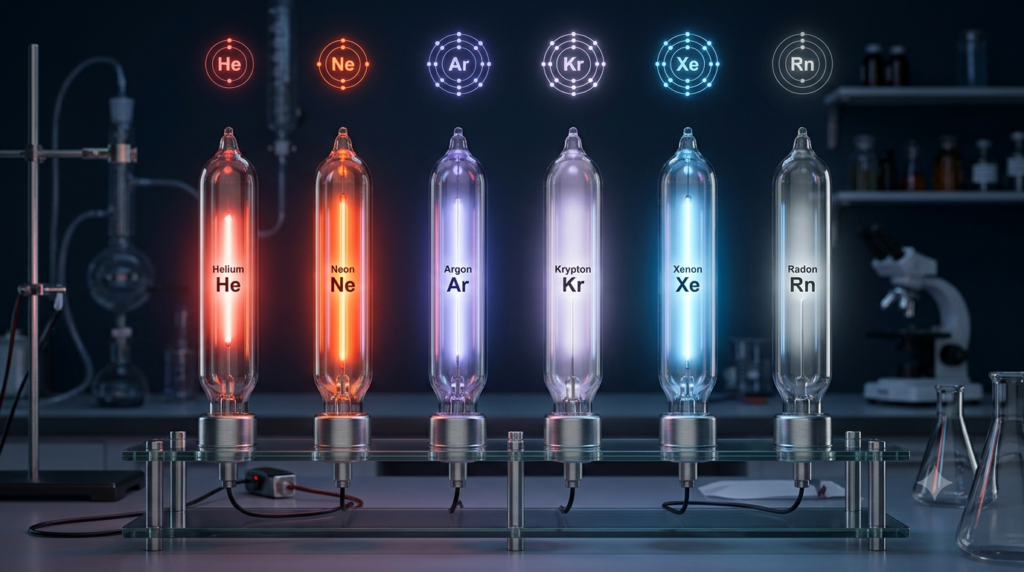
Group 18 elements are called noble gases. They include helium, neon, argon, krypton, xenon, radon, and oganesson.
These elements have stable outer electron configurations and generally show an oxidation state of 0 in their elemental forms.
Common oxidation states:
Helium (He): 0
Neon (Ne): 0
Argon (Ar): 0
Krypton (Kr): 0, +2
Xenon (Xe): 0, +2, +4, +6, +8
Radon (Rn): 0, +2 (limited known chemistry)
Oganesson (Og): 0 (predicted)
Noble gases were traditionally considered chemically inert. However, some heavier noble gases, particularly xenon, can form chemical compounds.
For example, xenon exhibits an oxidation state of +2 in XeF₂, +4 in XeF₄, and +6 in XeF₆.
Oxidation States of Transition Elements
Transition elements are found in Groups 3 to 12 of the periodic table. They are also known as transition metals.
Unlike many representative elements, transition metals frequently exhibit multiple oxidation states.
This happens because the energy difference between their outermost s-electrons and nearby d-electrons is relatively small. As a result, different numbers of electrons can participate in chemical bonding.
Some common oxidation states of transition elements are:
| Element | Symbol | Common oxidation states |
|---|---|---|
| Scandium | Sc | +3 |
| Titanium | Ti | +2, +3, +4 |
| Vanadium | V | +2, +3, +4, +5 |
| Chromium | Cr | +2, +3, +6 |
| Manganese | Mn | +2, +3, +4, +6, +7 |
| Iron | Fe | +2, +3 |
| Cobalt | Co | +2, +3 |
| Nickel | Ni | +2, +3 |
| Copper | Cu | +1, +2 |
| Zinc | Zn | +2 |
Some examples help explain these oxidation states:
Iron has an oxidation state of +2 in FeO and +3 in Fe₂O₃.
Copper has an oxidation state of +1 in Cu₂O and +2 in CuO.
Chromium has an oxidation state of +3 in Cr₂O₃ and +6 in CrO₃.
Manganese has an oxidation state of +7 in KMnO₄.
The ability to exhibit different oxidation states makes transition metals important in industrial chemistry, catalysis, metallurgy, and biological systems.
Oxidation States of Lanthanides
Lanthanides are a series of 15 elements with atomic numbers 57 to 71. They are also called rare-earth elements.
Most lanthanides commonly exhibit an oxidation state of +3. However, some can also show +2 or +4 under suitable chemical conditions.
Common oxidation states:
Lanthanum (La): +3
Cerium (Ce): +3, +4
Praseodymium (Pr): +3, +4
Neodymium (Nd): +3
Promethium (Pm): +3
Samarium (Sm): +2, +3
Europium (Eu): +2, +3
Gadolinium (Gd): +3
Terbium (Tb): +3, +4
Dysprosium (Dy): +3
Holmium (Ho): +3
Erbium (Er): +3
Thulium (Tm): +2, +3
Ytterbium (Yb): +2, +3
Lutetium (Lu): +3
The +3 oxidation state is dominant because lanthanides generally lose two 6s electrons and one additional electron during compound formation.
Oxidation States of Actinides
Actinides are a series of 15 elements with atomic numbers 89 to 103. They include actinium, thorium, uranium, plutonium, and other elements.
Many actinides can exhibit several oxidation states because their 5f, 6d, and 7s electrons can participate in chemical bonding.
Common oxidation states:
Actinium (Ac): +3
Thorium (Th): +4
Protactinium (Pa): +4, +5
Uranium (U): +3, +4, +5, +6
Neptunium (Np): +3, +4, +5, +6, +7
Plutonium (Pu): +3, +4, +5, +6, +7
Americium (Am): +2, +3, +4, +5, +6
Curium (Cm): +3, +4
Berkelium (Bk): +3, +4
Californium (Cf): +2, +3, +4
Einsteinium (Es): +2, +3
Fermium (Fm): +2, +3
Mendelevium (Md): +2, +3
Nobelium (No): +2, +3
Lawrencium (Lr): +3
Uranium is a well-known example because it commonly exhibits +4 and +6 oxidation states in its compounds.
For example, uranium has an oxidation state of +6 in uranium hexafluoride (UF₆).
Rules for Determining Oxidation States
There are several important rules that help determine the oxidation state of an element in a chemical compound.
1. Oxidation State of Free Elements
The oxidation state of an element in its free or uncombined form is always zero.
Examples:
Hydrogen (H₂): 0
Oxygen (O₂): 0
Nitrogen (N₂): 0
Iron (Fe): 0
Sulfur (S₈): 0
2. Oxidation State of Monoatomic Ions
The oxidation state of a monoatomic ion is equal to its ionic charge.
Examples:
Na⁺: +1
Mg²⁺: +2
Al³⁺: +3
Cl⁻: −1
O²⁻: −2
3. Oxidation State of Group 1 Elements
Group 1 elements generally have an oxidation state of +1 in their compounds.
For example, sodium in NaCl has an oxidation state of +1.
4. Oxidation State of Group 2 Elements
Group 2 elements generally exhibit an oxidation state of +2 in their compounds.
For example, calcium in CaCl₂ has an oxidation state of +2.
5. Oxidation State of Fluorine
Fluorine always has an oxidation state of −1 in its compounds.
For example, fluorine in HF has an oxidation state of −1.
6. Oxidation State of Oxygen
Oxygen usually has an oxidation state of −2.
However, there are important exceptions:
In peroxides, oxygen is −1.
In superoxides, the average oxidation state of oxygen is −½.
In OF₂, oxygen is +2.
In O₂F₂, oxygen has an average oxidation state of +1.
7. Oxidation State of Hydrogen
Hydrogen generally has an oxidation state of +1 when bonded to nonmetals.
In metal hydrides, it usually has an oxidation state of −1.
Examples:
H₂O: +1
HCl: +1
NaH: −1
CaH₂: −1
8. Sum of Oxidation States in Neutral Compounds
The sum of the oxidation states of all atoms in a neutral compound is always zero.
For example, in H₂O:
2(+1) + (−2) = 0
Therefore, the oxidation state of oxygen is −2.
9. Sum of Oxidation States in Polyatomic Ions
The sum of oxidation states of all atoms in a polyatomic ion is equal to the overall charge of the ion.
For example, in the sulfate ion (SO₄²⁻):
S + 4(−2) = −2
S − 8 = −2
S = +6
Therefore, sulfur has an oxidation state of +6.
How to Calculate Oxidation States
Calculating oxidation states becomes easier when the basic rules are understood.
Example 1: Oxidation State of Sulfur in H₂SO₄
Sulfuric acid has the chemical formula H₂SO₄.
Known oxidation states:
Hydrogen = +1
Oxygen = −2
Sulfur = x
The sum of oxidation states in a neutral compound is zero.
2(+1) + x + 4(−2) = 0
2 + x − 8 = 0
x − 6 = 0
x = +6
Therefore, the oxidation state of sulfur in H₂SO₄ is +6.
Example 2: Oxidation State of Nitrogen in HNO₃
Nitric acid has the formula HNO₃.
Known oxidation states:
Hydrogen = +1
Oxygen = −2
Nitrogen = x
(+1) + x + 3(−2) = 0
1 + x − 6 = 0
x = +5
Therefore, nitrogen has an oxidation state of +5.
Example 3: Oxidation State of Manganese in KMnO₄
Potassium permanganate has the formula KMnO₄.
Known oxidation states:
Potassium = +1
Oxygen = −2
Manganese = x
(+1) + x + 4(−2) = 0
1 + x − 8 = 0
x = +7
Therefore, manganese has an oxidation state of +7.
Difference Between Oxidation State and Valency
Oxidation state and valency are related chemical concepts, but they do not have exactly the same meaning.
Valency refers to the combining capacity of an atom, while oxidation state represents the formal charge assigned to an atom using oxidation-state rules.
The main differences are:
| Oxidation State | Valency |
|---|---|
| It can be positive, negative, or zero. | It is generally expressed as a non-negative whole number. |
| It can change depending on the compound. | It represents the combining capacity of an atom. |
| It is written with a sign, such as +2 or −1. | It is written without a positive or negative sign. |
| It is useful in redox reactions. | It is useful in understanding chemical combination. |
| It is assigned using specific rules. | It is based on the combining capacity of an element. |
For example, iron can exhibit oxidation states of +2 and +3. Its valency is commonly described as 2 or 3 in the corresponding compounds.
Importance of Oxidation States in Chemistry
Oxidation states are useful in many areas of chemistry because they provide information about electron transfer and chemical behaviour.
1. Understanding Redox Reactions
Oxidation states help identify oxidation and reduction in chemical reactions. An increase in oxidation state indicates oxidation, while a decrease indicates reduction.
2. Writing Chemical Formulas
They help determine the correct proportions of elements in ionic compounds. For example, magnesium has an oxidation state of +2 and chlorine has −1, resulting in the formula MgCl₂.
3. Studying Chemical Reactions
Oxidation states help chemists understand how elements change during chemical reactions.
4. Understanding Transition Metals
Many transition metals exhibit multiple oxidation states. Studying these states helps explain their different compounds, colours, and chemical properties.
5. Industrial Applications
Oxidation-state concepts are important in metal extraction, electroplating, batteries, corrosion prevention, and chemical manufacturing.
6. Biological Processes
Several biological processes involve changes in oxidation states. Cellular respiration, photosynthesis, and electron transport are important examples.
Conclusion
Oxidation states are fundamental to understanding the chemical behaviour of elements in the periodic table. They indicate the formal distribution of electrons in chemical compounds and help explain how elements combine and participate in chemical reactions.
Different elements exhibit different oxidation states depending on their electronic configurations and chemical environments. While alkali metals generally show +1 and alkaline earth metals usually show +2, transition metals, lanthanides, and actinides can exhibit multiple oxidation states.
Understanding the rules for assigning and calculating oxidation states makes it easier to study chemical formulas, redox reactions, inorganic compounds, and many other topics in chemistry. It provides an essential foundation for understanding how elements interact and change during chemical processes.
FAQs
1. What is the oxidation state of an element?
The oxidation state of an element is the hypothetical charge assigned to an atom in a chemical compound according to specific chemical rules. It indicates how electrons are formally distributed between atoms during chemical bonding. Oxidation states can be positive, negative, or zero. For example, sodium has an oxidation state of +1 in sodium chloride (NaCl), while chlorine has an oxidation state of −1. Oxidation states help chemists understand chemical bonding, identify oxidation and reduction, and study the behaviour of elements in different chemical reactions.
2. What are the common oxidation states of elements in the periodic table?
The common oxidation states of elements depend on their positions in the periodic table and their electronic configurations. Group 1 elements generally show +1, while Group 2 elements usually show +2. Group 17 elements commonly exhibit −1, although heavier halogens can also show positive oxidation states. Oxygen generally shows −2, and hydrogen usually shows +1. Transition metals such as iron, copper, and manganese can exhibit multiple oxidation states. For example, iron commonly shows +2 and +3, while manganese can exhibit several oxidation states, including +2, +4, and +7.
3. Why do elements have different oxidation states?
Elements exhibit different oxidation states because of differences in their electronic configurations, chemical bonding, and electronegativity. Some elements can lose, gain, or formally share different numbers of electrons depending on the substances they form. Transition metals particularly show multiple oxidation states because their outermost s-electrons and nearby d-electrons can participate in chemical bonding. For example, iron exhibits +2 and +3 oxidation states, while manganese can show several values. The chemical environment and the other elements present in a compound also influence the oxidation state of an element.
4. What is the oxidation state of oxygen in most compounds?
Oxygen generally has an oxidation state of −2 in most chemical compounds because it is highly electronegative and tends to attract electrons towards itself. However, there are some important exceptions. In hydrogen peroxide (H₂O₂), oxygen has an oxidation state of −1. In superoxides, its average oxidation state is −½. When oxygen combines with fluorine, its oxidation state becomes positive because fluorine is more electronegative. For example, oxygen has an oxidation state of +2 in oxygen difluoride (OF₂). These exceptions are important when calculating oxidation states in chemical compounds.
5. What is the difference between oxidation state and valency?
Oxidation state and valency are related but different chemical concepts. Oxidation state represents the hypothetical charge assigned to an atom in a compound, while valency describes the combining capacity of an element. Oxidation states can be positive, negative, or zero and are written with signs, such as +2 or −1. Valency is generally expressed as a non-negative whole number without a positive or negative sign. For example, iron can show oxidation states of +2 and +3, corresponding to commonly described valencies of 2 and 3 in those compounds.
6. How do you calculate the oxidation state of an element?
To calculate the oxidation state of an element, first identify the known oxidation states of the other atoms in the compound. Then apply the rule that the sum of all oxidation states in a neutral compound must equal zero. For a polyatomic ion, the sum must equal the overall ionic charge. For example, in H₂SO₄, hydrogen has an oxidation state of +1 and oxygen has −2. Let the oxidation state of sulfur be x. The equation is 2(+1) + x + 4(−2) = 0. Solving gives x = +6.
7. Which elements show multiple oxidation states?
Many elements show multiple oxidation states, particularly transition metals. Iron commonly exhibits +2 and +3, copper shows +1 and +2, and chromium exhibits +2, +3, and +6. Manganese can show oxidation states ranging from +2 to +7 in different compounds. Some nonmetals also exhibit multiple oxidation states. For example, sulfur shows −2, +2, +4, and +6, while nitrogen can exhibit several oxidation states from −3 to +5. The availability of different electrons for chemical bonding and the stability of resulting compounds influence these variations.
8. Why do transition metals exhibit variable oxidation states?
Transition metals exhibit variable oxidation states because their outermost s-electrons and nearby d-electrons have relatively similar energy levels. Consequently, different numbers of these electrons can participate in chemical bonding. This allows transition metals to form compounds with different oxidation states. For example, iron commonly exhibits +2 and +3, while manganese can show +2, +3, +4, +6, and +7. Variable oxidation states also influence the colours, magnetic properties, and chemical reactivity of many transition metal compounds. This characteristic makes transition metals important in industrial chemistry, catalysis, and biological processes.
9. What is the oxidation state of an element in its free form?
The oxidation state of an element in its free or uncombined elemental form is always zero. This rule applies whether the element exists as individual atoms, molecules, or larger structures. For example, hydrogen in H₂, oxygen in O₂, nitrogen in N₂, and chlorine in Cl₂ all have an oxidation state of zero. Similarly, metals such as iron (Fe), copper (Cu), and sodium (Na) have an oxidation state of zero in their elemental forms. However, when these elements form compounds or ions, their oxidation states may change according to the applicable chemical rules.
10. Why are oxidation states important in chemistry?
Oxidation states are important because they help explain how electrons are formally distributed in chemical compounds and how elements behave during chemical reactions. They are particularly useful for identifying oxidation and reduction in redox reactions. They also help determine chemical formulas, understand the properties of transition metal compounds, and balance certain chemical equations. Oxidation states have practical applications in batteries, corrosion prevention, metal extraction, electroplating, and industrial chemical manufacturing. They are also useful for understanding biological processes such as cellular respiration and photosynthesis, where electron-transfer reactions play an essential role.