Chemistry is the study of matter, its properties, composition, and the changes it undergoes. To understand chemical substances and their reactions, scientists need a simple and standard way to represent different elements. This is where chemical symbols become important.
A chemical symbol is a short form used to represent a chemical element. Instead of writing the complete name of an element every time, chemists use one or two letters to identify it. For example, H represents Hydrogen, O represents Oxygen, C represents Carbon, and Fe represents Iron.
Chemical symbols are used throughout chemistry, especially in the periodic table, chemical formulas, and chemical equations. They make scientific communication easier, save time, and provide a universal language that scientists can understand regardless of their native language.
In this article, we will learn what chemical symbols are, how they are written, why some symbols differ from element names, and how they are represented in the periodic table.
What Are Chemical Symbols?
A chemical symbol is an internationally recognized abbreviation used to represent a particular chemical element. Every officially recognized chemical element has its own unique symbol.
Most chemical symbols consist of one or two letters, although some recently discovered elements have temporary systematic symbols during the naming process.
For example:
H – Hydrogen
He – Helium
Li – Lithium
Be – Beryllium
C – Carbon
N – Nitrogen
O – Oxygen
Na – Sodium
Mg – Magnesium
Cl – Chlorine
Ca – Calcium
Fe – Iron
These symbols represent elements rather than individual atoms or specific quantities of an element. However, in a chemical equation or formula, their meaning can be understood from the surrounding notation.
For example, H₂O represents water. It contains hydrogen and oxygen, with two hydrogen atoms for every one oxygen atom.
Chemical symbols are essential because they allow scientists to describe elements, compounds, and chemical reactions using a consistent system.
History of Chemical Symbols
The use of symbols to represent substances has existed for thousands of years. Ancient civilizations used different signs and drawings to identify metals, minerals, and other materials.
During the development of modern chemistry, scientists recognized the need for a more systematic method of representing elements.
The Swedish chemist Jöns Jacob Berzelius played an important role in developing the modern system of chemical symbols in the early nineteenth century.
Before his system became widely accepted, different scientists used different signs and notations to represent elements. This made scientific communication difficult.
Berzelius introduced a simpler system based mainly on the first one or two letters of an element’s Latin or other historical name. His system made chemical notation easier to understand and use.
For example:
H represents Hydrogen.
O represents Oxygen.
C represents Carbon.
Fe represents Iron, from its Latin name Ferrum.
Au represents Gold, from its Latin name Aurum.
This system became the foundation of modern chemical notation and is still used today.
Rules for Writing Chemical Symbols
Chemical symbols follow specific rules. These rules help maintain consistency and prevent confusion when writing chemical formulas and equations.
1. Chemical Symbols Begin with a Capital Letter
The first letter of every chemical symbol is always written in uppercase.
Examples:
H – Hydrogen
C – Carbon
O – Oxygen
N – Nitrogen
S – Sulfur
Writing the first letter in uppercase makes chemical symbols easy to recognize.
2. The Second Letter Is Always Lowercase
If a chemical symbol contains two letters, the second letter must always be lowercase.
Examples:
He – Helium
Li – Lithium
Be – Beryllium
Ne – Neon
Na – Sodium
Mg – Magnesium
Ca – Calcium
It is important to understand the difference between uppercase and lowercase letters.
For example, Co represents Cobalt, while CO represents Carbon Monoxide when written as a chemical formula. Similarly, the symbol for Calcium is Ca, not CA.
Correct capitalization is essential in chemistry because changing the case of a letter can change the meaning of a chemical notation.
3. Most Symbols Contain One or Two Letters
Most chemical elements have symbols consisting of one or two letters.
Examples of one-letter symbols:
H – Hydrogen
B – Boron
C – Carbon
N – Nitrogen
O – Oxygen
F – Fluorine
P – Phosphorus
S – Sulfur
Examples of two-letter symbols:
He – Helium
Li – Lithium
Na – Sodium
Al – Aluminium
Si – Silicon
Ar – Argon
Fe – Iron
Cu – Copper
The use of short symbols makes chemical notation compact and convenient.
4. Each Element Has a Unique Symbol
Every officially recognized chemical element has its own distinct chemical symbol.
For example, H represents Hydrogen, while He represents Helium. Although both symbols begin with H, their second letters make them different.
This uniqueness helps scientists identify elements accurately in chemical formulas, laboratory experiments, and scientific research.
Why Do Some Chemical Symbols Differ from Element Names?
Many chemical symbols are formed from the first letter or first two letters of their English names. However, some symbols appear different from the names commonly used in English.
This happens because several chemical symbols come from the Latin or historical names of elements.
For example:
| Element Name | Chemical Symbol | Latin or Historical Name |
|---|---|---|
| Sodium | Na | Natrium |
| Potassium | K | Kalium |
| Iron | Fe | Ferrum |
| Copper | Cu | Cuprum |
| Silver | Ag | Argentum |
| Gold | Au | Aurum |
| Mercury | Hg | Hydrargyrum |
| Lead | Pb | Plumbum |
| Tin | Sn | Stannum |
| Antimony | Sb | Stibium |
These symbols were developed from historical naming traditions and became internationally accepted.
Understanding their origins makes it easier to remember some of the less obvious chemical symbols.
Chemical Symbols of Important Elements
The periodic table contains 118 officially recognized chemical elements. Each element has a unique name, symbol, and atomic number.
The following table shows some important elements and their chemical symbols.
| Atomic Number | Element | Symbol |
|---|---|---|
| 1 | Hydrogen | H |
| 2 | Helium | He |
| 3 | Lithium | Li |
| 4 | Beryllium | Be |
| 5 | Boron | B |
| 6 | Carbon | C |
| 7 | Nitrogen | N |
| 8 | Oxygen | O |
| 9 | Fluorine | F |
| 10 | Neon | Ne |
| 11 | Sodium | Na |
| 12 | Magnesium | Mg |
| 13 | Aluminium | Al |
| 14 | Silicon | Si |
| 15 | Phosphorus | P |
| 16 | Sulfur | S |
| 17 | Chlorine | Cl |
| 18 | Argon | Ar |
| 19 | Potassium | K |
| 20 | Calcium | Ca |
| 24 | Chromium | Cr |
| 25 | Manganese | Mn |
| 26 | Iron | Fe |
| 27 | Cobalt | Co |
| 28 | Nickel | Ni |
| 29 | Copper | Cu |
| 30 | Zinc | Zn |
| 35 | Bromine | Br |
| 47 | Silver | Ag |
| 50 | Tin | Sn |
| 53 | Iodine | I |
| 56 | Barium | Ba |
| 79 | Gold | Au |
| 80 | Mercury | Hg |
| 82 | Lead | Pb |
| 92 | Uranium | U |
These symbols are commonly used in chemistry textbooks, laboratory work, chemical formulas, and scientific discussions.
How Are Chemical Symbols Represented in the Periodic Table?
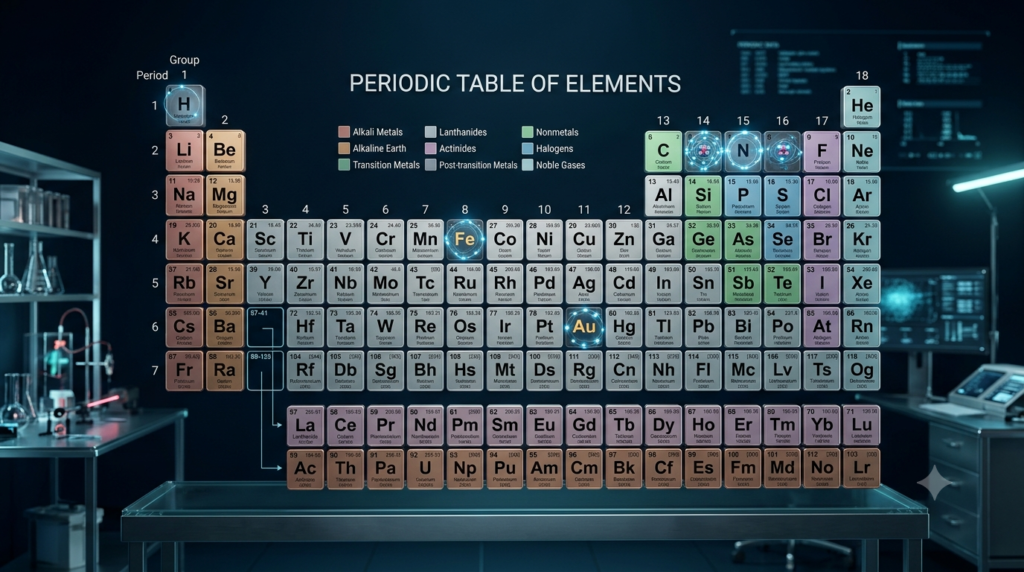
The periodic table is a systematic arrangement of chemical elements based on their increasing atomic numbers and recurring chemical properties.
Each element is displayed in an individual box or cell. These boxes contain important information that helps identify and understand the element.
Although the exact design can vary between periodic tables, most standard versions display the following information.
1. Atomic Number
The atomic number is usually displayed near the top of an element’s box.
It represents the number of protons present in the nucleus of an atom.
For example:
Hydrogen has atomic number 1.
Carbon has atomic number 6.
Oxygen has atomic number 8.
Sodium has atomic number 11.
Iron has atomic number 26.
The atomic number is one of the most important identifying properties of an element.
Every element has a unique atomic number. This number determines its position in the periodic table.
2. Chemical Symbol
The chemical symbol is generally displayed prominently in the centre of an element’s box.
For example, the symbol H appears in the Hydrogen box, while O appears in the Oxygen box.
The symbol is usually written in a larger font than the other information because it is the primary abbreviation used to identify the element.
3. Element Name
The complete name of the element is generally written below its chemical symbol.
For example:
H – Hydrogen
C – Carbon
O – Oxygen
Na – Sodium
Fe – Iron
The element name helps readers understand which element the symbol represents.
4. Atomic Mass
The relative atomic mass is commonly displayed near the bottom of an element’s box.
It represents the weighted average mass of the naturally occurring isotopes of an element, taking their relative abundances into account. For elements without characteristic natural isotopic abundances, some periodic tables display the mass number of a representative isotope instead.
For example:
Hydrogen – approximately 1.008
Carbon – approximately 12.011
Oxygen – approximately 15.999
Sodium – approximately 22.990
Iron – approximately 55.845
Atomic mass is useful in chemical calculations, particularly when determining the masses of substances involved in chemical reactions.
Understanding an Element’s Box in the Periodic Table
An element’s box provides several pieces of information in a compact format.
Consider Carbon as an example:
Atomic number: 6
Chemical symbol: C
Element name: Carbon
Relative atomic mass: approximately 12.011
The atomic number 6 tells us that a neutral carbon atom contains six protons and six electrons.
The symbol C is the internationally accepted short form for Carbon.
The element name identifies the substance, while the relative atomic mass provides information about its average atomic mass.
Similarly, the box for Oxygen contains its atomic number, symbol O, element name, and relative atomic mass.
Learning to read these boxes helps students and other readers understand the information presented in the periodic table.
Relationship Between Chemical Symbols and Atomic Numbers
Chemical symbols and atomic numbers are closely connected.
A chemical symbol identifies an element using letters, while its atomic number identifies it using a number.
For example:
H represents Hydrogen, which has atomic number 1.
C represents Carbon, which has atomic number 6.
O represents Oxygen, which has atomic number 8.
Na represents Sodium, which has atomic number 11.
Fe represents Iron, which has atomic number 26.
The atomic number is particularly important because it determines the identity of an element.
For example, every atom containing six protons is a carbon atom, regardless of how many neutrons it contains.
If the number of protons changes, the atom becomes a different element.
Chemical symbols and atomic numbers therefore provide two complementary ways of identifying elements.
Chemical Symbols in Chemical Formulas
Chemical symbols are not limited to the periodic table. They are also used to represent elements in chemical formulas.
A chemical formula shows which elements are present in a substance and the relative number of atoms of each element.
For example:
Water (H₂O)
The chemical formula of water is H₂O.
It contains:
Two hydrogen atoms.
One oxygen atom.
The subscript 2 indicates that two hydrogen atoms are present. The absence of a subscript after O means that one oxygen atom is present.
Carbon Dioxide (CO₂)
The chemical formula of carbon dioxide is CO₂.
It contains:
One carbon atom.
Two oxygen atoms.
Sodium Chloride (NaCl)
The chemical formula of sodium chloride is NaCl.
It contains sodium and chlorine in a 1:1 ratio in its formula units.
Ammonia (NH₃)
The chemical formula of ammonia is NH₃.
It contains:
One nitrogen atom.
Three hydrogen atoms.
These examples demonstrate how chemical symbols help represent the composition of different substances in a simple and standardized manner.
Chemical Symbols in Chemical Equations
Chemical symbols are also used in chemical equations to represent chemical reactions.
A chemical equation describes how reactants are converted into products.
For example, the formation of water can be represented as:
2H₂ + O₂ → 2H₂O
In this equation:
H₂ represents hydrogen gas.
O₂ represents oxygen gas.
H₂O represents water.
The arrow indicates the direction of the chemical reaction.
The number 2 before H₂ and H₂O represents the coefficients.
The equation shows that hydrogen reacts with oxygen to produce water.
Chemical symbols make it possible to represent chemical reactions accurately without repeatedly writing the complete names of substances.
Temporary Symbols for Newly Discovered Elements
When a new chemical element is discovered and its identity is confirmed, it goes through an official naming and approval process.
Before an official name and symbol are approved, a temporary systematic name and symbol may be used.
These temporary symbols are based on the digits of the element’s atomic number.
For example, the temporary symbol for an element with atomic number 118 was Uuo, derived from its systematic temporary name Ununoctium.
However, this element was later officially named Oganesson and given the symbol Og.
Today, Og is its accepted chemical symbol.
This system allows scientists to refer to newly discovered elements in a consistent way while their official names are being established.
Importance of Chemical Symbols in Chemistry
Chemical symbols play an essential role in the study and practical application of chemistry.
1. Make Scientific Communication Easier
Chemical symbols provide a common language for scientists around the world.
For example, the symbol O represents Oxygen regardless of the language spoken by a scientist.
This makes international scientific communication more convenient.
2. Save Time and Space
Writing chemical symbols is much faster than repeatedly writing complete element names.
For example, writing NaCl is simpler and more convenient than writing sodium chloride every time.
3. Help in Understanding Chemical Formulas
Chemical symbols make it possible to identify the elements present in a compound.
For example, CO₂ immediately indicates the presence of Carbon and Oxygen.
4. Help in Writing Chemical Equations
Chemical reactions can be represented using symbols and formulas.
This makes chemical equations shorter, clearer, and easier to balance.
5. Support Scientific Research
Chemists use chemical symbols in laboratory reports, scientific publications, research papers, and industrial processes.
A standardized system helps reduce confusion when identifying chemical substances.
6. Make the Periodic Table Easier to Read
Chemical symbols allow readers to quickly identify elements and understand their positions in the periodic table.
They also help connect an element’s name, atomic number, and chemical properties.
Common Mistakes When Writing Chemical Symbols
Although chemical symbols are simple, beginners sometimes make mistakes when writing them.
Understanding these common errors can help improve accuracy.
1. Using Incorrect Capitalization
A common mistake is writing both letters of a two-letter symbol in uppercase.
For example:
Incorrect: NA
Correct: Na
The first letter must be uppercase, and the second letter must be lowercase.
2. Confusing Similar Symbols
Some elements have symbols that look similar.
For example:
Co represents Cobalt.
CO represents Carbon Monoxide when used as a chemical formula.
Similarly:
N represents Nitrogen.
Ne represents Neon.
Ni represents Nickel.
Carefully observing each letter helps prevent confusion.
3. Assuming Every Symbol Comes from the English Name
Some chemical symbols are based on Latin or historical names.
For example, Sodium has the symbol Na, and Potassium has the symbol K.
Learning these historical symbols is important for understanding the periodic table.
4. Confusing Chemical Symbols with Chemical Formulas
A chemical symbol represents an element, whereas a chemical formula represents a substance and its composition.
For example:
H is the symbol for Hydrogen.
H₂ is the formula for hydrogen gas.
H₂O is the formula for water.
Understanding this difference is important when studying chemical notation.
Conclusion
Chemical symbols are one of the most important foundations of modern chemistry. They provide short, internationally recognized representations of chemical elements and make scientific communication simple and consistent.
Each element has a unique symbol, generally consisting of one or two letters. These symbols follow specific capitalization rules and are displayed prominently in the periodic table alongside information such as atomic number, element name, and relative atomic mass.
Chemical symbols are also essential for writing chemical formulas and equations, understanding compounds, and describing chemical reactions. By learning the symbols of important elements and understanding how they are represented in the periodic table, anyone can build a strong foundation for studying chemistry.
FAQs
1. What are chemical symbols?
Chemical symbols are short, internationally recognized abbreviations used to represent chemical elements. They usually consist of one or two letters taken from an element’s name or historical name. For example, H represents Hydrogen, O represents Oxygen, and Na represents Sodium. Every officially recognized chemical element has its own unique symbol. Chemical symbols make it easier to write chemical formulas, represent chemical reactions, and communicate scientific information. They are used worldwide in textbooks, laboratories, research papers, and the periodic table.
2. Who introduced the modern system of chemical symbols?
The Swedish chemist Jöns Jacob Berzelius introduced the modern system of chemical symbols in the early nineteenth century. His system used one or two letters, generally derived from the names of elements, including their Latin names. The first letter was written in uppercase, while the second letter, when present, was written in lowercase. This system replaced many complicated symbols previously used by scientists. It made chemical notation simpler, more practical, and easier to understand. The modern system of chemical symbols is based on the principles established by Berzelius.
3. Why do some chemical symbols differ from element names?
Some chemical symbols differ from their commonly used English element names because they are derived from Latin or historical names. For example, Sodium has the symbol Na from Natrium, Potassium has K from Kalium, and Iron has Fe from Ferrum. Similarly, Gold is represented by Au from Aurum, and Silver by Ag from Argentum. These symbols developed through historical scientific naming conventions and became internationally accepted. Learning these symbols is important because they are frequently used in chemical formulas, equations, and periodic tables.
4. What are the rules for writing chemical symbols?
Chemical symbols follow specific capitalization rules. The first letter must always be uppercase. If a symbol contains a second letter, it must be lowercase. For example, Hydrogen is represented by H, while Helium is represented by He. Similarly, Sodium is Na, and Calcium is Ca. Most chemical symbols contain one or two letters. Every officially recognized element has a unique symbol. Following these rules is important because incorrect capitalization can change the meaning of chemical notation. For example, Co represents Cobalt, whereas CO represents Carbon Monoxide.
5. How are chemical symbols represented in the periodic table?
Chemical symbols are generally displayed prominently in the centre of each element’s box in the periodic table. They are usually accompanied by the atomic number, element name, and relative atomic mass. For example, the box for Oxygen displays its atomic number 8, symbol O, and element name Oxygen. The exact arrangement of this information may vary depending on the periodic table’s design. Chemical symbols help readers quickly identify elements and understand their positions in the periodic table.
6. What is the difference between a chemical symbol and a chemical formula?
A chemical symbol represents a single chemical element, whereas a chemical formula represents a substance by showing the elements present and their relative proportions. For example, H is the chemical symbol for Hydrogen, and O represents Oxygen. However, H₂O is the chemical formula for water, containing two hydrogen atoms and one oxygen atom. Similarly, Na represents Sodium, while NaCl represents sodium chloride. Chemical symbols are the basic units used to construct chemical formulas and describe the composition of different substances.
7. Why are chemical symbols important in chemistry?
Chemical symbols are important because they provide a simple and standardized way to represent chemical elements. They save time, reduce lengthy writing, and make scientific communication easier across different languages. Scientists use these symbols to write chemical formulas, represent reactions, identify elements, and explain chemical processes. They are also essential for understanding the periodic table and studying the composition of compounds. Without chemical symbols, representing complex chemical reactions and substances would be much more difficult. They form the foundation of modern chemical notation.
8. How many chemical elements are represented in the periodic table?
The modern periodic table contains 118 officially recognized chemical elements. Each element has a unique chemical symbol and atomic number. These elements are arranged in increasing order of atomic number, beginning with Hydrogen (H), which has atomic number 1, and ending with Oganesson (Og), which has atomic number 118. The elements include naturally occurring substances and elements produced artificially in laboratories. Their symbols help scientists identify and study their properties, chemical behaviour, and relationships with other elements.
9. What does the capitalization of chemical symbols mean?
Capitalization is an important part of chemical notation because it helps distinguish different elements and substances. The first letter of a chemical symbol is always uppercase, while the second letter, if present, is lowercase. For example, Co represents Cobalt, while CO represents Carbon Monoxide when written as a chemical formula. Similarly, Ca represents Calcium. Writing both letters in uppercase or using incorrect capitalization can create confusion. Therefore, understanding the correct use of uppercase and lowercase letters is essential when writing chemical symbols and formulas.
10. What information does an element’s box provide in the periodic table?
An element’s box in the periodic table generally provides its atomic number, chemical symbol, element name, and relative atomic mass. The atomic number indicates the number of protons in the nucleus, while the chemical symbol is the internationally accepted abbreviation for the element. The element name identifies the substance, and the relative atomic mass provides information about its average atomic mass based on its naturally occurring isotopes. Together, these details help readers identify elements, understand their basic atomic information, and study their chemical properties.