The periodic table is divided into different blocks based on the type of atomic orbital into which the last electron of an atom enters. One of these divisions is the f-block, which contains a special group of metallic elements known as the inner transition elements. These elements are placed separately at the bottom of the periodic table to keep its overall structure compact and organized.
The f-block elements include two important series: the lanthanoids and actinoids. Lanthanoids consist of elements in which the 4f orbitals are progressively filled, while actinoids involve the filling of 5f orbitals. These elements have several interesting chemical and physical properties, such as variable oxidation states, coloured ions, magnetic behaviour, and the formation of complex compounds.
The f-block elements are important in modern science and technology. They are used in electronics, energy production, medical applications, powerful magnets, and various industrial processes. Understanding their electronic configurations and general properties helps explain their behaviour and their position in the periodic table.
What Are f-Block Elements?
The f-block elements are those elements in which the differentiating electron enters the f-subshell of the penultimate electron shell. They are also called inner transition elements because the electron enters an inner f-orbital rather than the outermost shell.
The f-block is located at the bottom of the modern periodic table and consists of two horizontal series:
Lanthanoids (4f series)
Actinoids (5f series)
Each series generally contains 14 elements associated with the filling of seven f-orbitals. Since each orbital can accommodate two electrons, the f-subshell can hold a maximum of 14 electrons.
The elements of these two series have similar chemical properties within their respective groups, although differences also exist due to their electronic configurations.
Position of f-Block Elements in the Periodic Table
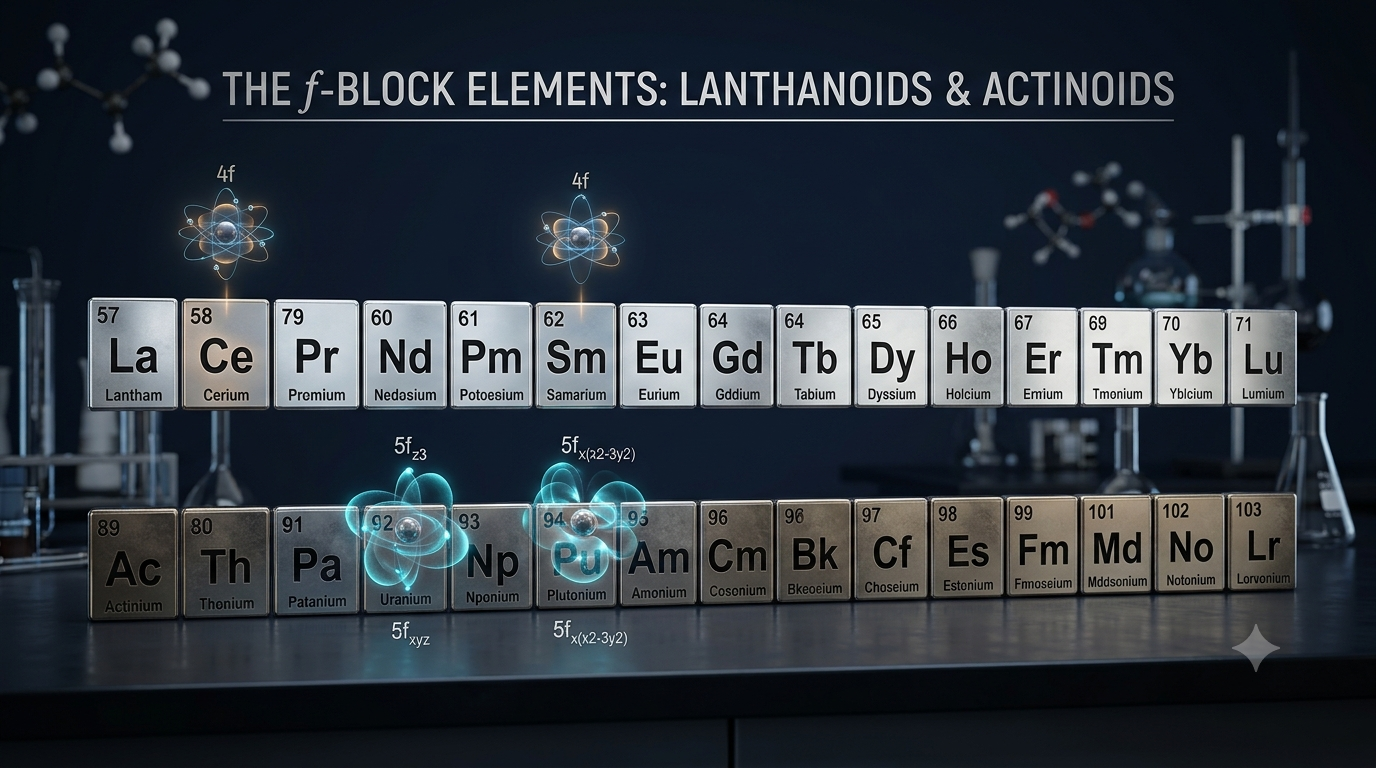
The f-block elements are usually displayed in two separate rows below the main body of the periodic table. This arrangement is used to maintain a convenient and compact shape of the periodic table.
The first series, known as the lanthanoids, is associated with the filling of the 4f orbitals. The second series, known as the actinoids, involves the filling of the 5f orbitals.
These two series belong to periods 6 and 7, respectively.
The f-block elements are positioned between the s-block and d-block regions in terms of their electronic filling sequence. However, their unique electronic configurations and properties distinguish them from other blocks.
Classification of f-Block Elements
The f-block elements are divided into two major series based on the type of f-orbital being filled.
1. Lanthanoids
The lanthanoids are a series of 14 elements generally associated with the filling of the 4f orbitals. They extend from cerium (Ce, atomic number 58) to lutetium (Lu, atomic number 71).
Lanthanum (La, atomic number 57) is usually discussed along with the lanthanoids because of its chemical similarities, although its electronic configuration does not contain a 4f electron.
The lanthanoids are generally silvery-white, soft, and reactive metals. Most of them commonly exhibit the +3 oxidation state.
They are used in various applications, including the manufacture of strong permanent magnets, glass polishing materials, optical devices, and electronic components.
2. Actinoids
The actinoids are a series of 14 elements generally associated with the filling of the 5f orbitals. They extend from thorium (Th, atomic number 90) to lawrencium (Lr, atomic number 103).
Actinium (Ac, atomic number 89) is also commonly included in discussions of the actinoid series because of its chemical relationship with these elements.
Most actinoids are radioactive, meaning their atomic nuclei are unstable and undergo radioactive decay. Some actinoids, such as uranium and plutonium, are particularly important in nuclear energy production.
Unlike the lanthanoids, actinoids show a wider range of oxidation states because their 5f, 6d, and 7s electrons can participate in chemical bonding.
Electronic Configuration of f-Block Elements
The electronic configuration of f-block elements is characterized by the progressive filling of the f-subshell.
The general electronic configuration of lanthanoids is:
[Xe] 4f⁰–¹⁴ 5d⁰–¹ 6s²
The general electronic configuration of actinoids is:
[Rn] 5f⁰–¹⁴ 6d⁰–¹ 7s²
Here, [Xe] represents the electronic configuration of xenon, while [Rn] represents that of radon.
In lanthanoids, electrons generally enter the 4f orbitals. Similarly, in actinoids, electrons progressively occupy the 5f orbitals.
However, the electronic configurations of these elements do not always follow a simple filling pattern. Small energy differences between f, d, and s orbitals can result in variations in their configurations.
For example:
Cerium (Ce): [Xe] 4f¹ 5d¹ 6s²
Gadolinium (Gd): [Xe] 4f⁷ 5d¹ 6s²
Europium (Eu): [Xe] 4f⁷ 6s²
Uranium (U): [Rn] 5f³ 6d¹ 7s²
These variations are important for understanding the chemical properties of f-block elements.
General Properties of f-Block Elements
The f-block elements exhibit several common physical and chemical properties. Although lanthanoids and actinoids share some similarities, they also have important differences.
1. Metallic Character
All f-block elements are metals. They generally have a shiny appearance when freshly prepared and show good electrical and thermal conductivity.
Most lanthanoids are silvery-white metals, while actinoids are also metallic in nature.
They are generally electropositive, meaning they tend to lose electrons and form positive ions during chemical reactions.
2. Atomic and Ionic Radii
The atomic and ionic radii of f-block elements generally decrease across their respective series.
This decrease occurs because the nuclear charge increases as the atomic number increases. However, the added electrons enter inner f-orbitals, which do not shield the increasing nuclear charge very effectively.
As a result, the outer electrons experience a stronger attraction towards the nucleus, causing a gradual decrease in atomic and ionic size.
This phenomenon is known as f-block contraction.
3. Lanthanoid Contraction
Lanthanoid contraction refers to the gradual decrease in the atomic and ionic radii of lanthanoids from lanthanum to lutetium.
It occurs because the nuclear charge increases across the series, while the 4f electrons provide relatively poor shielding.
The increasing effective nuclear charge pulls the electron cloud closer to the nucleus.
Lanthanoid contraction has several important consequences:
The lanthanoids have very similar chemical properties.
Their separation from one another becomes difficult.
The basic strength of their hydroxides generally decreases from lanthanum to lutetium.
Some elements of the 4d and 5d transition series have similar atomic sizes.
For example, zirconium (Zr) and hafnium (Hf) have nearly identical atomic and ionic radii, partly because of lanthanoid contraction.
4. Actinoid Contraction
Actinoid contraction is the gradual decrease in the atomic and ionic radii of actinoids with increasing atomic number.
This occurs mainly because the 5f electrons do not shield the increasing nuclear charge effectively.
Actinoid contraction is generally more complicated than lanthanoid contraction because the 5f electrons can participate more readily in chemical bonding.
This contraction influences the chemical behaviour, oxidation states, and complex formation of actinoid elements.
5. Oxidation States
The f-block elements exhibit different oxidation states, although certain oxidation states are more common.
Lanthanoids mainly show the +3 oxidation state. This is because they generally lose two 6s electrons and one additional electron from the 4f or 5d orbitals.
Some lanthanoids also exhibit +2 and +4 oxidation states.
Examples include:
Cerium (Ce): +3 and +4
Europium (Eu): +2 and +3
Ytterbium (Yb): +2 and +3
Samarium (Sm): +2 and +3
Actinoids show a wider range of oxidation states than lanthanoids. This happens because the energy differences between 5f, 6d, and 7s orbitals are relatively small.
For example:
Thorium (Th): +4
Uranium (U): +3, +4, +5, and +6
Neptunium (Np): several oxidation states, including +3 to +7
Plutonium (Pu): several oxidation states, including +3 to +7
The ability to exhibit multiple oxidation states makes actinoids chemically more complex.
6. Colour of Ions
Many f-block elements form coloured ions in aqueous solutions or solid compounds.
The colour of lanthanoid ions is mainly associated with electronic transitions within the 4f orbitals. These transitions occur when electrons absorb specific wavelengths of visible light and move between energy levels.
For example:
Neodymium (Nd³⁺) ions are often violet or pink.
Erbium (Er³⁺) ions are commonly pink.
Praseodymium (Pr³⁺) ions are generally green.
Some f-block ions are colourless because they have no possible f-f electronic transitions under ordinary conditions. For example, La³⁺ and Lu³⁺ have 4f⁰ and 4f¹⁴ configurations, respectively.
Many actinoid ions are also coloured due to electronic transitions involving their 5f orbitals.
7. Magnetic Properties
The magnetic properties of f-block elements are mainly related to the presence of unpaired electrons in their f-orbitals.
Elements containing unpaired electrons generally show paramagnetic behaviour. This means they are attracted towards an external magnetic field.
The magnetic behaviour depends on the number of unpaired electrons and their orbital and spin contributions.
Some f-block ions have strong magnetic properties, making them useful in the development of advanced magnetic materials.
For example, gadolinium is widely used in magnetic materials and certain medical imaging applications.
8. Formation of Complex Compounds
F-block elements can form complex compounds with different molecules and ions called ligands.
A ligand is an ion or molecule that donates an electron pair to a central metal ion, forming a coordinate bond.
Lanthanoid ions commonly form complexes with oxygen- and nitrogen-containing ligands.
Actinoids also form complexes, often with a wider variety of ligands because their 5f electrons can participate in bonding.
Complex formation is important in the separation, identification, and chemical processing of f-block elements.
9. Reactivity
Most f-block elements are chemically reactive metals.
Lanthanoids react with oxygen to form oxides and react with water to produce hydroxides and hydrogen gas. They also react with halogens to form halides.
Actinoids are generally reactive as well, although their reactivity varies from one element to another.
The chemical reactivity of these elements depends on factors such as atomic size, oxidation state, electronic configuration, and environmental conditions.
10. Radioactive Nature
One of the major differences between lanthanoids and actinoids is their radioactive behaviour.
Most naturally occurring lanthanoids have stable isotopes, although some isotopes are radioactive. Promethium, for example, has no stable isotopes.
All actinoids are radioactive. Their nuclei are unstable and release energy and particles during radioactive decay.
Some actinoids, such as uranium and thorium, occur naturally in the Earth’s crust. Other actinoids, particularly many heavier members of the series, are produced artificially through nuclear reactions.
Radioactivity makes actinoids important in nuclear science, but it also requires careful handling and appropriate radiation protection.
Difference Between Lanthanoids and Actinoids
Although lanthanoids and actinoids belong to the same f-block, they show several differences in their electronic structures and chemical properties.
| Basis | Lanthanoids | Actinoids |
|---|---|---|
| Orbital filling | 4f orbitals | 5f orbitals |
| Series | 4f series | 5f series |
| Period | 6th period | 7th period |
| Common oxidation state | Mainly +3 | Variable oxidation states |
| Radioactivity | Most have stable isotopes | All are radioactive |
| Contraction | Lanthanoid contraction | Actinoid contraction |
| Complex formation | Generally less extensive | Generally more extensive |
| Chemical bonding | Mostly ionic character | Greater variation in ionic and covalent character |
| Occurrence | Many occur naturally | Some occur naturally; many are synthetic |
| Examples | Cerium, Europium, Gadolinium | Uranium, Thorium, Plutonium |
Uses and Applications of f-Block Elements
The f-block elements play an important role in modern technology, industry, medicine, and energy production.
1. Permanent Magnets
Certain lanthanoids, particularly neodymium and samarium, are used to produce powerful permanent magnets.
Neodymium magnets are widely used in electric motors, wind turbines, headphones, speakers, and computer equipment.
2. Glass and Optical Materials
Cerium compounds are used in glass polishing and in the production of certain optical materials.
Some lanthanoid compounds are also used to produce coloured glass and improve the optical properties of materials.
3. Nuclear Energy
Uranium and plutonium are important materials in nuclear energy production.
Certain isotopes of these elements can undergo nuclear fission, releasing large amounts of energy. This energy can be used to generate electricity in nuclear power plants.
4. Medical Applications
Some f-block elements have important medical applications.
Gadolinium-based compounds are used as contrast agents in certain magnetic resonance imaging (MRI) procedures.
Certain radioactive isotopes of actinoid elements are also used in specialized medical and scientific applications.
5. Electronics and Technology
Lanthanoids are used in electronic devices, display screens, phosphors, lasers, and advanced materials.
For example, europium compounds are used in certain display and lighting technologies because of their ability to produce specific colours.
6. Scientific Research
Actinoids are important in nuclear chemistry, radiation research, and the study of atomic structure.
They help scientists understand nuclear reactions, radioactive decay, and the behaviour of heavy elements.
Importance of f-Block Elements in the Modern World
The importance of f-block elements continues to increase as technology develops.
Many modern devices depend on lanthanoid-based materials for their magnetic, optical, and electronic properties. Electric vehicles, renewable energy systems, communication devices, and advanced electronic equipment use materials containing certain rare earth elements.
Actinoids are especially important in nuclear science and energy production. Their radioactive properties make them valuable for specialized applications, although their use requires strict safety measures.
Research into f-block elements also supports the development of new materials, improved energy technologies, and advanced scientific instruments.
Conclusion
The f-block elements are an important part of the modern periodic table and are commonly known as inner transition elements. They consist of two series: lanthanoids and actinoids, which involve the filling of 4f and 5f orbitals, respectively.
These elements exhibit several characteristic properties, including metallic behaviour, variable oxidation states, coloured ions, magnetic properties, complex formation, and contraction across their series. Lanthanoids generally show a dominant +3 oxidation state, whereas actinoids exhibit a wider range of oxidation states and are all radioactive.
Because of their unique chemical and physical properties, f-block elements have significant applications in electronics, magnets, medicine, nuclear energy, and advanced materials. Studying these elements provides a better understanding of periodic trends and the relationship between electronic configuration and chemical behaviour.
FAQs
1. What are f-block elements?
The f-block elements are a group of metallic elements in which the differentiating electron enters the f-subshell of the penultimate electron shell. They are also known as inner transition elements because the electrons enter inner f-orbitals. These elements are placed in two separate rows at the bottom of the periodic table. They are divided into two series: lanthanoids and actinoids. The lanthanoids involve the filling of 4f orbitals, while the actinoids involve the filling of 5f orbitals. They are known for their unique electronic configurations, variable oxidation states, magnetic properties, and coloured ions.
2. Why are f-block elements called inner transition elements?
The f-block elements are called inner transition elements because the differentiating electron enters an inner f-subshell rather than the outermost shell. In these elements, the 4f or 5f orbitals are progressively filled. This makes their electronic configurations different from those of the s-block, p-block, and d-block elements. The filling of inner orbitals influences their chemical and physical properties, including atomic size, oxidation states, magnetic behaviour, and complex formation. The term inner transition elements distinguishes them from the d-block transition elements, in which the differentiating electron enters a d-subshell.
3. What are the two series of f-block elements?
The two series of f-block elements are lanthanoids and actinoids. Lanthanoids are associated with the filling of 4f orbitals and are generally represented by elements from cerium to lutetium, with lanthanum commonly included in the series. Actinoids are associated with the filling of 5f orbitals and generally extend from thorium to lawrencium, with actinium commonly included. Both series contain 14 elements associated with f-orbital filling. Lanthanoids are mostly non-radioactive, whereas all actinoids are radioactive. These two series show similarities as well as differences in their chemical and physical properties.
4. What is the general electronic configuration of f-block elements?
The general electronic configuration of lanthanoids is [Xe] 4f⁰–¹⁴ 5d⁰–¹ 6s², while that of actinoids is [Rn] 5f⁰–¹⁴ 6d⁰–¹ 7s². In these configurations, [Xe] and [Rn] represent the electronic configurations of xenon and radon, respectively. The f-orbitals are progressively filled as the atomic number increases. However, some elements show irregular electronic configurations because the energy differences between f, d, and s orbitals are relatively small. These electronic configurations help explain the characteristic chemical behaviour of f-block elements.
5. What is lanthanoid contraction?
Lanthanoid contraction is the gradual decrease in the atomic and ionic radii of lanthanoids with increasing atomic number from lanthanum to lutetium. This happens because the nuclear charge increases across the series, while the 4f electrons provide relatively poor shielding. Consequently, the outer electrons experience a stronger attraction towards the nucleus, reducing the size of the atoms and ions. Lanthanoid contraction explains why lanthanoids have very similar chemical properties and are difficult to separate. It also contributes to the nearly identical atomic sizes of certain 4d and 5d transition elements, such as zirconium and hafnium.
6. Why do f-block elements show variable oxidation states?
F-block elements show variable oxidation states because electrons from different orbitals can participate in chemical reactions. In lanthanoids, the +3 oxidation state is the most common, although some elements also exhibit +2 and +4 states. In actinoids, the energy differences between 5f, 6d, and 7s orbitals are relatively small. Therefore, different numbers of electrons can participate in bonding, resulting in several oxidation states. For example, uranium exhibits oxidation states such as +3, +4, +5, and +6. This variation makes actinoid chemistry more complex than lanthanoid chemistry.
7. Why are many f-block ions coloured?
Many f-block ions are coloured because their electrons can absorb specific wavelengths of visible light and undergo electronic transitions between energy levels within the f-orbitals. The remaining transmitted or reflected light produces the observed colour. In lanthanoids, these transitions generally occur between 4f energy levels, while in actinoids they involve 5f energy levels. The colour varies depending on the element and its oxidation state. However, not all f-block ions are coloured. For example, La³⁺ and Lu³⁺ ions are generally colourless because they have 4f⁰ and 4f¹⁴ configurations, respectively.
8. Why are actinoids radioactive?
Actinoids are radioactive because their atomic nuclei are unstable and undergo spontaneous radioactive decay. During this process, unstable nuclei release energy in the form of particles or electromagnetic radiation to reach more stable nuclear configurations. All actinoid elements are radioactive, although their half-lives vary considerably. Some actinoids, such as uranium and thorium, occur naturally in the Earth’s crust, while many heavier actinoids are produced artificially through nuclear reactions. Their radioactive properties make them important in nuclear energy production and scientific research, but they also require careful handling and appropriate radiation protection.
9. What are the important uses of f-block elements?
F-block elements have several important applications in modern science and technology. Lanthanoids such as neodymium and samarium are used to manufacture powerful permanent magnets. Cerium compounds are used in glass polishing, while europium compounds are useful in display and lighting technologies. Gadolinium-based compounds are used in certain MRI procedures. Actinoids such as uranium and plutonium are important in nuclear energy production because certain isotopes can undergo nuclear fission. Other f-block elements are used in lasers, optical materials, electronic devices, and scientific research because of their special magnetic, optical, and nuclear properties.
10. What is the main difference between lanthanoids and actinoids?
The main difference between lanthanoids and actinoids is the type of f-orbital being filled. Lanthanoids involve the progressive filling of 4f orbitals, whereas actinoids involve the filling of 5f orbitals. Lanthanoids mainly exhibit the +3 oxidation state and most have stable isotopes. In contrast, actinoids show a wider range of oxidation states, and all are radioactive. Actinoids also generally show greater variation in chemical bonding and complex formation. Both series are metallic inner transition elements, but their electronic structures give them different chemical and physical characteristics.