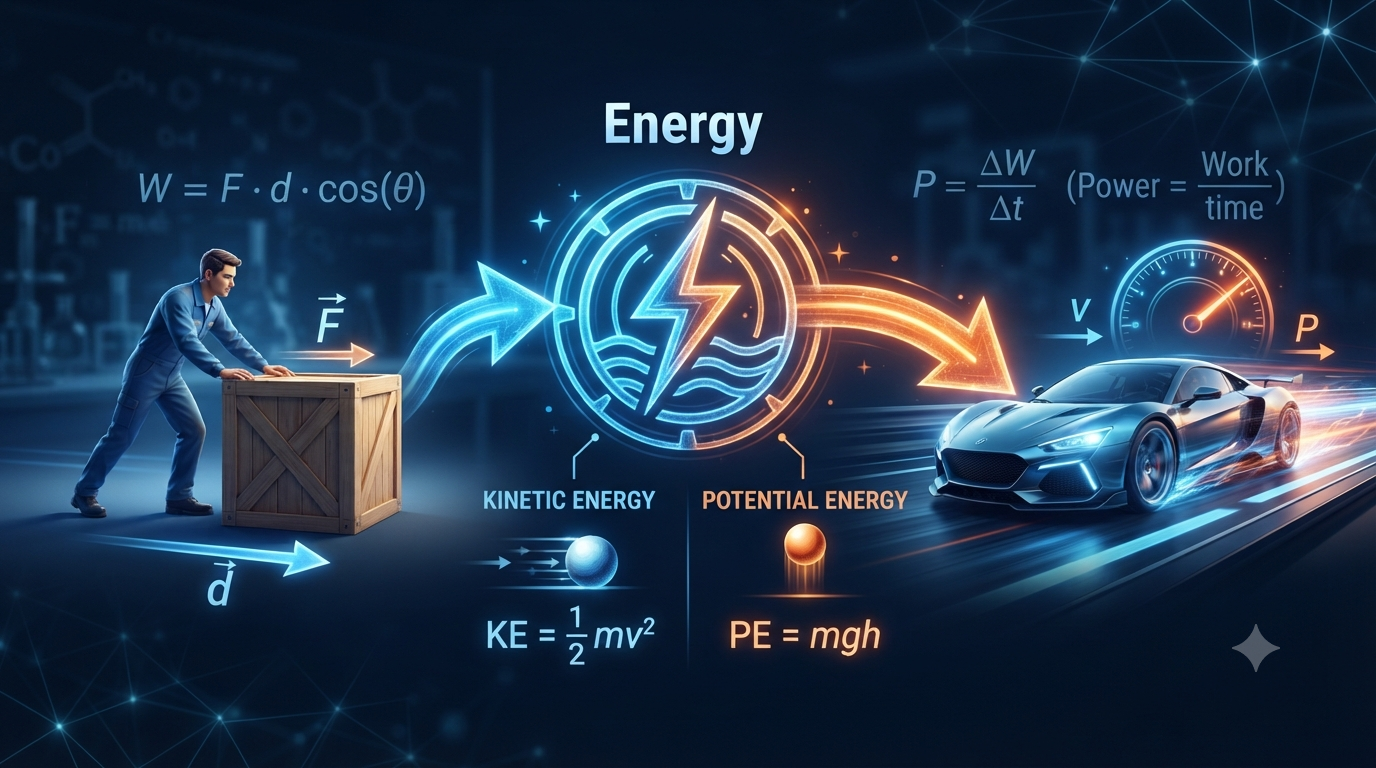
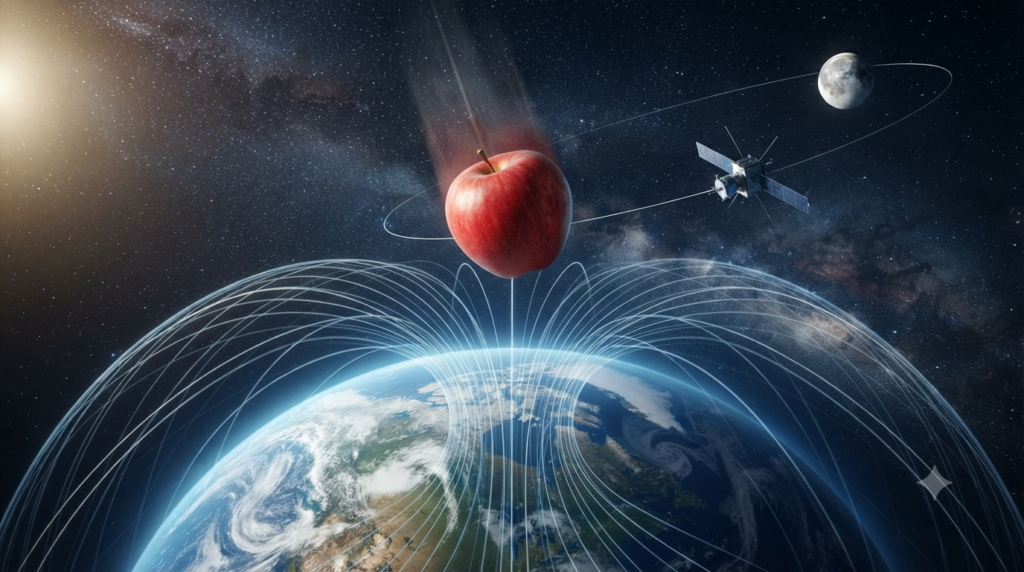
Work, energy, and power are three closely connected concepts in physics that help us understand how objects move, how forces produce changes, and how energy is transferred or used. Whenever a person lifts a bag, a machine moves a load, or a vehicle accelerates, these three ideas are involved. Work describes the transfer of energy caused by a force acting through a distance. Energy represents the ability to do work, while power tells us how quickly work is done or energy is transferred. Understanding their relationship makes it easier to explain everyday activities, mechanical systems, machines, and many natural phenomena. Although these concepts are related, each has a different meaning and role in physics.
What Is Work in Physics?
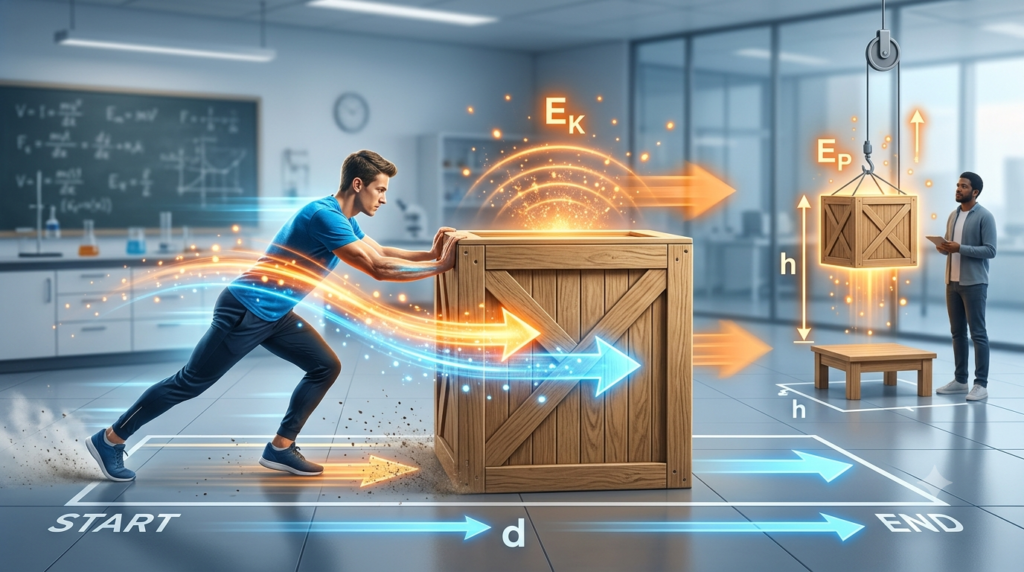
In physics, work is done when a force acting on an object produces displacement in the direction of the force or has a component along that displacement. Work describes the transfer of energy from one object or system to another through a force.
The formula for work is:
W = F × s × cos θ
Where:
W = work done
F = magnitude of the applied force
s = displacement of the object
θ = angle between the force and displacement
When the force and displacement are in the same direction, the angle is zero, and the formula becomes:
W = F × s
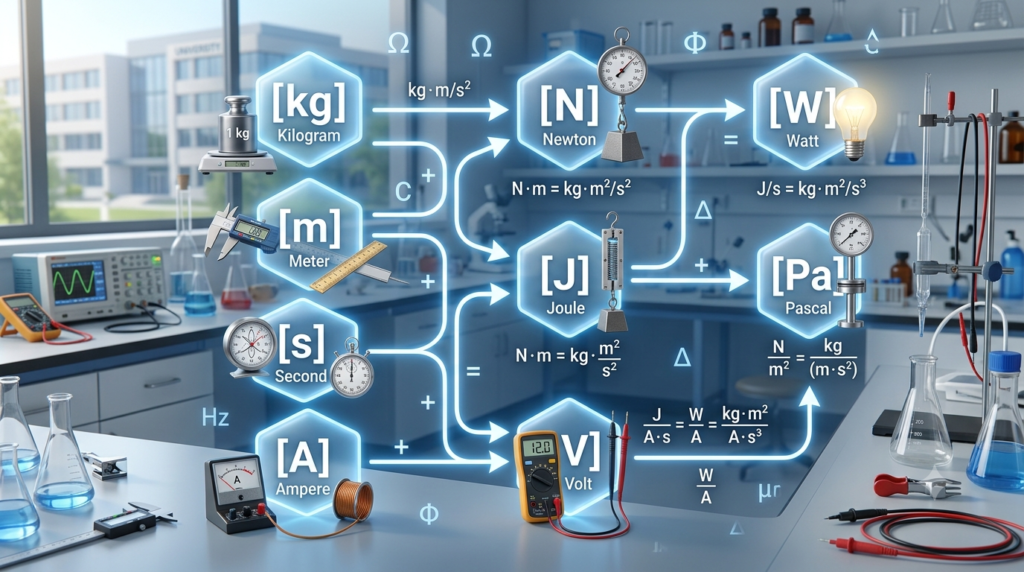
The SI unit of work is the joule (J). One joule of work is done when a force of one newton moves an object through a distance of one metre in the direction of the force.
For example, if a person pushes a box with a force of 20 N and the box moves 3 m in the same direction, the work done by the force is:
W = 20 × 3
W = 60 J
This means that 60 joules of energy have been transferred through the applied force, assuming friction and other relevant forces are not included in this calculation.
Work can be positive, negative, or zero. Positive work occurs when a force has a component in the direction of displacement. Negative work occurs when a force acts against displacement, such as friction slowing a moving object. Zero work occurs when there is no displacement or when the force is perpendicular to the displacement. For example, the centripetal force acting on an object moving in a circular path does no instantaneous work because it is perpendicular to the object’s motion.
What Is Energy?
Energy is the capacity of a system to do work or cause physical change. It is one of the most important concepts in physics because nearly every physical process involves energy transfer or transformation.
Energy exists in several forms, including kinetic energy, potential energy, thermal energy, chemical energy, electrical energy, and nuclear energy. These forms can change into one another, but the total energy of an isolated system remains constant.
The SI unit of energy is also the joule (J). This is because work and energy are closely connected: doing work on an object can transfer energy to it, while an object can release or transfer energy by doing work on another system.
Kinetic Energy
Kinetic energy is the energy an object possesses because of its motion. An object with greater mass or greater speed generally has more kinetic energy.
The formula for kinetic energy is:
KE = ½mv²
Where:
For example, a moving bicycle has kinetic energy. If its speed increases, its kinetic energy increases significantly because speed is squared in the formula.
Potential Energy
Potential energy is stored energy associated with an object’s position, shape, or arrangement. Gravitational potential energy is a common example.
Near Earth’s surface, gravitational potential energy is given by:
PE = mgh
Where:
PE = gravitational potential energy
m = mass
g = acceleration due to gravity
h = height above a chosen reference level
When a person lifts an object upward, work is done against gravity. This transfers energy to the object and increases its gravitational potential energy.
For example, lifting a 2 kg object through a height of 5 m, using g ≈ 9.8 m/s², increases its gravitational potential energy by:
PE = 2 × 9.8 × 5
PE = 98 J
The increase in potential energy is approximately 98 joules, assuming air resistance and other effects are negligible.
What Is Power in Physics?
Power is the rate at which work is done or energy is transferred. While work measures the amount of energy transferred, power describes how quickly that transfer occurs.
The formula for average power is:
P = W ÷ t
Where:
P = average power
W = work done
t = time taken
The SI unit of power is the watt (W). One watt is equal to one joule of energy transferred per second.
1 W = 1 J/s
For example, suppose two machines each do 600 J of work. If the first machine takes 10 seconds and the second takes 30 seconds, their average powers are:
Power of first machine = 600 ÷ 10 = 60 W
Power of second machine = 600 ÷ 30 = 20 W
Both machines perform the same amount of work, but the first machine has greater power because it completes the work in less time.
Power can also be expressed using force and velocity. When a force acts on an object moving with velocity in the direction of the force, instantaneous power is:
P = F × v
More generally, the instantaneous power delivered by a force is:
P = F × v × cos θ
This relationship is useful for understanding engines, motors, vehicles, and machines.
The Relationship Between Work and Energy
Work and energy are directly connected. When work is done on an object or system, energy is transferred to or from it. The amount of work done by the net force on an object equals the change in its kinetic energy. This is known as the work–energy theorem.
Wₙₑₜ = ΔKE
This means:
Net work = Final kinetic energy − Initial kinetic energy
If the net work done on an object is positive, its kinetic energy increases. If the net work is negative, its kinetic energy decreases.
For example, when a stationary ball is pushed, the applied force can do positive work on it. The ball gains kinetic energy and begins to move. When friction acts on a moving object, it generally does negative work and reduces the object’s kinetic energy.
Work can also change potential energy. When an object is lifted, work done against gravity increases its gravitational potential energy. When the object falls, gravitational potential energy can be transformed into kinetic energy.
Thus, work is not simply the movement of an object. It is a mechanism through which energy is transferred or transformed.
How Energy and Power Are Connected
Energy and power are connected through time. Power tells us how rapidly energy is transferred or converted.
The relationship is:
P = E ÷ t
Where E represents the amount of energy transferred in a time interval t. For constant power, this can also be written as:
E = P × t
For example, an electric motor operating at a power of 500 W for 20 seconds transfers 10,000 J of energy under an idealized constant-power assumption.
E = 500 × 20
E = 10,000 J
This does not necessarily mean that all the input energy becomes useful mechanical energy. Real machines experience losses, often through heat, sound, friction, and electrical resistance.
A high-power machine can transfer a large amount of energy in a short time. However, power alone does not tell us the total energy transferred unless the operating time is also known.
Understanding the Relationship Between Work, Energy, and Power
The relationship among these three quantities can be understood through a simple example of lifting a box.
Imagine that a worker lifts a 10 kg box through a height of 2 m. Taking g ≈ 9.8 m/s², the increase in gravitational potential energy is:
PE = mgh
PE = 10 × 9.8 × 2
PE = 196 J
If the worker lifts the box at a steady speed and air resistance is negligible, the work done by the worker against gravity is approximately 196 J. This is the energy transferred to the box as gravitational potential energy.
Now consider two workers who lift the same box through the same height. One takes 4 seconds, while the other takes 8 seconds.
Power of first worker = 196 ÷ 4 = 49 W
Power of second worker = 196 ÷ 8 = 24.5 W
Both workers do approximately the same work and transfer the same amount of gravitational potential energy. However, the first worker produces greater average power because the work is completed in less time.
This example shows the central relationship:
Work describes the energy transferred by a force through displacement.
Energy describes the capacity to do work and the amount of energy stored or transferred.
Power describes the rate at which work is done or energy is transferred.
Conservation of Energy and Mechanical Systems
The law of conservation of energy states that energy cannot be created or destroyed; it can only be transferred or transformed from one form to another. This principle explains how mechanical systems operate.
Consider a roller coaster at the top of a hill. It has a large amount of gravitational potential energy. As it moves downward, some of this potential energy is converted into kinetic energy, causing the coaster to speed up.
In an ideal system without friction, the total mechanical energy remains constant:
Mechanical energy = Kinetic energy + Potential energy
KE + PE = Constant
In real systems, friction and air resistance convert some mechanical energy into thermal energy and sound. The total energy is still conserved, even though the mechanical energy decreases.
Power is important in these systems because it indicates how quickly energy is converted or transferred. A motor with high power can increase the kinetic energy of a vehicle rapidly, while a braking system must remove energy at a particular rate to slow the vehicle safely.
Applications of Work, Energy, and Power in Everyday Life
Work, energy, and power are used to understand and design many devices and activities.
Electric motors: Motors convert electrical energy into mechanical energy. Their power rating indicates how quickly they can transfer energy or perform mechanical work.
Vehicles: The engine supplies power to move the vehicle, while the work done by the driving force changes its kinetic energy and helps overcome resistance.
Lifting machines: Cranes and elevators perform work against gravity to raise loads. Their power determines how quickly they can lift those loads.
Hydroelectric power plants: Water stored at a height has gravitational potential energy. As it flows downward, this energy is converted into electrical energy through turbines and generators.
Human activities: Walking, running, climbing stairs, and lifting objects involve energy transformations. The rate at which a person performs mechanical work can be described by power.
These applications show why understanding the difference between work, energy, and power is essential in engineering, transportation, electricity generation, and everyday problem-solving.
Conclusion
Work, energy, and power are fundamental concepts that explain how forces transfer energy, how objects store and transform energy, and how quickly physical processes occur. Work is the energy transferred when a force acts through displacement, while energy represents the capacity to do work. Power measures the rate at which work is performed or energy is transferred. The work–energy theorem connects net work with changes in kinetic energy, and the conservation of energy explains how energy moves between different forms. By understanding these relationships, we can better explain the motion of objects, the operation of machines, the performance of vehicles, and the functioning of many natural and technological systems. Together, these concepts provide a powerful foundation for studying mechanics and the wider world of physics.