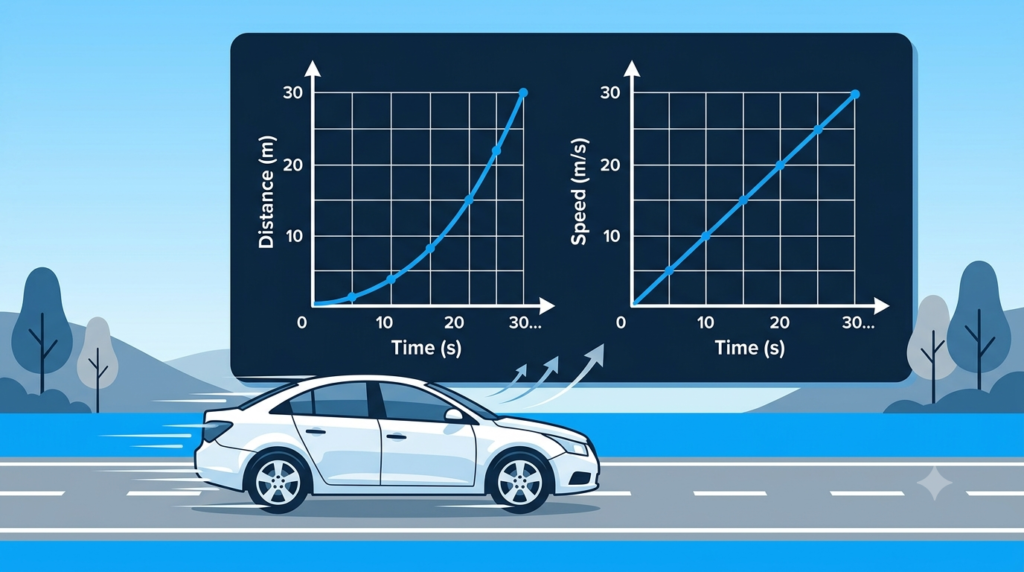
Energy is one of the most important ideas in physics. It helps us understand how objects move, how machines work, how electricity is produced, and how changes occur in nature. Although energy appears in many forms, two basic forms of mechanical energy are kinetic energy and potential energy. Kinetic energy is associated with motion, while potential energy is associated with stored energy due to an object’s position, shape, or condition. Understanding these two forms makes it easier to study motion, forces, work, machines, and many everyday physical processes.
What Is Kinetic Energy?
Kinetic energy is the energy possessed by an object because of its motion. Any moving object has kinetic energy. A moving car, a rolling ball, a flying aircraft, and even a moving particle have kinetic energy.
The amount of kinetic energy depends mainly on two factors: the mass of the object and its speed. A heavier object moving at the same speed as a lighter object has more kinetic energy. Similarly, an object moving faster has much more kinetic energy than the same object moving slowly.
The formula for kinetic energy is:
KE = ½mv²
Here, m represents the mass of the object and v represents its velocity. The SI unit of kinetic energy is the joule (J).
One important point is that velocity is squared in the formula. This means that if the speed of an object doubles, its kinetic energy becomes four times greater. Therefore, increasing speed has a significant effect on the energy of a moving object.
Examples of Kinetic Energy
Kinetic energy can be observed in many situations:
A moving bicycle has kinetic energy.
A running person possesses kinetic energy.
A moving train has kinetic energy.
Wind has kinetic energy because air is moving.
Flowing water has kinetic energy.
A rotating fan has kinetic energy because its blades are moving.
In each case, the energy is associated with motion.
What Is Potential Energy?
Potential energy is stored energy that an object possesses because of its position, shape, or condition. Unlike kinetic energy, an object does not need to be moving to have potential energy.
For example, a book placed on a high shelf has gravitational potential energy because of its position above the ground. If the book falls, its stored gravitational potential energy changes into kinetic energy.
Potential energy can exist in different forms. Gravitational potential energy depends on an object’s position in a gravitational field, while elastic potential energy is stored when an object such as a spring or rubber band is stretched or compressed.
For an object near Earth’s surface, gravitational potential energy can be calculated using:
PE = mgh
Here, m is mass, g is acceleration due to gravity, and h is height above the chosen reference level. The SI unit of potential energy is also the joule (J).
Examples of Potential Energy
Some common examples include:
Water stored behind a dam has gravitational potential energy.
A raised object has gravitational potential energy.
A compressed spring stores elastic potential energy.
A stretched rubber band stores elastic potential energy.
Fuel contains chemical potential energy.
Food contains chemical energy that can be released during chemical reactions.
These examples show that potential energy is not limited to objects at a height. Energy can be stored in different physical conditions.
Kinetic Energy and Potential Energy Together
Kinetic and potential energy are closely connected. In many situations, energy changes from one form to another.
Consider a ball held at a certain height. Before it is released, it has gravitational potential energy and very little kinetic energy. As the ball falls, its height decreases, so its potential energy decreases. At the same time, its speed increases, so its kinetic energy increases.
Near the bottom of its fall, much of the original potential energy has been converted into kinetic energy.
If air resistance and other energy losses are ignored, the total mechanical energy remains constant:
Eₜₒₜₐₗ = PE + KE
This is an example of the conservation of energy. Energy is not simply lost when one form changes into another. Instead, it is transferred or transformed.
How Energy Changes Form
Energy transformations happen constantly around us. A roller coaster provides a simple example. At the top of a hill, the coaster has a large amount of gravitational potential energy. As it moves downward, this potential energy is converted into kinetic energy, causing the coaster to move faster.
When the coaster climbs another hill, some of its kinetic energy changes back into gravitational potential energy. In a real system, however, some energy is transferred to the surroundings as thermal energy and sound because of friction and air resistance.
The same basic idea appears in many other systems. Water stored at a height in a hydroelectric power station has gravitational potential energy. As the water moves downward, it gains kinetic energy. The moving water can then turn turbines and help generate electrical energy.
Difference Between Kinetic and Potential Energy
The main difference between kinetic and potential energy is their relationship with motion and position.
Kinetic energy:
Exists because of motion.
Depends on mass and speed.
Increases when speed increases.
Formula: KE = ½mv².
A moving object has kinetic energy.
Potential energy:
Is stored because of position, shape, or condition.
Gravitational potential energy depends on mass, gravity, and height.
Formula near Earth’s surface: PE = mgh.
An object can have potential energy even when it is stationary.
Both forms are measured in joules and can be transformed into other forms of energy.
Why Kinetic and Potential Energy Matter
These concepts are important because they provide a simple way to understand many physical processes. Engineers use energy principles when designing vehicles, machines, bridges, power plants, and safety systems. Scientists use them to study motion and interactions in physical systems.
Even everyday activities involve energy transformations. When you climb stairs, chemical energy from your body helps increase your gravitational potential energy. When you ride a bicycle downhill, gravitational potential energy is converted into kinetic energy. When you stop the bicycle, some of its kinetic energy is transformed mainly into thermal energy through the brakes and friction.
Understanding energy also helps explain why objects speed up, slow down, rise, fall, and interact with their surroundings.
Conclusion
Kinetic and potential energy are two fundamental concepts in physics. Kinetic energy is the energy of motion, while potential energy is stored energy associated with position, shape, or condition. They can change from one form to another while the total amount of energy is conserved in an isolated system. The formulas KE = ½mv² and PE = mgh provide simple ways to calculate these forms of energy in common situations. By understanding how kinetic and potential energy interact, we can explain everything from a falling object and a roller coaster to flowing water and many modern machines.
FAQs
Kinetic energy is the energy possessed by an object because of its motion. Any moving object has kinetic energy, whether it is a moving car, a running person, a flying aircraft, or a rolling ball. Kinetic energy depends on the object’s mass and velocity. Its formula is KE = ½mv², where m is mass and v is velocity. Because velocity is squared, even a small increase in speed can significantly increase kinetic energy. Kinetic energy is measured in joules (J). When an object stops moving, its kinetic energy becomes zero, although its other forms of energy may still exist.
Potential energy is stored energy associated with an object’s position, shape, or condition. An object does not need to be moving to possess potential energy. For example, a book placed on a high shelf has gravitational potential energy because of its height above the ground. A stretched rubber band and a compressed spring also store potential energy because of their changed shapes. Potential energy can later be transformed into kinetic energy or other forms of energy. Its value depends on the type of potential energy being considered. Like kinetic energy, potential energy is measured in joules.
The formula for kinetic energy is KE = ½mv². In this equation, KE represents kinetic energy, m represents the mass of the object, and v represents its velocity. The SI unit of kinetic energy is the joule. The squared velocity is particularly important because it means kinetic energy changes rapidly with speed. For example, if the velocity of an object doubles while its mass remains unchanged, its kinetic energy becomes four times greater. This relationship helps explain why high-speed vehicles have much more kinetic energy than the same vehicles moving slowly.
Near Earth’s surface, gravitational potential energy can be calculated using PE = mgh. Here, PE represents potential energy, m is the object’s mass, g is acceleration due to gravity, and h is the height above a chosen reference level. The formula shows that gravitational potential energy increases when the object’s mass or height increases. For example, lifting a heavy object to a greater height gives it more gravitational potential energy. When the object falls, this stored energy can be converted into kinetic energy. The SI unit of gravitational potential energy is the joule.
The main difference is that kinetic energy is associated with motion, while potential energy is stored because of position, shape, or condition. A moving car has kinetic energy because it is moving, while a stationary car at the top of a hill can have gravitational potential energy because of its position. Kinetic energy depends on mass and velocity, whereas gravitational potential energy near Earth’s surface depends on mass, gravitational acceleration, and height. Both are forms of mechanical energy and are measured in joules. They can also change from one form into the other during physical processes.
Yes, potential energy can change into kinetic energy. A simple example is a ball falling from a height. Before it falls, the ball has gravitational potential energy because of its position. As it moves downward, its height decreases and its speed increases. Therefore, gravitational potential energy is gradually transformed into kinetic energy. At the bottom, much of the original potential energy may have become kinetic energy. In real situations, some energy may also be transferred to the surroundings as heat or sound because of air resistance and friction. This transformation demonstrates the conservation of energy.
Mechanical energy is the energy associated with an object’s motion and position. It is commonly considered the sum of kinetic energy and potential energy. The relationship can be written as Mechanical Energy = KE + PE. For example, a roller coaster has potential energy when it is high above the ground and kinetic energy when it is moving rapidly. As the roller coaster moves up and down, energy shifts between these two forms. If friction and air resistance are ignored, the total mechanical energy remains constant. In real systems, some mechanical energy is transferred into thermal energy and sound.
Kinetic energy increases rapidly with speed because velocity is squared in the kinetic energy formula KE = ½mv². This means that kinetic energy is not directly proportional to speed. If an object’s speed doubles, its kinetic energy becomes four times greater. If its speed triples, its kinetic energy becomes nine times greater, assuming its mass remains constant. This is why high-speed objects can produce much greater impacts than slower objects of the same mass. The squared velocity term is therefore one of the most important features of the kinetic energy equation.
Yes, a stationary object can have energy even though it has no kinetic energy. For example, a rock resting on a high cliff has gravitational potential energy because of its position. A compressed spring has elastic potential energy because of its shape. An object may also contain chemical, thermal, or other forms of energy. Therefore, being stationary does not mean that an object has no energy. It only means that its kinetic energy due to its motion is zero relative to the chosen reference frame. The object’s stored or internal energy may still be significant.
Kinetic and potential energy are important because they help explain how energy moves and changes in physical systems. They are used to understand falling objects, roller coasters, moving vehicles, machines, flowing water, and many other processes. By studying these forms of energy, physicists can often analyze motion without examining every detail of the forces involved. The concepts are also closely connected to the conservation of energy, one of the fundamental principles of physics. Understanding kinetic and potential energy therefore provides a foundation for studying mechanics, machines, electricity, engineering, and many real-world applications.
Related Post
What Is Power in Physics?
Power is an important concept in physics that tells us how quickly work is done or energy is transferred. Two […]
Read MoreKinetic and Potential Energy: Basic Concepts
Energy is one of the most important ideas in physics. It helps us understand how objects move, how machines work, […]
Read MoreDifferent Forms of Energy Explained
Energy is one of the most important ideas in science. It is involved in almost everything that happens around us, […]
Read MoreWhat Is Energy in Physics?
Energy is one of the most important ideas in physics. We use the word “energy” in everyday life when talking […]
Read MoreWhat Is Momentum in Physics?
Momentum is one of the fundamental concepts in physics used to describe the motion of an object. It helps us […]
Read MoreWhat Is Inertia and Why Does It Matter?
Have you ever noticed how your body moves forward when a bus suddenly stops? Or why you feel pushed backward […]
Read MoreWhat Is Rest and How Is It Defined in Physics?
When we look at an object that appears to be stationary, we naturally say that it is at rest. A […]
Read MoreMass and Weight: What Is the Difference?
Have you ever wondered why an object can have the same amount of matter but weigh differently in different places? […]
Read MoreHow Does Force Affect the Motion of an Object?
Force is one of the most important ideas in physics because it helps explain why objects start moving, stop moving, […]
Read MoreWhat Is Force in Physics?
Force is one of the most important ideas in physics. We experience forces every day, even when we do not […]
Read MoreWhat Is Acceleration in Physics?
Acceleration is one of the most important concepts in physics because it describes how the velocity of an object changes […]
Read MoreSpeed and Velocity: Understanding the Difference
When we describe how fast something is moving, we often use the word “speed.” In everyday conversation, speed and velocity […]
Read MoreDistance and Displacement: Definition and Differences
When an object moves from one place to another, we often describe its motion by saying how far it has […]
Read MoreWhat Is Motion in Physics?
Motion is one of the most basic and important ideas in physics. Everything around us is in some form of […]
Read MoreWhat Is a Reference Frame in Physics?
When we describe the motion of an object, we usually say whether it is moving, how fast it is moving, […]
Read MoreWhat Is a Reference Point in Physics?
In physics, we often describe where an object is, how it moves, or how far it has traveled. But to […]
Read MoreScalar vs Vector Quantities: Key Differences
In physics, we use physical quantities to describe measurable properties such as mass, time, speed, force, and velocity. However, not […]
Read MoreWhat Are Scalars and Vectors in Physics?
Physics is all about describing how things behave. We talk about the mass of an object, its speed, the distance […]
Read More