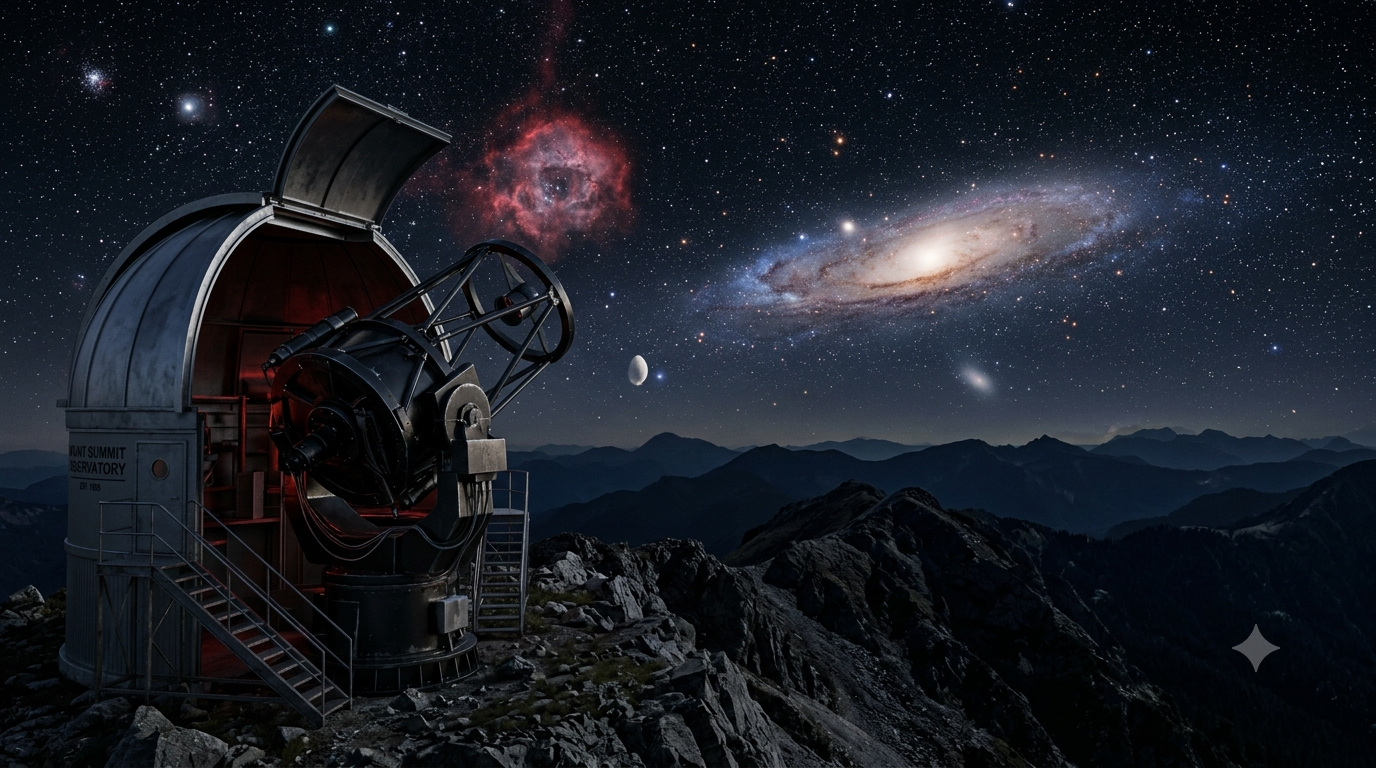
Astronomy is the scientific study of the universe, including stars, planets, moons, galaxies, black holes, and other celestial objects. It helps us understand how the universe began, how different objects move through space, and how stars and planetary systems develop over time. For beginners, astronomy can seem complicated because scientists use many specialized terms to describe celestial objects, cosmic events, and physical processes. Learning these terms makes it easier to understand astronomy books, educational articles, documentaries, and discoveries reported in the news.
You do not need an advanced scientific background to begin learning astronomy. A basic understanding of important terms can help you recognize objects in the night sky and understand how the universe works. This article explains essential astronomy terms in simple language, covering celestial objects, space, light, planetary motion, and major astronomical phenomena.
1. Astronomy
Astronomy is the scientific study of celestial objects and phenomena beyond Earth’s atmosphere. It includes the study of planets, stars, galaxies, comets, asteroids, and the universe as a whole.
Astronomers use telescopes, satellites, mathematical models, and scientific observations to investigate space. They study how celestial objects form, how they change over time, and how they interact through gravity and other physical processes.
Astronomy is closely connected to physics, chemistry, mathematics, and other sciences. For example, physicists help explain the forces acting on planets, while chemistry helps scientists understand the elements present in stars and interstellar clouds.
2. Universe
The universe includes all space, time, matter, and energy, together with the physical laws that govern them. It contains an enormous variety of structures, including galaxies, stars, planetary systems, and vast regions of space.
Scientists estimate that the observable universe is about 13.8 billion years old. The observable universe is the region from which light has had enough time to reach us since the early universe. The entire universe may extend far beyond the observable region, and its total size is not currently known.
Studying the universe helps scientists investigate its origin, expansion, structure, and possible future.
3. Celestial Object
A celestial object is a naturally occurring object in space. Examples include stars, planets, moons, asteroids, comets, and galaxies.
Celestial objects differ greatly in size, composition, temperature, and behavior. A planet may orbit a star, while a moon generally orbits a planet or another planetary body. A star produces energy through nuclear fusion in its core during most of its life.
Recognizing the differences between celestial objects is an important first step in learning astronomy.
4. Solar System
The solar system consists of the Sun and all the objects gravitationally bound to it. These include eight recognized planets, their moons, dwarf planets, asteroids, comets, and smaller bodies.
The eight planets, in order from the Sun, are Mercury, Venus, Earth, Mars, Jupiter, Saturn, Uranus, and Neptune.
The inner planets are mostly rocky, while Jupiter and Saturn are gas giants and Uranus and Neptune are ice giants. Beyond Neptune lies the Kuiper Belt, a region containing many icy objects.
The solar system formed approximately 4.6 billion years ago from a cloud of gas and dust. Understanding its structure helps scientists compare Earth with other planetary environments.
5. Star
A star is a massive, luminous ball of hot gas, primarily hydrogen and helium, held together by gravity. Most stars produce energy through nuclear fusion in their cores, where hydrogen nuclei combine to form helium.
The Sun is the closest star to Earth. Other stars appear much smaller and fainter because they are extremely far away.
Stars vary in size, color, temperature, brightness, and age. Blue stars generally have higher surface temperatures than red stars. Stars also evolve through different stages during their lifetimes, depending largely on their initial masses.
The study of stars helps astronomers understand how elements form and how planetary systems develop.
6. Planet
A planet is a celestial body that orbits a star, has enough mass for its gravity to make it nearly round, and has cleared most other objects from its orbital neighborhood.
In our solar system, Earth and the other seven recognized planets orbit the Sun. Planets do not generally produce their own visible light through nuclear fusion. Instead, they reflect light from their stars and emit energy according to their temperatures.
Planets can be rocky, like Earth and Mars, or giant planets, like Jupiter and Neptune. Astronomers also study planets orbiting stars beyond the Sun to understand how common planetary systems may be in the galaxy.
7. Moon and Natural Satellite
A moon, also called a natural satellite, is a celestial body that orbits a planet or another larger object. Earth’s Moon is the most familiar example.
Moons differ in size, surface conditions, and composition. Some have heavily cratered surfaces, while others may contain ice, underground oceans, or evidence of past geological activity.
Jupiter and Saturn have many known moons. Scientists study these objects to learn about planetary formation and the possibility of environments suitable for life.
A natural satellite should not be confused with an artificial satellite, which is a human-made object placed into orbit.
8. Galaxy
A galaxy is a large system of stars, gas, dust, dark matter, and other components held together by gravity. Galaxies come in different shapes, including spiral, elliptical, and irregular forms.
The Milky Way is the galaxy that contains our solar system. It is a spiral galaxy with a central region, a disk containing many stars, and extensive outer regions.
Galaxies can contain millions, billions, or even trillions of stars. They may also interact or merge with other galaxies over long periods.
Studying galaxies allows astronomers to investigate how large cosmic structures form and evolve.
9. Milky Way
The Milky Way is the galaxy in which Earth and the solar system are located. It contains hundreds of billions of stars, along with gas, dust, and dark matter.
Our solar system lies in a region of the Milky Way’s disk called the Orion Arm or Orion Spur, away from the galactic center.
From Earth, the Milky Way can appear as a faint, milky band across a dark sky in places with little light pollution. This appearance comes from the combined light of numerous distant stars in the galaxy’s disk.
Observing the Milky Way gives beginners a direct way to connect their night-sky observations with the larger structure of the universe.
10. Constellation
A constellation is an officially defined region of the sky. Many constellations are associated with recognizable patterns of stars, such as Orion, Scorpius, and Ursa Major.
The stars in a constellation may look close together from Earth, but they can be separated by enormous distances in space. Their apparent arrangement is mainly a result of our viewing position.
Constellations help astronomers map the sky and help beginners identify regions containing stars, planets, and other objects.
The Big Dipper, for example, is a well-known star pattern within Ursa Major, rather than a separate official constellation.
11. Asteroid
An asteroid is a small rocky or metallic body that orbits the Sun. Many asteroids are found in the asteroid belt between Mars and Jupiter, although others travel in different regions of the solar system.
Asteroids are remnants of the material from which the solar system formed. Their composition and structure provide clues about conditions in the early solar system.
Most asteroids are much smaller than planets. However, some are large enough to be nearly spherical, and scientists monitor certain asteroids whose orbits bring them relatively close to Earth.
Studying asteroids helps researchers investigate planetary formation and assess potential impact hazards.
12. Comet
A comet is an icy body that orbits the Sun. It contains frozen materials mixed with dust and rocky particles.
When a comet approaches the Sun, its surface can heat up, causing some ice to turn directly into gas. This process, called sublimation, releases gas and dust that can form a glowing cloud around the nucleus called a coma.
Solar radiation and the solar wind can help produce tails that extend away from the Sun. A comet’s tail does not necessarily point behind it along its direction of travel.
Comets are important because they preserve material from the early solar system and may provide clues about the origin and distribution of water and organic compounds.
13. Meteor, Meteoroid, and Meteorite
These three terms describe different stages or locations associated with small pieces of material traveling through space.
A meteoroid is a relatively small natural object moving through space. When it enters Earth’s atmosphere and produces a streak of light, the visible phenomenon is called a meteor. If part of the object survives the journey through the atmosphere and reaches the ground, the remaining material is called a meteorite.
Bright meteors are often called fireballs. A meteor shower occurs when Earth passes through a stream of debris, commonly left behind by a comet.
These terms are frequently confused, but understanding the distinction makes descriptions of space rocks and atmospheric events much clearer.
14. Nebula
A nebula is a large cloud of gas and dust in space. Some nebulae are regions where new stars form, while others are created when stars release material into their surroundings.
In star-forming nebulae, gravity can pull dense regions of gas together. Under suitable conditions, these regions may develop into protostars and eventually stars.
Other nebulae form when dying stars eject their outer layers or when massive stars explode. The material in these clouds can later become part of new stars and planetary systems.
Nebulae are especially interesting to astronomers because they reveal how matter moves between stars and how stellar life cycles shape galaxies.
15. Black Hole
A black hole is a region of space where gravity is so strong that nothing, including light, can escape from inside its event horizon.
Black holes can form when certain massive stars collapse at the end of their lives. Scientists have also discovered supermassive black holes in the centers of many galaxies.
Although black holes cannot be observed directly by the light escaping from inside their event horizons, astronomers can study their effects on nearby matter and light. Hot gas orbiting a black hole may emit powerful radiation before crossing the event horizon.
Black holes are important for understanding gravity under extreme conditions and the evolution of galaxies.
16. Light-Year
A light-year is a unit of distance, not time. It describes how far light travels through a vacuum in one year.
Light travels at approximately 300,000 kilometers per second. In one year, it travels about 9.46 trillion kilometers.
Astronomers use light-years because distances between stars and galaxies are far too large to express conveniently in kilometers.
For example, light from the Sun takes about 8 minutes and 20 seconds to reach Earth. When we observe a star that is 100 light-years away, we see light that began its journey approximately 100 years ago.
This means looking farther into space also allows us to observe objects as they appeared in the past.
17. Astronomical Unit
An astronomical unit (AU) is a standard unit of distance based on the average distance between Earth and the Sun. One AU is approximately 149.6 million kilometers.
Astronomers commonly use astronomical units to describe distances within the solar system.
For example, Earth is approximately 1 AU from the Sun, while Mars has an average orbital distance of about 1.52 AU. Neptune’s average distance from the Sun is roughly 30 AU.
Using astronomical units makes it easier to compare planetary distances without repeatedly writing extremely large numbers.
18. Orbit
An orbit is the path an object follows around another object under the influence of gravity. Planets orbit stars, moons orbit planets, and artificial satellites orbit Earth or other celestial bodies.
Most planetary orbits are elliptical, meaning they have the shape of a slightly or strongly stretched circle. An orbit’s shape and size depend on the object’s motion and the gravitational influence of the body it orbits.
Earth takes approximately one year to complete one orbit around the Sun. The Moon takes about 27.3 days to complete an orbit relative to distant stars.
Understanding orbits helps explain planetary motion, satellite communication, space missions, and many other astronomical processes.
19. Rotation and Revolution
Rotation and revolution describe two different types of motion.
Rotation is the spinning of an object around its own axis. Earth rotates approximately once every 24 hours, producing the familiar cycle of day and night.
Revolution refers to the orbital motion of one object around another. Earth revolves around the Sun in approximately 365.25 days, which forms the basis of our year.
These motions also influence other natural cycles. Earth’s axial tilt, combined with its revolution around the Sun, produces the seasons. The Moon’s orbital motion contributes to its changing appearance in the sky.
Understanding the difference between rotation and revolution helps explain many everyday astronomical observations.
20. Gravity
Gravity is the fundamental interaction that attracts objects with mass toward one another. It plays a major role in shaping the universe.
The Sun’s gravity keeps the planets in orbit, Earth’s gravity holds the atmosphere close to the surface, and gravity helps gas clouds collapse to form stars.
Gravity also influences the motion of galaxies and the structure of large cosmic systems. According to Einstein’s general theory of relativity, gravity can be understood as the curvature of spacetime caused by mass and energy.
Without gravity, stars, planets, and many other familiar astronomical structures could not form and remain organized in their present ways.
21. Telescope
A telescope is an instrument that collects electromagnetic radiation from distant objects to help scientists observe them in greater detail.
Optical telescopes collect visible light. Radio telescopes detect radio waves, while infrared, ultraviolet, X-ray, and gamma-ray telescopes observe other parts of the electromagnetic spectrum.
Some telescopes operate on the ground, while others are placed in space to avoid atmospheric interference or to detect radiation that Earth’s atmosphere blocks.
Telescopes allow astronomers to investigate objects too distant or faint to see with the unaided eye. They have helped scientists discover planets around other stars, study distant galaxies, and examine the evolution of the universe.
22. Electromagnetic Spectrum
The electromagnetic spectrum includes all forms of electromagnetic radiation, arranged by wavelength or frequency. It includes radio waves, microwaves, infrared radiation, visible light, ultraviolet radiation, X-rays, and gamma rays.
Visible light is only a small part of the spectrum. Many astronomical objects release most of their energy at wavelengths that human eyes cannot detect.
For example, infrared observations can reveal relatively cool objects and regions hidden by dust, while X-ray observations can reveal extremely hot gas around black holes and other energetic systems.
By studying different wavelengths, astronomers obtain a more complete understanding of celestial objects and the physical processes occurring within them.
23. Redshift and Blueshift
Redshift and blueshift describe changes in the observed wavelength of light.
Redshift occurs when light is shifted toward longer wavelengths, while blueshift occurs when it is shifted toward shorter wavelengths. These changes can result from relative motion between an object and an observer, and redshift can also result from the expansion of the universe.
Astronomers analyze these shifts to estimate how quickly stars and galaxies are moving along our line of sight. Measurements of galactic redshifts have played a major role in developing our understanding of the expanding universe.
However, interpreting a redshift requires considering its physical cause. Not every redshift has the same explanation, and cosmic expansion is especially important when studying very distant galaxies.
24. Big Bang
The Big Bang is the leading scientific model describing the early development of the universe. According to this model, the universe expanded from an extremely hot, dense early state about 13.8 billion years ago.
The Big Bang was not an ordinary explosion into empty space. Instead, space itself expanded, and the universe cooled as it developed.
Several important observations support this model, including the expansion of the universe, the cosmic microwave background radiation, and the observed abundance of light elements.
Scientists continue to investigate the earliest moments of cosmic history, including the physical processes that occurred during the universe’s earliest stages.
25. Cosmic Microwave Background
The cosmic microwave background (CMB) is radiation that fills the observable universe and represents light released when the early universe became cool enough for electrons and nuclei to combine into neutral atoms.
This occurred approximately 380,000 years after the Big Bang. Before then, light was repeatedly scattered by free electrons in the hot plasma, making the universe opaque to light over long distances.
As the universe expanded, this radiation stretched to longer wavelengths and cooled. Today, it is observed mainly in the microwave part of the electromagnetic spectrum.
Tiny temperature variations in the CMB provide valuable information about the early universe and the formation of large-scale cosmic structures.
26. Exoplanet
An exoplanet is a planet that orbits a star outside our solar system. Thousands of exoplanets have been confirmed, and many more candidates continue to be investigated.
Exoplanets vary widely. Some are small and rocky, while others are gas-rich or have no close equivalent among the planets in our solar system.
Astronomers commonly detect exoplanets by observing how they affect their host stars. The transit method identifies a small decrease in a star’s brightness when a planet passes in front of it. The radial velocity method detects the slight motion of a star caused by the gravity of an orbiting planet.
Studying exoplanets helps scientists understand how planetary systems form and whether environments that could support life might exist elsewhere.
27. Habitable Zone
The habitable zone is the region around a star where a planet with suitable atmospheric conditions could potentially maintain liquid water on its surface.
Its location depends on the star’s luminosity and temperature. Around a brighter star, the habitable zone is generally farther away than around a dimmer star.
Being in the habitable zone does not automatically mean a planet is habitable or contains life. Atmospheric composition, planetary mass, magnetic properties, geological activity, and many other factors can influence surface conditions.
Scientists use the concept to help prioritize the study of potentially habitable exoplanets, but the search for life requires much more than measuring a planet’s distance from its star.
28. Eclipse
An eclipse occurs when one celestial object blocks light from another or moves into another object’s shadow.
A solar eclipse occurs when the Moon passes between Earth and the Sun, blocking some or all of the Sun’s visible disk from a particular location. A lunar eclipse occurs when the Moon passes into Earth’s shadow.
Solar eclipses can be total, partial, or annular, depending on the alignment and the apparent sizes of the Sun and Moon. Lunar eclipses can also be total, partial, or penumbral.
Eclipses help scientists study the Sun, Earth’s atmosphere, the Moon’s orbit, and the geometry of the Earth-Moon-Sun system. During a solar eclipse, observers must use appropriate certified solar viewing protection except when the Sun is completely covered during the brief total phase of a total solar eclipse.
29. Supernova
A supernova is an extremely powerful stellar explosion. It can occur when a massive star reaches the end of its life and its core collapses, or when a white dwarf undergoes a runaway thermonuclear explosion under suitable conditions.
Supernovae release enormous amounts of energy and can temporarily become extremely bright. They distribute elements into surrounding space, helping enrich the material from which future stars and planets may form.
Astronomers study supernovae to understand stellar evolution, the formation of chemical elements, and changes in galaxies. Certain types of supernovae can also be used to estimate cosmic distances.
30. Dark Matter and Dark Energy
Dark matter and dark energy are two different concepts used to describe major features of the universe that ordinary visible matter alone cannot explain.
Dark matter is a form of matter inferred mainly from its gravitational effects. It helps explain observations such as the motions of stars within galaxies and the formation of large-scale cosmic structures. Its exact nature remains unknown.
Dark energy is the name given to whatever is driving the observed accelerated expansion of the universe in the standard cosmological model. Its physical explanation remains an active area of research.
Neither term means simply that scientists have discovered a dark-colored substance. Both refer to unresolved questions about the universe, and researchers continue to test competing explanations.
Why Learning Astronomy Terms Matters
Learning basic astronomy vocabulary makes it easier to understand scientific explanations and follow new discoveries. When you know the difference between a star and a planet, or between a meteor and a meteorite, descriptions of the night sky become clearer and more meaningful.
These terms also show how different areas of astronomy are connected. Gravity explains orbital motion, telescopes collect information about distant objects, and the electromagnetic spectrum helps scientists study the composition and behavior of celestial bodies. Concepts such as redshift, the cosmic microwave background, and the Big Bang connect observations of distant galaxies with the history of the universe.
Beginners do not need to memorize every term at once. It is more useful to understand a few concepts at a time and connect them with real observations. Watching the Moon’s phases, identifying bright planets, or observing a meteor shower can make these scientific ideas easier to remember.
Conclusion
Astronomy opens a window into the enormous and fascinating universe beyond Earth. Understanding essential terms such as galaxy, light-year, orbit, nebula, black hole, and exoplanet provides a strong foundation for further learning. These concepts help explain what celestial objects are, how they move, and how astronomers investigate the history and structure of the cosmos.
As you continue learning, try connecting each term with an actual object, observation, or discovery. Explore the night sky, use reliable astronomy resources, and ask questions about what you observe. With curiosity and consistent learning, even complex astronomical ideas become easier to understand. Every new term brings you one step closer to understanding the universe and our place within it.
FAQs
1. What is astronomy in simple words?
Astronomy is the scientific study of the universe and everything beyond Earth’s atmosphere. It includes the study of stars, planets, moons, galaxies, black holes, comets, and other celestial objects. Astronomers use telescopes, satellites, mathematics, and scientific observations to understand how these objects form, move, and change over time. Astronomy also explores the origin and evolution of the universe. Beginners can start learning astronomy by observing the Moon, identifying bright planets, and recognizing constellations. Understanding basic astronomy terms makes it easier to explore scientific discoveries and develop a deeper appreciation of the universe.
2. What are the most important astronomy terms for beginners?
Some of the most important astronomy terms for beginners include universe, galaxy, star, planet, moon, orbit, gravity, light-year, astronomical unit, and constellation. Other useful terms are asteroid, comet, nebula, black hole, telescope, and exoplanet. These words describe celestial objects, their movements, and the methods scientists use to study space. Beginners should also understand concepts such as rotation, revolution, redshift, and the Big Bang. Learning these terms gradually helps build a strong foundation for understanding astronomy articles, educational videos, and scientific discoveries. Connecting each term with a real astronomical example makes learning easier and more memorable.
3. What is the difference between a star and a planet?
A star is a massive celestial object that produces energy through nuclear fusion in its core during most of its life. The Sun is the closest star to Earth. A planet is an object that orbits a star, is nearly spherical because of its gravity, and has cleared most other objects from its orbital neighborhood. Planets do not produce energy through sustained hydrogen fusion like stars. Instead, they reflect light from their host stars and emit thermal radiation. Stars generally appear as points of light in the night sky, while some planets can be identified by their brightness and changing positions.
4. What is a light-year, and why is it important in astronomy?
A light-year is a unit of distance that measures how far light travels through a vacuum in one year. Light travels approximately 300,000 kilometers per second, covering about 9.46 trillion kilometers in a year. Astronomers use light-years because distances between stars and galaxies are extremely large. For example, when we observe a star located 100 light-years away, we see light that left it approximately 100 years ago. This means astronomy allows us to observe objects as they appeared in the past. Light-years help scientists describe cosmic distances and understand the vast scale of the observable universe.
5. What is the difference between an asteroid, a comet, and a meteor?
Asteroids are small rocky or metallic bodies that orbit the Sun, while comets contain ice, dust, and rocky material. When a comet approaches the Sun, its ice can release gas and dust, sometimes creating a visible coma and tail. A meteor is the streak of light produced when a meteoroid enters Earth’s atmosphere and heats the surrounding air. If a piece survives its passage through the atmosphere and reaches the ground, it is called a meteorite. These objects help scientists study the formation of the solar system and understand the materials left over from its early history.
6. What is the difference between rotation and revolution?
Rotation is the spinning of an object around its own axis, while revolution describes an object’s movement around another object. Earth rotates approximately once every 24 hours, producing the cycle of day and night. Earth also revolves around the Sun, completing one orbit in approximately 365.25 days. This orbital period forms the basis of our calendar year. Earth’s seasons occur because its rotational axis is tilted relative to its orbital plane as it revolves around the Sun. Understanding rotation and revolution helps explain planetary motion, the changing appearance of celestial objects, and several important natural cycles in the solar system.
7. What is a galaxy, and which galaxy contains Earth?
A galaxy is a vast system of stars, gas, dust, dark matter, and other components held together by gravity. Galaxies can have spiral, elliptical, or irregular shapes and may contain millions or billions of stars. Earth is located in the Milky Way, a spiral galaxy containing hundreds of billions of stars. Our solar system lies in a region called the Orion Arm or Orion Spur, away from the galactic center. Galaxies can interact and merge over long periods, influencing their structure and development. Studying galaxies helps astronomers understand how stars form, how cosmic structures evolve, and how the universe is organized.
8. What is a black hole, and how do astronomers study it?
A black hole is a region of space where gravity is so strong that nothing can escape from inside its event horizon, including light. Some black holes form when massive stars collapse, while supermassive black holes are found in the centers of many galaxies. Astronomers study black holes by observing their effects on nearby stars, gas, and other matter. Material falling toward a black hole can become extremely hot and release radiation before crossing the event horizon. Scientists can also study gravitational waves produced by certain black hole mergers. These observations help researchers investigate gravity and the behavior of matter under extreme conditions.
9. What is an exoplanet, and can it support life?
An exoplanet is a planet that orbits a star outside our solar system. Scientists have discovered thousands of exoplanets with different sizes, compositions, and orbital characteristics. Some are rocky, while others are gas-rich or have properties unlike any planet in our solar system. Researchers investigate whether certain exoplanets could support life by studying their atmospheres, temperatures, and potential for liquid water. A planet located in its star’s habitable zone may have conditions suitable for liquid water, but this alone does not establish habitability. No confirmed evidence of life beyond Earth has been discovered so far, making exoplanet research an important area of astronomy.
10. How can beginners start learning astronomy?
Beginners can start learning astronomy by observing the night sky and becoming familiar with the Moon, bright planets, and recognizable constellations. Reading introductory astronomy articles helps build knowledge of essential terms such as galaxy, orbit, light-year, and gravity. A basic pair of binoculars can reveal lunar craters and some star clusters, although many observations can be made without equipment. Beginners can also use reliable sky maps and astronomy applications to identify visible celestial objects. Learning one topic at a time is more effective than memorizing many definitions at once. Regular observation and curiosity help develop a lasting interest in astronomy.