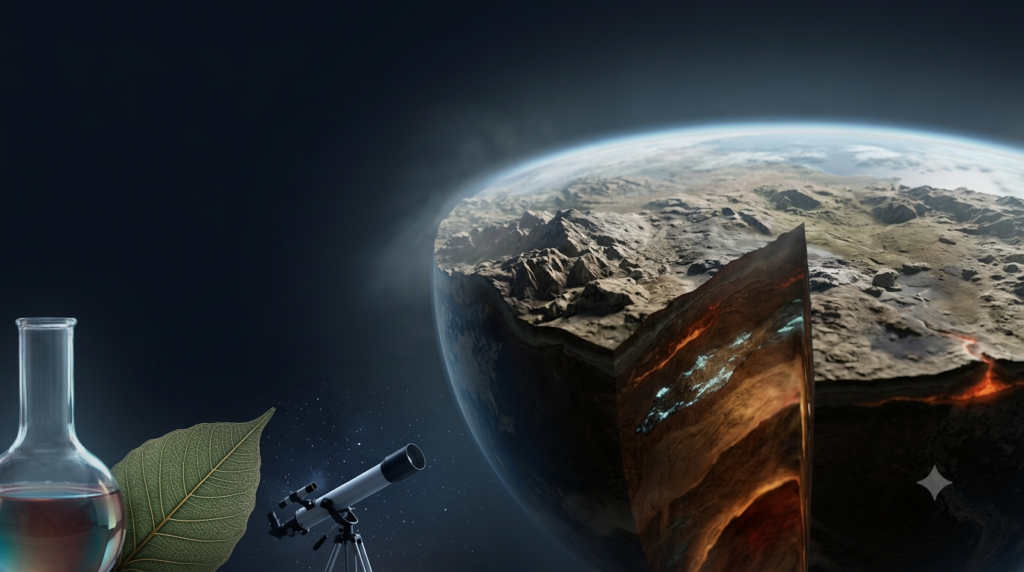
The universe contains billions of galaxies, countless stars, planets, moons, and many other objects that are far beyond the reach of human exploration. Some of these objects are so distant that their light takes millions or even billions of years to reach Earth. Although astronomers cannot visit most of them directly, they can study their properties using advanced scientific instruments, mathematical models, and observations collected from Earth and space.
Astronomy is the science of studying celestial objects and the physical processes that occur throughout the universe. Astronomers investigate objects beyond Earth to understand their composition, temperature, movement, distance, age, and origin. They use telescopes to collect light, analyze radiation from space, study gravitational effects, and send robotic spacecraft to explore nearby worlds. By combining these methods, astronomers can investigate objects that are otherwise impossible to reach and gradually build a clearer picture of how the universe works.
What Do Astronomers Study Beyond Earth?
Astronomers investigate a wide variety of objects and phenomena beyond Earth. Each type of object provides different clues about the structure, history, and behavior of the universe.
Stars
Stars are enormous spheres of hot gas that produce energy through nuclear fusion in their cores. The Sun is the closest star to Earth and provides an important opportunity to study stellar processes in detail.
Astronomers study distant stars to determine their temperatures, chemical compositions, brightness, masses, and ages. These properties help scientists understand how stars form, evolve, and eventually reach the end of their lives.
Planets and Moons
Astronomers study planets and moons within our solar system as well as planets orbiting other stars, known as exoplanets. They investigate planetary atmospheres, surface features, orbital movements, temperatures, and possible conditions for life.
Some planets can be studied through direct spacecraft exploration, while others are examined using telescopes and indirect observational techniques.
Galaxies
Galaxies are enormous systems containing stars, gas, dust, dark matter, and other components held together by gravity. The Milky Way is the galaxy that contains our solar system.
By studying distant galaxies, astronomers can investigate how stars form, how galaxies evolve, and how the universe has changed over billions of years.
Black Holes and Other Cosmic Objects
Astronomers also investigate black holes, neutron stars, supernovae, nebulae, asteroids, and comets. These objects reveal information about extreme physical conditions, stellar evolution, planetary formation, and the behavior of matter under intense gravity.
Because many of these objects cannot be examined directly, astronomers rely on radiation, gravitational effects, and other measurable evidence to understand them.
How Astronomers Collect Information From Space
Most astronomical research begins with observations. Since distant celestial objects cannot usually be reached physically, scientists collect signals that travel from those objects to instruments on Earth or in space.
Using Telescopes to Observe the Universe
Telescopes are among the most important tools in astronomy. They collect electromagnetic radiation from distant objects and help scientists examine details that cannot be seen with the unaided eye.
Optical telescopes collect visible light. They can reveal stars, planets, galaxies, and other objects. Some telescopes use lenses to focus light, while others use mirrors. Large telescopes generally collect more light, making faint and distant objects easier to study.
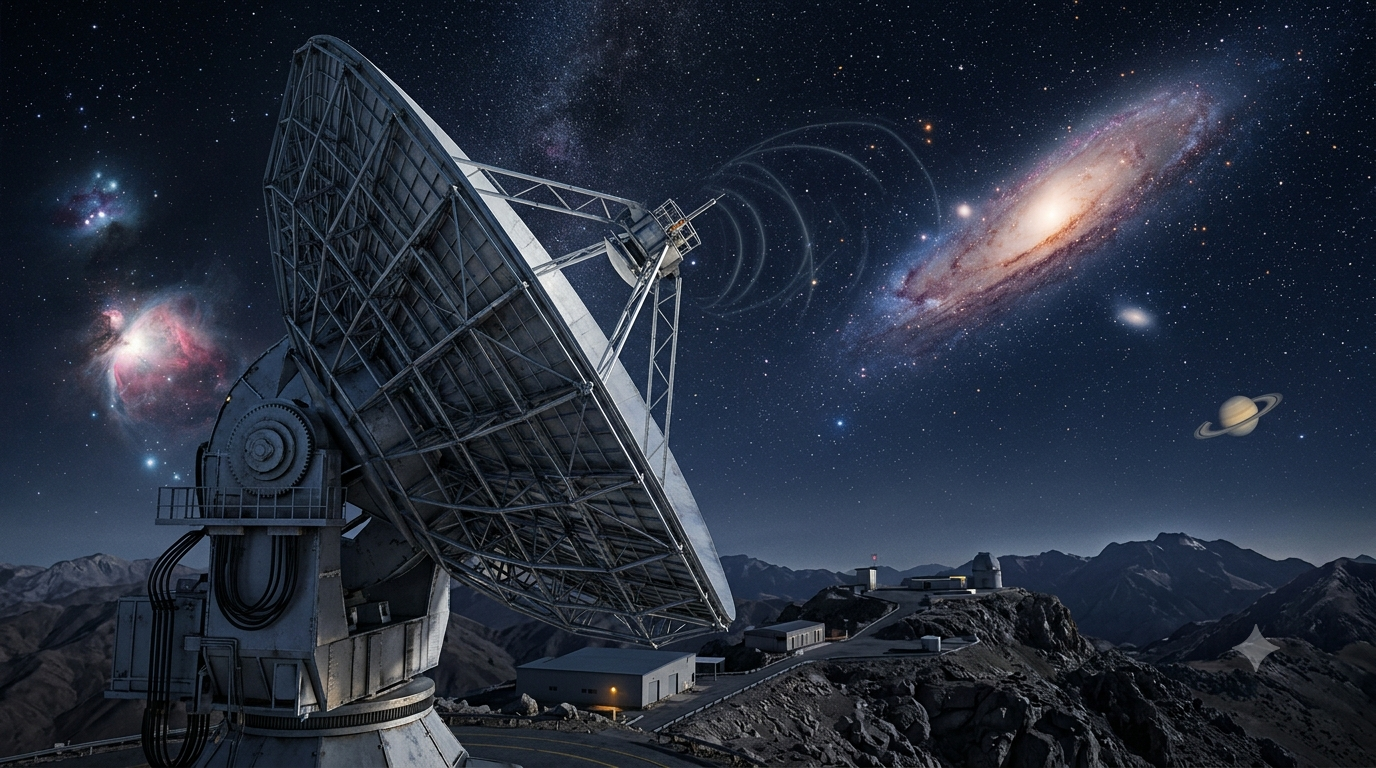
Radio telescopes detect radio waves emitted by celestial objects. They are useful for investigating pulsars, gas clouds, galaxies, and other sources of radio emission. Some astronomical objects produce signals that are difficult or impossible to study using visible light alone.
Infrared telescopes detect infrared radiation, which can reveal relatively cool objects and regions hidden behind clouds of cosmic dust. Ultraviolet, X-ray, and gamma-ray telescopes help astronomers study energetic events, including stellar explosions and material surrounding black holes.
Each type of telescope provides a different view of the universe. By comparing observations across multiple wavelengths, astronomers can develop a more complete understanding of an object.
Observing From Earth and Space
Astronomers use both ground-based and space-based observatories.
Ground-based telescopes are built on Earth, often at high elevations where the atmosphere is thinner and the sky is clearer. They can be large and relatively accessible for maintenance and upgrades. However, Earth’s atmosphere absorbs some wavelengths of radiation and distorts incoming light.
Space telescopes operate above the atmosphere. They can observe wavelengths that Earth’s atmosphere blocks or weakens, and they avoid atmospheric distortion. Instruments such as the Hubble Space Telescope and the James Webb Space Telescope have provided important observations of stars, galaxies, planetary systems, and the early universe.
Space observatories are expensive to build and maintain, and repairs can be difficult or impossible. Astronomers therefore use both ground-based and space-based facilities to benefit from their different strengths.
How Light Helps Astronomers Understand Distant Objects
Light carries much more information than the appearance of an object. By examining the properties of incoming radiation, astronomers can determine many characteristics of celestial bodies without visiting them.
Measuring Brightness
Astronomers measure the brightness of celestial objects to investigate their energy output and compare their properties.
However, the brightness observed from Earth depends on both the object’s actual luminosity and its distance. A nearby star may appear brighter than a much more powerful star located far away.
Scientists use distance measurements and other observations to estimate an object’s intrinsic luminosity, which is the total energy it emits per unit of time.
Brightness measurements can also reveal changes over time. For example, a star that periodically becomes dimmer might have a companion object passing in front of it, or it may naturally vary in brightness.
Studying Spectra
One of the most powerful techniques in astronomy is spectroscopy. This method separates incoming light into its component wavelengths, producing a spectrum that can be analyzed.
Atoms and molecules interact with light in specific ways. They absorb or emit radiation at characteristic wavelengths, producing patterns that can act like chemical fingerprints.
By studying these patterns, astronomers can identify elements and molecules present in stars, planetary atmospheres, and interstellar gas clouds.
Spectroscopy also helps scientists estimate temperature, pressure, magnetic fields, and motion. For example, the spectrum of a star can reveal whether it contains hydrogen, helium, or heavier elements.
Detecting Changes in Wavelength
The wavelength of light can change depending on the relative motion between a source and an observer. This effect is known as the Doppler effect.
When an astronomical object moves toward an observer, its spectral lines generally shift toward shorter wavelengths. This is called blueshift. When the object moves away, its spectral lines generally shift toward longer wavelengths, producing redshift.
Astronomers use these shifts to measure the motion of stars, galaxies, and gas clouds. They can also detect planets indirectly by measuring the small movements of their host stars caused by gravitational interactions.
Redshift is particularly important in cosmology, the study of the universe as a whole. Measurements of distant galaxies help scientists investigate the expansion of the universe.
How Astronomers Measure Distances in Space
Knowing the distance to a celestial object is essential for understanding its true size, brightness, and physical properties. Because space is extremely vast, astronomers use several techniques depending on the distance involved.
Parallax
Parallax is a method used to measure distances to relatively nearby stars. It relies on observing the apparent change in a star’s position against more distant background objects as Earth moves around the Sun.
The closer a star is, the greater its apparent positional shift. Astronomers measure this angle and use geometry to calculate the distance.
Parallax measurements provide a foundation for determining distances to nearby stars and calibrating other astronomical distance methods.
Standard Candles
Some astronomical objects have known or predictable intrinsic brightnesses. These objects are called standard candles.
By comparing their known luminosity with their observed brightness, astronomers can estimate how far away they are.
Certain types of variable stars, including Cepheid variables, and specific types of supernovae are important examples. These objects help scientists measure distances beyond the range of ordinary parallax measurements.
Redshift and the Expanding Universe
For many distant galaxies, astronomers measure redshift to investigate their recession relative to Earth and estimate their distances using models of cosmic expansion.
The relationship between redshift and distance is especially useful for studying the large-scale structure of the universe. However, converting redshift into distance requires an appropriate cosmological model, and nearby galaxies may have additional motions that complicate the calculation.
By combining different distance-measurement techniques, astronomers construct a cosmic distance scale that extends from nearby stars to extremely distant galaxies.
How Astronomers Discover Planets Beyond Our Solar System
Planets outside our solar system are called exoplanets. Most are too distant and faint to be seen clearly as individual objects using ordinary telescopes. Astronomers therefore use several techniques to detect them.
The Transit Method
The transit method detects a planet when it passes in front of its host star from our point of view.
During a transit, the star appears slightly dimmer because the planet blocks a small fraction of its light. Sensitive instruments can measure this change in brightness.
Repeated dips at regular intervals can indicate the presence of an orbiting planet. The amount of dimming helps scientists estimate the planet’s size relative to its star, while the time between transits reveals its orbital period.
When combined with information about the host star, these observations help astronomers estimate the planet’s radius and orbital characteristics.
The Radial Velocity Method
A planet and its star both move around their shared center of mass. Although a star is much more massive than a planet, the planet’s gravity can cause the star to move slightly.
Astronomers detect this motion by measuring periodic shifts in the star’s spectral lines. These changes reveal the star’s movement toward and away from Earth.
The radial velocity method can provide information about a planet’s orbital period and minimum mass. When combined with transit observations, it can help scientists estimate the planet’s density and investigate whether it is likely to be rocky or gaseous.
Direct Imaging
In some cases, astronomers can capture images of exoplanets directly. This is difficult because planets are usually much fainter than their host stars and may appear very close to them in the sky.
Special instruments, including coronagraphs and advanced image-processing systems, help reduce the overwhelming glare from stars.
Direct imaging is particularly useful for studying certain young, hot, large planets that are relatively far from their host stars. The light collected from these planets can provide information about their atmospheres and temperatures.
How Spacecraft Help Astronomers Explore the Solar System
Telescopes allow astronomers to study many objects from a distance, but robotic spacecraft can travel much closer to selected destinations. These missions provide detailed information that cannot always be obtained through remote observations.
Robotic Probes and Orbiters
Robotic probes can travel through space to study planets, moons, comets, asteroids, and other targets.
Flyby spacecraft pass near an object and collect observations during a limited period. Orbiters travel around a target and can observe it repeatedly over months or years.
Orbiters often carry cameras, spectrometers, radar instruments, and particle detectors. These instruments help scientists map surfaces, analyze atmospheres, measure magnetic fields, and investigate geological activity.
Landers and Rovers
Landers descend onto the surfaces of planets or moons and conduct measurements from a fixed location. Rovers can move across a surface, allowing them to examine different rocks, soil samples, and geological features.
Mars missions, for example, have used robotic rovers to study the planet’s geology and search for evidence of environments that may once have supported microbial life.
Spacecraft can also study worlds that are difficult to explore from Earth, including the icy moons of the outer solar system.
Returning Samples to Earth
Some missions collect material from celestial objects and return it to Earth for laboratory analysis.
Scientists can examine these samples using instruments that are too large, delicate, or complex to send into space. Laboratory studies may reveal chemical compositions, mineral structures, isotopic ratios, and clues about the history of the sampled material.
Sample-return missions can therefore provide a level of detail that remote observations alone may not achieve.
How Astronomers Study Invisible Phenomena
Not everything in the universe produces light that can be detected directly. Some important cosmic phenomena must be investigated through their effects on surrounding matter or through signals other than electromagnetic radiation.
Gravitational Effects
Gravity influences the motion of stars, planets, gas, and galaxies. Astronomers measure these movements to estimate the masses of celestial objects and investigate the distribution of matter.
For example, stars orbiting an unseen companion may reveal the presence of a black hole. Similarly, the motions of stars and gas in galaxies provide evidence for additional gravitational mass that cannot be explained by visible matter alone.
Astronomers also study gravitational lensing, which occurs when gravity bends light traveling from a distant source. A massive object between the source and the observer can distort, magnify, or multiply the observed image.
Gravitational lensing helps scientists study distant galaxies and investigate the distribution of dark matter.
Gravitational Waves
Gravitational waves are disturbances in spacetime produced by accelerating masses under suitable conditions. Powerful events, such as the mergers of black holes and neutron stars, can generate detectable waves.
Observatories on Earth can measure extremely small changes associated with gravitational waves passing through them.
These observations provide a new way to investigate cosmic events that may be difficult to study using light alone. When gravitational-wave detections are combined with electromagnetic observations, scientists can obtain additional information about the objects involved.
Neutrinos and Cosmic Rays
Neutrinos are subatomic particles that interact very weakly with matter. They can travel enormous distances through space and pass through stars and planets with little interaction.
Specialized detectors can identify neutrinos produced by the Sun, supernovae, and other energetic environments.
Cosmic rays are high-energy particles that travel through space and reach Earth. By measuring them, scientists can investigate energetic astrophysical processes, although magnetic fields can change the directions of charged particles before they arrive.
These methods allow astronomers to study aspects of the universe that ordinary optical telescopes cannot reveal.
How Computers and Artificial Intelligence Support Astronomy
Modern astronomical instruments can collect enormous amounts of data. Large observatories may record millions of measurements or images during their operations. Computers are essential for organizing, processing, and analyzing this information.
Processing Astronomical Images
Astronomical images often require calibration to correct for detector noise, instrumental effects, and other sources of error. Scientists may combine multiple exposures to reveal faint objects or improve image quality.
Image-processing techniques also help distinguish real astronomical signals from artifacts produced by instruments or data-processing methods.
Finding Patterns in Large Datasets
Computer algorithms can identify unusual objects, track changes in brightness, classify galaxies, and search for possible exoplanets.
Machine learning can help researchers examine datasets that are too large to inspect manually. For example, automated systems can flag unusual light curves or identify objects that deserve further investigation.
However, computer-generated results still require scientific evaluation. Algorithms can produce false positives or miss unexpected discoveries, so astronomers validate important findings using additional observations and independent methods.
Building and Testing Models
Astronomers use computer simulations to investigate how galaxies form, how stars evolve, how planetary systems develop, and how the universe changes over time.
These models are based on physical laws and mathematical relationships. Researchers compare their predictions with actual observations to determine whether the models explain the evidence.
When observations disagree with a model, scientists may need to improve their calculations, reconsider assumptions, or investigate previously unknown physical processes.
Why Astronomers Use Multiple Methods Together
No single observational technique can answer every astronomical question. Different methods reveal different properties, and combining them often produces a more reliable explanation.
For example, when studying an exoplanet, astronomers might use the transit method to estimate its radius and radial velocity measurements to estimate its mass. Together, these measurements help determine its average density.
Spectroscopy can then provide information about its atmosphere, while infrared observations may reveal its temperature and thermal properties.
Similarly, studying a distant galaxy may require optical images to examine its structure, infrared observations to investigate dust-obscured regions, and spectroscopy to measure its chemical composition and redshift.
Using independent methods also helps scientists identify uncertainties and rule out alternative explanations. A discovery becomes more convincing when several lines of evidence support the same conclusion.
Challenges in Studying Objects Beyond Earth
Although astronomical technology has advanced considerably, studying the universe remains challenging.
Enormous Distances
The distances between celestial objects are so great that even the fastest spacecraft would take extremely long periods to reach many destinations. As a result, most astronomical objects must be studied remotely.
Limited and Delayed Information
Light travels at a finite speed. When astronomers observe a distant galaxy, they see light that left it in the past. A galaxy millions of light-years away is observed as it appeared millions of years ago.
This delay allows astronomers to investigate the history of the universe, but it also means they cannot immediately observe the present state of distant objects.
Atmospheric and Instrumental Limitations
Earth’s atmosphere can absorb or distort incoming radiation. Telescopes also have limitations related to their size, sensitivity, resolution, and operating conditions.
Even space telescopes experience instrumental noise and finite lifetimes. Scientists must carefully calibrate their equipment and estimate measurement uncertainties.
Interpreting Incomplete Evidence
Astronomers often work with incomplete observations. Two different physical explanations may sometimes produce similar signals.
To address this problem, researchers compare independent measurements, test theoretical models, repeat observations, and evaluate alternative explanations. Scientific conclusions may change as better instruments and stronger evidence become available.
The Future of Astronomical Research
Astronomy continues to advance through larger telescopes, more sensitive detectors, improved spacecraft, and increasingly powerful computing systems.
Future observatories will help scientists investigate the atmospheres of more exoplanets, detect fainter galaxies, map the distribution of matter, and study the early stages of cosmic history.
Advances in gravitational-wave astronomy and neutrino detection will also expand the range of signals available for studying the universe.
Robotic exploration may provide more detailed information about planetary surfaces, subsurface oceans, asteroids, and comets. Improvements in artificial intelligence and data analysis will help researchers identify patterns and discoveries hidden within enormous datasets.
These developments will not eliminate every mystery, but they will allow astronomers to test existing ideas more precisely and investigate questions that were previously beyond the reach of science.
Conclusion
Astronomers study objects beyond Earth by collecting and analyzing information carried by light, other forms of radiation, particles, and gravitational effects. Telescopes reveal the properties of stars and galaxies, spectroscopy helps identify chemical compositions and measure motion, and specialized techniques allow scientists to estimate cosmic distances and discover planets around distant stars. Robotic spacecraft provide close-up observations of selected objects within our solar system, while computers and simulations help researchers interpret complex data.
The greatest strength of modern astronomy lies in combining these approaches. By comparing independent observations and testing scientific models, astronomers can learn about objects that humans may never physically reach. Every improvement in observation and analysis brings new opportunities to understand the origin, structure, evolution, and future of the universe.
FAQs
1. How do astronomers study objects beyond Earth?
Astronomers study objects beyond Earth by collecting and analyzing information from space. They use telescopes to observe stars, planets, galaxies, and other celestial objects. Different instruments detect visible light, infrared radiation, radio waves, X-rays, and other signals. Scientists analyze these observations to determine an object’s distance, temperature, composition, movement, and structure. They also use mathematical models, computer simulations, and robotic spacecraft to investigate the universe. By combining several methods, astronomers can understand objects that are too distant or dangerous for direct human exploration. These techniques help scientists investigate the history, structure, and evolution of the universe.
2. Why are telescopes important in astronomy?
Telescopes are important because they collect radiation from distant celestial objects and make it possible to study details that the human eye cannot detect. Optical telescopes observe visible light, while radio and infrared telescopes detect other forms of electromagnetic radiation. Larger telescopes can generally collect more light, helping astronomers observe faint and distant objects. Specialized telescopes also reveal phenomena that are invisible in ordinary photographs. Some telescopes operate on Earth, while others are placed in space to avoid atmospheric interference. By analyzing telescope observations, astronomers can investigate stars, galaxies, planetary systems, and many other features of the universe.
3. How do astronomers determine the composition of stars and planets?
Astronomers determine the composition of stars and planets mainly through spectroscopy. This technique separates incoming light into different wavelengths, creating a spectrum containing patterns associated with particular atoms and molecules. Each chemical element produces characteristic spectral lines when it emits or absorbs radiation under suitable conditions. Scientists compare observed patterns with laboratory measurements to identify substances present in astronomical objects. For example, stellar spectra can reveal hydrogen, helium, and heavier elements. When suitable light from a planet’s atmosphere passes through or is emitted by its gases, spectroscopy can help identify atmospheric molecules. These measurements provide valuable information without requiring scientists to visit the objects directly.
4. How do astronomers measure distances between Earth and celestial objects?
Astronomers use different methods to measure cosmic distances, depending on how far away an object is. Parallax is commonly used for nearby stars by measuring their apparent positional shifts as Earth moves around the Sun. For greater distances, scientists use standard candles, which are objects with known or predictable intrinsic brightness. Comparing intrinsic brightness with observed brightness helps estimate distance. Astronomers also measure the redshift of distant galaxies and use models of cosmic expansion to estimate their distances. These techniques work together to create a cosmic distance scale, allowing researchers to investigate nearby stars, distant galaxies, and the large-scale structure of the universe.
5. How do astronomers discover planets outside our solar system?
Astronomers discover planets outside our solar system, called exoplanets, using several observational techniques. The transit method detects a small decrease in a star’s brightness when a planet passes in front of it. The radial velocity method measures slight changes in a star’s motion caused by a planet’s gravitational pull. In some cases, astronomers use direct imaging to capture light from a planet while reducing the glare of its host star. Each method provides different information. Transit observations help estimate planetary size, while radial velocity measurements reveal information about planetary mass. Combining these results allows scientists to investigate planetary density, orbits, and possible atmospheric properties.
6. What is the difference between ground-based and space-based telescopes?
Ground-based telescopes operate on Earth’s surface, often at high-altitude locations with clear skies. They can be easier to maintain and upgrade, and some have very large collecting areas. However, Earth’s atmosphere can distort incoming light and absorb certain wavelengths of radiation. Space-based telescopes operate above the atmosphere, allowing them to observe wavelengths that may be blocked from the ground and reducing atmospheric distortion. Examples include the Hubble Space Telescope and the James Webb Space Telescope. Space telescopes are expensive to launch and maintain, while ground-based observatories remain essential for many types of research. Astronomers use both to obtain complementary information about the universe.
7. How do astronomers study black holes if they cannot see them directly?
Astronomers study black holes by observing their effects on nearby matter, light, and surrounding objects. A black hole’s gravity can influence the movement of nearby stars and gas. Material falling toward a black hole can become extremely hot and emit powerful radiation before crossing the event horizon. Scientists use telescopes to study this radiation and the behavior of surrounding material. Astronomers can also investigate black holes through gravitational waves produced when two black holes merge. In some cases, observations reveal a dark central region surrounded by glowing material. Together, these signals provide evidence about black holes, their masses, and their environments.
8. What role do spacecraft play in studying objects beyond Earth?
Spacecraft allow scientists to investigate selected celestial objects from much closer distances than Earth-based telescopes can achieve. Robotic probes, orbiters, landers, and rovers carry instruments that measure surface conditions, atmospheric properties, magnetic fields, and chemical compositions. Orbiters can repeatedly observe a planet or moon, while landers and rovers examine its surface directly. Some missions also collect samples from asteroids or other bodies for detailed laboratory analysis on Earth. These missions have improved our understanding of planets, moons, comets, and asteroids. Although spacecraft cannot visit every distant object, they provide detailed measurements that complement observations made by astronomical telescopes.
9. How do computers and artificial intelligence help astronomers?
Computers help astronomers process enormous quantities of information collected by modern observatories. They correct images for instrumental effects, analyze measurements, compare observations, and simulate physical processes. Artificial intelligence and machine learning can identify patterns in large datasets, classify galaxies, detect unusual objects, and search for possible planets. These tools are particularly valuable when researchers must examine millions of images or repeated brightness measurements. However, automated systems can produce errors or overlook unexpected signals. Astronomers therefore evaluate important results, compare them with independent observations, and use scientific reasoning to confirm discoveries. Computers make research more efficient, but reliable conclusions still depend on evidence and careful analysis.
10. What challenges do astronomers face when studying the universe?
Astronomers face several challenges when studying objects beyond Earth. Enormous distances make direct exploration difficult, and light from distant objects takes years or billions of years to reach us. Earth’s atmosphere can distort observations or block certain wavelengths, while telescopes have limitations in sensitivity and resolution. Astronomical instruments can also produce noise, and observations may not provide enough information to explain an object completely. Scientists must account for uncertainties and consider alternative explanations before accepting conclusions. To overcome these difficulties, they develop improved instruments, use different observation methods, repeat measurements, and build mathematical models. These efforts steadily improve our understanding of the universe.