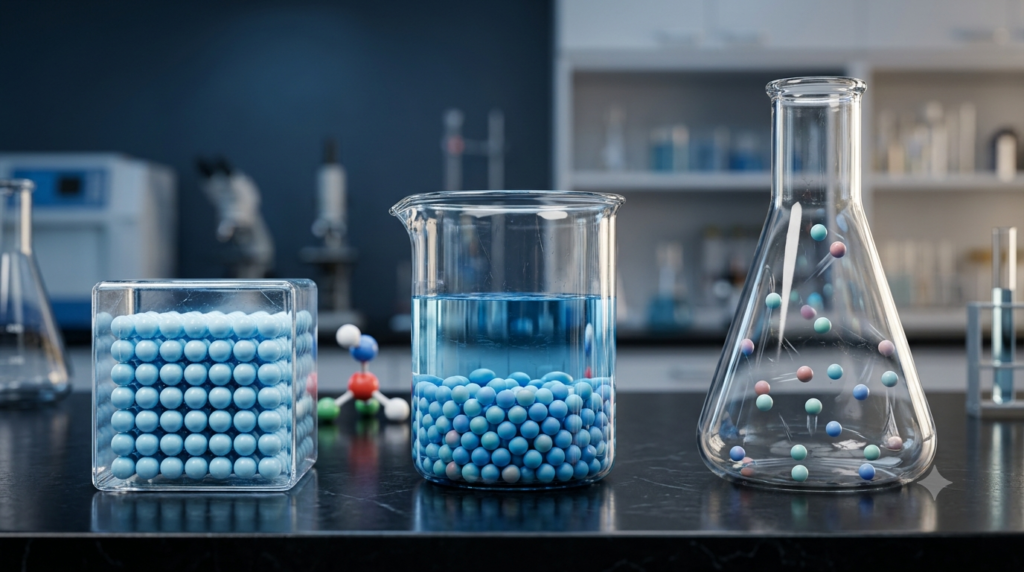
Everything around us is made of matter, from the air we breathe and the water we drink to the soil beneath our feet and the devices we use every day. Although matter exists in different physical states, such as solids, liquids, and gases, it can also be classified according to its chemical composition. This classification helps us understand what substances are made of, how their components are combined, and how they behave under different conditions.
Based on composition, matter is broadly divided into two main categories: pure substances and mixtures. Pure substances have a fixed chemical composition, whereas mixtures contain two or more substances physically combined in varying proportions. Pure substances are further classified into elements and compounds, while mixtures are classified into homogeneous and heterogeneous mixtures.
Understanding this classification is essential for studying chemistry because it helps distinguish substances, identify their properties, separate mixtures, and understand chemical changes.
What Is Matter?
Matter is anything that has mass and occupies space. It consists of particles such as atoms, molecules, or ions. These particles determine the physical and chemical properties of a substance.
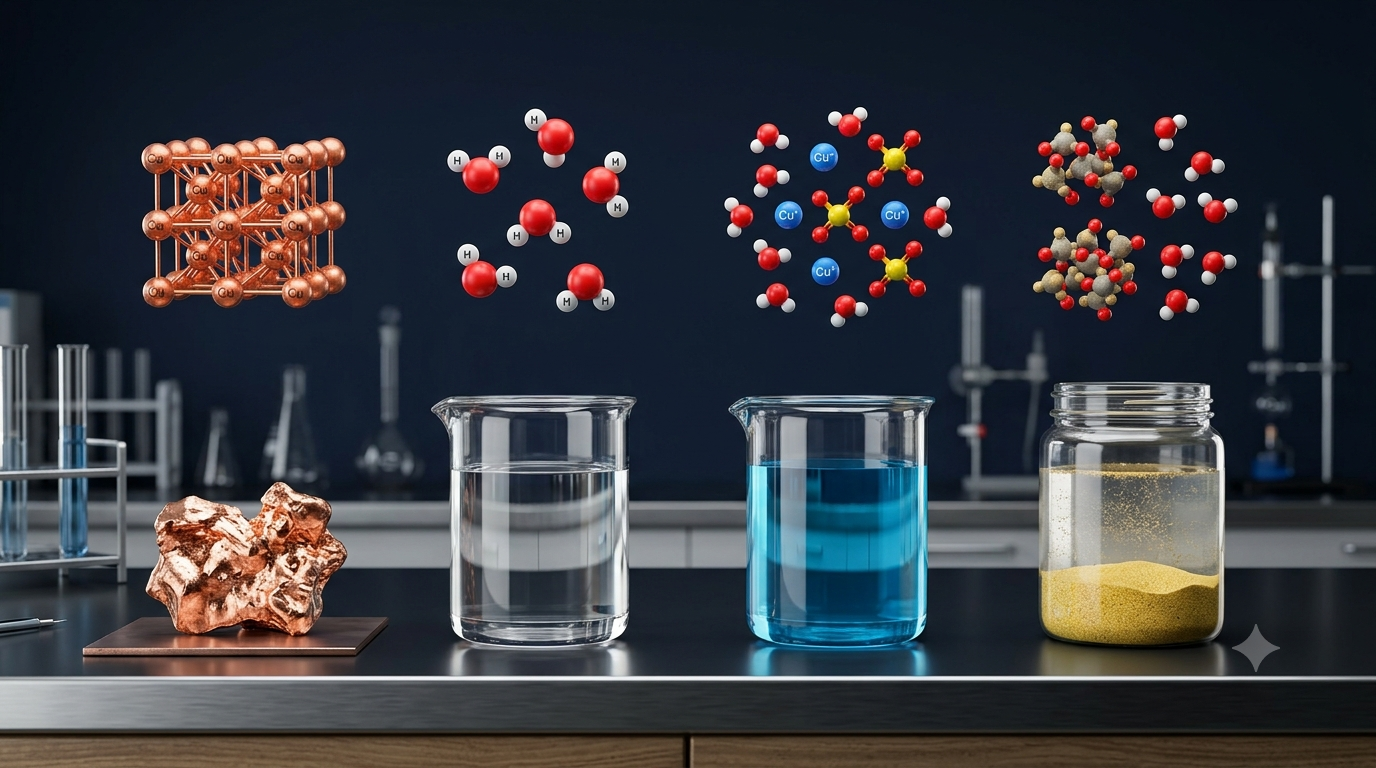
For example, a piece of copper consists mainly of copper atoms, while pure water consists of water molecules containing hydrogen and oxygen atoms. Air, on the other hand, is a mixture of gases, including nitrogen, oxygen, and argon.
Matter can be classified in two common ways. One method is based on its physical state, such as solid, liquid, or gas. Another method is based on its composition, which focuses on the types of substances present and how they are combined.
Classification by composition is especially useful because two materials may exist in the same physical state but have completely different compositions. For example, pure liquid water is a compound, while liquid salt water is a mixture.
Classification of Matter Based on Composition
Matter is broadly classified into two major groups: pure substances and mixtures.
The classification can be represented as follows.
Text block: Classification chart
Matter
This classification is based on whether matter contains one chemically defined substance or a physical combination of different substances.
1. Pure Substances
A pure substance is a form of matter that has a definite chemical composition and characteristic properties. It consists of one chemical substance, although that substance may contain one type of element or multiple elements chemically combined.
Pure substances are classified into two main types: elements and compounds.
Examples include pure copper, oxygen, distilled water, and sodium chloride. These substances differ in their structures and properties, but each has a defined chemical identity.
Fundamental Properties of Pure Substances
Fixed composition: A pure substance has a definite chemical composition. Pure water, for example, contains hydrogen and oxygen in a fixed atomic ratio.
Characteristic properties: Pure substances have characteristic physical and chemical properties under specified conditions. These may include density, melting point, boiling point, and chemical reactivity.
Uniform chemical identity: A pure substance consists of a single chemical substance rather than a physical combination of different substances.
Not separated by ordinary physical methods: The components of a compound cannot be separated by simple physical methods such as filtration or evaporation. Chemical processes are needed to break the compound into its constituent substances.
A pure substance may be an element or a compound. The difference depends on whether its chemical identity involves one type of element or two or more elements chemically combined.
2. Elements
An element is a pure substance that consists of only one type of atom, defined by its atomic number. It cannot be broken down into simpler substances by ordinary chemical reactions.
Examples of elements include hydrogen, oxygen, carbon, iron, copper, gold, and helium.
Each element has a unique atomic number, which is equal to the number of protons in the nucleus of its atoms. Elements are organized in the periodic table according to their atomic numbers and recurring chemical properties.
Fundamental Properties of Elements
One type of atom: Every element is defined by a particular number of protons in its atomic nucleus. For example, every carbon atom has six protons.
Cannot be chemically decomposed into simpler elements: Ordinary chemical reactions may rearrange the atoms of an element or cause it to react with other substances, but they do not convert it into a simpler element.
Different physical states: Elements can exist as solids, liquids, or gases under ordinary conditions. Iron is a solid, mercury is a liquid, and oxygen is a gas at typical room conditions.
Different chemical properties: Elements have different reactivities and bonding behaviours. Sodium reacts readily with water, whereas gold is much less reactive under ordinary conditions.
Examples of Elements
Iron (Fe): A metallic element used in construction, machinery, and tools.
Oxygen (O): An element essential for aerobic respiration and involved in many combustion reactions.
Carbon (C): An element found in living organisms and materials such as graphite and diamond.
Helium (He): A noble gas used in applications such as cryogenics and certain scientific instruments.
Elements may exist as individual atoms or as molecules containing atoms of the same element. For example, oxygen gas commonly exists as O₂, meaning each oxygen molecule contains two oxygen atoms. It is still an element because it contains only oxygen atoms.
3. Compounds
A compound is a pure substance formed when two or more different elements chemically combine in a fixed proportion. The atoms are held together by chemical bonds, and the resulting compound has properties that can differ significantly from those of its constituent elements.
Examples include water (H₂O), carbon dioxide (CO₂), sodium chloride (NaCl), and ammonia (NH₃).
For example, hydrogen is a highly flammable gas, and oxygen supports combustion. However, water, which is formed from hydrogen and oxygen, has very different properties and can be used to extinguish many ordinary fires.
Fundamental Properties of Compounds
Two or more elements: A compound contains atoms of at least two different elements chemically combined.
Fixed composition: A pure compound has a definite chemical composition. Water has two hydrogen atoms for every oxygen atom in each molecule.
New properties: A compound generally has physical and chemical properties different from those of the elements from which it is formed.
Chemical separation: The elements in a compound can be separated only through appropriate chemical reactions or other processes that change its chemical identity, not by ordinary physical separation methods.
Definite chemical formula: A compound can be represented by a chemical formula that indicates the elements present and their proportions. For example, CO₂ represents carbon dioxide.
Examples of Compounds
Water (H₂O): Contains hydrogen and oxygen chemically combined in a fixed ratio.
Carbon dioxide (CO₂): Contains carbon and oxygen and is produced by processes such as respiration and combustion.
Sodium chloride (NaCl): Common table salt, consisting of sodium and chloride ions arranged in an ionic structure.
Ammonia (NH₃): A compound containing nitrogen and hydrogen that is widely used in fertilizer production.
Difference Between Elements and Compounds
| Property | Element | Compound |
|---|---|---|
| Composition | One type of atom | Two or more different elements chemically combined |
| Chemical decomposition | Cannot be decomposed into simpler elements by ordinary chemical reactions | Can be decomposed into simpler substances through suitable chemical reactions |
| Composition ratio | Defined by its element identity | Elements occur in a fixed proportion in a pure compound |
| Representation | Chemical symbol | Chemical formula |
| Examples | Fe, O₂, He | H₂O, CO₂, NaCl |
The key difference is that an element contains only one type of atom, whereas a compound contains different elements chemically combined.
4. Mixtures
A mixture is formed when two or more substances are physically combined without being chemically combined into a single new substance. The substances in a mixture retain their chemical identities, although they may interact with one another.
Mixtures can contain elements, compounds, or both. Their composition can vary, depending on how much of each substance is present.
Examples include air, salt water, soil, fruit juice, and brass.
For example, salt water is formed by mixing salt and water. The amount of salt can be increased or decreased, and the salt can be recovered by evaporating the water under suitable conditions.
Fundamental Properties of Mixtures
Variable composition: The proportions of the substances in a mixture can vary. Salt water may contain a small or large amount of dissolved salt.
Retention of chemical identity: The components generally retain their chemical identities. Mixing iron filings with sulfur powder, for example, does not automatically produce iron sulfide.
Physical separation: Components can often be separated by physical methods such as filtration, distillation, evaporation, decantation, or magnetic separation, depending on their properties.
No single fixed chemical formula: A mixture does not have one fixed chemical formula representing all its components because their proportions can vary.
Variable physical properties: The properties of a mixture depend on the substances present and their proportions.
Mixtures are extremely common in nature. Air contains several gases, seawater contains water and dissolved salts, and soil contains minerals, organic matter, water, air, and other materials.
Mixtures are divided into two major types: homogeneous and heterogeneous mixtures.
5. Homogeneous Mixtures
A homogeneous mixture has a uniform composition throughout at the scale being considered. Its components are distributed evenly, and the mixture generally appears as a single phase.
Examples include salt dissolved in water, sugar solution, air under ordinary conditions, and many metal alloys.
Fundamental Properties of Homogeneous Mixtures
Uniform composition: Samples taken from different parts of a well-mixed homogeneous mixture have the same composition under the same conditions.
Single visible phase: The mixture generally appears uniform, without visibly distinct components.
Components may be difficult to distinguish: The individual substances are often not visible separately, even though they retain their chemical identities.
Variable proportions: The amounts of the components can vary without necessarily changing the identity of the substances present.
Physical separation is possible: Suitable physical methods can separate the components. For example, dissolved salt can be recovered from salt water through evaporation or crystallization.
Examples of Homogeneous Mixtures
Salt water: Salt dissolves in water and becomes distributed throughout the solution.
Sugar solution: Dissolved sugar is distributed throughout the water when the solution is properly mixed.
Air: Clean, well-mixed air is a homogeneous mixture of gases, mainly nitrogen and oxygen, along with smaller amounts of argon, carbon dioxide, and other gases.
Brass: A common alloy composed mainly of copper and zinc. Its composition can vary depending on the intended properties and application.
A homogeneous mixture is often called a solution. In a typical solution, the solute is the substance dissolved, and the solvent is the substance that dissolves it. In salt water, salt is the solute and water is the solvent.
6. Heterogeneous Mixtures
A heterogeneous mixture has a non-uniform composition. Its components are distributed unevenly and may form distinguishable regions or phases.
Examples include oil mixed with water, sand in water, soil, and many types of salad.
Fundamental Properties of Heterogeneous Mixtures
Non-uniform composition: Different portions of the mixture may contain different proportions of its components.
Distinguishable components or regions: Components may be visible directly or may be identified using a microscope or other analytical method.
Multiple phases may be present: Many heterogeneous mixtures contain two or more physically distinct phases.
Physical separation: Components can often be separated using suitable physical methods, such as filtration, decantation, sieving, or separating funnels.
Examples of Heterogeneous Mixtures
Oil and water: Oil and water generally form separate liquid layers because they are largely immiscible.
Sand and water: Sand particles remain separate from the water and may settle at the bottom.
Soil: Soil contains varying proportions of mineral particles, organic matter, water, air, and sometimes living organisms.
Granite: This rock contains different minerals, such as quartz, feldspar, and mica, that can often be distinguished visually.
Some heterogeneous mixtures have components that are not easily visible to the naked eye. Milk, for example, is an emulsion containing tiny fat droplets dispersed in a water-based phase. It may look uniform but is classified as a colloidal system rather than a true molecular solution.
Difference Between Homogeneous and Heterogeneous Mixtures
| Property | Homogeneous Mixture | Heterogeneous Mixture |
|---|---|---|
| Composition | Uniform throughout at the relevant scale | Non-uniform |
| Appearance | Generally uniform | Often visibly non-uniform |
| Phases | Usually one phase | Often two or more phases |
| Component visibility | Components are not usually distinguishable | Components or regions may be distinguishable |
| Examples | Salt water, air, brass | Oil and water, sand and water, granite |
The distinction depends on the distribution of components and the scale of observation. A mixture that looks uniform to the naked eye may still have a more complex microscopic structure.
Methods of Separating Mixtures
Because the components of a mixture generally retain their chemical identities, many mixtures can be separated using physical methods. The most suitable method depends on differences in physical properties, such as particle size, solubility, density, magnetism, or boiling point.
1. Filtration
Filtration separates an insoluble solid from a fluid using a porous material.
For example, sand can be separated from water using filter paper. The sand remains on the filter, while the water passes through.
2. Evaporation
Evaporation can be used to recover a dissolved solid from a solution when the solvent is removed.
For example, salt can be obtained from salt water by evaporating much of the water. Crystallization may be used when the aim is to obtain crystals of the dissolved substance.
3. Distillation
Distillation separates substances by vaporizing a component and then condensing its vapour. It is useful when components have sufficiently different volatilities or boiling behaviours.
Simple distillation can be used to obtain water from a salt solution, while fractional distillation is commonly used to separate liquid mixtures with closer boiling points.
4. Magnetic Separation
Magnetic separation uses a magnet to separate magnetic materials from non-magnetic materials.
For example, iron filings can be separated from a mixture containing sand by using a magnet.
5. Decantation
Decantation involves carefully pouring off a liquid while leaving a settled solid or a separate liquid layer behind.
For example, water can be poured off after sand has settled at the bottom of a container.
6. Chromatography
Chromatography separates components based on their different interactions with a stationary phase and a moving phase.
It is used to separate and identify components of mixtures, such as pigments in ink, dyes, and substances in chemical samples.
These methods are useful in laboratories, food production, water treatment, medicine, and many industrial processes.
Key Differences Between Pure Substances and Mixtures
| Property | Pure Substance | Mixture |
|---|---|---|
| Composition | Fixed chemical identity and composition | Variable proportions of components |
| Components | One chemical substance | Two or more substances |
| Chemical identity | One defined substance | Components retain their chemical identities |
| Separation | Compounds require chemical change to decompose into constituent elements | Components can often be separated physically |
| Melting and boiling behaviour | Often characteristic under specified conditions; pure substances may melt or boil at definite temperatures at a given pressure | Often occurs over a range, although some mixtures show special phase-change behaviour |
| Examples | Pure copper, oxygen, distilled water | Air, salt water, soil |
An important point is that a pure substance is not necessarily an element. Pure water is a pure substance because it consists of a single compound. Similarly, a mixture is not necessarily heterogeneous; air and salt water can be homogeneous mixtures.
Why Is the Classification of Matter Important?
Classifying matter according to composition helps scientists and students understand the nature of materials and choose suitable methods to study them.
In chemistry: Classification helps distinguish elements, compounds, and mixtures and provides a foundation for studying chemical reactions.
In industry: Manufacturers need to know the composition of raw materials to produce metals, medicines, fuels, fertilizers, and other products with suitable properties.
In environmental science: Air, water, and soil contain mixtures whose components must be measured to monitor pollution and maintain environmental quality.
In medicine: Many medicines are formulated as mixtures of active ingredients and other substances. Understanding their composition is important for quality control and safe use.
In daily life: The classification explains why salt dissolves in water, why oil forms a separate layer, and why filtration can remove suspended particles from water.
In laboratories: Scientists use knowledge of composition to select appropriate analytical and separation techniques.
This classification is therefore more than a theoretical concept. It helps explain how materials are identified, processed, purified, and used in practical applications.
Conclusion
Matter can be classified according to its composition into two major categories: pure substances and mixtures. Pure substances include elements, which contain one type of atom, and compounds, which contain two or more elements chemically combined in fixed proportions. Mixtures contain two or more substances physically combined and can have variable compositions.
Homogeneous mixtures have a uniform composition, while heterogeneous mixtures have a non-uniform composition. Their components can often be separated using physical methods such as filtration, evaporation, distillation, magnetic separation, and chromatography.
Understanding these categories helps explain the composition and behaviour of materials in everyday life and provides a strong foundation for further study in chemistry and other sciences.
FAQs
1. What Is the Classification of Matter Based on Its Composition?
The classification of matter based on its composition is a method of grouping substances according to the types of particles they contain and how those particles are combined. Matter is broadly divided into two main categories: pure substances and mixtures. Pure substances include elements and compounds, while mixtures are classified as homogeneous or heterogeneous. An element contains one type of atom, whereas a compound contains two or more different elements chemically combined in a fixed proportion. A mixture contains two or more substances physically combined. This classification helps scientists understand the properties, composition, and separation of different materials.
2. What Are Pure Substances and Their Main Types?
A pure substance is matter with a definite chemical identity and composition. It contains only one chemical substance, which may be an element or a compound. Pure substances have characteristic properties, such as density and melting point, under specified conditions. Elements, including iron, oxygen, and copper, contain one type of atom. Compounds, such as water, carbon dioxide, and sodium chloride, contain two or more different elements chemically combined in definite proportions. Unlike mixtures, pure substances do not contain varying proportions of different chemical substances. Understanding pure substances helps distinguish individual chemical substances from materials made by combining several substances.
3. What Is the Difference Between an Element and a Compound?
An element is a pure substance consisting of one type of atom, defined by its atomic number. Examples include hydrogen, oxygen, iron, and gold. A compound is a pure substance formed when two or more different elements chemically combine in a fixed proportion. Water, represented by H₂O, contains hydrogen and oxygen, while carbon dioxide, represented by CO₂, contains carbon and oxygen. Elements cannot be decomposed into simpler elements through ordinary chemical reactions, but compounds can be broken down into simpler substances through suitable chemical reactions. Therefore, the main difference is the type of atoms present and how they are chemically combined.
4. What Is a Mixture, and What Are Its Main Characteristics?
A mixture is formed when two or more substances are physically combined without becoming a single new chemical substance. Its components generally retain their chemical identities, and their proportions can vary. Examples include air, salt water, soil, and brass. Unlike a pure compound, a mixture does not have one fixed chemical formula representing all its components. Many mixtures can be separated using physical methods such as filtration, evaporation, distillation, and magnetic separation. Mixtures are common in everyday life and industrial processes. Their properties depend on the types, amounts, and distribution of the substances present.
5. What Is a Homogeneous Mixture? Give Examples.
A homogeneous mixture has a uniform composition throughout at the scale being considered. Its components are distributed evenly, and it generally appears as a single phase. Examples include salt water, sugar solution, air under ordinary conditions, and many metal alloys. In salt water, dissolved salt is distributed throughout the water, making different samples of a well-mixed solution similar in composition. The proportions of the components can vary without necessarily changing the identity of the substances present. Although the components may not be visibly distinguishable, they retain their chemical identities and can often be separated using suitable physical methods.
6. What Is a Heterogeneous Mixture? Give Examples.
A heterogeneous mixture has a non-uniform composition, meaning its components are not distributed evenly throughout the material. Different portions may contain different amounts of the substances present. Examples include oil mixed with water, sand in water, soil, and granite. In a mixture of sand and water, the sand remains a separate solid phase and may settle at the bottom. Some heterogeneous mixtures have components that are too small to distinguish with the naked eye. For example, milk contains tiny fat droplets dispersed in a water-based phase. Heterogeneous mixtures can often be separated using methods such as filtration, decantation, or centrifugation.
7. How Can We Distinguish Between Pure Substances and Mixtures?
Pure substances have a definite chemical identity and composition, whereas mixtures contain two or more substances in proportions that can vary. A pure substance may be an element, such as copper, or a compound, such as pure water. A mixture may be homogeneous, like salt water, or heterogeneous, like sand mixed with water. Pure compounds have characteristic properties under specified conditions, while mixtures often show properties that depend on their composition. Mixture components can frequently be separated through physical processes, whereas separating the elements of a compound requires a suitable chemical reaction. These differences help identify and classify materials.
8. What Methods Are Used to Separate Mixtures?
Mixtures can often be separated using physical methods based on differences in properties such as particle size, solubility, density, magnetism, and boiling behaviour. Filtration separates insoluble solids from liquids, while evaporation can recover a dissolved solid from a solution. Distillation separates substances through vaporization and condensation. Magnetic separation removes magnetic materials, such as iron filings, from non-magnetic substances. Decantation separates a liquid from settled solids or another immiscible liquid. Chromatography separates components according to their interactions with stationary and moving phases. The appropriate method depends on the composition of the mixture and the properties of its components.
9. Why Is Air Classified as a Homogeneous Mixture?
Air is generally classified as a homogeneous mixture because its major gaseous components are distributed relatively uniformly under ordinary, well-mixed conditions. These components include nitrogen, oxygen, argon, carbon dioxide, and small quantities of other gases. They are physically mixed rather than chemically combined into a single compound. The proportions of atmospheric gases can vary slightly with location, altitude, humidity, and environmental conditions. Air can be separated into its components through industrial processes, such as liquefaction followed by fractional distillation. Although air usually behaves as a homogeneous mixture, local particles, droplets, or pollutants can make particular air samples more complex.
10. Why Is the Classification of Matter Important in Chemistry?
The classification of matter is important because it helps scientists understand the composition, properties, and behaviour of substances. By distinguishing elements, compounds, and mixtures, students can understand how materials are formed and how they can be separated or chemically changed. This knowledge is useful in laboratory experiments, industrial manufacturing, medicine, environmental monitoring, and food production. For example, water treatment requires methods to remove unwanted substances from mixtures, while chemical manufacturing depends on the correct identification and use of pure substances. Learning this classification also provides a foundation for studying chemical reactions, atomic structure, solutions, and the physical and chemical properties of materials.