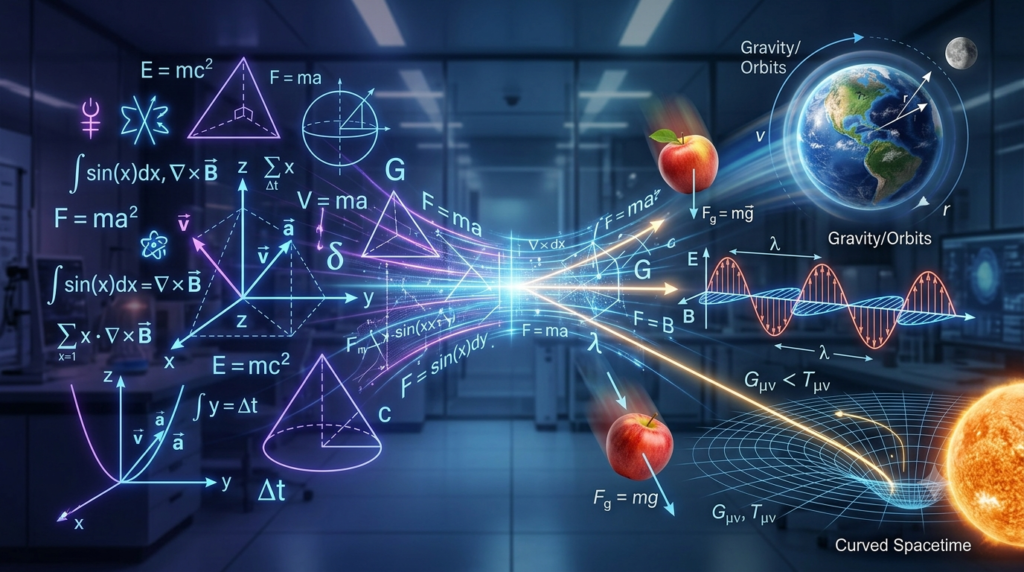
Physics is one of the most powerful ways humans try to understand the natural world. From the motion of planets and the falling of an object to the behavior of atoms and the nature of light, physics looks for the basic rules that govern how things happen. It does not simply describe what we observe. It tries to explain why those observations occur and how different phenomena are connected.
The natural world can appear extremely complicated, but physics often reveals simple principles hidden beneath that complexity. By using observations, experiments, measurements, mathematics, and logical reasoning, physicists develop models and laws that help explain everything from everyday motion to the evolution of the universe.
Physics Begins With Observation
Understanding nature begins with observing what happens. People have always noticed natural events such as objects falling, the Sun rising, the Moon changing its appearance, and water flowing downhill. Physics turns these everyday observations into questions that can be investigated scientifically.
For example, instead of simply noticing that an object falls when released, physicists ask why it falls, how quickly it accelerates, and whether the same pattern occurs for different objects. These questions transform a simple observation into a scientific investigation.
Careful observation is important because nature does not always behave in the way our intuition suggests. A systematic approach allows physicists to distinguish between what appears to happen and what actually happens.
Experiments Reveal Patterns
Observation alone is not always enough. Physics uses experiments to test ideas under controlled conditions. An experiment allows scientists to change one factor, measure the result, and compare it with predictions.
Suppose a physicist wants to understand how the length of a pendulum affects its motion. By changing the length while keeping other conditions similar, the physicist can collect measurements and look for a consistent relationship.
Repeated experiments help reveal patterns. When the same relationship appears under different conditions, confidence in the underlying explanation increases. If an experiment disagrees with a prediction, physicists do not simply ignore the result. They investigate whether the model, measurement, or assumptions need to be changed.
Mathematics Gives Physics Precision
Mathematics is one of the main languages of physics. Natural phenomena can often be expressed through mathematical relationships that allow scientists to make precise predictions.
Newton’s laws of motion, for example, connect force, mass, and acceleration. Instead of saying only that a stronger force can produce greater acceleration, physics can express the relationship mathematically as:
F = ma
This equation allows us to calculate how an object should respond when a force acts on it.
Mathematics also helps physicists discover relationships that are difficult to recognize through observation alone. Equations can describe the motion of planets, the behavior of electric circuits, the propagation of waves, and the interactions of particles.
Physical Laws Describe Regularities
A physical law describes a consistent pattern observed in nature. Laws such as the laws of motion, conservation of energy, and the laws of thermodynamics help explain how physical systems behave.
A law does not necessarily explain every detail about why nature behaves that way. Instead, it tells us what relationship consistently occurs under particular conditions.
For example, conservation of energy tells us that energy cannot simply disappear or appear from nothing in an isolated system. It can change from one form to another. A moving object can have kinetic energy, which can eventually become thermal energy through friction.
Such principles apply across many different situations, making them extremely useful for understanding the natural world.
Theories Provide Deeper Explanations
In everyday language, the word “theory” can mean a guess. In science, however, a scientific theory is a well-supported framework that explains a wide range of observations and experimental results.
Theories help connect individual facts into a broader explanation. The theory of electromagnetism, for example, connects electric and magnetic phenomena. Einstein’s theories of relativity explain gravity, space, time, and motion under conditions where classical physics is insufficient.
A strong theory does more than explain existing observations. It can also make predictions that can be tested through new experiments and observations.
Physics Connects Different Phenomena
One of the remarkable features of physics is its ability to connect phenomena that initially seem unrelated.
Electricity and magnetism were once treated as separate areas of study. Later developments showed that they are deeply connected and form the broader theory of electromagnetism. Light itself is understood as an electromagnetic wave.
Similarly, the same principles of mechanics that describe objects moving on Earth can be used to understand the motion of planets and spacecraft. The laws may appear in different forms depending on the situation, but the underlying physical principles can remain connected.
These connections make physics more than a collection of separate facts. It is a framework for understanding relationships throughout nature.
Physics Explains Matter and Its Interactions
Physics also explores what matter is made of and how its components interact.
At the atomic level, matter consists of atoms containing nuclei and electrons. At an even deeper level, nuclei contain protons and neutrons, which themselves are made of quarks. Quantum physics provides the framework for describing the behavior of matter and energy at microscopic scales.
Particles interact through fundamental forces. These interactions help determine how matter forms structures and how physical systems change.
Although the microscopic world behaves differently from our everyday experience, experiments have repeatedly shown that quantum theories can accurately predict the behavior of extremely small systems.
Physics Explains Energy and Change
Energy is another central concept in physics. Almost every physical process involves energy being transferred or transformed.
The energy stored in chemical substances can be converted into heat. Electrical energy can produce light and motion. Solar energy can drive processes on Earth. In stars, nuclear processes release enormous amounts of energy.
Understanding energy allows physicists to explain why systems change and how much change is possible. It also helps engineers design machines, power systems, buildings, vehicles, and technologies more efficiently.
The principle of energy conservation provides a powerful way to analyze complicated processes by tracking energy as it moves between different forms.
Physics Helps Explain Space and the Universe
Physics is not limited to objects that can be studied in a laboratory. It also provides tools for understanding the largest structures in existence.
The laws of physics help scientists study stars, galaxies, black holes, and the expanding universe. Observations of light from distant objects provide information about their motion, composition, temperature, and history.
General relativity provides a framework for understanding gravity as a consequence of the geometry of spacetime. Modern cosmology combines observations and physical theories to investigate how the universe has evolved over billions of years.
The same scientific approach used to study a falling object can therefore be extended to questions about the entire universe.
Physics Uses Models to Understand Complexity
Nature can be too complicated to describe in complete detail. Physics therefore uses models.
A model is a simplified representation of a physical system that focuses on the features most important to a particular question. For example, when studying the motion of a ball, a physicist might initially ignore air resistance. This simplification makes the problem easier to analyze.
A useful model does not need to include every detail. It needs to capture the important behavior accurately enough for its intended purpose.
When a model fails to explain observations, scientists improve it or develop a better one. This process is an important part of scientific progress.
Physics Is Based on Testing and Revision
Physics does not assume that every explanation is permanently correct. Scientific knowledge changes when new evidence provides a better understanding.
Classical mechanics works extremely well for many everyday situations, but it does not fully describe extremely fast objects or microscopic systems. Relativity and quantum mechanics expanded our understanding by addressing situations where classical ideas become inadequate.
This does not mean older physics was useless. Instead, newer theories often show the conditions under which earlier theories work and extend them to situations that require a deeper explanation.
Scientific progress therefore depends on questioning assumptions, testing predictions, and being willing to revise explanations.
Why Physics Matters in Everyday Life
The principles of physics operate everywhere around us. A bicycle stays balanced through principles involving motion and forces. A refrigerator transfers thermal energy. A smartphone depends on electricity, electromagnetism, semiconductor physics, and materials science. Communication technologies rely on electromagnetic waves and sophisticated physical systems.
Even natural events such as rainbows, tides, earthquakes, lightning, and the movement of clouds involve physical processes.
Learning physics helps us see these events differently. Instead of seeing them as isolated occurrences, we begin to recognize the principles and relationships behind them.
Conclusion
Physics explains the natural world by combining observation, experimentation, mathematics, models, and logical reasoning. It searches for patterns and develops laws and theories that can describe and predict physical behavior. From the smallest particles to the largest galaxies, physics provides a connected framework for understanding how nature works.
Its greatest strength is not simply that it gives us equations. It teaches us how to ask meaningful questions about the world, test possible explanations, and improve our understanding when new evidence appears. By studying physics, we move from simply observing nature to understanding the principles that shape it.