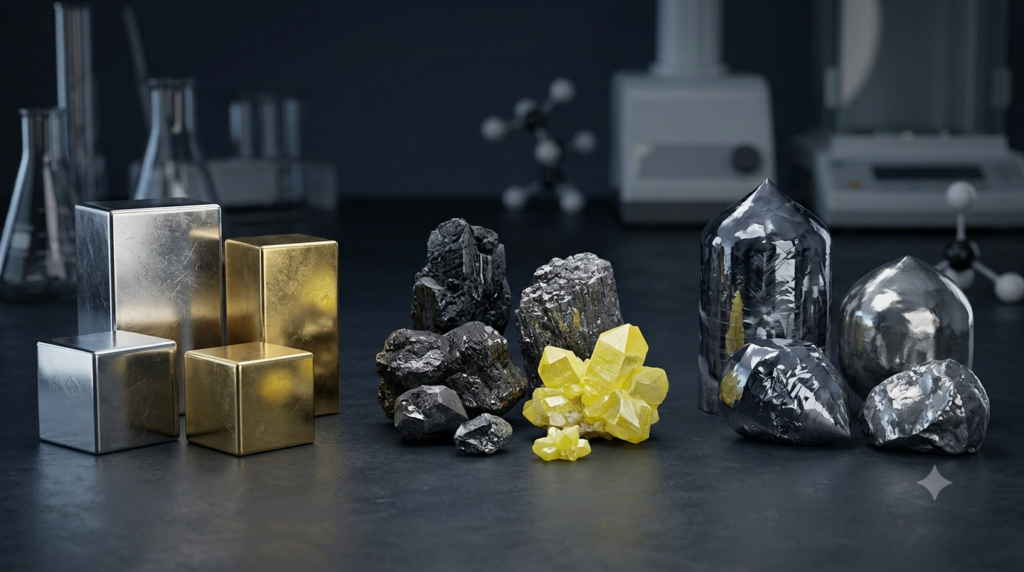
Transition elements are an important group of metals in the periodic table. They are known for their unique physical and chemical properties, including variable oxidation states, the formation of coloured compounds, catalytic activity, and the ability to form complex ions. These elements play an essential role in many natural processes, industrial applications, and modern technologies.
Iron used in construction, copper used in electrical wiring, nickel used in stainless steel, and platinum used in catalytic converters are all examples of transition elements. Their properties make them useful in several fields, including engineering, electronics, medicine, manufacturing, and chemical industries.
Understanding transition elements helps explain why certain metals show different colours, form various compounds, and behave differently from many other elements. In this article, we will explore the definition, position, electronic configuration, important characteristics, examples, and applications of transition elements.
What Are Transition Elements?
Transition elements are elements that have partially filled d-orbitals in their atoms or in at least one of their commonly formed oxidation states.
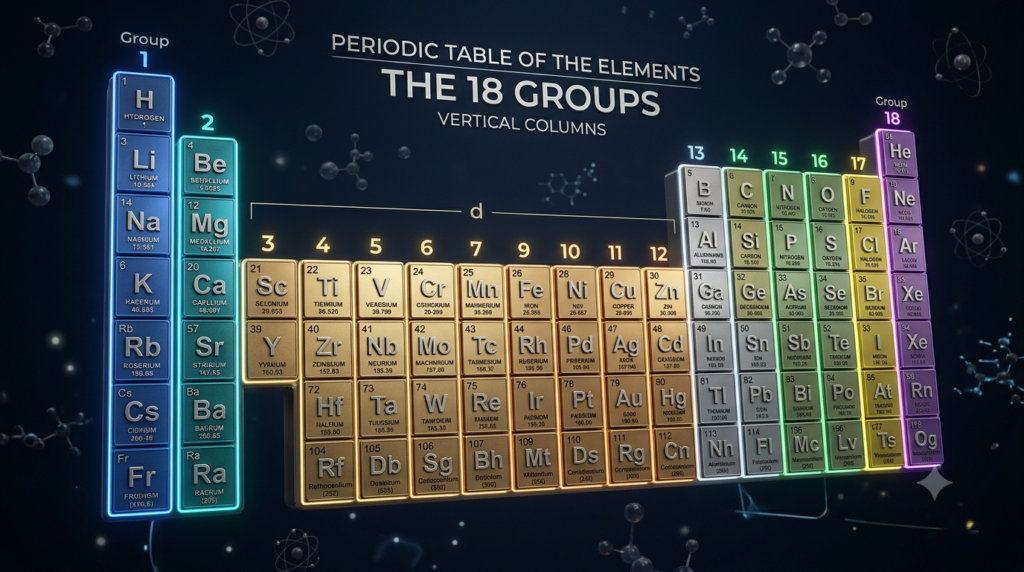
They are located mainly in the central region of the periodic table, between the s-block and p-block elements. These elements belong to Groups 3 to 12 and are commonly known as d-block elements.
The term transition refers to the position of these elements between the highly reactive metals of the s-block and the elements of the p-block.
However, it is important to understand that all d-block elements are not necessarily transition elements. According to the commonly used IUPAC definition, an element is considered a transition element if its atom has an incomplete d-subshell or if it can form cations with an incomplete d-subshell.
For example, iron (Fe), copper (Cu), chromium (Cr), and manganese (Mn) are transition elements. Zinc (Zn), on the other hand, is generally not classified as a transition element because both its atom and its common Zn²⁺ ion have completely filled d-orbitals.
Position of Transition Elements in the Periodic Table
Transition elements occupy the middle portion of the periodic table. They are found in the d-block, which consists of ten columns corresponding to Groups 3 to 12.
These elements are arranged into four main transition series based on the filling of their d-orbitals.
The four transition series are:
First transition series (3d series): Scandium to Zinc.
Second transition series (4d series): Yttrium to Cadmium.
Third transition series (5d series): Hafnium to Mercury.
Fourth transition series (6d series): Elements associated with the filling of 6d orbitals, including those from Rutherfordium onward.
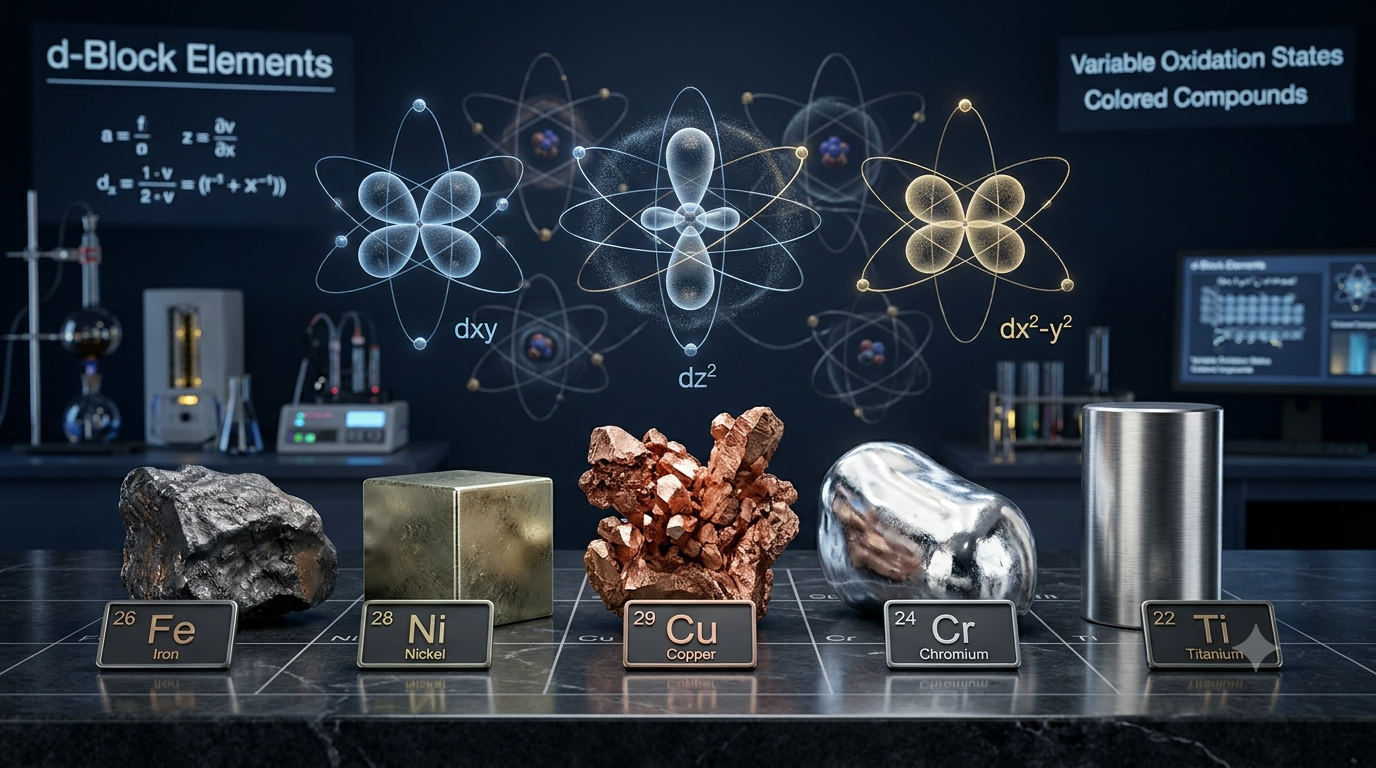
The first transition series is particularly important because it contains several commonly encountered metals, such as titanium, chromium, manganese, iron, cobalt, nickel, and copper.
Electronic Configuration of Transition Elements
The electronic configuration of transition elements is one of the main reasons behind their distinctive chemical properties.
In these elements, electrons are progressively added to the d-orbitals of the penultimate electron shell. The general electronic configuration of d-block elements is:
(n − 1)d¹–¹⁰ ns⁰–²
Here:
n represents the outermost principal energy level.
(n − 1)d represents the d-subshell of the penultimate shell.
ns represents the outermost s-subshell.
For example, the electronic configurations of some transition elements are:
| Element | Symbol | Electronic Configuration |
|---|---|---|
| Scandium | Sc | [Ar] 3d¹ 4s² |
| Titanium | Ti | [Ar] 3d² 4s² |
| Vanadium | V | [Ar] 3d³ 4s² |
| Chromium | Cr | [Ar] 3d⁵ 4s¹ |
| Manganese | Mn | [Ar] 3d⁵ 4s² |
| Iron | Fe | [Ar] 3d⁶ 4s² |
| Cobalt | Co | [Ar] 3d⁷ 4s² |
| Nickel | Ni | [Ar] 3d⁸ 4s² |
| Copper | Cu | [Ar] 3d¹⁰ 4s¹ |
| Zinc | Zn | [Ar] 3d¹⁰ 4s² |
Chromium and copper show exceptions to the expected electronic configuration. Chromium has a half-filled 3d subshell, while copper has a completely filled 3d subshell. These arrangements are relatively stable.
During the formation of positive ions, electrons are generally removed from the outermost ns orbital before the (n − 1)d orbital.
For example:
Fe: [Ar] 3d⁶ 4s²
Fe²⁺: [Ar] 3d⁶
Fe³⁺: [Ar] 3d⁵
The electronic configuration of transition elements explains many of their important characteristics, including variable oxidation states, magnetic behaviour, and the formation of coloured compounds.
Important Characteristics of Transition Elements
Transition elements possess several physical and chemical properties that distinguish them from other groups of elements.
1. Metallic Nature
Transition elements are metals and generally show typical metallic properties.
They are usually hard, strong, and have high tensile strength. Most of them are solid at room temperature, with mercury being an important exception because it is liquid at room temperature.
They also have metallic lustre and are generally good conductors of heat and electricity.
For example, copper and silver are excellent electrical conductors, while iron and chromium are widely used in construction and manufacturing.
Their metallic nature makes them useful in buildings, machinery, electrical equipment, vehicles, and industrial tools.
2. High Melting and Boiling Points
Most transition elements have relatively high melting and boiling points compared with many other metals.
This property is mainly associated with strong metallic bonding. Both d-electrons and s-electrons can contribute to metallic bonding, resulting in strong attraction between metal atoms.
Tungsten is a notable example because it has an exceptionally high melting point of approximately 3422°C.
However, melting points are not identical across the transition series. Their values depend on electronic configuration and the strength of metallic bonding.
3. Variable Oxidation States
One of the most important characteristics of transition elements is their ability to show variable oxidation states.
This happens because the energy difference between the outermost s-orbitals and the d-orbitals is relatively small. As a result, electrons from both types of orbitals may participate in chemical bonding.
For example, iron commonly shows +2 and +3 oxidation states.
Fe²⁺ is called the ferrous ion, while Fe³⁺ is called the ferric ion.
Similarly:
Manganese shows oxidation states ranging from +2 to +7.
Chromium commonly shows +2, +3, and +6 oxidation states.
Copper commonly shows +1 and +2 oxidation states.
Vanadium shows several oxidation states, including +2, +3, +4, and +5.
This ability allows transition elements to form a wide variety of compounds with different chemical properties.
4. Formation of Coloured Compounds
Many transition elements form coloured ions and compounds. This is one of their most easily observed characteristics.
The colour is generally associated with electronic transitions between different energy levels within partially filled d-orbitals.
When light falls on a transition metal compound, certain wavelengths may be absorbed by its electrons. The remaining transmitted or reflected light produces the colour that we observe.
For example:
Copper(II) sulfate is blue.
Potassium dichromate is orange.
Potassium permanganate is purple.
Nickel(II) salts are often green.
Chromium(III) compounds can show green or violet colours.
However, not all transition metal compounds are coloured. Ions with completely filled or empty d-orbitals often do not show d–d electronic transitions.
For example, Zn²⁺ has a completely filled d¹⁰ configuration and its compounds are generally colourless when the other ions present do not contribute colour.
5. Catalytic Properties
Transition elements and their compounds often act as effective catalysts.
A catalyst increases the rate of a chemical reaction without being permanently consumed in the overall reaction.
Transition metals are particularly useful as catalysts because they can show variable oxidation states and provide surfaces on which reactants can be adsorbed.
Some important examples include:
Iron is used as a catalyst in the Haber process for ammonia production.
Nickel is used in the hydrogenation of vegetable oils.
Platinum and palladium are used in catalytic converters in vehicles.
Vanadium(V) oxide is used as a catalyst in the Contact process for producing sulfuric acid.
Their catalytic properties make transition elements extremely important in chemical manufacturing and environmental technologies.
6. Formation of Complex Compounds
Transition elements have a strong tendency to form complex compounds, also called coordination compounds.
A complex is formed when a central metal atom or ion is surrounded by molecules or ions known as ligands. These ligands donate electron pairs to the central metal ion, forming coordinate bonds.
Transition metal ions can form complexes because they have suitable orbitals and can accept electron pairs from surrounding ligands.
Examples include:
[Cu(NH₃)₄]²⁺
[Fe(CN)₆]⁴⁻
[Co(NH₃)₆]³⁺
[Ag(NH₃)₂]⁺
Complex compounds are important in analytical chemistry, biological systems, medicine, and industrial processes.
For example, haemoglobin contains iron in a complex structure that helps transport oxygen in the blood.
7. Magnetic Properties
Many transition elements and their compounds show magnetic properties because of the presence of unpaired d-electrons.
The most common types of magnetic behaviour are paramagnetism and diamagnetism.
Paramagnetism: Substances containing one or more unpaired electrons are generally attracted by an external magnetic field.
Diamagnetism: Substances in which all electrons are paired are generally weakly repelled by an external magnetic field.
For example, iron, cobalt, and nickel are well-known ferromagnetic metals at ordinary temperatures.
Some transition metal ions, such as Fe³⁺ and Mn²⁺, also show strong paramagnetic behaviour because they contain unpaired electrons.
These magnetic properties are useful in electric motors, generators, magnetic storage devices, and other electronic applications.
8. Formation of Alloys
Transition elements readily form alloys with one another and with other metals.
An alloy is a mixture of two or more elements, at least one of which is a metal, that possesses metallic properties.
Alloys are produced to improve properties such as strength, hardness, corrosion resistance, and durability.
Examples include:
Stainless steel: Mainly iron, chromium, and often nickel.
Brass: Copper and zinc.
Bronze: Mainly copper and tin.
Nichrome: Mainly nickel and chromium.
These alloys are widely used in construction, household equipment, electrical heating elements, vehicles, and industrial machinery.
9. High Density and Hardness
Many transition elements have high densities and are relatively hard.
This is generally related to their closely packed metallic structures and strong metallic bonding.
For example, iron, cobalt, nickel, and tungsten are known for their strength and density.
Tungsten is particularly useful in applications that require materials capable of withstanding high temperatures and mechanical stress.
However, density and hardness vary considerably among transition elements. Not every transition metal is equally dense or hard.
10. Formation of Interstitial Compounds
Transition metals can form interstitial compounds when small atoms, such as hydrogen, carbon, nitrogen, or boron, occupy spaces between metal atoms in their crystal structures.
These compounds are often hard and have high melting points.
Examples include:
Titanium carbide (TiC).
Tungsten carbide (WC).
Iron nitride (Fe₄N).
Interstitial compounds are important in manufacturing cutting tools, machine components, protective coatings, and other materials requiring high hardness and wear resistance.
Differences Between Transition Elements and Other Metals
Transition elements have several properties that distinguish them from metals in the s-block and p-block.
| Property | Transition Elements | Many Other Metals |
|---|---|---|
| Position | Mainly Groups 3–12 | Found in different groups |
| Electronic configuration | Involves d-orbitals | Usually involves s or p orbitals |
| Oxidation states | Often variable | Frequently show fewer common states |
| Coloured compounds | Common | Less common |
| Complex formation | Often strong tendency | Varies considerably |
| Catalytic activity | Common in many elements | Varies |
| Magnetic properties | Frequently observed | Depends on electronic structure |
These differences are general trends rather than strict rules. The properties of individual metals depend on their electronic structures and chemical environments.
Examples of Important Transition Elements
Several transition elements are particularly important because of their properties and practical applications.
Iron (Fe)
Iron is one of the most widely used transition metals. It is strong, relatively abundant, and an important component of steel.
It commonly shows +2 and +3 oxidation states. Iron is also essential in biological systems because it is present in haemoglobin, which helps transport oxygen in the blood.
Copper (Cu)
Copper is a reddish-brown metal known for its excellent electrical and thermal conductivity.
It is commonly found in +1 and +2 oxidation states. Copper is widely used in electrical wiring, electronic equipment, plumbing, and the manufacture of alloys.
Chromium (Cr)
Chromium is a hard, shiny metal that provides excellent resistance to corrosion.
It is used in stainless steel production, metal plating, and protective coatings. Chromium compounds can show different colours and oxidation states.
Nickel (Ni)
Nickel is a silvery-white metal known for its corrosion resistance and ability to form useful alloys.
It is used in stainless steel, rechargeable batteries, electroplating, and hydrogenation reactions.
Manganese (Mn)
Manganese is an important transition metal that shows several oxidation states.
It is used in steel manufacturing, dry-cell batteries, and chemical industries. Potassium permanganate, a compound of manganese, is a strong oxidising agent.
Titanium (Ti)
Titanium is a strong, lightweight metal with excellent corrosion resistance.
It is widely used in aircraft, spacecraft, medical implants, and chemical processing equipment.
Applications of Transition Elements
Transition elements have numerous applications in everyday life and modern industries because of their useful physical and chemical properties.
1. Construction and Engineering
Iron and its alloys are widely used in buildings, bridges, railway tracks, vehicles, and heavy machinery. Their strength and durability make them essential engineering materials.
2. Electrical and Electronic Industries
Copper and silver are used in electrical wiring, circuits, connectors, and electronic components because of their excellent electrical conductivity.
3. Chemical Industries
Transition metals such as iron, nickel, platinum, and vanadium are used as catalysts in important industrial chemical reactions.
4. Medical Applications
Titanium is used to manufacture medical implants because it is strong, lightweight, and biocompatible.
Certain transition metal complexes are also used in medical treatments. For example, cisplatin is a platinum-based compound used in cancer chemotherapy.
5. Automobile Industry
Chromium, nickel, iron, and other transition metals are used in vehicle manufacturing. Platinum-group metals are also important components of automotive catalytic converters, which help reduce harmful exhaust emissions.
6. Energy Storage and Technology
Nickel, cobalt, and manganese are used in different types of rechargeable batteries. These metals are important in energy storage systems, electric vehicles, and portable electronic devices.
7. Jewellery and Decorative Materials
Gold, silver, and platinum are used in jewellery, ornaments, and decorative products because of their attractive appearance and resistance to corrosion.
Gold and silver are d-block metals, although they are not classified as transition elements under the strict incomplete d-subshell definition because their common ions generally have d¹⁰ configurations.
Difference Between d-Block Elements and Transition Elements
The terms d-block elements and transition elements are often used together, but they do not have exactly the same meaning.
d-block elements are those elements in which the differentiating electron enters a d-orbital.
Transition elements are d-block elements whose atoms have incomplete d-subshells or whose ions can form incomplete d-subshells.
For example, zinc belongs to the d-block because its differentiating electrons enter the 3d subshell. However, zinc is generally excluded from the transition elements because its atom and its common Zn²⁺ ion have completely filled 3d orbitals.
Similarly, cadmium and mercury are generally not classified as transition elements under this strict definition.
Therefore, all transition elements belong to the d-block, but not all d-block elements are transition elements.
Conclusion
Transition elements are an important group of metals located in the central region of the periodic table. Their partially filled d-orbitals are responsible for many of their distinctive chemical and physical properties.
Variable oxidation states, coloured compounds, catalytic activity, complex formation, magnetic behaviour, and the ability to form alloys make these elements different from many other metals.
Elements such as iron, copper, chromium, nickel, and titanium are widely used in construction, electronics, transportation, medicine, and chemical industries. Their importance extends from everyday materials to advanced technologies.
Studying transition elements provides a better understanding of chemical bonding, electronic configurations, coordination chemistry, and the practical applications of metals in modern science and industry.
FAQs
1. What are transition elements?
Transition elements are elements that have partially filled d-orbitals in their atoms or in at least one of their commonly formed oxidation states. They are mainly located in Groups 3 to 12 of the periodic table. These elements are known for their unique chemical and physical properties, such as variable oxidation states, coloured compounds, catalytic activity, magnetic behaviour, and complex formation. Common examples include iron, copper, chromium, manganese, nickel, and titanium. Transition elements are widely used in construction, electrical equipment, chemical industries, medicine, and modern technology.
2. Where are transition elements located in the periodic table?
Transition elements are located in the central region of the periodic table, mainly in Groups 3 to 12. This region is known as the d-block because the differentiating electron enters a d-orbital. They are arranged into four transition series: 3d, 4d, 5d, and 6d. The first transition series extends from scandium to zinc and contains several important metals, including iron, cobalt, nickel, and copper. Their position between the s-block and p-block elements gives them the name transition elements.
3. What is the general electronic configuration of transition elements?
The general electronic configuration of d-block elements is (n − 1)d¹–¹⁰ ns⁰–², where n represents the outermost principal energy level. In transition elements, electrons progressively enter the d-orbitals of the penultimate shell. For example, iron has the electronic configuration [Ar] 3d⁶ 4s², while manganese has [Ar] 3d⁵ 4s². Chromium and copper show exceptions because of the relatively stable half-filled and completely filled d-subshell arrangements. This electronic configuration explains several important properties, including variable oxidation states, magnetic behaviour, and coloured compounds.
4. Why do transition elements show variable oxidation states?
Transition elements show variable oxidation states because the energy difference between their outermost s-orbitals and d-orbitals is relatively small. Therefore, electrons from both orbitals can participate in chemical bonding. This allows transition elements to lose different numbers of electrons and form ions with different charges. For example, iron commonly exhibits +2 and +3 oxidation states, while copper shows +1 and +2 oxidation states. Manganese can exhibit several oxidation states, ranging from +2 to +7. This property allows transition elements to form a wide variety of chemical compounds.
5. Why do transition metal compounds have different colours?
Many transition metal compounds show different colours because of electronic transitions within their partially filled d-orbitals. When visible light falls on these compounds, electrons absorb specific wavelengths of light and move between different energy levels. The remaining light produces the colour observed by the human eye. For example, copper(II) sulfate is blue, potassium permanganate is purple, and potassium dichromate is orange. However, not all transition metal compounds are coloured. Compounds containing ions with completely filled or empty d-orbitals generally do not show colour due to d–d electronic transitions.
6. Why are transition elements good catalysts?
Many transition elements and their compounds are effective catalysts because they can show variable oxidation states and provide surfaces for reactant adsorption. These properties help chemical reactions take place more quickly by providing alternative reaction pathways with lower activation energy. For example, iron is used as a catalyst in the Haber process for manufacturing ammonia. Nickel is used in the hydrogenation of vegetable oils, while vanadium(V) oxide is used in the Contact process for producing sulfuric acid. Platinum and palladium are also used in automobile catalytic converters to reduce harmful exhaust emissions.
7. Why do transition elements form complex compounds?
Transition elements readily form complex compounds because their metal atoms and ions can accept electron pairs from surrounding molecules or ions called ligands. These ligands donate electron pairs to the central metal ion, forming coordinate bonds. The resulting structures are known as coordination complexes. Examples include [Cu(NH₃)₄]²⁺, [Fe(CN)₆]⁴⁻, and [Co(NH₃)₆]³⁺. Complex formation is an important characteristic of transition elements and has applications in analytical chemistry, biological processes, medicine, and industrial manufacturing. Haemoglobin, which contains iron, is an important example of a biological coordination complex.
8. Why do transition elements show magnetic properties?
Transition elements show magnetic properties mainly because of the presence of unpaired electrons in their d-orbitals. When unpaired electrons are present, their magnetic moments can produce paramagnetic behaviour, in which a substance is attracted by an external magnetic field. Some transition metals, such as iron, cobalt, and nickel, also show ferromagnetism, allowing them to become strongly magnetised. In contrast, substances with completely paired electrons generally show diamagnetic behaviour. These magnetic properties make transition elements useful in electric motors, generators, magnetic storage devices, and various electronic applications.
9. Why do transition elements have high melting and boiling points?
Most transition elements have high melting and boiling points because of strong metallic bonding between their atoms. Both s-electrons and d-electrons can contribute to metallic bonding, creating strong attractive forces within the metallic structure. Considerable energy is therefore required to separate their atoms during melting and boiling. For example, tungsten has an exceptionally high melting point of approximately 3422°C. However, melting and boiling points vary across the transition series depending on electronic configuration and bonding strength. Mercury is an important exception because it is liquid at room temperature.
10. What are the important applications of transition elements in everyday life?
Transition elements have numerous applications in everyday life and modern industries. Iron is used in construction, machinery, and steel manufacturing, while copper is widely used in electrical wiring and electronic devices. Chromium and nickel are important components of stainless steel because they improve corrosion resistance. Titanium is used in aircraft, medical implants, and chemical equipment. Platinum and palladium are used in catalytic converters, while nickel, cobalt, and manganese are important in rechargeable batteries. Transition metals are also used in jewellery, industrial catalysts, medical treatments, and advanced technologies because of their useful physical and chemical properties.