Everything around us is made of matter. The air we breathe, the water we drink, the food we eat, and the objects we use every day are all examples of matter. Although matter appears continuous when we observe it with our eyes, scientific evidence shows that it is made up of extremely tiny particles. These particles are constantly involved in motion and interactions, even when an object appears completely still.
The particle nature of matter is a fundamental concept in science that helps explain the properties and behaviour of solids, liquids, and gases. It also explains everyday observations such as the spreading of perfume through a room, the dissolving of sugar in water, and the expansion of gases when heated. By studying the particle model of matter, we can understand how substances behave at a microscopic level and connect these invisible processes to the physical world we experience.
What Is the Particle Nature of Matter?
The particle nature of matter is the scientific idea that all ordinary matter is composed of tiny particles rather than being completely continuous. These particles are too small to be seen individually with the naked eye, but their existence can be understood through experiments and scientific observations.
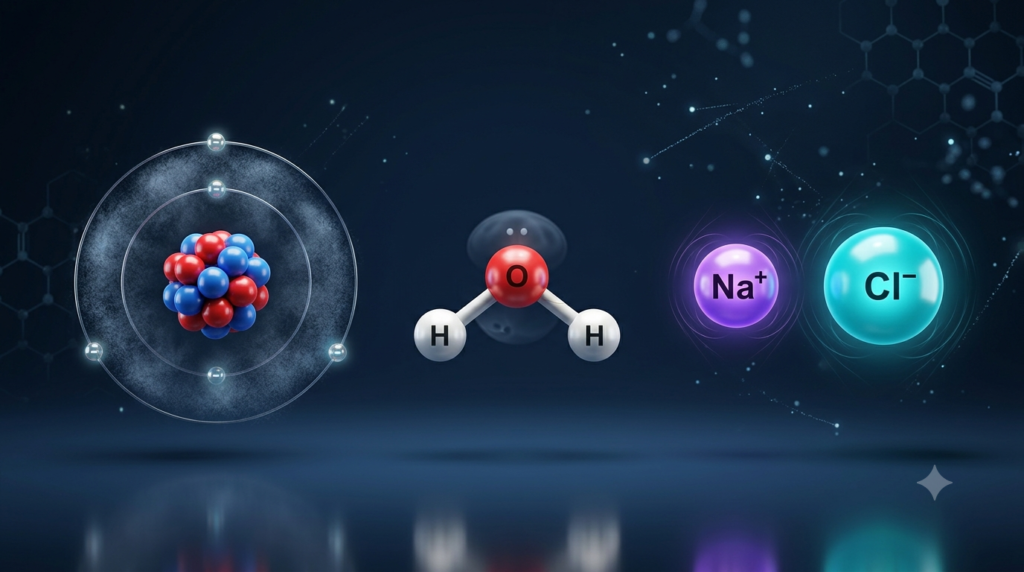
Depending on the substance, its particles may be atoms, molecules, ions, or combinations of these. An atom is a basic unit of a chemical element. A molecule consists of two or more atoms chemically bonded together. Ions are electrically charged atoms or groups of atoms.
For example, a piece of copper contains an enormous number of copper atoms arranged in a solid structure. Pure water contains water molecules, each consisting of two hydrogen atoms bonded to one oxygen atom. Common salt contains positively charged sodium ions and negatively charged chloride ions arranged in an ionic crystal structure.
Although these particles are incredibly small, their combined behaviour determines the properties of the materials we observe. The strength of interactions between particles, their arrangement, and their motion help determine whether a substance exists as a solid, liquid, or gas under particular conditions.
Main Characteristics of Matter Particles
The particle model describes several important characteristics that help explain the behaviour of matter.
Matter Is Made Up of Tiny Particles
Matter is not infinitely divisible into smaller pieces while retaining all the characteristics of the original substance. It is made of microscopic units with specific structures and properties.
Consider a small crystal of sugar. When placed in water, it gradually dissolves, and its individual sugar molecules spread throughout the liquid. The sugar does not disappear; its molecules become distributed among the water molecules.
This observation supports the idea that matter contains particles much smaller than the objects we can see.
Particles Have Spaces Between Them
Particles are not necessarily packed together without any gaps. The amount of space between them depends on the substance and its physical state.
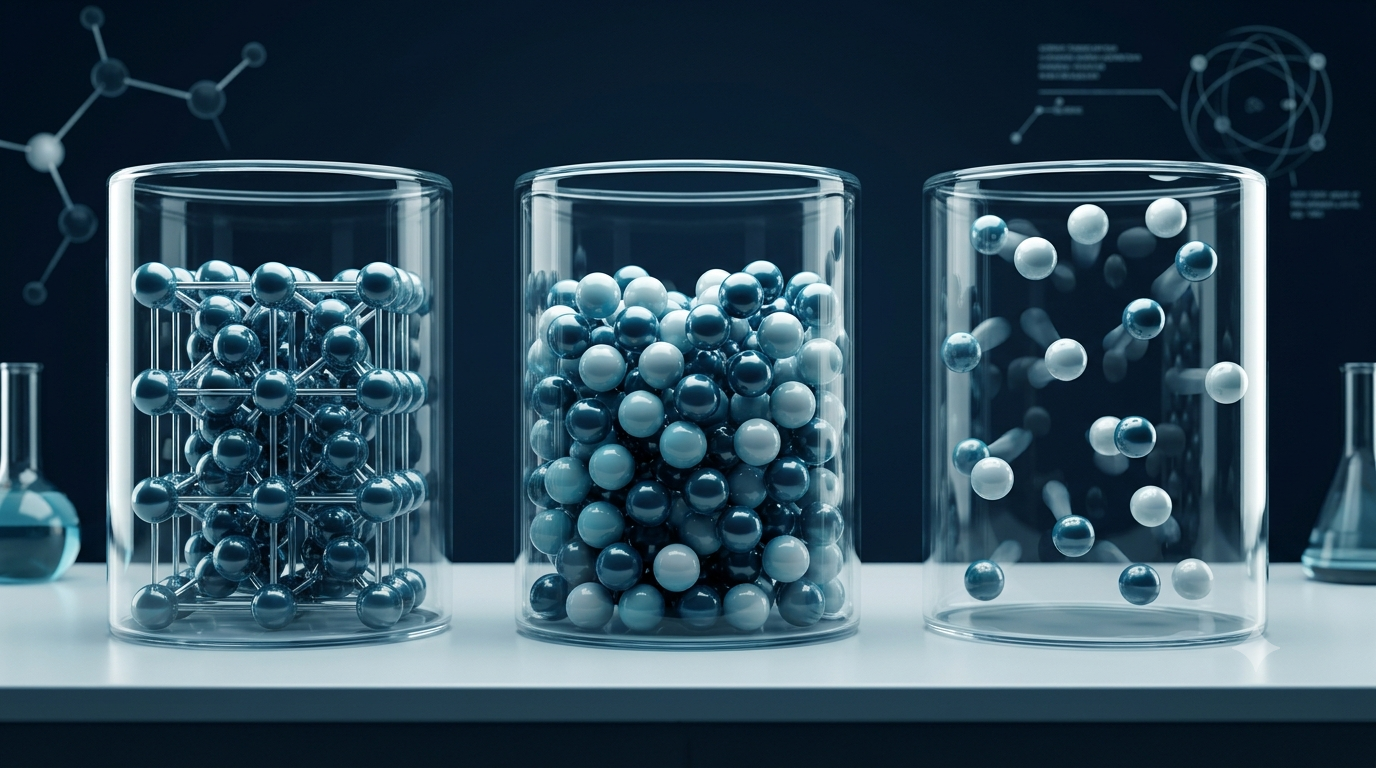
In most solids, particles are closely packed. In liquids, particles remain relatively close but can move past one another. In gases, particles are generally much farther apart compared with their own sizes.
These differences help explain why gases can be compressed much more easily than most liquids and solids. When a gas is compressed, its particles can be brought closer together because a considerable amount of space exists between them.
The spaces between particles do not mean that every material has empty gaps of the same size. Particle arrangement varies with the structure and conditions of the substance.
Particles Are in Constant Motion
Particles of matter are not completely motionless. Their movement depends on the physical state and temperature of the substance.
In a solid, particles generally vibrate around relatively fixed positions. In a liquid, particles move around and slide past neighbouring particles. In a gas, particles move freely and randomly, frequently colliding with one another and with the walls of their container.
Increasing the temperature usually increases the average kinetic energy of particles. As a result, their motion generally becomes more energetic.
Even a solid object resting on a table contains particles undergoing microscopic motion. The object appears stationary because its overall position does not change, not because its particles have stopped moving.
Particles Attract One Another
Particles can exert attractive and repulsive forces on one another. The nature and strength of these interactions depend on the substance and the distances between its particles.
In many solids, strong interactions help maintain a stable arrangement. In liquids, particles remain close together but can move past one another. In gases at ordinary low-pressure conditions, particles are usually far enough apart that their intermolecular attractions have a relatively small effect on their overall motion.
These interactions help explain why solids retain their shape, liquids maintain a relatively definite volume, and gases expand to fill available space.
Evidence That Matter Is Made of Particles
Scientists developed the particle model through observations, experiments, and the gradual improvement of atomic theory. Several familiar phenomena provide evidence for the microscopic structure of matter.
Diffusion
Diffusion is the net spreading of particles from a region of higher concentration to a region of lower concentration due to their random motion.
A simple example is the smell of perfume spreading through a room. When perfume is sprayed, many perfume molecules enter the surrounding air. These molecules move randomly and mix with air molecules, eventually reaching different parts of the room.
The spreading does not require the perfume molecules to be deliberately directed towards every corner. Their continuous random motion, together with mixing in the air, produces the overall distribution.
Diffusion generally occurs faster in gases than in liquids because gas particles move freely and are usually separated by greater distances. Temperature, particle size, concentration differences, and the nature of the medium can also influence diffusion.
Dissolving of Sugar in Water
When sugar is added to water and stirred, the visible sugar crystals gradually disappear. This process provides another useful example of the particle nature of matter.
Water molecules interact with the sugar molecules at the crystal’s surface. Individual sugar molecules separate from the crystal and become surrounded by water molecules. These dissolved molecules then spread throughout the liquid.
The resulting solution contains both water and sugar particles, even though the original sugar crystals are no longer visible.
Dissolving does not mean that the sugar has been destroyed. The sugar molecules remain present in the solution unless a separate chemical process changes them.
Brownian Motion
Brownian motion is the irregular, random movement of microscopic particles suspended in a fluid, such as tiny pollen particles in water.
The suspended particles are continually struck by surrounding fluid molecules. These collisions occur from different directions and are not perfectly balanced at every moment. As a result, the suspended particles move in an irregular manner.
Brownian motion was investigated in detail by botanist Robert Brown in 1827. Later, Albert Einstein developed a theoretical explanation of the phenomenon in 1905, helping establish a strong connection between observable motion and the existence of microscopic molecules.
Brownian motion is important because it provides visible evidence of the effects of molecular motion, even though individual molecules cannot ordinarily be seen with a conventional optical microscope.
How the Particle Model Explains Solids, Liquids, and Gases
The particle model explains the different physical states of matter by considering particle arrangement, motion, and interactions.
Solids
In a solid, particles are usually closely packed and held in relatively stable positions by interactions with neighbouring particles. They can vibrate, but they generally cannot move freely from one position to another under ordinary conditions.
This arrangement explains why solids usually have a definite shape and volume. A metal spoon, a stone, and an ice cube retain their overall shapes unless an external force or a change in conditions alters them.
Most solids are difficult to compress because their particles already occupy a closely packed arrangement. However, solids are not all identical. Some have highly ordered crystal structures, while others, such as glass, lack long-range crystalline order.
Liquids
In a liquid, particles remain close together but can move past one another. Their arrangement is less rigid than that of particles in a solid.
This mobility explains why liquids flow and take the shape of their containers. Water poured into a glass changes its shape to fit the glass, but its volume remains approximately constant under ordinary conditions.
Liquids are generally difficult to compress because their particles are already relatively close together. Their ability to flow depends on how easily particles move and how they interact with neighbouring particles.
Gases
In a gas, particles are usually widely separated relative to their sizes and move rapidly in random directions. They frequently collide with one another and with the walls of their container.
This behaviour explains why a gas expands to occupy the available space. It also explains why gases can be compressed significantly: the particles can be brought closer together by reducing the volume available to them.
Gas pressure results from particles colliding with the walls of a container and transferring momentum to those walls. The combined effect of countless collisions produces the pressure measured by instruments.
How Temperature Affects the Motion of Particles
Temperature is closely related to the average kinetic energy of particles. For a substance in thermal equilibrium, increasing its temperature generally increases the average energy associated with random particle motion.
When water is heated, its molecules move more energetically. As the temperature rises, the liquid may eventually reach its boiling point, where vapour bubbles can form throughout the liquid under suitable pressure conditions.
Cooling generally reduces the average kinetic energy of particles. Under suitable conditions, this can cause a gas to condense into a liquid or a liquid to freeze into a solid.
During a phase change of a pure substance at constant pressure, the temperature can remain constant while energy is transferred. This happens because the energy changes the arrangement and interactions of particles rather than simply increasing their average kinetic energy.
The relationship between temperature and particle motion is fundamental to understanding heating, cooling, melting, freezing, evaporation, condensation, and boiling.
The Particle Nature of Matter and Changes of State
Matter can change from one physical state to another when temperature or pressure changes. These changes are known as changes of state.
Melting occurs when a solid changes into a liquid. Freezing is the reverse process. Evaporation and boiling change a liquid into a gas, while condensation changes a gas into a liquid. Sublimation occurs when a solid changes directly into a gas, and deposition is the reverse process.
These changes can be explained by considering the energy of particles and the interactions between them.
When a solid absorbs enough energy under appropriate conditions, its particles can move out of their relatively fixed positions, allowing the material to become a liquid. When a liquid absorbs additional energy, some particles can escape into the gaseous state.
The particle model also explains why evaporation can occur below the boiling point. In a liquid, particles have a range of kinetic energies. Some particles at the surface have enough energy to escape into the surrounding gas, even when the liquid as a whole is not boiling.
A familiar example is the drying of wet clothes. Water molecules escape from the fabric into the surrounding air through evaporation. Warm temperatures and moving air can increase the rate of drying under suitable conditions.
Basic Formulas Used to Explain Particle Behaviour
Mathematical relationships help scientists describe particle motion and the behaviour of gases. The following formulas apply under specific scientific conditions.
Average translational kinetic energy of a gas particle
Eₖ = 3/2 kBTHere, Eₖ represents the average translational kinetic energy per particle, kB is the Boltzmann constant, and T is the absolute temperature measured in kelvin. This relationship applies to an ideal gas in thermal equilibrium.
Ideal gas equation
PV = nRTHere, P is the absolute pressure, V is the volume, n is the amount of gas in moles, R is the universal gas constant, and T is the absolute temperature. The equation provides a useful model for many gases, especially at relatively low pressures and high temperatures.
Relationship between particle number and amount of substance
N = nNAHere, N is the number of specified particles, n is the amount of substance in moles, and NA is the Avogadro constant, approximately 6.022 × 10²³ mol⁻¹.
For example, one mole of water contains approximately 6.022 × 10²³ water molecules. This enormous number illustrates why even a small sample of matter contains an immense number of particles.
Important note: These equations describe particular aspects of particle behaviour. They do not mean that all substances behave as ideal gases or that every particle in a substance has exactly the same kinetic energy.
The Difference Between Atoms, Molecules, and Particles
The word particle is a broad scientific term. Its precise meaning depends on the context.
An atom is the basic unit of a chemical element that retains its chemical identity. Atoms consist of a nucleus containing protons and usually neutrons, surrounded by electrons.
A molecule consists of two or more atoms chemically bonded together. Oxygen gas commonly exists as O₂ molecules, while water consists of H₂O molecules.
An ion is an atom or group of atoms with a net electrical charge. Sodium chloride contains sodium ions and chloride ions arranged in a crystal lattice rather than separate, discrete sodium chloride molecules.
In some scientific contexts, particles may also refer to electrons, protons, neutrons, photons, or other microscopic entities. These are not all the same type of object, and they should not be treated as interchangeable.
Understanding these distinctions helps explain why different substances have different properties and why chemical reactions involve changes in the arrangement and bonding of atoms and ions.
Why the Particle Nature of Matter Is Important
The particle model is useful in many branches of science and technology.
In chemistry, it helps explain chemical reactions, solutions, gas behaviour, and changes of state. Chemical reactions involve changes in how atoms are arranged and bonded, while the atoms themselves are conserved in ordinary chemical reactions.
In physics, particle models help explain pressure, temperature, diffusion, thermal expansion, and the behaviour of gases. More advanced theories use statistical methods to connect the motion of enormous numbers of particles with measurable properties such as pressure and temperature.
In biology, the particle nature of matter helps explain how oxygen and carbon dioxide move between the lungs and blood, how dissolved substances travel through body fluids, and how molecules interact within cells.
In environmental science, particle movement is important for understanding how gases disperse in the atmosphere, how pollutants spread through water, and how substances move through soil.
The same basic concept therefore connects everyday observations with processes occurring inside living organisms, industrial systems, and the natural environment.
Limitations of the Simple Particle Model
Although the particle model is extremely useful, a simple representation of particles as tiny solid spheres has limitations.
Real atoms have internal structures involving nuclei and electrons. Electrons are described by quantum mechanics, and their behaviour cannot be fully represented by the idea of tiny classical balls following definite paths.
Similarly, particles do not always behave like ideal gas particles. At high pressures or low temperatures, interactions between gas particles can become important, and the ideal gas equation may no longer provide an accurate description.
The particle model also needs refinement when explaining complex materials, chemical bonding, electrical conductivity, magnetism, and phenomena at very small scales.
Scientists use more advanced models when greater accuracy is required. These include kinetic theory, statistical mechanics, quantum mechanics, and models of molecular structure.
The simple particle model remains valuable because it introduces the essential ideas of particle arrangement, motion, and interactions without requiring advanced mathematics.
Conclusion
The particle nature of matter is a fundamental scientific concept that explains how substances are structured and why they behave differently under different conditions. Matter consists of microscopic units such as atoms, molecules, and ions. These particles have spaces between them, move continuously, and interact through forces that influence their arrangement and behaviour.
Diffusion, Brownian motion, and the dissolving of sugar in water provide evidence for the microscopic nature of matter. Differences in particle arrangement and movement explain why solids retain their shape, liquids flow, and gases expand to fill their containers. Changes in temperature and pressure can alter particle behaviour and cause changes of state.
Although the simple particle model does not explain every detail of matter, it provides an essential foundation for chemistry, physics, biology, and other scientific fields. By connecting invisible particles with observable events, it helps us understand the physical world in a clear and logical way.
FAQs
1. What Is the Particle Nature of Matter?
The particle nature of matter is the scientific concept that all matter consists of extremely small particles, such as atoms, molecules, and ions. These particles are too small to be seen individually with the naked eye, but their behaviour can be understood through scientific experiments. Particles have spaces between them, remain in constant motion, and interact with one another through attractive and repulsive forces. Their arrangement and movement determine the physical properties of substances. This concept helps explain why solids maintain their shape, liquids flow, gases expand, and substances mix or dissolve under suitable conditions.
2. What Are the Main Characteristics of Matter Particles?
Matter particles have several important characteristics. First, all matter consists of tiny particles. Second, spaces exist between particles, although the amount of space varies with the substance and its physical state. Third, particles are continuously moving, with their motion depending on temperature and the surrounding conditions. Fourth, particles interact through forces that influence their arrangement and behaviour. These characteristics explain many everyday observations, including the spreading of perfume, the dissolving of sugar in water, and the expansion of gases when heated. Together, these ideas form the foundation of the particle model used to understand the properties of matter.
3. What Evidence Proves That Matter Is Made of Particles?
Several scientific observations support the particle nature of matter. Diffusion demonstrates how substances spread because their particles move randomly. For example, perfume molecules gradually spread through the surrounding air. Dissolving sugar in water shows how sugar molecules separate from crystals and distribute throughout the liquid. Brownian motion provides further evidence through the irregular movement of tiny suspended particles caused by collisions with surrounding fluid molecules. Modern experimental techniques, including electron microscopy and X-ray diffraction, also provide information about the microscopic structure of materials. Together, these observations and techniques support the scientific understanding that matter has a particulate structure.
4. How Does the Particle Model Explain Solids, Liquids, and Gases?
The particle model explains the three common states of matter through differences in particle arrangement, movement, and interactions. In solids, particles usually remain closely packed and vibrate around relatively fixed positions, giving solids a definite shape and volume. In liquids, particles remain close together but can move past one another, allowing liquids to flow and take the shape of their containers. In gases, particles move freely and are generally much farther apart. Consequently, gases expand to fill available space and can be compressed more easily than most solids and liquids. These differences explain many observable properties of substances.
5. Why Are Particles in Matter Always Moving?
Particles are constantly moving because they possess energy. In solids, particles generally vibrate around their positions, while particles in liquids move around one another. Gas particles move freely and randomly, frequently colliding with other particles and container walls. Temperature is closely related to the average kinetic energy of particles. When a substance is heated, its particles generally gain kinetic energy and move more energetically. When it is cooled, their average kinetic energy generally decreases. However, cooling does not mean that particles automatically stop moving. Their behaviour depends on the substance, its physical state, and the conditions under which it exists.
6. What Is Diffusion, and How Does It Support the Particle Theory?
Diffusion is the net movement of particles from a region of higher concentration to a region of lower concentration because of their random motion. A familiar example occurs when perfume is sprayed in one part of a room and its smell gradually spreads. Perfume molecules move through the air and mix with surrounding gas molecules. Diffusion generally occurs faster in gases than in liquids because gas particles move freely and are usually separated by greater distances. Temperature and concentration differences also influence the process. Diffusion supports the particle theory by demonstrating how microscopic particle movement produces observable changes in the distribution of substances.
7. How Does Temperature Affect the Movement of Matter Particles?
Temperature affects the average kinetic energy of particles. For an ideal gas in thermal equilibrium, the average translational kinetic energy of its particles is directly proportional to its absolute temperature. Heating generally increases particle motion, while cooling generally decreases it. These changes influence physical processes such as evaporation, diffusion, and thermal expansion. When a solid absorbs sufficient energy, it may melt; when a liquid loses sufficient energy, it may freeze. During a phase change at constant pressure, the temperature of a pure substance can remain constant while energy changes the arrangement and interactions of its particles rather than increasing their average kinetic energy.
8. Why Can Gases Be Compressed More Easily Than Solids and Liquids?
Gases can generally be compressed more easily because their particles are widely separated relative to their sizes. When pressure is applied, the particles can be brought closer together, reducing the volume occupied by the gas. In most solids and liquids, particles are already relatively close together, leaving much less room for compression. This difference explains why air can be compressed inside a syringe when its outlet is closed, while water is much more difficult to compress under ordinary conditions. The particle model connects this everyday observation to microscopic structure and helps explain how gas pressure and volume change when external conditions are altered.
9. What Is the Difference Between Atoms, Molecules, and Ions?
Atoms, molecules, and ions are different types of particles found in matter. An atom is the basic unit of a chemical element and contains a nucleus surrounded by electrons. A molecule consists of two or more atoms chemically bonded together, such as an oxygen molecule, O₂, or a water molecule, H₂O. An ion is an atom or group of atoms with a net electrical charge because electrons have been gained or lost. For example, sodium ions have a positive charge, while chloride ions have a negative charge. Understanding these differences helps explain chemical bonding, the structure of substances, and how chemical reactions occur.
10. Why Is the Particle Nature of Matter Important in Science?
The particle nature of matter is important because it provides a foundation for understanding many physical and chemical processes. In physics, it helps explain temperature, gas pressure, diffusion, and changes of state. In chemistry, it explains dissolving, chemical reactions, and molecular interactions. In biology, particle movement helps scientists understand gas exchange, the transport of dissolved substances, and processes occurring inside cells. Environmental science also uses particle concepts to study the movement of pollutants through air, water, and soil. Although simple particle models have limitations, they provide a useful starting point for understanding how microscopic structures and movements influence the observable properties of matter.