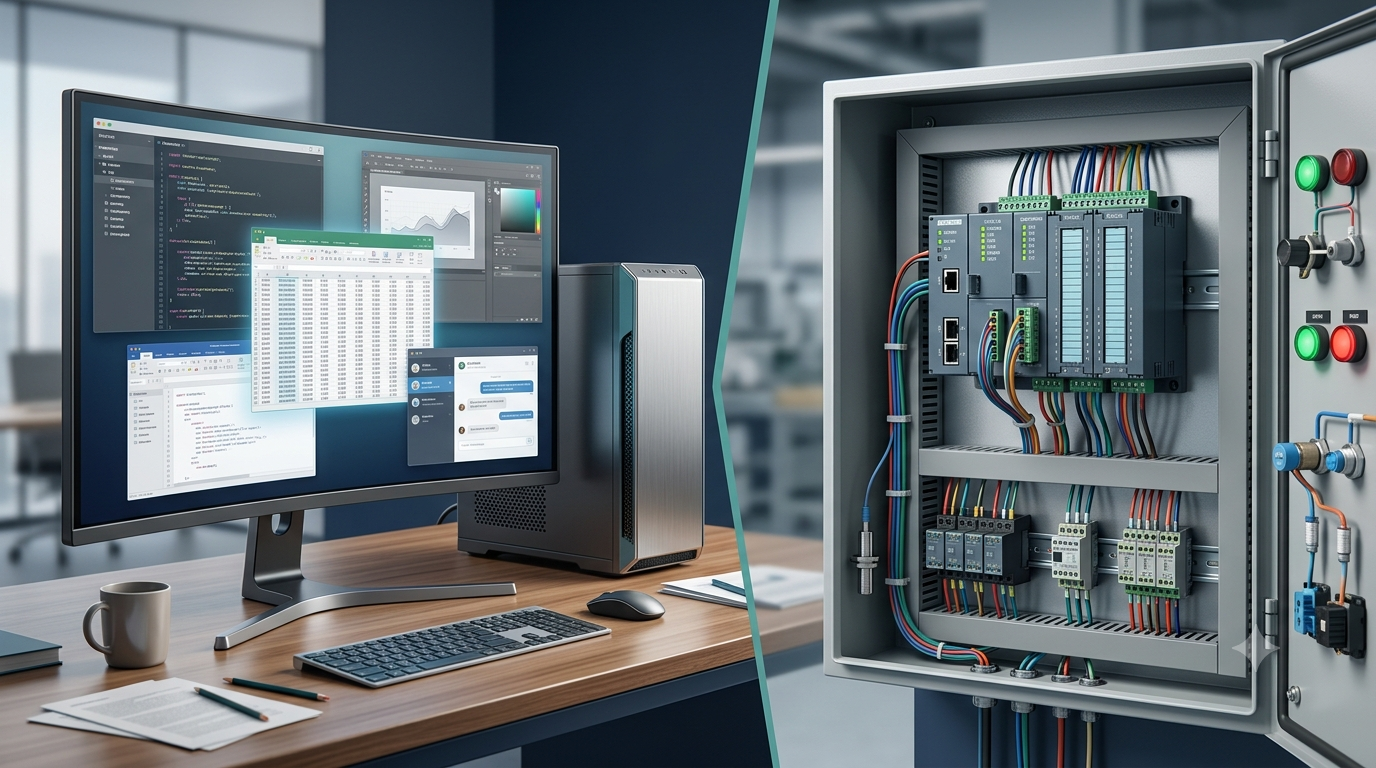
Computers are used in almost every area of modern life, from education and business to healthcare, scientific research, transportation, and communication. However, not all computers are designed to perform the same type of work. Some computers can handle many different tasks, while others are built to perform a specific function efficiently and reliably. Based on their intended use, computers can be broadly classified into general-purpose computers and special-purpose computers.
General-purpose computers are designed to perform a wide variety of tasks by running different software applications. Special-purpose computers, on the other hand, are developed to perform one particular task or a limited set of closely related operations. Both types play important roles in modern technology. Understanding their differences helps us recognize why laptops, desktop computers, ATMs, traffic control systems, and industrial machines are designed differently according to their requirements.
What Are General-Purpose Computers?
A general-purpose computer is a computer designed to perform multiple types of tasks by executing different programs. Its functionality can be changed or expanded by installing software, changing program instructions, or connecting compatible hardware devices.
These computers are widely used in homes, schools, offices, laboratories, and businesses because they can support many activities without requiring a separate computer for each task.
For example, a desktop computer can be used to write documents, create presentations, browse the internet, edit photographs, calculate mathematical problems, watch videos, and develop software. The same computer can perform these tasks by running different applications.
General-purpose computers are usually equipped with a processor, memory, storage devices, input devices, output devices, and an operating system. These components work together to execute instructions and allow users to interact with different programs.
Examples of General-Purpose Computers
Common examples include:
Desktop computers: Used for office work, education, programming, gaming, and multimedia activities.
Laptop computers: Portable computers suitable for studying, working, communicating, and entertainment.
Workstations: Powerful computers used for engineering, scientific calculations, computer-aided design, and advanced graphics.
Servers: Computers that provide services such as website hosting, file storage, database management, and application access to other computers.
Tablets: Portable computing devices used for reading, browsing, online learning, communication, and productivity.
Smartphones: Devices that perform many computing tasks through applications, including communication, navigation, photography, and internet access.
Although these devices differ in size, processing power, and design, they can perform multiple functions through software.
Characteristics of General-Purpose Computers
1. Versatility
The most important characteristic of a general-purpose computer is its ability to perform different tasks. A single computer can support word processing, calculations, entertainment, communication, and many other activities.
2. Programmability
General-purpose computers can execute different programs. Users can install existing applications or develop new software to extend their capabilities.
3. Software Support
These computers typically support a range of applications and development tools. Their operating systems manage hardware resources and provide an environment for running programs.
4. Upgradability
Depending on the device, components such as memory, storage, graphics cards, and peripheral devices can be upgraded or replaced. Software can also be updated to introduce new features.
5. User Interaction
General-purpose computers commonly provide interfaces that allow users to select applications, enter information, adjust settings, and perform different operations.
6. Adaptability
A general-purpose computer can be adapted to changing needs. For example, a computer initially used for studying can later be used for professional work, programming, or graphic design.
Advantages of General-Purpose Computers
General-purpose computers offer several benefits.
They can perform many different tasks using a single device.
They reduce the need to purchase separate computers for different activities.
They support a wide range of software applications.
They can be adapted to changing personal or professional requirements.
They are useful for education, research, business, communication, and entertainment.
They can support software development and other specialized activities when equipped with suitable hardware and applications.
Their flexibility makes them particularly valuable in environments where users regularly perform different types of work.
Limitations of General-Purpose Computers
Despite their advantages, general-purpose computers have some limitations.
First, they may contain hardware and software features that are unnecessary for a particular task. This can increase their cost and complexity. Second, their performance depends on the specifications of their processor, memory, storage, and other components. A standard computer may not provide sufficient performance for demanding industrial or scientific applications.
General-purpose computers may also require regular operating system updates, security maintenance, and software management. In applications that demand predictable timing, continuous operation, or specialized hardware interfaces, a general-purpose computer may require additional configuration or a dedicated control system.
What Are Special-Purpose Computers?
A special-purpose computer is a computer designed to perform a specific task or a limited range of related tasks. Its hardware and software are selected and configured to meet the requirements of that particular application.
Unlike a general-purpose computer, which can run many different types of applications, a special-purpose computer focuses on a defined function. Its design may prioritize speed, accuracy, energy efficiency, reliability, compact size, or real-time response.
Many special-purpose computers operate automatically with limited direct user interaction. They are commonly found inside electronic appliances, vehicles, medical equipment, industrial machines, and automated control systems.
For example, a washing machine may contain an embedded computer that controls water intake, washing time, drum movement, and drainage. The computer is not intended to function as a desktop computer. Instead, it executes the instructions necessary to operate the washing machine.
Similarly, an electronic traffic signal controller manages signal timing and may respond to sensor inputs according to programmed rules.
Examples of Special-Purpose Computers
1. ATM Controllers
Automated teller machines use computer systems designed to manage banking transactions, communicate with banking networks, validate user requests, and control cash-dispensing mechanisms.
2. Traffic Signal Controllers
These computers control traffic lights according to programmed schedules, sensor information, or coordinated traffic management systems.
3. Washing Machine Controllers
Embedded computers regulate washing cycles, water levels, motor operation, and other machine functions.
4. Automobile Control Units
Modern vehicles contain electronic control units that manage specific functions, such as engine operation, braking assistance, airbag deployment, or battery management in electric vehicles.
5. Medical Equipment Controllers
Specialized computer systems help operate and monitor equipment such as patient monitors, infusion pumps, and certain diagnostic instruments. Their design must meet the safety and reliability requirements of the intended medical application.
6. Industrial Controllers
Programmable logic controllers, commonly called PLCs, are designed to monitor inputs and control industrial processes such as conveyor systems, packaging machines, and manufacturing equipment.
7. Digital Cameras
Digital cameras use embedded processors to perform functions such as image processing, exposure control, autofocus management, and file storage.
8. Microwave Oven Controllers
These computers manage cooking time, power settings, user commands, and other operating functions.
Characteristics of Special-Purpose Computers
1. Task-Specific Design
The hardware and software are selected to perform a defined function. This focused design can make the system more efficient for its intended application.
2. High Efficiency
Because the system is optimized for a limited set of tasks, it may require fewer resources than a general-purpose computer performing comparable specialized work.
3. Reliable Operation
Special-purpose computers can be designed for continuous operation in specific environments. Industrial and safety-related systems may include diagnostic features, fault detection, and protective mechanisms.
4. Limited General Flexibility
Many special-purpose computers cannot be easily repurposed to perform unrelated tasks. Their functionality is generally determined by their design and programmed application.
5. Integration with Other Devices
These computers often communicate directly with sensors, motors, switches, displays, communication interfaces, and other electronic components.
6. Automatic Operation
Many special-purpose computers work automatically after receiving input from sensors or users. For example, a temperature controller can activate a cooling system when the measured temperature exceeds a specified level.
7. Application-Specific Performance
Their design may emphasize low power consumption, compact dimensions, predictable response times, or specialized processing capabilities, depending on the task.
Advantages of Special-Purpose Computers
Special-purpose computers provide several important advantages.
They can be optimized for a particular task.
They may consume less power than a more flexible system with unnecessary capabilities.
They can be compact and easily integrated into machines or appliances.
They can provide predictable responses in control applications.
They can operate automatically with minimal user intervention.
Their focused design can simplify the user interface and reduce unnecessary functionality.
These advantages make them suitable for applications in which a computer must perform a specific operation consistently.
Limitations of Special-Purpose Computers
The main limitation is their restricted flexibility. A computer designed to control a washing machine cannot normally be used for document editing or general internet browsing.
Changing its functionality may require new firmware, hardware modifications, specialized programming, or complete replacement. Developing a custom system can also involve substantial design and testing costs.
Additionally, some special-purpose computers depend on specific sensors, components, communication systems, or software. If these components become unavailable or incompatible with newer technology, maintaining the system can become difficult.
General-Purpose vs Special-Purpose Computers: Key Differences
Although both types of computers process data and execute instructions, they differ in their design objectives, flexibility, and typical applications.
| Basis of Comparison | General-Purpose Computers | Special-Purpose Computers |
|---|---|---|
| Definition | Designed to perform many different tasks | Designed for a specific task or limited set of tasks |
| Main objective | Flexibility and versatility | Efficiency and performance for a defined function |
| Programming | Can run many different programs | Usually runs software tailored to its intended application |
| Flexibility | Generally high | Generally limited |
| Hardware design | Supports a broad range of applications | Optimized for specific requirements |
| Software | Supports different applications and tools | Often uses dedicated software or firmware |
| User interaction | Often allows extensive direct interaction | May operate automatically with limited interaction |
| Power consumption | Varies with the device and workload | Can be optimized for low power consumption |
| Cost | Depends on specifications and configuration | Depends on design complexity and production volume |
| Upgrades | Often supports software upgrades and, on some devices, hardware upgrades | May require specialized modifications or replacement |
| Examples | Desktop computers, laptops, workstations | Traffic controllers, appliance controllers, embedded control units |
| Common uses | Education, business, programming, communication | Automation, monitoring, control, and dedicated operations |
The table shows that the central difference is not simply processing speed or physical size. It is the purpose for which the computer is designed.
Working Principles of General-Purpose and Special-Purpose Computers
Both types of computers use the fundamental principles of computing. They receive input, process data according to instructions, and produce output. However, their software, hardware configuration, and operating methods may differ.
How a General-Purpose Computer Works
A general-purpose computer typically follows these steps:
The user provides input through a keyboard, mouse, touchscreen, microphone, or another input device.
The operating system and application software manage the requested operation.
The processor executes program instructions and performs calculations or logical operations.
Memory stores data and instructions required during processing.
The computer displays or otherwise delivers the results through an output device.
The user can switch to another application and perform a different task.
For example, when a user creates a spreadsheet, the computer executes spreadsheet software. The same device can later run a web browser or a programming environment.
How a Special-Purpose Computer Works
A special-purpose computer usually follows a task-oriented process:
A sensor, switch, user command, or another device provides input.
The computer reads the input and evaluates it according to programmed rules.
The processor executes the required control instructions.
The system produces an output, such as activating a motor, displaying a measurement, or changing a signal.
The computer repeats the process as necessary to maintain operation.
For example, a temperature controller measures the temperature using a sensor. If the temperature exceeds a programmed threshold, the controller can activate a cooling device. It continues monitoring the temperature and adjusts its output according to the control program.
Both systems process instructions, but a special-purpose controller is often designed around a specific input-output relationship.
Can a Computer Be Both General-Purpose and Special-Purpose?
Yes. The distinction is based on the computer’s intended role and configuration rather than a completely different underlying technology.
Many modern devices combine general-purpose processing capabilities with specialized functions.
For example, a smartphone is a general-purpose computing device because it can run communication, productivity, entertainment, navigation, and educational applications. At the same time, it contains specialized components and embedded controllers that manage functions such as power delivery, camera operation, and wireless communication.
Similarly, a modern vehicle may contain a general-purpose infotainment computer alongside several specialized electronic control units. The infotainment system supports navigation, media playback, and communication, while dedicated controllers manage functions such as braking assistance or battery monitoring.
A general-purpose processor can also be programmed to perform a specialized task. However, a dedicated controller may be more suitable when the application requires specific electrical interfaces, predictable timing, low power consumption, or a compact design.
Therefore, general-purpose and special-purpose computers should be understood as two broad design categories. Real-world systems may combine characteristics of both.
Applications in Everyday Life
General-purpose and special-purpose computers often work together in modern environments.
Education
Schools and colleges use general-purpose computers for online learning, presentations, simulations, research, and programming. Special-purpose systems may be used in laboratory equipment, digital measuring instruments, and educational robotics.
Healthcare
General-purpose computers help healthcare professionals manage records, analyze information, prepare reports, and access medical software. Special-purpose computers operate or support medical instruments designed for particular monitoring, measurement, or treatment functions.
Banking
Banks use general-purpose computer systems for administration, data analysis, software development, and transaction management. ATMs contain dedicated control systems that coordinate user input, banking communication, and cash-dispensing operations.
Manufacturing
General-purpose computers support product design, production planning, quality analysis, and inventory management. Special-purpose computers and industrial controllers operate machinery, monitor sensors, and automate repetitive manufacturing processes.
Transportation
General-purpose computers are used for scheduling, navigation planning, communication, and transportation management. Special-purpose controllers support vehicle subsystems, railway signaling, and traffic control.
Homes and Consumer Electronics
Computers such as laptops and tablets support communication, work, study, and entertainment. Embedded computers operate household appliances, smart thermostats, digital cameras, and home automation equipment.
These examples demonstrate that the two categories are complementary. General-purpose systems provide flexibility, while special-purpose systems provide focused control and functionality.
How to Choose Between General-Purpose and Special-Purpose Computers
The choice depends on the task, operating environment, performance requirements, and available budget.
A general-purpose computer is appropriate when the user needs to perform multiple activities, install different applications, modify workflows, or adapt the system to future requirements.
A special-purpose computer is more appropriate when a device must perform a clearly defined function, operate automatically, interact with specific hardware, or meet particular timing and power requirements.
Before selecting a system, consider the following factors:
Task requirements: Determine whether the application involves many different activities or one specific operation.
Performance: Identify the processing speed, accuracy, response time, and workload requirements.
Flexibility: Consider whether the system will need to support new functions in the future.
Power consumption: Evaluate energy requirements, especially for battery-powered or continuously operating devices.
Reliability: Determine whether the system must operate continuously or meet strict safety requirements.
Cost: Consider initial development or purchase costs as well as maintenance and upgrade expenses.
Integration: Check whether the computer must connect to sensors, motors, industrial equipment, or other systems.
The most suitable computer is the one that meets the application’s requirements without introducing unnecessary complexity or cost.
Conclusion
General-purpose and special-purpose computers serve different but equally important roles in modern technology. General-purpose computers are designed to perform a wide variety of tasks through different software applications. They are useful for education, business, communication, research, programming, and entertainment. Special-purpose computers are designed for specific functions and are commonly used in automation, industrial control, transportation, medical equipment, and household appliances.
The main difference lies in their design objectives. General-purpose computers emphasize flexibility and adaptability, whereas special-purpose computers focus on performing defined tasks efficiently and reliably. Neither type is universally better than the other. The appropriate choice depends on the intended application, performance requirements, cost, and operating conditions. Together, these two categories form an essential part of the computing systems used in everyday life and modern industry.
FAQs
1. What is a general-purpose computer?
A general-purpose computer is a computer designed to perform many different tasks by running various software applications. It can be used for activities such as writing documents, browsing the internet, performing calculations, editing images, watching videos, and developing software. Desktop computers, laptops, workstations, and many tablets are examples of general-purpose computers. Their main advantage is flexibility because users can install different programs according to their requirements. The same computer can support education, business, communication, research, and entertainment without needing a separate device for every activity.
2. What is a special-purpose computer?
A special-purpose computer is designed to perform a particular task or a limited set of related tasks. Its hardware and software are configured to meet the requirements of a specific application. Examples include traffic signal controllers, washing machine controllers, ATM control systems, and industrial machine controllers. These computers may operate automatically and interact with sensors, motors, or other electronic components. Their focused design can improve efficiency, reduce unnecessary functionality, and support reliable operation. However, they generally offer less flexibility than general-purpose computers when users need to perform unrelated tasks.
3. What is the main difference between general-purpose and special-purpose computers?
The main difference is their intended use. A general-purpose computer can perform many different tasks by running various applications, whereas a special-purpose computer is designed for a specific function or a limited range of related operations. For example, a laptop can be used for studying, programming, communication, and entertainment. In contrast, a washing machine controller manages washing cycles, water levels, and motor operation. General-purpose computers emphasize flexibility and adaptability, while special-purpose computers focus on meeting particular operational requirements efficiently. Both types process data and execute instructions, but their designs serve different objectives.
4. What are some examples of general-purpose computers?
Common examples of general-purpose computers include desktop computers, laptops, workstations, servers, tablets, and smartphones. Desktop computers are frequently used for office work, education, and entertainment. Laptops provide similar capabilities in a portable form. Workstations support demanding activities such as engineering design, scientific research, and advanced graphics processing. Servers provide services such as website hosting, database management, and file storage. Tablets and smartphones support communication, navigation, online learning, and productivity through applications. These devices are considered general-purpose because they can perform multiple types of tasks rather than being restricted to one specific function.
5. What are some examples of special-purpose computers?
Examples of special-purpose computers include ATM controllers, traffic signal controllers, washing machine controllers, automobile electronic control units, industrial programmable logic controllers, and microwave oven controllers. These systems are designed to perform specific operations according to programmed instructions. An ATM controller coordinates banking transactions and cash dispensing, while a traffic signal controller manages traffic lights. A washing machine controller regulates washing cycles and motor operation. Industrial controllers monitor sensors and operate machinery. Many special-purpose computers are embedded inside larger devices, allowing them to perform their functions automatically with limited direct user interaction.
6. What are the advantages of general-purpose computers?
General-purpose computers offer flexibility, versatility, and broad software compatibility. A single computer can perform different activities, including word processing, mathematical calculations, internet browsing, programming, and multimedia editing. Users can install new applications to meet changing requirements. Many desktop computers and workstations also allow hardware upgrades, such as additional memory or storage. This flexibility makes general-purpose computers useful in homes, educational institutions, offices, laboratories, and businesses. Instead of purchasing a separate device for every activity, users can complete many tasks on one system, making general-purpose computers practical for environments with varied computing needs.
7. What are the advantages of special-purpose computers?
Special-purpose computers can be optimized for a specific task, allowing them to provide efficient and predictable operation. Their focused hardware and software may reduce unnecessary processing, power consumption, and system complexity. Many are designed to operate automatically and continuously in appliances, vehicles, industrial facilities, and monitoring equipment. For example, an industrial controller can repeatedly monitor sensor inputs and control machinery according to programmed rules. Special-purpose computers can also be designed for compact installation and particular environmental conditions. Their advantages are especially valuable when an application requires consistent performance, specialized interfaces, or reliable control of a specific process.
8. Can a general-purpose computer perform special-purpose tasks?
Yes, a general-purpose computer can perform specialized tasks when it has suitable hardware and software. For example, a laptop can run graphic design applications, scientific simulations, accounting software, or programming tools. A powerful workstation can also perform advanced engineering calculations and three-dimensional modelling. However, some specialized applications require dedicated interfaces, precise timing, low power consumption, or direct control of physical equipment. In such cases, a special-purpose computer may be more suitable. The distinction depends on the intended application and system configuration, rather than meaning that general-purpose computers cannot perform specialized work.
9. Why are special-purpose computers used in industrial automation?
Special-purpose computers are widely used in industrial automation because they can monitor equipment, process sensor information, and control machines according to programmed instructions. For example, programmable logic controllers operate conveyor belts, packaging machines, assembly lines, and other industrial systems. These controllers can respond to input signals and activate outputs according to defined control rules. Depending on the design, they may support predictable response times, continuous operation, and communication with industrial equipment. Their focused functionality makes them suitable for repetitive control tasks. Industrial systems may also include safety mechanisms, diagnostics, and protective features to reduce operational risks.
10. Which is better, a general-purpose computer or a special-purpose computer?
Neither type is always better because the appropriate choice depends on the intended task. A general-purpose computer is preferable when users need flexibility, different applications, and the ability to adapt to changing requirements. A special-purpose computer is often more suitable when a system must perform a clearly defined function efficiently, automatically, or under specific operating conditions. For example, a laptop is appropriate for education and office work, whereas a dedicated controller is better suited to managing a washing machine or traffic signal. Selecting the right type requires considering performance, cost, reliability, power consumption, and future requirements.