
In everyday life, the word “work” usually means doing something that requires effort. We may say that carrying a heavy bag, pushing a wall, or lifting a box involves work. In physics, however, work has a more specific meaning. Simply applying force or making an effort does not always mean that physical work has been done.
In physics, work is done when a force causes an object to move through a distance in the direction of the force, or has a component in that direction. This idea connects force and motion and helps explain many everyday processes, from lifting objects to moving vehicles and operating machines. Understanding work is also important because it forms the foundation for the concepts of energy and power.
What Is Work in Physics?
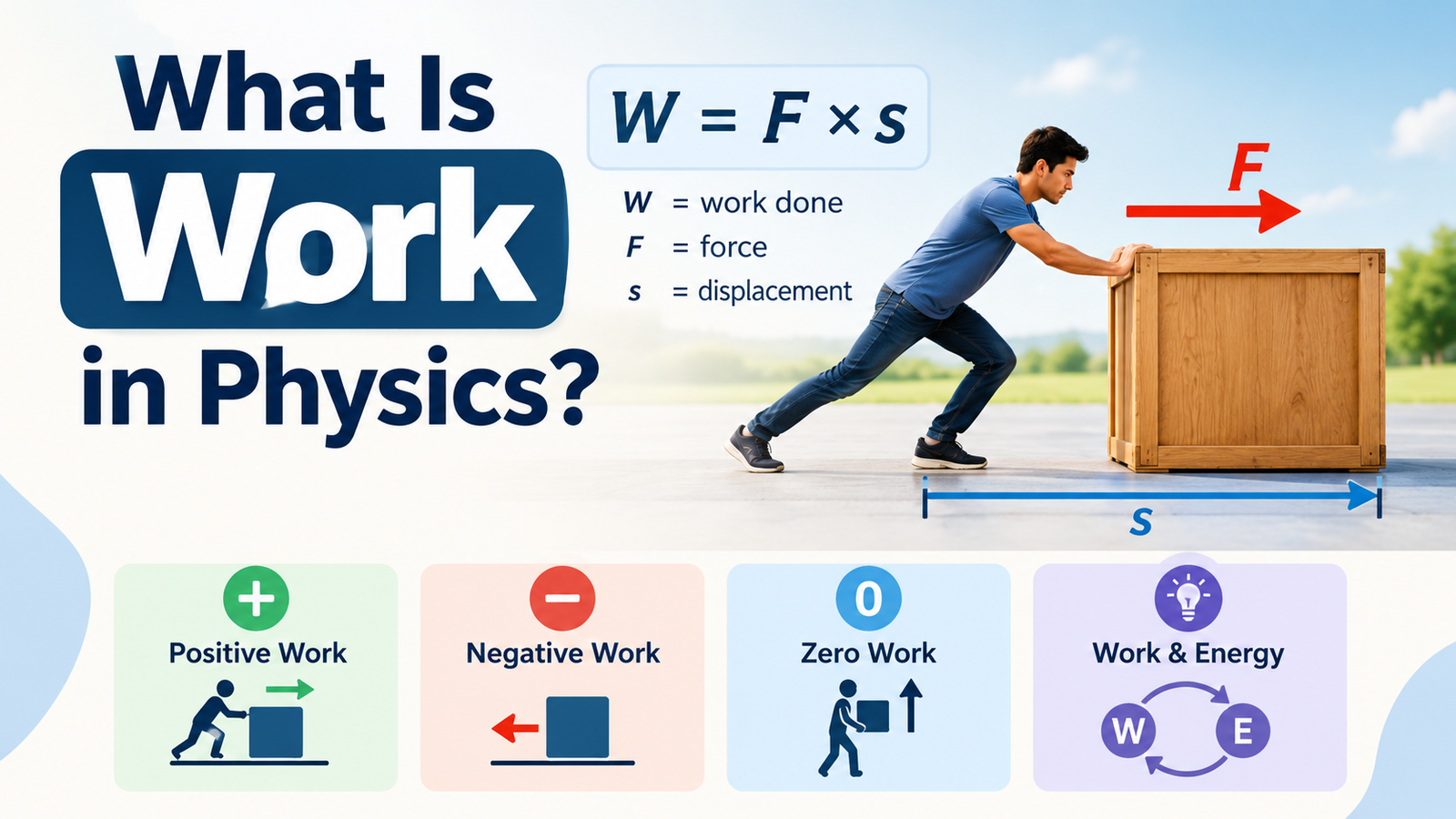
In physics, work is done when a force acting on an object causes displacement.
The simplest mathematical expression for work is:
W = F × s
where:
W = work done
F = force applied
s = displacement of the object in the direction of the force
This formula applies when the force and displacement are in the same direction.
For example, suppose a person pushes a box with a force of 20 N and the box moves 5 m in the same direction as the force.
Therefore, the work done is 100 joules.
Work Requires Both Force and Displacement
Two conditions are important for work to be done in physics:
A force must act on the object.
The object must undergo displacement due to the force.
If there is force but no displacement, the work done is zero. Similarly, if there is displacement but no force acting in the relevant direction, the work done by that force is zero.
This is why the physics definition of work is different from the everyday meaning of the word.
Force Without Displacement
Imagine pushing against a strong wall with all your strength. You are applying force to the wall, but the wall does not move.
Since the displacement of the wall is zero:
W = F × 0 = 0
Therefore, the mechanical work done on the wall is zero, even though you may feel tired.
Displacement in the Wrong Direction
Consider a person carrying a bag while walking horizontally at constant height. The person applies an upward force on the bag to support its weight, while the bag’s displacement is horizontal.
Because the supporting force and displacement are perpendicular, the work done by that upward force is zero.
This example shows that the direction of force and displacement matters.
Direction of Force and Displacement
When force and displacement are not in the same direction, we use the angle between them.
The general formula for work is:
W = F s cos θ
where:
F = magnitude of force
s = displacement
θ = angle between force and displacement
The value of work depends on this angle.
Positive Work
Work is positive when the force has a component in the same direction as the displacement.
For example, when you push a box forward and the box moves forward, the applied force does positive work.
When θ = 0°:
So the work is maximum when force and displacement are in the same direction.
Negative Work
Work is negative when a force acts opposite to the direction of displacement.
Friction is a common example. If a box moves forward across a rough surface, friction acts backward. Therefore, friction does negative work on the box.
When θ = 180°:
Negative work generally reduces the mechanical energy associated with an object’s motion.
Zero Work
Work is zero when the force is perpendicular to the displacement.
When θ = 90°:
For example, when an object moves horizontally while a force acts vertically, that force does no work on the object.
What Is the SI Unit of Work?
The SI unit of work is the joule, represented by J.
From the formula:
W = F × s
The SI unit of force is the newton (N), and the SI unit of displacement is the metre (m).
Therefore:
1 J = 1 N × 1 m
So, one joule of work is done when a force of one newton causes a displacement of one metre in the direction of the force.
The joule is also the SI unit of energy because work and energy are closely connected.
Work and Energy
Work and energy are strongly related in physics. When work is done on an object, energy can be transferred to or from that object.
For example, when you lift a book from the floor to a table, you apply an upward force and move the book upward. The work you do transfers energy to the book, increasing its gravitational potential energy.
Similarly, when a force accelerates a moving object, work can increase its kinetic energy.
This relationship is expressed through the work-energy theorem, which states that the net work done on an object is equal to the change in its kinetic energy.
Wₙₑₜ = ΔK
This makes work an important concept for understanding how forces change the motion and energy of objects.
Examples of Work in Everyday Life
Work in physics appears in many ordinary activities.
Lifting an Object
When you lift a bag upward, your force acts upward and the bag moves upward. Therefore, you do positive work on the bag.
Pushing a Box
When you push a box across the floor, your applied force causes displacement. If the force has a component in the direction of motion, positive work is done by that force.
Friction on a Moving Object
Friction usually acts opposite to motion. Therefore, friction does negative work on a moving object and can reduce its kinetic energy.
Carrying an Object
If you carry a bag horizontally at constant height, the upward supporting force you apply to the bag is perpendicular to its horizontal displacement. Therefore, the work done by that upward force is zero.
Work Done by a Variable Force
The formula W = F × s is most directly useful when the force remains constant and has a fixed direction.
In some situations, the force changes as the object moves. A spring is a simple example. The force exerted by a stretched or compressed spring changes with its displacement.
For a variable force, the work done can be determined from the area under a force-displacement graph. In more advanced physics, calculus is used to calculate work when the force changes continuously.
This shows how the concept of work can connect basic physics with mathematical methods.
Why Is Work Important in Physics?
Work is important because it provides a way to describe energy transfer through forces. Instead of considering only how much force is applied, physics also considers how far an object moves and in what direction.
The concept of work helps us understand:
How forces transfer energy
How objects gain or lose kinetic energy
How potential energy can change
How machines transfer energy
How power is related to the rate of doing work
How mechanical systems behave
Work therefore provides a bridge between force, motion, and energy.
Conclusion
Work in physics has a precise meaning that is different from the everyday use of the word. Work is done when a force causes displacement and has a component in the direction of that displacement. For a constant force, work can be calculated using W = F s cos θ. Depending on the direction of force and displacement, work can be positive, negative, or zero.
The SI unit of work is the joule. More importantly, work describes how forces transfer energy from one object or system to another. Once the idea of work is understood, concepts such as energy, kinetic energy, potential energy, and power become much easier to understand.
FAQs
In physics, work is done when a force causes an object to undergo displacement. The force must have a component in the direction of the displacement. Work describes the transfer of energy caused by a force acting over a distance. For example, when a person pushes a box and the box moves forward, the person does work on the box. However, simply applying force does not always mean that work is done. If an object does not move, the work done on it is zero. Work is measured in joules (J), and its value depends on the force, displacement, and angle between them.
The formula for work depends on the direction and magnitude of the applied force. When a constant force acts in the same direction as displacement, work is calculated using W = F × s. Here, W represents work, F represents force, and s represents displacement. When the force makes an angle θ with the displacement, the general formula is W = F s cos θ. For example, if a force of 10 N moves an object 4 m in the same direction, the work done is 40 J. This formula helps calculate how much energy a force transfers during motion.
The SI unit of work is the joule, represented by the symbol J. One joule is the amount of work done when a force of one newton moves an object through a distance of one metre in the direction of the force. Therefore, 1 J = 1 N × 1 m. Since a newton is equal to a kilogram metre per second squared, a joule can also be expressed as kg m²/s². The joule is also the SI unit of energy. Work and energy are closely related because work describes the transfer of energy by forces acting through displacement.
Work done by a force is zero when there is no displacement in the direction of that force. This can happen in several situations. First, if a force acts on an object but the object does not move, the work done is zero. Second, if the force is perpendicular to the displacement, its contribution to work is zero. For example, when a person carries a bag horizontally at a constant height, the upward supporting force does no work on the bag. Mathematically, W = F s cos 90° = 0. Thus, force alone is not sufficient for work to be done.
Positive work occurs when a force has a component in the same direction as an object’s displacement. For example, pushing a box forward while it moves forward results in positive work by the pushing force. Negative work occurs when a force acts opposite to the displacement. Friction acting on a sliding box is a common example because it generally opposes the motion. Positive work can increase an object’s kinetic energy, while negative work can reduce it. The sign of work depends on the angle between force and displacement. Positive work corresponds to an angle smaller than 90°, while negative work corresponds to an angle greater than 90°.
No mechanical work is done on an object by a force if the object has zero displacement. According to the formula W = F × s, the work becomes zero when displacement is zero, regardless of how large the force may be. For example, when someone pushes against a rigid wall, the wall may experience a force, but it does not move. Therefore, the work done on the wall by that pushing force is zero. The person may still become tired because the body uses chemical energy and performs internal biological processes. This illustrates the difference between everyday effort and mechanical work in physics.
Work and energy are closely connected because work is one way energy is transferred between objects or systems. When a force does positive work on an object, it can increase the object’s energy. For example, lifting a book increases its gravitational potential energy. When friction does negative work on a moving object, some of its mechanical energy may be converted into thermal energy. The work-energy theorem states that the net work done on an object equals the change in its kinetic energy: Wₙₑₜ = ΔK. Thus, work helps explain how forces change an object’s motion and how energy moves through physical systems.
Work is a scalar quantity because it has magnitude but no direction of its own. Although work is calculated using force and displacement, which are vectors, their dot product produces a scalar value. The formula for work is W = F · s = F s cos θ. The result may be positive, negative, or zero, but it is not assigned a spatial direction like force or displacement. For example, if a force does 50 J of work on an object, the value describes the amount of energy transferred by that force. Work therefore differs from force, velocity, and displacement, which are vector quantities.
Friction usually acts opposite to the direction of motion, so it generally does negative work on a moving object. The work done by friction can be calculated using W = F s cos θ. When friction and displacement are in opposite directions, θ = 180°, making the work negative. For example, if friction of 5 N acts on a box moving 3 m, the work done by friction is W = 5 × 3 × cos 180° = −15 J. This negative work often reduces the object’s kinetic energy and converts some mechanical energy into thermal energy.
Work and power are related but different physical quantities. Work measures the amount of energy transferred by a force through displacement, while power measures how quickly that work is done. Work is measured in joules, whereas power is measured in watts. The formula for average power is P = W/t, where P is power, W is work, and t is the time taken. For example, two people may do the same amount of work while lifting identical objects, but the person who completes the task in less time produces greater average power. Power therefore describes the rate of doing work.
Related Post
What Do Coefficients Mean in Chemistry Formulas?
When you look at a chemical equation, you may notice numbers written before chemical formulas. These numbers are called coefficients. […]
Read MoreHow to Read Subscripts in Chemical Formulas
Chemical formulas are a simple way to represent substances using symbols and numbers. When you look at a formula such […]
Read MoreHow to Identify Elements in a Chemical Formula
Chemical formulas provide a simple way to describe the substances that make up the world around us. A formula may […]
Read MoreHow Elements Are Represented in Chemical Formulas
Chemistry deals with many different substances, from the oxygen we breathe to the water we drink and the minerals found […]
Read MoreChemical Symbols and Their Role in Chemistry Formulas
Chemistry is often described as the science of matter, but understanding chemistry also means learning how scientists communicate information about […]
Read MoreHow Chemical Formulas Represent Substances
Chemical formulas are one of the simplest ways scientists communicate information about matter. A substance may contain millions or billions […]
Read MoreWhat Is a Chemical Formula in Chemistry?
Chemistry is the study of substances, their properties, and the changes they undergo. To describe these substances clearly, chemists need […]
Read MoreBasic Types of Chemistry Formulas Explained
Chemistry formulas are one of the simplest ways scientists describe substances, reactions, and relationships between different particles. A formula can […]
Read MoreHow to Read and Understand Chemistry Formulas
Chemistry formulas may look like a collection of letters, numbers, and symbols, but they are actually a simple language used […]
Read MoreWhat Are Chemistry Formulas and Why Are They Important?
Chemistry is the science of substances, their properties, and the changes they undergo. To describe these substances clearly, chemists use […]
Read MoreHow to Verify an Answer Using Units
In physics, getting a numerical answer is only part of solving a problem. The next question is whether that answer […]
Read MoreHow to Check Whether a Physics Formula Is Correct
A physics formula is more than a collection of symbols and numbers. It represents a relationship between physical quantities and […]
Read MoreHow to Avoid Unit Conversion Mistakes in Physics
Unit conversion is one of the most common sources of mistakes in physics. A formula may be correct, the calculation […]
Read MoreHow to Avoid Sign Errors in Physics Calculations
Physics calculations are not only about choosing the correct formula and putting numbers into it. The signs of physical quantities […]
Read MoreCommon Mistakes When Using Physics Formulas
Physics formulas help us describe motion, forces, energy, electricity, heat, waves, and many other phenomena using mathematical relationships. A formula […]
Read MoreHow to Study Physics Formulas Step by Step
Physics formulas are an important part of learning physics, but simply memorizing them is not enough. A formula represents a […]
Read MoreHow to Organize Physics Formulas for Easy Revision
Physics becomes much easier when formulas are organized in a clear and meaningful way. Many learners struggle not because they […]
Read MoreHow to Build a Physics Formula Sheet
Physics involves many formulas, and remembering all of them can become difficult as you move from basic concepts to more […]
Read More