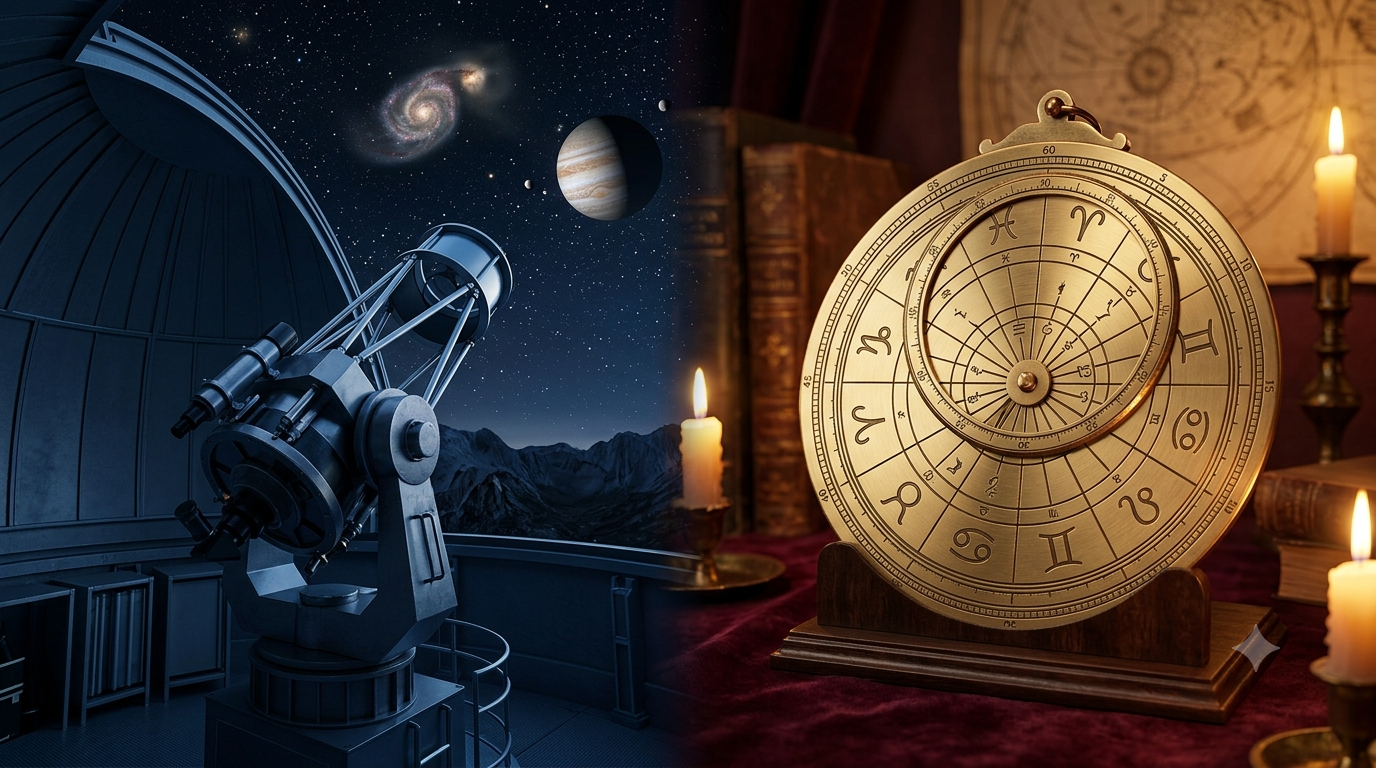
Astronomy and astrology are two terms that are often confused because both involve celestial objects such as stars, planets, the Sun, and the Moon. They have a long history of human interest in the sky, and both have influenced how people understand their place in the universe. However, despite their similar names and shared interest in celestial objects, astronomy and astrology are fundamentally different in their methods, purposes, and reliability.
Astronomy is a natural science that studies the universe through observation, mathematics, physics, and scientific investigation. It helps us understand how stars form, why planets move, how galaxies develop, and how the universe changes over time. Astrology, on the other hand, is a belief system that interprets the positions of celestial objects as having connections with human personality, relationships, and future events.
Understanding the difference between astronomy and astrology helps us distinguish scientific knowledge from traditional beliefs and symbolic interpretations. Both have played roles in human history, but only astronomy is recognized as a scientific discipline based on testable evidence.
What Is Astronomy?
Astronomy is the scientific study of celestial objects, space, and the physical universe as a whole. It investigates everything beyond Earth’s atmosphere, including planets, moons, stars, galaxies, nebulae, black holes, and other cosmic phenomena.
Astronomers use scientific methods to understand how these objects form, move, interact, and evolve. They collect information through telescopes, space observatories, satellites, robotic spacecraft, and mathematical models. By studying light and other forms of radiation from distant objects, astronomers can investigate places that are too far away for humans to visit directly.
For example, astronomy helps scientists understand why the Moon changes its apparent shape throughout the month, how solar and lunar eclipses occur, and why planets follow predictable paths around the Sun. It also helps researchers investigate the origin of the universe, the possibility of life beyond Earth, and the nature of mysterious objects such as black holes.
Astronomy relies on observations, experiments where possible, mathematical calculations, and evidence that other researchers can examine. Scientific explanations may change when new evidence becomes available. This willingness to test and improve explanations is one of the most important features of astronomy.
What Is Astrology?
Astrology is a system of beliefs that interprets the positions and apparent movements of celestial objects as meaningful in relation to human lives and events on Earth. It commonly uses the positions of the Sun, Moon, planets, and zodiac signs to create interpretations about personality, relationships, opportunities, and possible future experiences.
In many forms of astrology, a person’s birth date, birth time, and birthplace are used to prepare a birth chart. Astrologers interpret the positions of celestial objects within this chart according to the traditions and rules of a particular astrological system.
For example, horoscope columns may suggest that people born under a particular zodiac sign are naturally confident, emotionally sensitive, or likely to experience changes in their careers. Some people consult astrologers when thinking about relationships, personal decisions, marriage, or important events.
Astrology has developed in different cultures, including ancient Mesopotamia, India, China, and the Mediterranean world. Its traditions vary, and different systems use different calculations and interpretations.
However, astrology has not been established as a reliable scientific method for predicting personality traits or future events. Controlled scientific studies have not demonstrated that astrological predictions consistently perform better than chance under suitable testing conditions. Therefore, astrology is generally classified as a belief system or divinatory practice rather than a science.
Key Differences Between Astronomy and Astrology
Although astronomy and astrology both refer to celestial objects, their approaches are very different. The following comparison highlights their main distinctions.
| Basis of Comparison | Astronomy | Astrology |
|---|---|---|
| Meaning | The scientific study of the universe and celestial objects | A belief system that interprets celestial positions in relation to human affairs |
| Main purpose | To understand the physical universe | To interpret personality, relationships, or possible future events |
| Scientific status | An established natural science | Not recognized as a scientific discipline |
| Methods | Observation, measurement, mathematics, and scientific testing | Traditional rules, symbolic interpretations, and astrological charts |
| Evidence | Uses measurable observations and testable explanations | Relies on astrological traditions and interpretations that lack reliable scientific validation |
| Main subjects | Stars, planets, galaxies, black holes, and cosmic processes | Zodiac signs, birth charts, planetary positions, and horoscopes |
| Predictions | Makes testable predictions about celestial events and physical processes | Makes interpretations or predictions about human experiences and events |
| Tools | Telescopes, satellites, observatories, and scientific instruments | Birth charts, zodiac tables, astrological software, and interpretive systems |
| Ability to be tested | Scientific claims can be tested and revised using evidence | Claims can be tested, but reliable predictive effects have not been established |
| Practical applications | Space exploration, satellite operations, and understanding celestial events | Personal reflection, cultural practices, and traditional guidance |
The central difference is that astronomy investigates what happens in the universe using scientific evidence, whereas astrology assigns meanings to celestial positions in relation to human life.
The Historical Connection Between Astronomy and Astrology
Astronomy and astrology were more closely connected in ancient times than they are today. Early civilizations carefully observed the night sky because celestial patterns were important for agriculture, navigation, calendars, religious ceremonies, and the organization of daily life.
Ancient astronomers and sky observers recorded the movements of the Sun, Moon, planets, and stars. These observations helped people recognize seasonal changes, predict eclipses, and develop calendars. At the same time, many societies believed that celestial events carried messages about rulers, wars, harvests, and other events on Earth.
In ancient Mesopotamia, for example, systematic observations of celestial phenomena developed alongside practices that interpreted those phenomena as omens. In ancient Greece, astronomical ideas and astrological traditions also developed together. Similar connections appeared in other parts of the world, including India, where astronomy and astrology developed within distinct but historically interacting traditions.
Over time, the study of celestial objects became increasingly mathematical and systematic. Improved instruments, careful measurements, and new theories helped researchers explain planetary motion and other astronomical phenomena.
During the Scientific Revolution, scientists such as Nicolaus Copernicus, Johannes Kepler, and Galileo Galilei contributed to major changes in humanity’s understanding of the cosmos. Their work helped establish the foundations of modern astronomy.
Astronomy gradually developed into a discipline that requires explanations to be supported by evidence and tested against observations. Astrology continued in various cultural and traditional forms, but its claims about human affairs did not gain comparable scientific support.
This history shows that the two subjects share some historical roots without having the same scientific status today.
How Astronomy Uses the Scientific Method
One of the most important features of astronomy is its reliance on the scientific method. Astronomers do not simply accept an explanation because it is traditional or widely believed. They compare ideas with observations and investigate whether those ideas can explain the available evidence.
The process often begins with a question. An astronomer might ask how a planet formed, what causes a star to become brighter, or whether a distant planet has an atmosphere.
Researchers then collect relevant data, develop explanations, and compare their predictions with observations. They may use computer simulations, mathematical equations, and instruments to investigate their questions.
For example, astronomers can predict when a solar eclipse will occur by calculating the relative positions and motions of the Sun, Moon, and Earth. These predictions can be checked against actual observations. The calculations are based on physical models that have been tested and refined over time.
Astronomy also involves uncertainty. Measurements may contain errors, and scientific explanations can be incomplete. Researchers address these problems by improving instruments, repeating observations, comparing independent results, and revising models when necessary.
This process makes astronomy a reliable way to build knowledge about the universe. Its conclusions remain open to improvement, but they are supported by evidence that can be independently examined.
How Astrology Interprets Celestial Positions
Astrology also uses information about the positions of celestial objects, but it interprets that information differently. Instead of focusing primarily on the physical processes that govern the universe, astrology associates celestial arrangements with symbolic meanings related to human experiences.
In Western astrology, the zodiac is divided into twelve signs. A person’s Sun sign is generally determined by the Sun’s apparent position along the zodiac at the time of birth, according to the system being used. Astrological birth charts also consider the Moon, planets, houses, and aspects between celestial bodies.
Vedic astrology, also known as Jyotisha, uses its own traditional framework and calculations. It commonly employs a sidereal zodiac and may include concepts such as planetary periods and lunar mansions. Other astrological traditions have their own methods and interpretations.
These systems can differ in how they calculate and interpret celestial positions. Their followers may use them for cultural practices, spiritual reflection, or personal guidance.
However, the existence of a detailed calculation system does not establish that its interpretations are scientifically accurate. To demonstrate scientific reliability, astrological claims would need to produce consistent, measurable results under controlled conditions and outperform appropriate comparison methods.
The proposed connections between planetary positions and individual personality or future life events have not been established through reliable scientific evidence.
Examples That Clearly Explain the Difference
A few practical examples make the distinction between astronomy and astrology easier to understand.
Example 1: Predicting a Solar Eclipse
Astronomers calculate when the Moon will pass between the Earth and the Sun, producing a solar eclipse for observers in particular locations. Their predictions are based on the known motions of celestial bodies and can be checked through observation.
An astrological interpretation might assign symbolic meaning to the same eclipse and suggest that it represents a period of change or transformation.
The astronomical prediction concerns a measurable physical event. The astrological interpretation concerns a proposed meaning for human life that has not been scientifically established.
Example 2: Studying Mars
An astronomer studies Mars to understand its atmosphere, surface, geological history, temperature, and potential for past or present microbial life. The investigation uses spacecraft observations, telescopic measurements, and scientific models.
An astrologer may associate Mars with qualities such as energy, ambition, conflict, or determination within an astrological chart.
The same planet is involved, but the questions being asked and the methods being used are different.
Example 3: Reading a Horoscope
An astronomer does not use a person’s zodiac sign to determine their scientific abilities, romantic future, or career success. Astronomy studies physical phenomena and does not provide such personal predictions based on zodiac signs.
An astrologer may interpret a horoscope to offer suggestions about relationships, work, or personal decisions.
Horoscopes can feel relevant to readers, but a statement that seems personally accurate is not necessarily evidence of a reliable predictive method. Broad statements, selective attention to successful predictions, and the tendency to remember confirming examples can influence how people judge horoscope accuracy.
Example 4: Discovering a New Planet
Astronomers may identify an exoplanet by measuring the slight dimming of a star when a planet passes in front of it or by detecting the gravitational influence of an orbiting planet on its star.
The discovery can be checked through additional observations and scientific analysis.
Astrology does not use these techniques to establish scientific claims about the planet’s physical properties or to demonstrate that its position predicts specific events in human lives.
These examples show that astronomy and astrology may discuss the same celestial objects while pursuing fundamentally different goals.
Why Astronomy Is Important
Astronomy is important because it expands our understanding of the universe and Earth’s place within it. By studying celestial objects, scientists investigate how the universe began evolving, how stars and planets form, and how galaxies change over billions of years.
Astronomy also contributes to practical technologies. Research in astronomy and space science has supported advances in imaging, sensors, data processing, optics, and other technical fields. Satellites, whose operation depends partly on accurate knowledge of orbital motion, support communication, navigation, weather monitoring, and environmental observation.
The study of the Sun helps scientists understand solar activity and its potential effects on satellites, communication systems, and electrical infrastructure. Observations of near-Earth asteroids also help researchers identify and assess possible impact hazards.
Astronomy encourages critical thinking by teaching people how to evaluate evidence, interpret data, and distinguish scientific explanations from unsupported claims. It also inspires curiosity about fundamental questions, including whether life exists elsewhere in the universe.
Its value comes from both its scientific discoveries and its contribution to humanity’s broader understanding of nature.
Why Astrology Remains Popular
Despite the lack of reliable scientific evidence supporting its predictive claims, astrology remains popular in many societies. Several factors help explain its continued appeal.
First, astrology offers a familiar framework for thinking about personality and life experiences. Zodiac signs provide simple categories that people can use when discussing their behavior, emotions, and relationships.
Second, horoscopes often address common human concerns, such as love, work, uncertainty, and personal growth. During difficult periods, people may find comfort in a system that appears to offer explanations or guidance.
Third, astrology has cultural and historical significance. In some communities, astrological traditions are connected with family customs, ceremonies, and important decisions. People may continue these practices because they are meaningful within their social or cultural environment.
Finally, people naturally look for patterns and explanations. A prediction that appears to match an experience may be memorable, while predictions that do not match may be forgotten. This can make astrology seem more accurate than it is.
Understanding these reasons does not require dismissing the people who value astrology. It simply means recognizing that personal meaning, cultural importance, and scientific reliability are different things.
Can Astronomy and Astrology Be Considered the Same Subject?
No. Astronomy and astrology are not the same subject, even though they share historical connections and refer to many of the same celestial objects.
Astronomy investigates the universe through scientific observation, mathematical analysis, and evidence-based explanations. Its findings can be tested, challenged, and improved through further research.
Astrology interprets celestial positions through traditional or symbolic systems and attempts to relate them to human personality or events. Its claims about reliable prediction have not been supported by sufficient scientific evidence.
The distinction is similar to the difference between studying the physical properties of a substance and assigning symbolic meaning to it. Both activities may involve the same object, but they answer different questions and follow different standards of evidence.
A person can study astronomy while also taking an interest in astrology as a cultural or historical subject. However, it is important not to treat astrological interpretations as scientifically demonstrated facts.
Conclusion
Astronomy and astrology share an interest in celestial objects, but they differ significantly in their purposes, methods, and scientific standing. Astronomy is an established natural science that uses observation, mathematics, physics, and testable evidence to explain the universe. It helps us understand planets, stars, galaxies, eclipses, and many other cosmic phenomena. Astrology, in contrast, interprets celestial positions as symbols associated with human personality and possible future events, but its predictive claims have not been reliably demonstrated by scientific research.
Learning the difference between astronomy and astrology helps us appreciate the historical importance of both while recognizing the value of evidence-based knowledge. Astrology may hold cultural or personal meaning for some people, but astronomy provides a scientific framework for understanding the physical universe. By asking questions, checking evidence, and thinking critically, anyone can develop a clearer understanding of the cosmos and humanity’s place within it.
FAQs
1. What is the main difference between astronomy and astrology?
Astronomy is a scientific discipline that studies celestial objects, space, and the universe using observation, mathematics, physics, and evidence. Astrology is a belief system that interprets the positions of the Sun, Moon, planets, and other celestial objects in relation to human personality and life events. Astronomy investigates how the universe physically works, while astrology attempts to find symbolic connections between celestial positions and human experiences. Astronomical explanations can be tested and verified through observations, whereas astrology’s predictions about personality and future events have not been consistently supported by reliable scientific evidence.
2. Is astronomy a science and astrology a pseudoscience?
Astronomy is an established natural science because it uses systematic observations, mathematical models, and testable explanations to understand the universe. Its predictions, such as the timing of eclipses and planetary movements, can be checked against actual observations. Astrology is generally classified as a pseudoscience because its central claims about connections between celestial positions and human affairs have not demonstrated reliable scientific validity. Although astrology has historical and cultural significance, these qualities do not establish scientific accuracy. The main distinction is the use of evidence, testing, and reproducible results to evaluate claims about the natural world.
3. Why are astronomy and astrology often confused?
Astronomy and astrology are often confused because their names are similar and both involve celestial objects, including stars, planets, and the Sun. Historically, the two subjects also developed alongside each other in several ancient civilizations. Early sky observers recorded planetary movements for calendar-making and other practical purposes while also interpreting celestial events as signs or omens. Over time, astronomy developed into a scientific discipline based on measurable evidence, while astrology continued as a system of symbolic interpretation. Their shared history and vocabulary explain the confusion, but their modern purposes and methods are fundamentally different.
4. Did astronomy and astrology originate together?
Astronomy and astrology have closely connected historical roots, although their development varied across cultures and periods. Ancient civilizations observed the Sun, Moon, stars, and planets to create calendars, track seasons, and understand recurring celestial events. Some societies also interpreted these observations as signs connected with rulers, agriculture, or personal affairs. In ancient Mesopotamia and Greece, systematic observations of celestial movements existed alongside astrological traditions. Over centuries, astronomy increasingly relied on mathematical explanations, improved instruments, and scientific testing. Astrology continued through traditional interpretive systems. Their historical relationship helps explain why the subjects share terminology, but modern astronomy and astrology are not equivalent disciplines.
5. Can astronomy predict future events accurately?
Astronomy can accurately predict many physical events in space because celestial objects follow patterns that scientists can describe mathematically. For example, astronomers can calculate the dates and locations of solar and lunar eclipses, estimate planetary positions, and predict the movements of many celestial bodies. Such predictions are based on observations and physical laws, although uncertainty can vary depending on the event and available information. Astronomy does not, however, use zodiac signs or planetary positions to reliably predict an individual’s marriage, personality, career, or personal future. Its predictions concern measurable physical phenomena rather than unsupported claims about human destiny.
6. What does astrology claim about planets and zodiac signs?
Astrology claims that the positions of celestial objects at particular times, especially a person’s birth, have symbolic connections with personality traits, relationships, and life experiences. In Western astrology, the twelve zodiac signs are commonly associated with different characteristics, while birth charts include planetary positions and other astrological elements. Vedic astrology follows a different traditional framework and uses concepts such as planetary periods and lunar mansions. Astrologers interpret these elements according to the rules of their respective systems. However, scientific research has not established that zodiac signs or birth charts reliably determine personality or predict individual life events.
7. How do astronomers study planets and stars?
Astronomers study planets and stars using telescopes, space observatories, satellites, spacecraft, and mathematical models. They collect light and other forms of radiation to investigate an object’s temperature, chemical composition, movement, distance, and physical properties. For example, scientists can study a star’s light spectrum to identify elements present in its atmosphere. They can also detect planets orbiting distant stars by measuring changes in the star’s brightness or motion. These observations are analyzed using established scientific principles and compared with other evidence. This approach allows astronomers to develop and test explanations about celestial objects, even when those objects are extremely far away.
8. Why do people believe in astrology despite limited scientific evidence?
People may believe in astrology because it offers familiar explanations for personality, relationships, and uncertain life experiences. Horoscope descriptions can feel personally meaningful, especially when they discuss common emotions or situations. People may also remember predictions that appear accurate while overlooking those that do not match their experiences. This tendency is related to confirmation bias, the tendency to notice or favor information that supports existing beliefs. Cultural traditions, family practices, and personal experiences can also influence belief in astrology. Understanding these factors does not mean that people cannot find personal meaning in astrology, but personal meaning is different from scientifically demonstrated accuracy.
9. Can someone study astronomy and still be interested in astrology?
Yes, someone can study astronomy and remain interested in astrology as a cultural, historical, or social subject. Astronomy explains the physical properties and movements of celestial objects through scientific investigation, while astrology can be studied to understand traditional beliefs and their influence on societies. For example, a researcher may investigate how ancient civilizations used astronomical observations in calendars while examining how those observations influenced astrological traditions. However, scientific astronomy does not validate astrology’s claims about human personality or future events. Maintaining a clear distinction between scientific evidence and symbolic interpretation allows people to explore historical beliefs without confusing them with established scientific knowledge.
10. Why is it important to understand the difference between astronomy and astrology?
Understanding the difference between astronomy and astrology helps people evaluate information accurately and develop critical-thinking skills. Astronomy provides evidence-based explanations of the universe and supports practical applications in space exploration, satellite technology, and the study of celestial hazards. Astrology, meanwhile, represents traditional beliefs that some people use for cultural practices or personal reflection. Confusing the two can lead people to mistake symbolic interpretations for scientifically established facts. By examining how claims are tested and whether reliable evidence supports them, readers can make informed judgments. Learning this distinction also encourages curiosity about space and appreciation for the scientific methods used to understand the universe.