Everything around us is made of matter. The air we breathe, the water we drink, the food we eat, and the objects we use every day contain different forms of matter. However, all materials are not made of the same type of substance. Some contain only one chemically defined substance, while others contain two or more substances mixed together. Understanding this difference is an important part of chemistry.
In chemistry, matter is commonly classified into pure substances and mixtures. A pure substance has a fixed chemical composition and characteristic properties, whereas a mixture contains two or more substances physically combined in varying proportions. Mixtures are often described as impure substances in introductory chemistry, although the word impure does not necessarily mean dirty, unsafe, or useless.
Learning about pure and impure substances helps us understand the composition of materials, identify substances, separate mixtures, and explain many everyday chemical processes. This article explores their definitions, characteristics, types, examples, differences, and practical applications.
What Is a Pure Substance in Chemistry?
A pure substance is a form of matter that has a definite chemical composition and characteristic properties. It consists of only one chemical substance, such as a particular element or compound. Its composition does not change from one sample to another, provided the substance remains chemically unchanged.
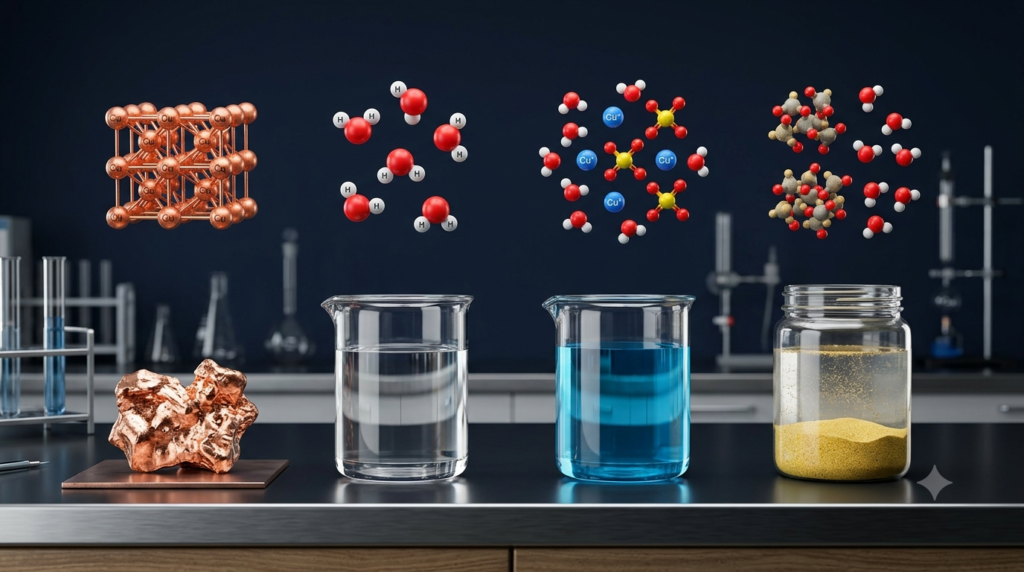
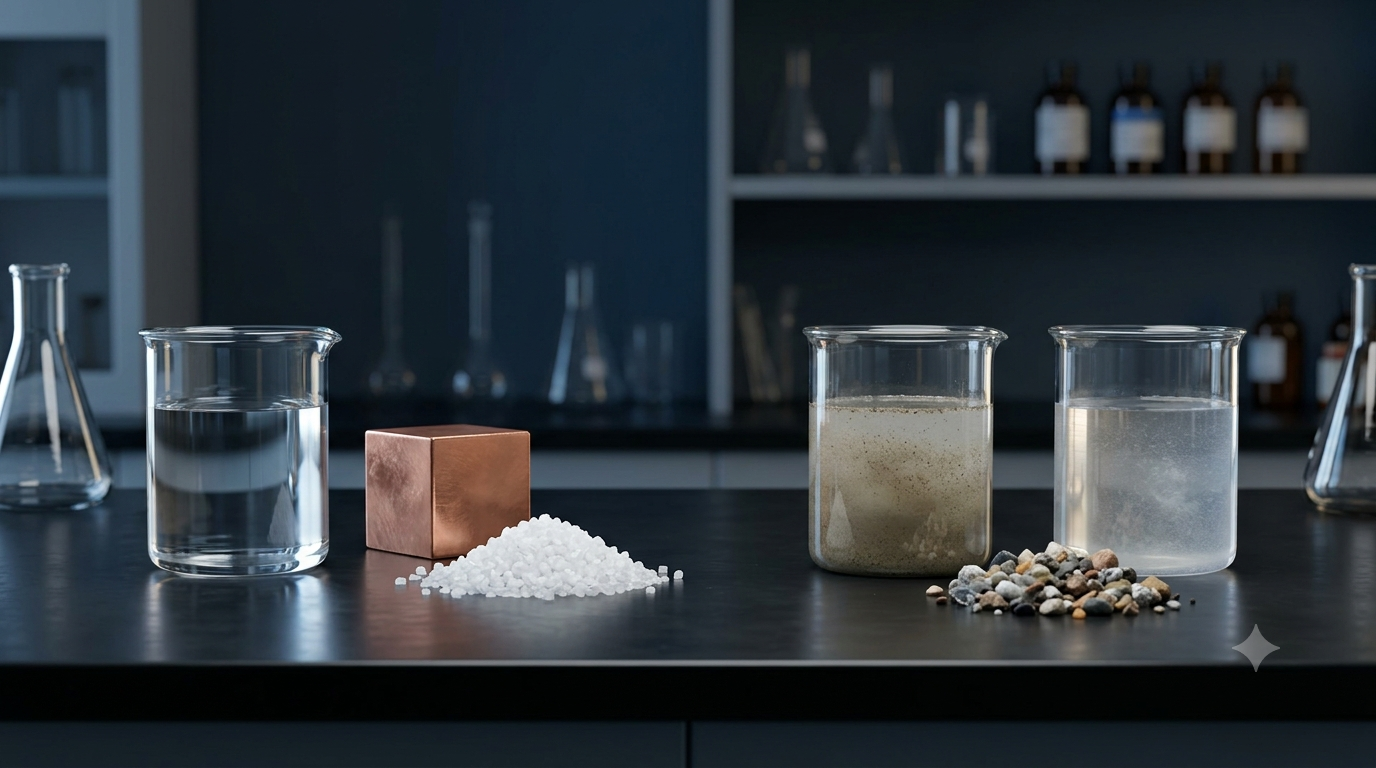
For example, pure copper contains copper atoms, while pure distilled water contains water molecules. Similarly, pure sodium chloride contains sodium and chloride ions arranged in a specific chemical structure.
A pure substance has characteristic physical properties, such as melting point, boiling point, and density, under specified conditions. These properties help scientists identify substances and distinguish them from mixtures.
Pure substances are classified into two main types: elements and compounds.
1. Elements
An element is a pure substance consisting of only one type of atom. It cannot be broken down into simpler substances by ordinary chemical reactions.
Examples of elements include:
Oxygen (O): An element essential for respiration and combustion.
Iron (Fe): A metal used in construction, machinery, and tools.
Gold (Au): A metal used in jewellery and electronic components.
Carbon (C): An element found in diamond, graphite, and many organic compounds.
Helium (He): A gas used in applications such as balloons and certain scientific instruments.
Elements may exist as individual atoms or as molecules containing atoms of the same element. For example, oxygen gas consists mainly of O₂ molecules, while helium exists as individual He atoms under ordinary conditions.
Each element has its own atomic number, which identifies it and determines the number of protons in its nucleus.
2. Compounds
A compound is a pure substance formed when two or more different elements chemically combine in a fixed proportion.
The elements in a compound are held together by chemical bonds. A compound generally has properties that differ from those of the elements from which it is formed.
Examples include:
Water (H₂O): Formed from hydrogen and oxygen.
Carbon dioxide (CO₂): Formed from carbon and oxygen.
Sodium chloride (NaCl): Common table salt, composed of sodium and chloride ions.
Ammonia (NH₃): A compound containing nitrogen and hydrogen.
Calcium carbonate (CaCO₃): Found in limestone, chalk, and marble.
For example, hydrogen is a highly flammable gas, and oxygen supports combustion. However, water has very different properties from either element. This demonstrates how chemical combination produces a substance with its own characteristic properties.
A compound can be broken down into simpler substances through suitable chemical reactions, unlike an element. Physical methods such as ordinary filtration cannot separate a compound into its constituent elements.
What Is an Impure Substance in Chemistry?
In introductory chemistry, an impure substance usually refers to a material that contains a mixture of two or more substances. These substances are physically combined rather than chemically bonded into a single compound.
A mixture may contain elements, compounds, or both. Its composition can vary depending on how much of each component is present.
For example, tap water may contain water, dissolved minerals, and small quantities of other substances. Air contains several gases, including nitrogen, oxygen, argon, and carbon dioxide. Soil contains mineral particles, organic matter, water, air, and other components.
The term impure substance is commonly used when a material contains unwanted components or contaminants. However, in scientific classification, it is more accurate to call such a material a mixture. Not every mixture is undesirable or contaminated.
Characteristics of Impure Substances
Impure substances, when understood as mixtures, have several important characteristics.
1. Variable composition
The proportions of the components can change. For example, the amount of sugar dissolved in a glass of water can be increased or decreased without producing a new compound.
2. Components retain their chemical identities
The substances in a mixture generally retain their individual chemical identities. Mixing iron filings with sulfur at room temperature, for example, does not automatically produce iron sulfide.
3. Separation by physical methods
Mixtures can often be separated using physical processes such as filtration, evaporation, distillation, or chromatography. The appropriate method depends on the properties of the components.
4. No single fixed melting or boiling point in many cases
Many mixtures melt or boil over a range of temperatures rather than at one sharp temperature. However, some mixtures, such as particular azeotropic liquids and eutectic mixtures, can show special phase-change behaviour.
5. Components may be visible or invisible
Some mixtures contain clearly visible components, while others appear uniform. Sand mixed with water is visibly non-uniform, whereas salt dissolved in water usually appears uniform.
Types of Mixtures
Mixtures are generally classified into two major types: homogeneous mixtures and heterogeneous mixtures.
1. Homogeneous Mixtures
A homogeneous mixture has a uniform composition throughout the sample at the scale being considered. Its components are distributed evenly, so different portions have essentially the same composition.
Examples include:
Salt dissolved completely in water.
Sugar dissolved in water.
Air that is well mixed.
Vinegar, which is a solution of acetic acid in water.
Brass, an alloy mainly containing copper and zinc.
A homogeneous mixture is also called a solution in many common contexts. A solution typically consists of a solvent and one or more solutes. The solvent is the component that dissolves the solute.
For example, when salt dissolves in water, water acts as the solvent and salt acts as the solute. The salt particles become distributed throughout the water, producing a uniform solution.
Although homogeneous mixtures may look like pure substances, their compositions can vary. A glass of salt water may contain a small amount of salt, while another glass may contain a much larger amount. Both can still be homogeneous mixtures.
2. Heterogeneous Mixtures
A heterogeneous mixture has a non-uniform composition. Its different components or regions may have different physical properties and may sometimes be distinguished visually.
Examples include:
Sand mixed with water.
Oil mixed with water.
Soil.
Vegetable salad.
Granite, which contains different minerals.
When oil and water are mixed, they generally form separate layers because they are immiscible under ordinary conditions. This makes the heterogeneous nature of the mixture easy to observe.
In a mixture of sand and water, sand particles do not dissolve. They may settle at the bottom, allowing the components to be separated by sedimentation and decantation or by filtration.
Some heterogeneous mixtures contain particles too small to see with the naked eye. Milk, for example, is an emulsion containing tiny fat droplets dispersed in a water-based phase. It may look uniform, but it is not a true molecular solution.
Differences Between Pure Substances and Impure Substances
The following comparison highlights the main differences between pure substances and mixtures.
| Property | Pure Substances | Impure Substances or Mixtures |
|---|---|---|
| Composition | Fixed chemical composition | Variable composition |
| Components | One chemical substance | Two or more substances |
| Chemical identity | Consists of one defined chemical substance | Contains multiple chemical substances |
| Physical properties | Characteristic properties under specified conditions | Properties depend on composition |
| Melting point | Usually sharp at a given pressure for a pure crystalline substance | Often melts over a range |
| Boiling point | Usually characteristic at a given pressure | Often boils over a range |
| Separation | Compounds require chemical methods to separate into elements | Components can often be separated physically |
| Examples | Pure copper, oxygen, distilled water | Air, salt water, soil, brass |
An important point is that the melting and boiling behaviour of mixtures is not identical in every case. Some mixtures show special phase transitions, so these properties should be used alongside other evidence when identifying a material.
Examples of Pure and Impure Substances in Daily Life
Pure substances and mixtures are found throughout our daily lives. Understanding their differences helps us classify familiar materials correctly.
1. Water
Pure water contains only H₂O as its chemical substance, apart from any unavoidable trace impurities. Distilled water is produced by distillation and is often used when low mineral content is required.
Tap water, on the other hand, usually contains dissolved minerals and other substances. Therefore, it is generally a mixture rather than a chemically pure substance.
2. Air
Air is a homogeneous mixture of gases under ordinary conditions. Its major components are nitrogen and oxygen, along with argon, carbon dioxide, and varying amounts of water vapour.
The composition of air can change with humidity, location, and environmental conditions. Therefore, ordinary air is not a pure substance.
3. Table Salt
Pure sodium chloride is a compound with the chemical formula NaCl. Commercial table salt may contain small amounts of other substances, such as added iodine-containing compounds or anti-caking agents, depending on the product.
Thus, pure sodium chloride and commercially prepared table salt may not have exactly the same composition.
4. Milk
Milk is a complex mixture containing water, fats, proteins, lactose, minerals, and other components. Its composition depends on the animal source and processing methods.
Milk is not a pure substance because it contains many different chemical substances.
5. Gold Jewellery
Pure gold is an element. However, jewellery is often made from gold alloys that contain other metals, such as copper or silver. These metals can increase hardness and change colour.
For example, 18-karat gold contains 18 parts gold out of 24 parts by mass in the standard karat definition. The remaining proportion consists of other metals. Therefore, 18-karat gold is an alloy and a mixture, not pure gold.
6. Sugar
Pure sucrose is a compound with the chemical formula C₁₂H₂₂O₁₁. Refined commercial sugar consists predominantly of sucrose, but its exact purity depends on the product and manufacturing process.
This example shows why it is important to distinguish between a chemically defined substance and a commercial material that mainly contains that substance.
How Can We Identify a Pure Substance?
Scientists use several methods to determine whether a material is pure or contains other components. No single test is suitable for every substance, so the method depends on the material and the level of accuracy required.
1. Melting Point Test
A pure crystalline substance generally melts over a narrow temperature range under controlled conditions. If a sample contains certain impurities, its melting behaviour may change, often producing a lower melting temperature and a broader melting range.
For example, chemists can compare the melting range of a crystalline organic compound with a reliable reference value to assess its purity.
However, this method is not universal. Different substances behave differently, and some mixtures have well-defined melting behaviour.
2. Boiling Point Test
At a given pressure, a pure liquid generally has a characteristic boiling point. Measuring the boiling temperature can therefore provide useful information about its identity and purity.
Mixtures of liquids often boil over a temperature range because their composition changes during boiling. However, some mixtures form azeotropes that boil at a constant temperature under specified conditions.
3. Chromatography
Chromatography is a technique used to separate the components of a mixture based on differences in their interactions with a stationary phase and a moving phase.
For example, paper chromatography can separate the coloured components of some inks. If several components produce separate spots, the sample contains multiple detectable substances.
More advanced methods, such as gas chromatography and high-performance liquid chromatography, are widely used in laboratories to analyse complex samples.
4. Spectroscopic Methods
Spectroscopic techniques examine how substances interact with electromagnetic radiation. Methods such as infrared spectroscopy and ultraviolet-visible spectroscopy can help identify chemical substances and detect certain impurities.
Other analytical methods, including mass spectrometry, can provide detailed information about molecular composition.
These techniques are especially useful when simple physical tests cannot provide enough information.
Methods Used to Separate Mixtures
One major advantage of understanding mixtures is that their components can often be separated by using differences in physical properties.
1. Filtration
Filtration separates an insoluble solid from a fluid by passing the mixture through a suitable filter.
For example, sand can be separated from water using filter paper. The sand remains on the filter, while the water passes through.
2. Evaporation
Evaporation can be used to recover a dissolved solid from a solution. When salt water is heated or left under suitable conditions, water evaporates and salt remains behind.
This method is useful when recovering a non-volatile solid is the main objective. It may not be suitable if the liquid also needs to be collected.
3. Distillation
Distillation separates substances using differences in volatility and boiling behaviour. The more volatile component vaporises and is then condensed into a liquid.
Simple distillation can be used to obtain water from a salt solution. Fractional distillation is useful for separating certain mixtures of liquids with different boiling behaviours.
4. Magnetic Separation
Magnetic separation uses a magnet to remove magnetic materials from a mixture.
For example, iron filings can be separated from a mixture containing sand because iron is attracted to a magnet while ordinary sand is not.
5. Chromatography
Chromatography separates components according to their different interactions with the stationary and mobile phases. It is commonly used to analyse inks, pigments, pharmaceuticals, food samples, and biological substances.
The choice of separation method depends on the nature of the mixture and the properties of its components.
Why Is the Study of Pure and Impure Substances Important?
Understanding purity and mixtures has many applications in science, industry, medicine, and daily life.
1. Medicine and healthcare: Pharmaceutical products must meet defined quality standards. Identifying impurities is essential because unwanted substances can affect safety, stability, and effectiveness.
2. Food quality: Testing helps detect unwanted contaminants, verify ingredient composition, and check whether food products meet required standards.
3. Water treatment: Natural and municipal water may contain dissolved salts, suspended particles, microorganisms, and other substances. Different treatment processes remove different types of contaminants.
4. Chemical manufacturing: Industries often require raw materials with specific purity levels to produce reliable products and control chemical reactions.
5. Scientific research: Pure substances help scientists investigate chemical reactions and measure physical properties more accurately. Uncontrolled impurities can alter experimental results.
6. Environmental monitoring: Scientists analyse air, water, and soil to identify pollutants and understand environmental changes.
Purity does not always mean that a material is automatically safe. A chemically pure substance can be hazardous, while a carefully controlled mixture can be suitable for a specific use. Safety depends on the substance, its concentration, the exposure route, and the intended application.
Common Misconceptions About Pure and Impure Substances
Several misunderstandings can make this topic confusing for beginners.
Misconception 1: Every clear liquid is pure.
A clear liquid may contain dissolved substances that cannot be seen. Salt water and sugar solutions can appear completely transparent while remaining mixtures.
Misconception 2: Every mixture is dirty or harmful.
Many useful materials are mixtures. Air, milk, alloys, and many medicines contain multiple substances and are not necessarily contaminated.
Misconception 3: Pure substances must be elements.
Compounds such as pure water and pure sodium chloride are also pure substances. A pure substance can be either an element or a compound.
Misconception 4: Mixtures can only contain solids.
Mixtures can contain solids, liquids, and gases in different combinations. Air is a mixture of gases, while salt water is a mixture of a solid dissolved in a liquid.
Misconception 5: Physical separation can break a compound into its elements.
Physical processes can separate the components of many mixtures, but breaking a compound into its constituent elements requires suitable chemical processes.
Understanding these distinctions provides a strong foundation for more advanced topics in chemistry.
Conclusion
Pure substances and impure substances, commonly discussed as mixtures in introductory chemistry, are important classifications of matter. A pure substance has a definite chemical composition and may be an element, such as iron, or a compound, such as water. A mixture contains two or more substances physically combined in proportions that can vary.
Mixtures may be homogeneous, like salt water, or heterogeneous, like sand mixed with water. Scientists distinguish and analyse these materials using techniques such as melting point testing, chromatography, spectroscopy, filtration, evaporation, and distillation.
Understanding purity is useful in medicine, food production, water treatment, manufacturing, and environmental science. Most importantly, it helps us recognise that a material’s appearance alone does not reveal its composition. By studying the properties and composition of matter, we can better understand the chemical world around us.
FAQs
1. What is a pure substance in chemistry?
A pure substance is a form of matter that has a definite chemical composition and characteristic properties. It consists of only one chemical substance and cannot be separated into different substances by ordinary physical methods. Pure substances are classified into elements and compounds. Examples include pure iron, oxygen, distilled water, and sodium chloride. Elements contain only one type of atom, while compounds contain two or more different elements chemically combined in fixed proportions. Pure substances are important in chemistry because their predictable properties help scientists identify materials, study chemical reactions, and perform accurate experiments.
2. What is an impure substance in chemistry?
An impure substance generally refers to a material containing more than one chemical substance. In introductory chemistry, such materials are usually classified as mixtures. Their components may be present in different proportions and can often be separated using physical methods. Examples include tap water containing dissolved minerals, air containing different gases, and salt water containing dissolved sodium chloride. However, the term impure does not always mean dirty or harmful. Many useful materials are mixtures. Scientists also use the term impurity specifically for an unwanted substance present in a material that is intended to have a particular composition or purity.
3. What are the main differences between pure substances and mixtures?
The main difference is their chemical composition. A pure substance has a definite composition, whereas a mixture contains two or more substances in proportions that can vary. Pure substances have characteristic physical properties under specified conditions, while the properties of mixtures depend on their composition. Pure compounds can be broken down into simpler substances through suitable chemical reactions, whereas mixtures can often be separated by physical methods. Examples of pure substances include oxygen, copper, and pure water. Examples of mixtures include air, milk, soil, and salt water. These differences help chemists classify matter and select suitable separation techniques.
4. What are the two main types of pure substances?
The two main types of pure substances are elements and compounds. An element contains only one type of atom and cannot be broken down into simpler substances through ordinary chemical reactions. Examples include iron, oxygen, gold, and carbon. A compound forms when two or more different elements chemically combine in a fixed proportion. Examples include water, carbon dioxide, and sodium chloride. Elements and compounds have different chemical structures and properties. For instance, hydrogen and oxygen are gases, but their compound, water, is a liquid under ordinary room conditions. Understanding these two categories is essential for learning how matter is classified in chemistry.
5. What are homogeneous and heterogeneous mixtures?
Homogeneous and heterogeneous mixtures are the two major types of mixtures. A homogeneous mixture has a uniform composition throughout the sample. Examples include salt water, sugar solution, and well-mixed air. Its different components cannot usually be distinguished by ordinary visual inspection. A heterogeneous mixture has a non-uniform composition, meaning its components or regions differ in their properties. Examples include oil mixed with water, sand mixed with water, and soil. Some heterogeneous mixtures, such as milk, appear uniform to the naked eye but contain tiny dispersed particles. This classification helps scientists understand mixture structure and choose suitable methods for separating components.
6. Is distilled water a pure substance or a mixture?
Distilled water is generally treated as a pure substance in basic chemistry because distillation removes most dissolved salts and many other non-volatile impurities. Chemically pure water consists of H₂O molecules and has a definite composition. However, ordinary distilled water may still contain trace contaminants or dissolved gases absorbed from its surroundings. Therefore, distilled water is not necessarily perfectly pure in an absolute sense. Its purity depends on the equipment, storage conditions, and production process. Distilled water is commonly used in laboratories, batteries designed for such water, and certain industrial applications where a low concentration of dissolved minerals is desirable.
7. Can pure substances be separated by physical methods?
A pure substance cannot be separated into different chemical substances by ordinary physical methods because it consists of only one chemical substance. However, compounds can be broken down into simpler substances through suitable chemical reactions. For example, water can be decomposed into hydrogen and oxygen using electrolysis. Elements cannot be broken down into simpler substances by ordinary chemical reactions. In contrast, mixtures can often be separated physically because their components retain their individual chemical identities. Filtration separates insoluble solids from liquids, evaporation recovers dissolved solids, and distillation separates substances based on volatility. The method chosen depends on the properties of the materials involved.
8. How can we identify whether a substance is pure or impure?
Scientists use several methods to investigate the purity of a substance. Measuring its melting point or boiling point can provide useful information because pure substances generally show characteristic phase-change behaviour under specified conditions. Chromatography can reveal multiple components in a sample, while spectroscopy can help identify chemical substances and detect certain impurities. Scientists may also use density measurements and other physical or chemical tests. However, no single test can establish purity in every situation. Some mixtures show special melting or boiling behaviour, and very small quantities of impurities may remain undetected. Reliable purity assessment often requires several suitable analytical techniques.
9. Why is it important to separate impurities from substances?
Separating unwanted impurities is important because they can affect the quality, safety, performance, and properties of materials. In medicine, impurities may influence the safety or stability of pharmaceutical products. In food production, testing helps detect unwanted contaminants and verify ingredient composition. Water treatment removes different contaminants to make water suitable for its intended use. Chemical industries also require materials with controlled purity to achieve reliable results and consistent manufacturing quality. However, not every additional component is harmful or unwanted. Some mixtures are deliberately prepared because their combined properties are useful. Whether a substance needs purification depends on its intended application and quality requirements.
10. What are some common examples of pure substances and mixtures in everyday life?
Everyday examples of pure substances include pure copper, oxygen, gold, and chemically pure sodium chloride. Pure water is another example because it contains only H₂O as its chemical substance. Common mixtures include air, milk, soil, tap water, tea, and seawater. Brass is an alloy made mainly from copper and zinc, while salt water contains salt dissolved in water. Commercial products may also contain additional ingredients, so they are not necessarily chemically pure even when one component is dominant. Classifying these materials depends on their actual composition rather than their appearance. This knowledge helps explain familiar materials and their behaviour in everyday situations.