The periodic table is one of the most important tools in chemistry. It provides an organized arrangement of all known chemical elements and helps us understand their properties, structures, and behaviour. From the oxygen we breathe to the iron used in buildings, every element around us has a place in the periodic table.
Chemists use the periodic table to identify elements, compare their properties, understand chemical reactions, and predict how different elements interact with one another. It also helps students and researchers develop a clear understanding of the basic principles of chemistry.
The periodic table may look like a collection of boxes containing symbols and numbers, but it represents a great deal of scientific information. Its arrangement is based on the atomic number of each element, and its structure reveals important patterns in the behaviour of matter.
In this article, we will learn what the periodic table is, how it is organized, what information it contains, and why it is so important in chemistry.
What Is the Periodic Table?
The periodic table is a systematic arrangement of chemical elements according to their increasing atomic numbers. Each element occupies a specific position based on the number of protons in its nucleus.
A chemical element is a pure substance that contains only one type of atom. For example, hydrogen, oxygen, carbon, gold, and iron are all chemical elements.
Every element has its own atomic number and unique chemical properties. The periodic table organizes these elements in a way that makes their similarities and differences easier to understand.
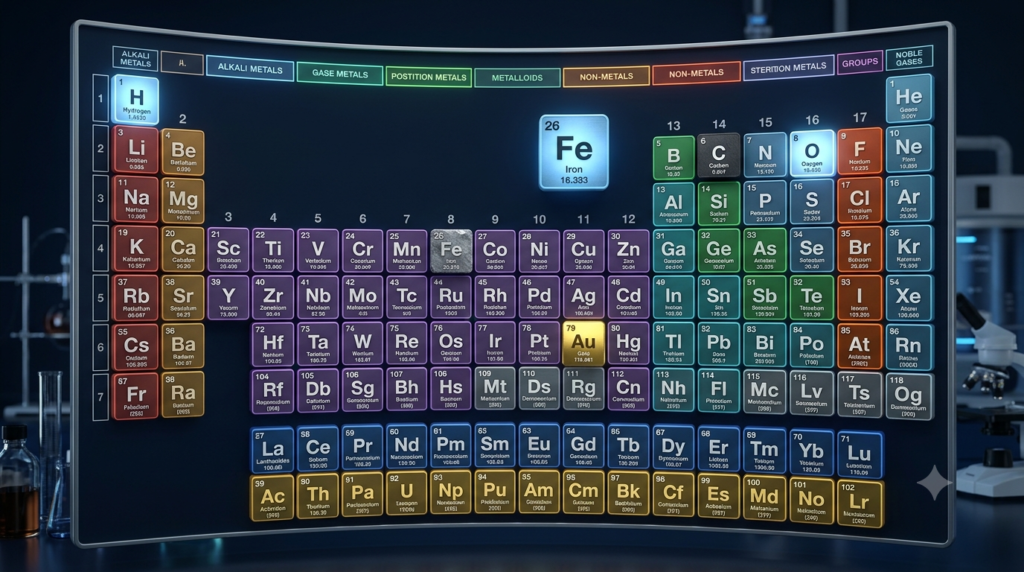
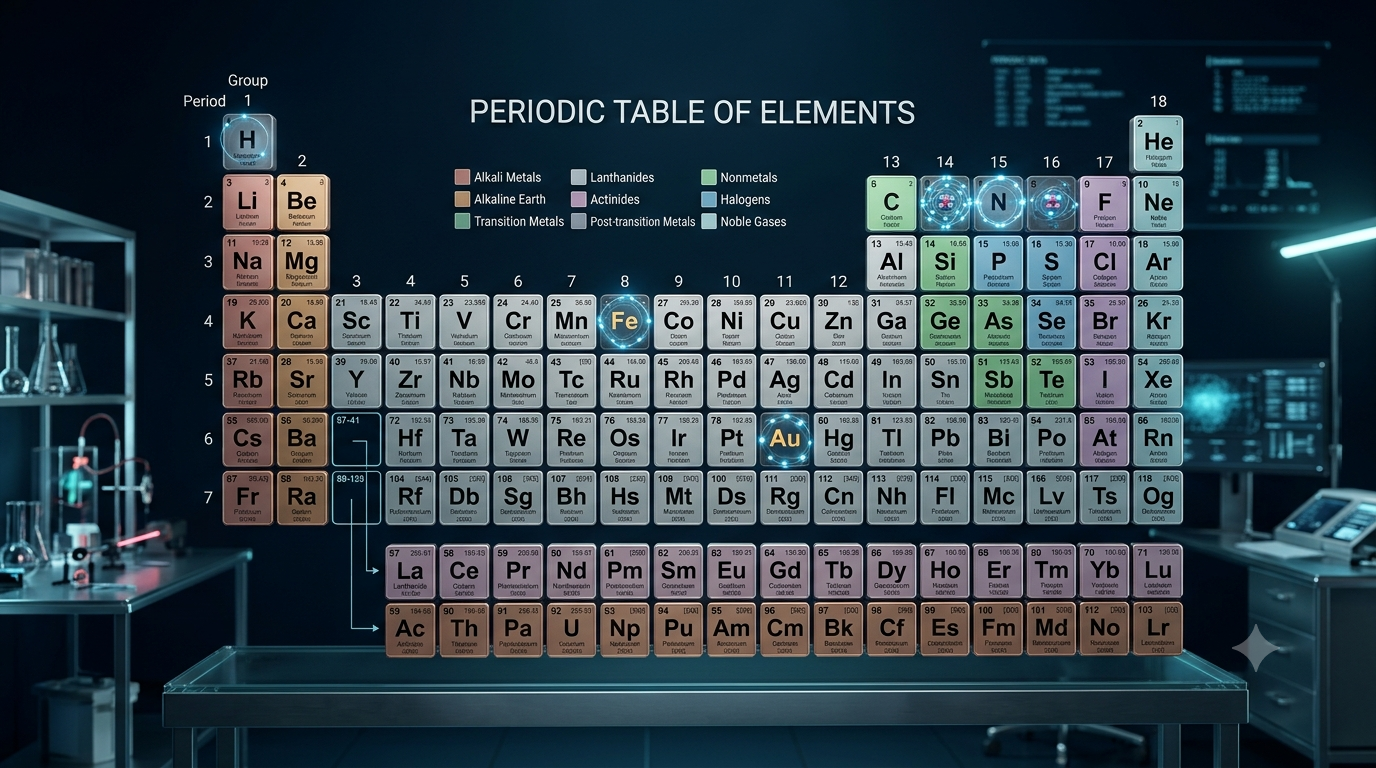
The modern periodic table contains 118 officially recognized elements, beginning with hydrogen (atomic number 1) and ending with oganesson (atomic number 118).
Elements are arranged in horizontal rows called periods and vertical columns called groups. Elements in the same group often have similar chemical properties because they have similar outermost electron arrangements.
The periodic table is not simply a list of elements. It is a scientific reference that helps explain how atoms are structured and how elements behave during chemical reactions.
Who Developed the Periodic Table?
The development of the periodic table was the result of many scientific contributions. However, Russian chemist Dmitri Mendeleev is widely recognized as the scientist who developed the first widely accepted periodic table in 1869.
<escape>Dmitri Mendeleev</escape> arranged the known elements mainly according to their increasing atomic masses. He noticed that elements with similar chemical properties appeared at regular intervals.
One of his most important contributions was leaving gaps in his table for elements that had not yet been discovered. He predicted the properties of some of these missing elements based on the patterns in his arrangement.
Later discoveries confirmed several of his predictions, demonstrating the usefulness of his periodic system.
However, Mendeleev’s arrangement was not completely accurate for every element because atomic mass did not always produce the correct order.
In 1913, English physicist Henry Moseley showed that elements should be arranged according to their atomic numbers rather than their atomic masses.
This discovery provided the foundation for the modern periodic table used today.
How Is the Periodic Table Organized?
The modern periodic table is organized according to increasing atomic number. Its structure consists of horizontal rows, vertical columns, and different blocks that represent the arrangement of electrons in atoms.
Understanding this organization makes it easier to identify elements and study their properties.
1. Periods (Horizontal Rows)
Horizontal rows in the periodic table are called periods.
The modern periodic table contains seven periods. Each period begins with an element whose atom has a new principal electron shell being occupied and generally ends with a noble gas.
As we move from left to right across a period, the atomic number increases by one for each successive element.
The properties of elements gradually change across a period. For example, elements generally change from metals on the left side to nonmetals on the right side.
The seven periods are:
Period 1: Contains 2 elements.
Period 2: Contains 8 elements.
Period 3: Contains 8 elements.
Period 4: Contains 18 elements.
Period 5: Contains 18 elements.
Period 6: Contains 32 elements.
Period 7: Contains 32 elements.
The number of elements in each period is related to how electrons occupy different energy levels and subshells.
2. Groups (Vertical Columns)
Vertical columns in the periodic table are called groups.
There are 18 groups in the modern periodic table. Elements belonging to the same group often show similar chemical properties.
This similarity is mainly related to the number and arrangement of electrons in their outermost shell, known as valence electrons.
For example, lithium, sodium, and potassium belong to Group 1. They are known as alkali metals and are highly reactive.
Similarly, fluorine, chlorine, and bromine belong to Group 17. These elements are called halogens and commonly form compounds with metals.
Groups help chemists understand the similarities between elements and predict their chemical behaviour.
3. Blocks of the Periodic Table
The periodic table is also divided into four main blocks based on the type of atomic orbital into which the last electron enters.
These blocks are:
s-block: Includes elements from Groups 1 and 2, along with hydrogen and helium based on their electron configurations.
p-block: Includes elements from Groups 13 to 18, except helium.
d-block: Contains elements from Groups 3 to 12, commonly known as transition elements.
f-block: Contains the lanthanide and actinide series, which are usually displayed separately at the bottom of the periodic table.
These blocks provide information about the electronic structure of elements and help explain their chemical properties.
What Information Does the Periodic Table Provide?
Each element is represented by a separate box in the periodic table. Although the exact design may differ between periodic tables, most boxes contain several important details.
The main information includes:
1. Element Name
Every element has an official name, such as hydrogen, carbon, oxygen, sodium, or calcium.
Element names help identify substances and distinguish one chemical element from another.
2. Chemical Symbol
Each element has a unique chemical symbol, usually consisting of one or two letters.
The first letter is always capitalized, while the second letter, when present, is lowercase.
Examples include:
H – Hydrogen
O – Oxygen
C – Carbon
Na – Sodium
Fe – Iron
Au – Gold
Ag – Silver
Some symbols are based on Latin names. For example, the symbol Fe comes from the Latin name Ferrum, meaning iron.
Chemical symbols are widely used in chemical formulas and equations.
3. Atomic Number
The atomic number represents the number of protons in the nucleus of an atom.
For example:
Hydrogen has atomic number 1.
Carbon has atomic number 6.
Oxygen has atomic number 8.
Sodium has atomic number 11.
Iron has atomic number 26.
The atomic number is the most important factor in determining the position of an element in the modern periodic table.
In a neutral atom, the number of electrons is equal to the number of protons.
4. Atomic Mass
Atomic mass represents the mass of an atom. In most periodic tables, the displayed value is the standard atomic weight, which generally reflects the weighted average of the masses of naturally occurring isotopes of an element.
For example, the standard atomic weight of carbon is approximately 12.011.
Atomic mass is useful in chemical calculations, especially when determining the quantities of substances involved in chemical reactions.
5. Electron Configuration
Electron configuration describes how electrons are distributed among the energy levels and orbitals of an atom.
For example:
Hydrogen: 1s¹
Carbon: 1s² 2s² 2p²
Oxygen: 1s² 2s² 2p⁴
Sodium: 1s² 2s² 2p⁶ 3s¹
Electron configuration helps explain why elements have particular chemical properties and why elements in the same group often behave similarly.
Types of Elements in the Periodic Table
Chemical elements are commonly classified into three broad categories: metals, nonmetals, and metalloids.
This classification helps us understand their physical and chemical properties.
1. Metals
Metals are generally found on the left side and in the centre of the periodic table.
Most metals have properties such as:
Good electrical conductivity.
Good thermal conductivity.
Metallic lustre.
Malleability, meaning they can be shaped into thin sheets.
Ductility, meaning they can be drawn into wires.
Examples include iron, copper, aluminium, gold, and silver.
Metals have many practical applications. Iron is used in construction, copper is used in electrical wiring, and aluminium is widely used in transportation and packaging.
2. Nonmetals
Nonmetals are mainly found on the right side of the periodic table, with hydrogen being an important exception because it is located on the left.
Many nonmetals are poor conductors of heat and electricity. Their physical properties vary considerably. Some are gases, while others are solids or liquids at room temperature.
Examples include oxygen, nitrogen, carbon, sulfur, and chlorine.
Nonmetals are essential for life and many chemical processes. Oxygen is needed for cellular respiration, carbon forms the foundation of organic compounds, and nitrogen is important for proteins and genetic material.
3. Metalloids
Metalloids have properties that are intermediate between metals and nonmetals.
They are generally located along the staircase-like boundary separating metals and nonmetals.
Common examples include boron, silicon, germanium, arsenic, and antimony.
Silicon is particularly important because of its semiconductor properties. It is widely used in computer chips, electronic devices, solar cells, and other modern technologies.
What Are the Important Groups in the Periodic Table?
Some groups have special names because their elements share important chemical characteristics.
1. Alkali Metals (Group 1)
Alkali metals include lithium, sodium, potassium, rubidium, caesium, and francium.
They are highly reactive metals and generally have one electron in their outermost shell.
They readily lose this electron to form positive ions with a +1 charge.
Sodium is used in several chemical industries, while lithium is important in rechargeable batteries.
2. Alkaline Earth Metals (Group 2)
This group includes beryllium, magnesium, calcium, strontium, barium, and radium.
These elements generally have two valence electrons and commonly form ions with a +2 charge.
Calcium is important for bones and teeth, while magnesium is used in alloys and several biological processes.
3. Transition Metals (Groups 3–12)
Transition metals occupy the central region of the periodic table.
They often have high melting points, good conductivity, and the ability to form compounds with different colours.
Examples include iron, copper, nickel, chromium, and zinc.
They are widely used in construction, manufacturing, electrical equipment, and industrial chemical processes.
4. Halogens (Group 17)
Halogens are highly reactive nonmetals.
This group includes fluorine, chlorine, bromine, iodine, and astatine.
They generally have seven electrons in their outermost shell and tend to gain one electron during chemical reactions.
Chlorine is commonly used for water disinfection, while iodine is used in certain medical and chemical applications.
5. Noble Gases (Group 18)
Noble gases include helium, neon, argon, krypton, xenon, and radon.
They have very low chemical reactivity under ordinary conditions because their outermost electron shells are generally complete.
Helium is used in balloons and certain cooling applications, while neon is used in lighting.
Argon is commonly used as a protective gas in welding.
Why Is the Periodic Table Important in Chemistry?
The periodic table is essential because it organizes chemical information in a meaningful way. It helps chemists understand elements, recognize patterns, and predict how substances may behave.
Here are some of its most important uses.
1. It Organizes All Known Chemical Elements
The periodic table provides a systematic arrangement of all 118 officially recognized elements.
Without this organization, studying individual elements would be much more difficult.
It allows students, teachers, and scientists to find important information about an element quickly.
Instead of memorizing every element separately, we can understand their properties by studying their positions in the table.
2. It Helps Predict Chemical Properties
One of the greatest advantages of the periodic table is that it reveals patterns in the properties of elements.
Elements in the same group often have similar chemical behaviour because of their similar valence electron arrangements.
For example, sodium and potassium both belong to Group 1. Both are highly reactive metals and commonly form +1 ions.
By knowing an element’s position, chemists can make useful predictions about its chemical behaviour.
3. It Helps Understand Chemical Reactions
Chemical reactions involve the rearrangement of atoms and their electrons.
The periodic table provides information about electron configurations, valence electrons, and common ionic charges.
This information helps explain why certain elements react with one another.
For example, sodium can lose one electron to form a positive ion, while chlorine can gain one electron to form a negative ion.
These ions attract each other and form sodium chloride (NaCl), commonly known as table salt.
Understanding the positions of sodium and chlorine in the periodic table helps explain why this reaction occurs.
4. It Helps Understand Atomic Structure
The periodic table is closely connected to the structure of atoms.
The atomic number tells us the number of protons in an atom. For a neutral atom, it also tells us the number of electrons.
The position of an element provides useful information about its electron arrangement.
For example, sodium has atomic number 11 and an electron configuration of 2, 8, 1.
This means sodium has one electron in its outermost occupied shell, which explains why it readily loses one electron during many chemical reactions.
5. It Makes the Study of Chemistry Easier
Chemistry includes a large number of elements, compounds, reactions, and formulas.
The periodic table brings important information about elements into one organized reference.
Students can use it to understand:
Atomic numbers and atomic masses.
Element symbols and names.
Groups and periods.
Valence electrons.
Metallic and nonmetallic properties.
Chemical families.
Periodic trends.
It reduces the need to memorize every property separately and makes learning chemistry more systematic.
6. It Helps Explain Periodic Trends
Periodic trends are patterns in the physical and chemical properties of elements across periods and down groups.
Some important periodic trends include:
Atomic radius: Generally decreases from left to right across a period and increases down a group.
Ionization energy: Generally increases from left to right across a period and decreases down a group.
Electronegativity: Generally increases from left to right across a period and decreases down a group, with some exceptions.
Electron affinity: Describes the energy change when an atom gains an electron. Its trend is more complex, although useful patterns can be observed across the periodic table.
These trends help chemists compare elements and understand their behaviour.
7. It Supports Scientific Research
Scientists use the periodic table in many areas of scientific research.
Researchers studying new materials, chemical compounds, batteries, catalysts, and electronic devices rely on information about elemental properties.
The periodic table helps them identify suitable elements for particular applications.
For example, researchers use lithium in battery technology, silicon in semiconductor devices, and platinum in catalytic applications.
It continues to be an important reference in the development of new scientific and technological discoveries.
8. It Connects Chemistry with Everyday Life
The elements listed in the periodic table are present in almost everything around us.
Some everyday examples include:
Oxygen is essential for breathing.
Carbon is present in living organisms.
Calcium is important for bones and teeth.
Iron is used in buildings and machinery.
Copper is used in electrical wires.
Silicon is used in electronic devices.
Aluminium is used in cans, vehicles, and aircraft.
The periodic table helps us understand the chemical elements responsible for many everyday materials and processes.
What Are Periodic Trends?
Periodic trends are regular patterns in the properties of elements as we move across periods or down groups.
These trends exist because atomic structure and electron arrangements change in predictable ways.
Understanding periodic trends is important because they help explain why elements have different physical and chemical properties.
The most important periodic trends include the following:
1. Atomic Radius
Atomic radius is a measure of the size of an atom.
Across a period, atomic radius generally decreases because the number of protons increases while electrons are added to the same principal shell. The stronger effective nuclear attraction generally pulls the electrons closer to the nucleus.
Down a group, atomic radius generally increases because additional electron shells are occupied.
2. Ionization Energy
Ionization energy is the energy required to remove an electron from an isolated gaseous atom.
Across a period, ionization energy generally increases because the attraction between the nucleus and the outer electrons becomes stronger.
Down a group, ionization energy generally decreases because the outermost electrons are farther from the nucleus and experience greater shielding.
3. Electronegativity
Electronegativity is the ability of an atom to attract shared electrons in a chemical bond.
Across a period, electronegativity generally increases.
Down a group, electronegativity generally decreases.
Fluorine is the most electronegative element on the commonly used Pauling scale.
4. Metallic Character
Metallic character refers to how strongly an element displays metallic properties, including its tendency to lose electrons in chemical reactions.
Metallic character generally decreases from left to right across a period and increases from top to bottom down a group.
These trends help chemists compare elements and predict their behaviour.
Applications of the Periodic Table in Everyday Life
The periodic table is not limited to chemistry laboratories or classrooms. It is closely connected to modern technology, medicine, agriculture, manufacturing, and environmental science.
Some important applications include:
1. Medicine and Healthcare
Several elements are important in medical treatments, diagnostic procedures, and healthcare equipment.
For example, iodine is used in certain antiseptic preparations, while radioactive isotopes of elements such as technetium are used in medical imaging.
Calcium and iron are also essential nutrients for maintaining normal body functions.
2. Electronics and Technology
Modern electronic devices depend on the properties of different chemical elements.
Silicon is widely used in semiconductors, while copper is important for electrical wiring.
Lithium and other elements are used in rechargeable battery technologies.
3. Agriculture
Elements such as nitrogen, phosphorus, and potassium are essential plant nutrients.
They are commonly supplied through fertilizers to support plant growth and improve agricultural productivity.
The periodic table helps explain the chemical identity of these elements and their role in plant nutrition.
4. Construction and Manufacturing
Iron, aluminium, copper, zinc, and other metals are widely used in construction and manufacturing.
Iron is important for steel production, aluminium is used in lightweight structures, and copper is used in electrical systems.
Understanding the properties of these elements helps industries select appropriate materials.
5. Environmental Science
The periodic table helps scientists study the movement and effects of elements in the environment.
For example, carbon is important in the carbon cycle, nitrogen is involved in the nitrogen cycle, and phosphorus is essential for ecosystems.
Scientists also monitor potentially harmful elements such as mercury, lead, and arsenic to understand environmental contamination.
What Is the Difference Between the Periodic Table and a List of Elements?
A list of elements simply provides the names or symbols of chemical elements. It may arrange them alphabetically or in another basic order.
The periodic table, however, organizes elements according to increasing atomic number and displays important relationships between their properties.
The main differences are:
| List of Elements | Periodic Table |
|---|---|
| Provides element names or symbols. | Organizes elements systematically. |
| May follow alphabetical order. | Follows increasing atomic number. |
| Does not necessarily show periodic patterns. | Reveals periodic trends and relationships. |
| Provides limited information. | Includes groups, periods, and other useful details. |
| Makes comparisons less convenient. | Makes comparisons easier. |
Therefore, the periodic table is much more than a simple list. It is a scientific system that explains relationships between chemical elements.
Conclusion
The periodic table is one of the most valuable tools in chemistry because it organizes all known chemical elements according to their atomic numbers and reveals important patterns in their properties. Its structure, consisting of groups, periods, and blocks, helps us understand atomic structure, electron configurations, chemical reactions, and periodic trends.
From identifying elements to predicting their chemical behaviour, the periodic table makes the study of chemistry more organized and understandable. It also plays an important role in scientific research, medicine, agriculture, electronics, manufacturing, and environmental science.
Learning how to read and understand the periodic table provides a strong foundation for studying chemistry. Whether you are a beginner, student, teacher, or simply curious about science, understanding the periodic table helps you discover how the elements form the materials and substances that make up our world.
FAQs
1. What Is the Periodic Table in Chemistry?
The periodic table is a systematic arrangement of all known chemical elements according to their increasing atomic numbers. It organizes elements into horizontal rows called periods and vertical columns called groups. Each element has a unique atomic number, chemical symbol, and set of properties. The periodic table helps chemists understand the similarities and differences between elements. It also provides useful information about atomic structure, electron configurations, atomic masses, and chemical behaviour. The modern periodic table contains 118 officially recognized elements and is one of the most important reference tools in chemistry.
2. Who Invented the Periodic Table?
Russian chemist Dmitri Mendeleev is widely recognized for developing the first widely accepted periodic table in 1869. He arranged the known elements mainly according to their increasing atomic masses and noticed that elements with similar properties appeared at regular intervals. He also left gaps for elements that had not yet been discovered and predicted some of their properties. Later discoveries supported several of his predictions. In 1913, Henry Moseley demonstrated that elements should be arranged according to atomic number rather than atomic mass. This discovery established the foundation of the modern periodic table.
3. How Many Elements Are in the Modern Periodic Table?
The modern periodic table contains 118 officially recognized chemical elements. Hydrogen is the first element, with atomic number 1, while oganesson is the last currently recognized element, with atomic number 118. These elements include metals, nonmetals, and metalloids. Some elements occur naturally, while others have been produced artificially in laboratories. Each element has a unique atomic number that identifies the number of protons in its nucleus. Scientists continue to study the properties of known elements and investigate the possibility of creating new elements through nuclear research.
4. What Are Groups and Periods in the Periodic Table?
Groups and periods are the two main ways of organizing elements in the periodic table. Groups are the 18 vertical columns, while periods are the seven horizontal rows. Elements in the same group often have similar chemical properties because they have similar outermost electron arrangements. Moving from left to right across a period, the atomic number increases by one for each successive element. Moving down a group, elements have additional occupied electron shells. Understanding groups and periods helps chemists compare elements, identify chemical families, and predict their general properties and behaviour.
5. What Are the Three Main Types of Elements in the Periodic Table?
The three main types of elements are metals, nonmetals, and metalloids. Metals are generally good conductors of heat and electricity and are usually malleable and ductile. Examples include iron, copper, aluminium, and gold. Nonmetals generally have poor electrical conductivity and include elements such as oxygen, nitrogen, carbon, and sulfur. Metalloids have properties intermediate between metals and nonmetals. Common examples include silicon, boron, and germanium. These classifications help scientists understand the physical and chemical characteristics of elements and identify their possible uses in technology, industry, and everyday life.
6. Why Is the Periodic Table Important in Chemistry?
The periodic table is important because it organizes chemical elements and reveals patterns in their properties. It helps chemists understand atomic structure, electron configurations, chemical reactions, and the relationships between different elements. By studying an element’s position, scientists can make predictions about its chemical behaviour and common properties. The periodic table also makes chemistry easier to learn because students do not need to memorize every element separately. It is widely used in education, scientific research, medicine, manufacturing, agriculture, and material development. It provides a foundation for understanding many important concepts in chemistry.
7. What Information Does Each Element Box in the Periodic Table Contain?
Each element box generally contains the element’s name, chemical symbol, atomic number, and atomic mass or standard atomic weight. The atomic number represents the number of protons in the nucleus, while the chemical symbol provides a short way to identify the element. The atomic mass provides information about the mass of its atoms. Some periodic tables also display electron configurations, oxidation states, and other properties. The exact information depends on the design of the periodic table. These details help students and scientists identify elements and understand their basic atomic and chemical characteristics.
8. What Are Periodic Trends in Chemistry?
Periodic trends are regular patterns in the properties of elements across periods and down groups in the periodic table. Important periodic trends include atomic radius, ionization energy, electronegativity, and metallic character. For example, atomic radius generally decreases from left to right across a period and increases down a group. Ionization energy generally increases across a period and decreases down a group. Electronegativity usually follows a similar pattern to ionization energy. These trends occur because of changes in nuclear charge, electron shielding, and electron shell arrangements. They help chemists compare elements and predict their chemical behaviour.
9. What Is the Difference Between the Periodic Table and a List of Elements?
A list of elements simply provides the names or symbols of chemical elements, often without showing their relationships. The periodic table is a scientifically organized arrangement based on increasing atomic number. It places elements into groups and periods according to their atomic structure and recurring chemical properties. This arrangement makes it easier to identify similarities, compare elements, and understand periodic trends. A simple list provides basic identification, whereas the periodic table offers much more scientific information. It helps students and researchers understand how elements are related and how they behave during chemical reactions.
10. How Is the Periodic Table Used in Everyday Life?
The periodic table helps us understand the chemical elements used in everyday products, materials, and technologies. Oxygen is essential for breathing, iron is used in buildings and machinery, and copper is widely used in electrical wiring. Silicon is important in computers and electronic devices, while lithium is used in rechargeable batteries. Nitrogen, phosphorus, and potassium are essential elements in agricultural fertilizers. Other elements are used in medicines, medical imaging, construction, and manufacturing. By understanding the periodic table, we can learn how different elements contribute to modern technology, human activities, and the natural environment.