Helium is one of the most interesting elements in the periodic table. It is a colourless, odourless, tasteless, and extremely light gas that has several unique properties. With the atomic number 2, helium is the second element in the periodic table, immediately after hydrogen. Although it belongs to Group 18, the noble gases, its position is unusual because its electronic configuration is different from that of the other elements in this group.
Helium has only two electrons, which completely fill its first and only electron shell. This arrangement makes it highly stable and explains why helium rarely reacts with other elements. Unlike most elements, helium does not follow the usual pattern of having eight electrons in its outermost shell to achieve stability. Instead, its stability comes from having a completely filled first shell, which can hold a maximum of only two electrons.
Its unique electronic configuration, chemical stability, and physical properties make helium an important element in chemistry and physics. Understanding helium also helps explain the arrangement of elements in the periodic table and the concept of periodic classification.
1. What Is Helium?
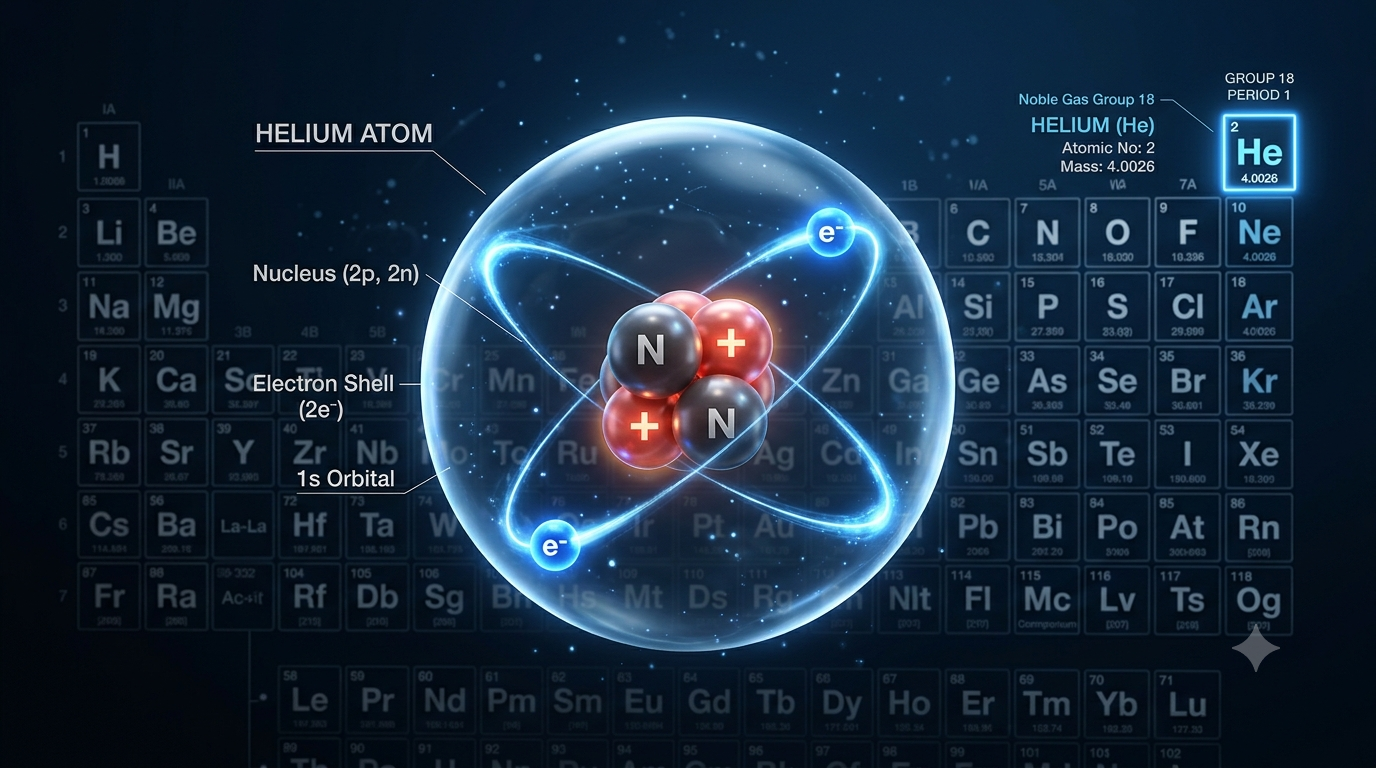
Helium is a chemical element represented by the symbol He. It has an atomic number of 2, meaning that every helium atom contains two protons in its nucleus. A neutral helium atom also contains two electrons.
Helium is classified as a noble gas because its outermost electron shell is completely filled. It is the lightest noble gas and the second-lightest element after hydrogen.
Some important characteristics of helium include:
Chemical symbol: He
Atomic number: 2
Atomic mass: Approximately 4.0026 u
Group: 18
Period: 1
Block: s-block
Element category: Noble gas
Electron configuration: 1s²
Number of protons: 2
Number of electrons: 2 in a neutral atom
Physical state at room temperature: Gas
Helium is commonly found in natural gas deposits and is also present in the universe, particularly in stars. It is produced in large quantities through nuclear fusion inside stars, where hydrogen nuclei combine to form helium.
2. Position of Helium in the Periodic Table
Helium occupies a special position in the periodic table. It is placed in the first period and Group 18, along with other noble gases such as neon, argon, krypton, xenon, and radon.
Its position is unusual because its electron configuration suggests a relationship with Group 2 elements, while its chemical properties strongly resemble those of Group 18 elements.
The first period of the periodic table contains only two elements:
Hydrogen (H)
Helium (He)
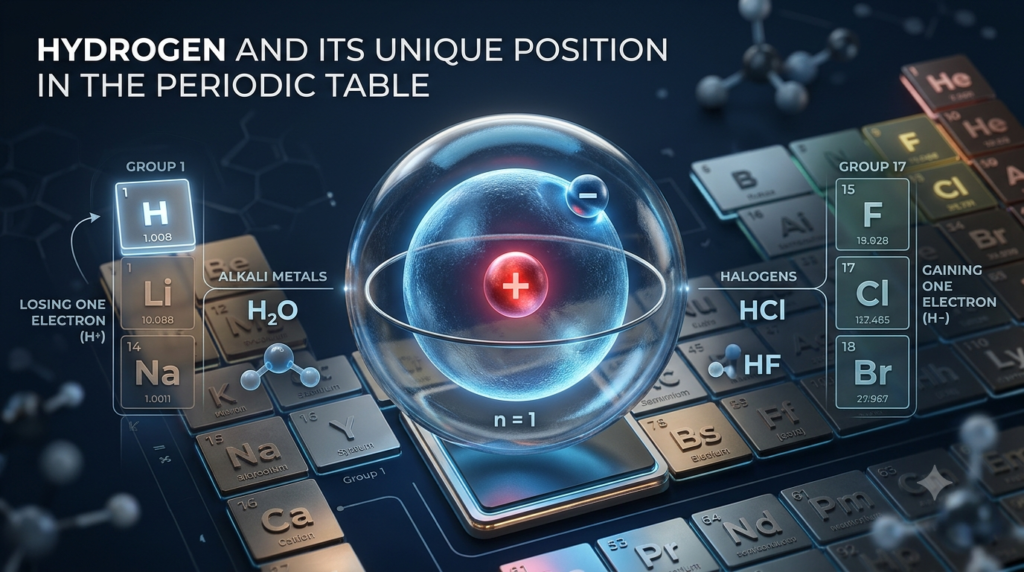
Hydrogen has one electron, while helium has two. Since the first electron shell can accommodate a maximum of two electrons, helium has a completely filled outermost shell.
Helium is therefore placed in Group 18 because its filled electron shell gives it the chemical stability associated with noble gases.
3. Why Is Helium Placed in Group 18?
The main reason helium is placed in Group 18 is its chemical behaviour.
Group 18 elements are known as noble gases because they have completely filled outermost electron shells. This electronic arrangement makes them highly stable and generally unreactive.
Helium has only two electrons, but both occupy its first and only electron shell. This shell is completely filled, making helium chemically stable.
The electronic configuration of helium is:
He = 1s²
The first electron shell, also called the K shell, can hold a maximum of two electrons. Since helium already has two electrons, it does not need to gain, lose, or share electrons to achieve a stable electronic configuration.
Other noble gases generally have eight electrons in their outermost shell, but helium is an important exception because its first shell requires only two electrons for stability.
Therefore, helium is placed in Group 18 based on its chemical properties and stable electronic configuration rather than simply following the usual octet pattern.
4. Electronic Configuration of Helium
Electronic configuration describes how electrons are distributed among the shells and orbitals of an atom.
Helium has an atomic number of 2, so a neutral helium atom contains two electrons.
Both electrons occupy the 1s orbital, which is the lowest-energy orbital in the atom.
The electronic configuration of helium is:
1s²
This configuration means:
1: The first principal energy level.
s: The type of orbital.
²: The number of electrons present in that orbital.
The 1s orbital can accommodate a maximum of two electrons with opposite spins. When both electrons occupy this orbital, the orbital becomes completely filled.
This arrangement is responsible for the exceptional stability of helium.
Unlike elements that have partially filled outermost shells, helium has no available lower-energy orbital in its first shell to accommodate another electron. This contributes to its very low chemical reactivity.
5. Why Does Helium Have Only Two Electrons in Its Outer Shell?
Helium belongs to the first period of the periodic table. Elements in the first period have electrons only in the first principal energy level.
The first electron shell contains only one orbital, called the 1s orbital. According to the rules of electron arrangement, an orbital can hold a maximum of two electrons with opposite spins.
Therefore, the first shell can accommodate only two electrons.
Helium has two electrons, and both occupy the 1s orbital. As a result, its outermost shell is completely filled.
This is different from elements in higher periods, where the outermost shell can accommodate more electrons.
For example:
Helium has 2 electrons in its outermost shell.
Neon has 8 electrons in its outermost shell.
Argon has 8 electrons in its outermost shell.
Although helium has only two outermost electrons, it is just as stable in its electron shell arrangement as the other noble gases.
6. Helium and the Duplet Rule
The duplet rule explains the stability of atoms that have two electrons in their outermost shell.
The first electron shell can hold a maximum of two electrons. When an atom has two electrons in this shell, it achieves a stable electronic configuration.
Helium follows the duplet rule because its only electron shell contains two electrons.
This is an important difference between helium and most other noble gases.
The octet rule generally describes the tendency of atoms to achieve eight electrons in their outermost shell. However, this rule does not apply to helium because its first shell cannot accommodate eight electrons.
Helium achieves stability through a duplet rather than an octet.
This concept is particularly important when studying chemical bonding and the electronic configurations of elements.
7. Why Is Helium Different from Other Noble Gases?
Helium shares several properties with other noble gases, but it also has some important differences.
All noble gases have stable outermost electron configurations and show very low chemical reactivity. However, helium is unique because it has only one electron shell.
The following table compares helium with other common noble gases.
| Property | Helium | Neon | Argon |
|---|---|---|---|
| Atomic number | 2 | 10 | 18 |
| Period | 1 | 2 | 3 |
| Group | 18 | 18 | 18 |
| Electron configuration | 1s² | 1s² 2s² 2p⁶ | 1s² 2s² 2p⁶ 3s² 3p⁶ |
| Outermost electrons | 2 | 8 | 8 |
| Chemical reactivity | Extremely low | Extremely low | Extremely low |
| Shell arrangement | Duplet | Octet | Octet |
The comparison shows that helium achieves stability with only two electrons, while neon and argon have eight electrons in their outermost shells.
Despite this difference, all three elements belong to Group 18 because of their stable electron configurations and similar chemical behaviour.
8. Why Is Helium Considered an s-Block Element?
The periodic table is divided into four major blocks: s-block, p-block, d-block, and f-block.
These blocks are based on the type of orbital into which the last electron of an element enters.
Helium has the electronic configuration 1s². Its second and final electron enters the 1s orbital.
Since its electrons occupy an s orbital, helium is classified as an s-block element.
However, it is placed in Group 18 rather than Group 2.
This creates an interesting distinction between its block classification and its group position.
Group 2 elements also have their outermost electrons in s orbitals, but they generally have two electrons in an outer shell that is not completely filled because the p orbitals of that shell are still empty.
Helium, on the other hand, has a completely filled first shell because the first energy level contains only the 1s orbital.
Therefore, its chemical properties are much closer to those of noble gases than to Group 2 metals.
9. Why Is Helium Chemically Inert?
Helium is considered chemically inert because it has an extremely stable electronic configuration.
Its first electron shell is completely filled, so it has very little tendency to participate in chemical reactions.
Atoms generally form chemical bonds by gaining, losing, or sharing electrons to achieve more stable electronic arrangements.
Helium does not normally need to undergo these changes because its existing electronic configuration is already highly stable.
Some important reasons for its low chemical reactivity include:
1. Completely filled electron shell
Helium has two electrons in its only electron shell. This shell is completely filled and provides a stable electronic arrangement.
2. High ionisation energy
Helium has an extremely high first ionisation energy. A large amount of energy is required to remove an electron from a helium atom.
3. Very small atomic size
Helium has a very small atomic radius, and its electrons are held strongly by the nucleus.
4. Low tendency to form chemical bonds
Because of its stable electronic configuration, helium has almost no tendency to gain, lose, or share electrons under ordinary conditions.
Although helium is described as chemically inert, this does not mean that chemical interactions involving helium are absolutely impossible under every condition. Some unusual helium-containing species can exist under extreme conditions or in specialised experimental environments.
10. Important Physical Properties of Helium
Helium has several unusual physical properties that make it useful in scientific and industrial applications.
1. Colourless and odourless
Helium is a colourless and odourless gas. It cannot be identified by its appearance or smell.
2. Extremely low density
Helium is much less dense than air. This property allows helium-filled balloons to rise in the atmosphere.
3. Very low boiling point
Helium has an exceptionally low boiling point of approximately −268.9°C at atmospheric pressure.
4. Non-flammable
Unlike hydrogen, helium does not burn in air. This makes it a safer lifting gas for balloons and airships.
5. Very low chemical reactivity
Helium rarely reacts with other elements because of its stable electron configuration.
6. Excellent thermal properties
Helium is used in specialised cooling systems because liquid helium can reach extremely low temperatures.
7. Exists as individual atoms
Under ordinary conditions, helium exists as individual atoms rather than forming molecules such as H₂ or O₂.
These properties make helium an important element in scientific research, medical equipment, and modern technology.
11. Discovery of Helium
The discovery of helium is particularly interesting because it was first identified in the Sun before it was discovered on Earth.
In 1868, French astronomer Pierre Janssen and British astronomer Norman Lockyer independently observed an unusual yellow spectral line in sunlight during studies of the solar spectrum.
This spectral line did not match the known spectral lines of any element at that time.
Lockyer and English chemist Edward Frankland proposed that the unknown substance was a new element and named it helium after the Greek word Helios, meaning Sun.
In 1895, Scottish chemist William Ramsay discovered helium on Earth while studying the mineral cleveite. Around the same period, Swedish chemists Per Teodor Cleve and Nils Abraham Langlet also independently obtained helium from minerals.
This discovery confirmed that helium was not limited to the Sun and could also be found on Earth.
The history of helium demonstrates how spectroscopy can help scientists identify elements in distant astronomical objects.
12. Natural Occurrence of Helium
Helium is the second most abundant element in the observable universe after hydrogen. It is produced mainly through nuclear fusion processes inside stars.
During nuclear fusion, hydrogen nuclei combine through a series of nuclear reactions to form helium nuclei, releasing enormous amounts of energy.
This process powers stars, including the Sun.
On Earth, helium is relatively rare in the atmosphere because it is extremely light. Some helium atoms escape Earth’s gravitational influence after reaching the upper atmosphere.
Most commercially available helium is obtained from certain natural gas deposits where it has accumulated over geological periods.
Helium is also produced through the radioactive decay of heavy elements such as uranium and thorium in Earth’s crust. During these processes, alpha particles are released. An alpha particle is essentially the nucleus of a helium-4 atom. After capturing two electrons, it becomes a neutral helium atom.
13. Isotopes of Helium
Isotopes are atoms of the same element that have the same number of protons but different numbers of neutrons.
Helium has two naturally occurring isotopes:
1. Helium-3 (³He)
Helium-3 contains:
2 protons
1 neutron
2 electrons in a neutral atom
It is a rare isotope found in small quantities on Earth and is also present in the solar wind.
2. Helium-4 (⁴He)
Helium-4 contains:
2 protons
2 neutrons
2 electrons in a neutral atom
It is the most abundant and stable isotope of helium.
Most naturally occurring helium on Earth is helium-4, which is produced through radioactive decay processes.
The study of helium isotopes is important in nuclear physics, geology, astronomy, and scientific research.
14. Uses of Helium
Helium has many important applications because of its low density, non-flammable nature, chemical stability, and extremely low boiling point.
1. Balloons and airships
Helium is used to fill decorative balloons, weather balloons, and certain airships. Because it is lighter than air and non-flammable, it provides a safer alternative to hydrogen for lifting applications.
2. Medical equipment
Liquid helium is used to cool superconducting magnets in many magnetic resonance imaging (MRI) systems. These magnets require extremely low temperatures to maintain superconductivity.
3. Scientific research
Helium is widely used in laboratories for experiments involving low temperatures, superconductivity, and quantum physics.
4. Industrial applications
Helium is used as a shielding gas in specialised welding processes, particularly when an inert atmosphere is required to protect materials from unwanted chemical reactions.
5. Space exploration
Helium is used in some space systems for pressurising tanks and purging fuel lines because it is chemically stable and does not easily react with other substances.
6. Leak detection
Because helium atoms are very small and chemically inert, helium is useful for detecting leaks in vacuum systems, pipelines, and specialised industrial equipment.
7. Breathing mixtures
Special helium-oxygen mixtures are used in certain deep-sea diving applications to reduce some of the problems associated with breathing compressed gases at high pressures.
These applications demonstrate that helium is valuable in fields ranging from everyday technology to advanced scientific research.
15. Why Is Helium’s Position in the Periodic Table Important?
Helium’s position is important because it demonstrates that elements are classified according to their chemical properties and electronic configurations, not simply by the number of electrons in their outermost shell.
Its electronic configuration, 1s², makes it an s-block element. However, its complete outermost shell gives it the chemical characteristics of a noble gas.
This explains why helium is placed in Group 18 instead of Group 2.
Its position also highlights an important principle of periodic classification: the periodic table organises elements in a way that reflects similarities in their chemical behaviour.
Helium is an excellent example of how electronic configuration helps explain the arrangement of elements in the periodic table.
Conclusion
Helium holds a special position in the periodic table because its electronic configuration differs from that of other noble gases while producing similar chemical stability. With an atomic number of 2 and an electronic configuration of 1s², helium has a completely filled first electron shell. Although it is an s-block element, it is placed in Group 18 because its chemical properties closely resemble those of other noble gases.
Its low chemical reactivity, extremely low boiling point, low density, and non-flammable nature make it valuable in many scientific and industrial applications. From cooling MRI magnets to supporting space exploration and scientific research, helium plays an important role in modern technology. Studying helium provides a clear understanding of electron configuration, the duplet rule, noble gases, and the principles behind the periodic table.
FAQs
1. Why does helium have a special position in the periodic table?
Helium has a special position in the periodic table because its electronic configuration is different from that of other noble gases. Its atomic number is 2, and its electronic configuration is 1s². Although helium is an s-block element, it is placed in Group 18 because its first electron shell is completely filled. This makes it chemically stable and gives it properties similar to other noble gases. Its position demonstrates that chemical properties and electronic stability are important factors in the classification of elements.
2. Why is helium placed in Group 18 instead of Group 2?
Helium is placed in Group 18 because its chemical properties are similar to those of other noble gases. Although its electronic configuration ends in 1s², its first electron shell is completely filled. Group 2 elements have two outermost electrons but generally have an incomplete outermost shell because additional orbitals are available. Helium does not have this situation because its first shell contains only the 1s orbital. Therefore, helium behaves like a noble gas rather than an alkaline earth metal.
3. What is the electronic configuration of helium?
The electronic configuration of helium is 1s². This means that both electrons of a neutral helium atom occupy the 1s orbital, which belongs to the first principal energy level. The 1s orbital can hold a maximum of two electrons with opposite spins. Since helium has exactly two electrons, its first electron shell becomes completely filled. This stable electronic arrangement explains why helium has very low chemical reactivity and belongs to the noble gas family in the periodic table.
4. Why does helium follow the duplet rule instead of the octet rule?
Helium follows the duplet rule because its only electron shell can accommodate a maximum of two electrons. Both electrons occupy the 1s orbital, making the first shell completely filled. The octet rule applies to many elements that achieve stability with eight electrons in their outermost shell. However, helium belongs to the first period, where only the 1s orbital is available. Therefore, two electrons are sufficient for helium to achieve a stable electronic configuration.
5. Is helium an s-block or p-block element?
Helium is classified as an s-block element because its final electron enters the 1s orbital. Its electronic configuration is 1s², indicating that its electrons occupy an s orbital. However, helium is placed in Group 18 rather than Group 2 because its chemical properties are similar to those of noble gases. This makes helium an interesting exception in the periodic table, where its block classification is based on electron configuration while its group position reflects its chemical behaviour.
6. Why is helium chemically inert?
Helium is chemically inert because its only electron shell is completely filled with two electrons. This arrangement is highly stable, so helium has almost no tendency to gain, lose, or share electrons under ordinary conditions. It also has an extremely high ionisation energy, meaning that removing an electron requires a large amount of energy. Due to these characteristics, helium rarely forms chemical bonds with other elements. Its low chemical reactivity makes it useful in applications that require a chemically stable gas.
7. What are the main physical properties of helium?
Helium is a colourless, odourless, and tasteless gas at room temperature. It is the second-lightest element after hydrogen and has a very low density compared with air. Helium is non-flammable and has an extremely low boiling point of approximately −268.9°C. It also has very low chemical reactivity and excellent cooling properties when converted into liquid helium. These characteristics make it useful in balloons, scientific experiments, medical equipment, superconducting systems, and specialised industrial applications.
8. Who discovered helium and how was it discovered?
Helium was first identified in the Sun in 1868 by astronomers Pierre Janssen and Norman Lockyer through the study of sunlight. They observed an unusual yellow spectral line that did not match any known element. Lockyer and chemist Edward Frankland proposed the name helium, derived from the Greek word Helios, meaning Sun. In 1895, Scottish chemist William Ramsay discovered helium on Earth while studying the mineral cleveite. This discovery confirmed that helium also exists naturally on our planet.
9. What are the most important uses of helium?
Helium has several important applications because of its low density, non-flammable nature, chemical stability, and extremely low boiling point. It is used to fill balloons and weather balloons, cool superconducting magnets in MRI machines, and support scientific research involving extremely low temperatures. Helium is also used in specialised welding, leak detection, space exploration, and certain deep-sea diving breathing mixtures. Its unique physical and chemical properties make it valuable in medicine, industrial processes, advanced technology, and scientific research.
10. What makes helium different from other noble gases?
Helium differs from other noble gases mainly because it has only one electron shell containing two electrons. Its electronic configuration is 1s², whereas other commonly known noble gases have eight electrons in their outermost shells. Despite this difference, helium has similar chemical stability because its first shell is completely filled. It is also the lightest noble gas and has the lowest boiling point among all elements. These characteristics make helium a unique member of Group 18 in the periodic table.