
Mathematical Expressions vs Formulas Explained

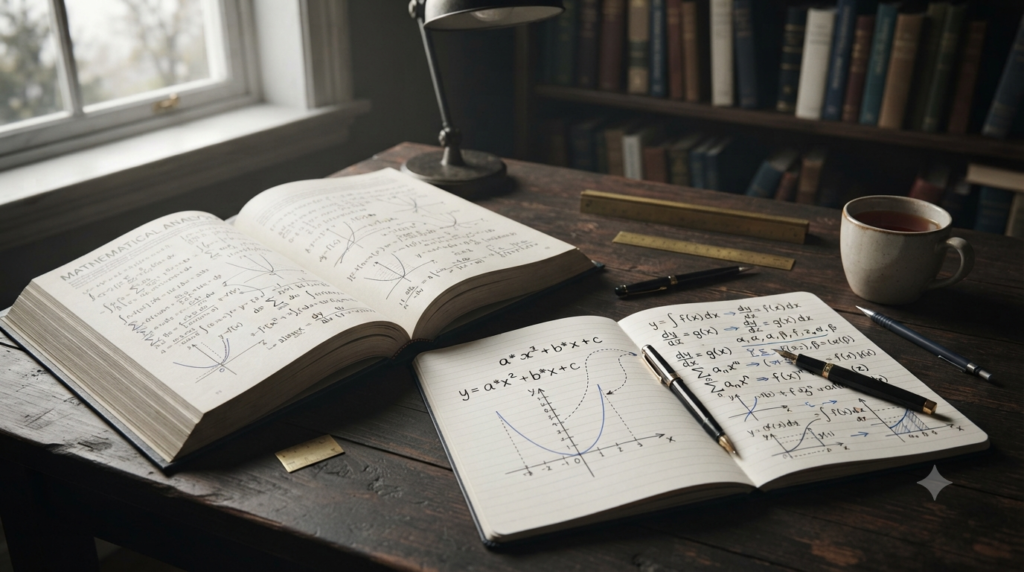
Mathematical expressions and formulas with algebraic examples and equations

Mathematics uses symbols, numbers, variables, and operations to represent ideas in a compact form. Two terms that often appear together are mathematical expressions and mathematical formulas. Although they may look similar, they serve different purposes. Understanding the difference between them makes it easier to read mathematical statements, simplify problems, and apply formulas correctly.

An expression can represent a mathematical quantity or relationship using numbers, variables, and operations, but it does not necessarily state that one quantity is equal to another. A formula, on the other hand, is a mathematical rule that shows how one quantity is related to other quantities, usually through an equality. For example, 3x + 5 is an expression, while A = l × w is a formula for the area of a rectangle.

Knowing how expressions and formulas work is an important foundation for algebra, geometry, physics, chemistry, statistics, and many other areas of science and mathematics.

What Is a Mathematical Expression?

A mathematical expression is a combination of numbers, variables, mathematical operators, and sometimes functions that represents a mathematical quantity.

Expressions can contain:

  • Numbers

  • Variables

  • Addition and subtraction

  • Multiplication and division

  • Powers and roots

  • Fractions

  • Mathematical functions

  • Parentheses and other grouping symbols

For example:

5 + 3

2x + 7

4a² - 3a + 6

x² + y²

All of these are mathematical expressions.

An expression can be evaluated when the values of its variables are known. For example, consider:

3x + 4

If x = 5, substitute 5 for x:

3(5) + 4 = 15 + 4 = 19

Therefore, the value of the expression is 19.

An expression itself does not usually make a statement that two quantities are equal. It simply represents a mathematical quantity.

Parts of a Mathematical Expression

A mathematical expression is built from different components. Understanding these components helps you read and manipulate expressions correctly.

Constants

A constant is a fixed numerical value.

Examples include:

5, 10, −3, ½, and π

In the expression:

4x + 7

the numbers 4 and 7 are constants or numerical coefficients and terms, depending on their role.

Variables

A variable is a symbol that represents a value that can change.

Common variables include:

x, y, a, b, m, and n

In:

5x + 2

x is the variable.

Coefficients

A coefficient is a number multiplied by a variable.

In:

7x

7 is the coefficient of x.

In:

−3y²

−3 is the coefficient of y².

Operators

Operators indicate mathematical operations.

Common operators include:

+ addition

− subtraction

× multiplication

÷ division

^ or superscripts for powers

For example:

4x + 6

contains multiplication between 4 and x, followed by addition.

Terms

A term is a part of an expression separated from other terms by addition or subtraction.

For example:

3x² + 5x − 8

has three terms:

3x²

5x

−8

Understanding terms is important when simplifying and solving algebraic expressions.

What Is a Mathematical Formula?

A mathematical formula is a rule or relationship that uses mathematical symbols to describe how quantities are related.

Most formulas use an equality sign because they show that two mathematical quantities are equal.

For example:

A = l × w

This formula states that the area A of a rectangle is equal to its length l multiplied by its width w.

Another familiar example is:

v = d/t

This formula describes the relationship between velocity or speed, distance, and time in an appropriate context.

Formulas are commonly used to calculate unknown quantities when other quantities are known.

For example, if a rectangle has a length of 8 cm and a width of 5 cm, its area can be calculated using:

A = l × w

Substituting the values:

A = 8 × 5

A = 40 cm²

The formula provides a general rule that can be used for many different rectangles.

Why Formulas Are Important

Formulas allow mathematical relationships to be expressed in a short and reusable form.

Instead of explaining a relationship with a long sentence every time, a formula can represent it using a few symbols.

For example, the area of a circle is:

A = πr²

This formula tells us that the area A depends on the radius r.

Similarly, the relationship between distance, speed, and time can be represented as:

d = st

A formula can therefore act as a mathematical tool for solving a wide range of problems.

Formulas are especially important in science. Physics, chemistry, astronomy, engineering, economics, and statistics all use formulas to describe relationships between measurable quantities.

Mathematical Expression vs Mathematical Formula

Expressions and formulas can look very similar because both use numbers, variables, and mathematical operations. The main difference is their purpose.

An expression represents a mathematical quantity.

A formula represents a mathematical relationship or rule.

Consider these examples:

3x + 5

This is an expression.

y = 3x + 5

This is a formula or equation expressing a relationship between x and y.

The expression 3x + 5 can be used as part of a formula, but by itself it does not establish an equality.

Another example is:

πr²

This is an expression.

A = πr²

This is a formula for the area of a circle.

The expression represents the calculation on the right side, while the formula connects that calculation with the quantity A.

Key Differences Between Expressions and Formulas

The differences can be understood through their purpose and structure.

FeatureMathematical ExpressionMathematical Formula
Main purposeRepresents a quantityShows a mathematical relationship
Usually contains =NoUsually yes
VariablesMay contain variablesCommonly contains variables
Can be evaluatedYesYes, when values are known
Used for calculationsYesYes
Shows a general ruleNot necessarilyUsually
Example4x + 7A = l × w

The distinction is not simply about whether an equals sign appears. An expression can appear on either side of an equation or formula. What matters is the mathematical role it plays.

Examples of Mathematical Expressions

Expressions appear throughout mathematics.

Arithmetic Expressions

Simple arithmetic expressions contain numbers and operations.

Examples:

8 + 4

15 − 7

6 × 9

24 ÷ 3

These can be evaluated directly.

For example:

8 + 4 = 12

Algebraic Expressions

Algebraic expressions contain variables.

Examples include:

2x + 5

a² + b²

3x² − 4x + 1

7m − 2n

Their values depend on the values assigned to their variables.

Fractional Expressions

Expressions can also contain fractions.

For example:

(x + 2)/3

or

5/x

These are still expressions because they represent mathematical quantities rather than necessarily stating a relationship between two quantities.

Expressions With Powers

Powers are frequently used in mathematical expressions.

Examples:

x²

3a³

2x⁴ + 5

These expressions are common in algebra, geometry, physics, and other scientific subjects.

Examples of Mathematical Formulas

Formulas are found in almost every branch of mathematics and science.

Area of a Rectangle

A = l × w

where A is area, l is length, and w is width.

Area of a Circle

A = πr²

where A is area and r is radius.

Perimeter of a Rectangle

P = 2(l + w)

where P is perimeter.

Simple Interest

I = Prt

where I is interest, P is principal, r is the rate expressed appropriately, and t is time.

Distance Formula

For motion at constant speed:

d = st

where d is distance, s is speed, and t is time.

These formulas provide general relationships that can be applied to many numerical situations.

An Expression Can Be Part of a Formula

One important idea is that expressions and formulas are not completely separate mathematical objects.

A formula often contains one or more expressions.

Consider:

A = πr²

The left side, A, is an expression representing the area.

The right side, πr², is also an expression representing the calculation used to determine the area.

The entire statement forms a formula.

Similarly:

E = mc²

contains the expression mc². The complete relationship connects energy E with mass m and the speed of light c.

This shows why learning expressions is essential before learning more advanced formulas.

Expressions, Equations, and Formulas

Expressions are sometimes confused with equations and formulas. These terms are related but should not be treated as identical.

An expression represents a quantity.

An equation states that two mathematical expressions are equal.

A formula gives a general mathematical relationship that can be used to calculate or describe quantities.

For example:

2x + 5

is an expression.

2x + 5 = 15

is an equation.

A = πr²

is a formula.

An equation may be used to solve for an unknown variable, while a formula is generally used as a reusable mathematical relationship.

How to Identify an Expression

When you encounter a mathematical statement, ask whether it simply represents a quantity.

For example:

4x² + 3x − 7

This is an expression.

There is no equality connecting it to another quantity.

Another example:

√(x + 5)

is also an expression.

It represents a mathematical quantity involving a square root.

How to Identify a Formula

To identify a formula, look for a general relationship between quantities.

For example:

C = 2πr

This gives the circumference of a circle in terms of its radius.

Similarly:

V = lwh

gives the volume of a rectangular box in terms of its length, width, and height.

A formula normally allows you to calculate one quantity when the required variables are known.

Why the Difference Matters

At first, the difference between expressions and formulas may seem small. However, it becomes increasingly important as mathematics becomes more advanced.

When simplifying an expression, the goal is usually to rewrite it in an equivalent but simpler form.

For example:

3x + 2x + 5

can be simplified to:

5x + 5

When using a formula, the goal is often to substitute known values and calculate an unknown quantity.

For example:

A = πr²

If r = 4 cm:

A = π(4)²

A = 16π cm²

The two processes are related but serve different purposes.

Expressions and Formulas in Science

Expressions and formulas are essential for communicating scientific ideas.

In physics, formulas describe relationships involving quantities such as force, energy, momentum, speed, and acceleration.

For example:

F = ma

In chemistry, formulas represent substances and mathematical relationships involving quantities such as concentration, amount, and mass.

In geometry, formulas describe areas, volumes, angles, and lengths.

In statistics, formulas are used to calculate quantities such as averages, variance, and probability.

In all these areas, expressions provide the mathematical building blocks from which formulas are constructed.

Common Mistakes to Avoid

One common mistake is treating every mathematical expression as a formula. A collection of numbers, variables, and operations does not automatically represent a general rule.

Another mistake is assuming that an equals sign alone explains the complete meaning of a mathematical statement. The symbols and quantities on both sides must form a meaningful relationship.

Students and beginners may also confuse an expression with an equation. For example:

x + 5

is not an equation because nothing is stated to be equal to it.

But:

x + 5 = 12

is an equation.

It is also important to remember that formulas may be rearranged. For example, from:

d = st

we can obtain:

s = d/t

and:

t = d/s

These forms express the same underlying relationship when the variables and conditions are appropriate.

A Simple Way to Remember the Difference

A useful way to remember the distinction is:

Expression = mathematical quantity

Formula = mathematical relationship or rule

For example:

2x + 3 → expression

y = 2x + 3 → relationship expressed as an equation or formula

A = πr² → formula

Thinking about the purpose of the mathematical statement is more useful than simply looking for an equals sign.

Conclusion

Mathematical expressions and formulas are fundamental parts of mathematics. An expression combines numbers, variables, operations, and other mathematical elements to represent a quantity. A formula uses mathematical relationships to show how different quantities are connected and often provides a rule for calculating an unknown value.

For example, 3x + 5 is an expression, while A = πr² is a formula. Expressions can appear inside formulas, equations, and larger mathematical statements, making them essential building blocks for more advanced mathematics.

Once you understand the difference between expressions, equations, and formulas, it becomes easier to simplify algebraic expressions, substitute values into formulas, solve mathematical problems, and understand scientific relationships. This basic distinction may seem simple, but it forms an important foundation for learning algebra, geometry, physics, chemistry, statistics, and many other areas where mathematics is used.

FAQs

1. What is a mathematical expression?

A mathematical expression is a combination of numbers, variables, operators, and mathematical symbols that represents a quantity. It may contain addition, subtraction, multiplication, division, powers, roots, or functions. For example, 3x + 5 is an algebraic expression. An expression does not normally state that one quantity is equal to another. Its value can be calculated when the values of its variables are known. For example, if x = 4, then 3x + 5 = 3(4) + 5 = 17. Expressions are basic building blocks used in algebra, equations, formulas, and many areas of mathematics.

2. What is a mathematical formula?

A mathematical formula is a general rule or relationship that shows how different quantities are connected. Formulas commonly use an equality sign and variables to represent quantities. For example, A = πr² is the formula for the area of a circle. By substituting a known value for the radius, you can calculate the area. Formulas are widely used in mathematics and science because they provide reusable methods for solving problems. Geometry, physics, chemistry, statistics, and engineering all depend on formulas to represent relationships between measurable or calculated quantities.

3. What is the difference between an expression and a formula?

The main difference is their purpose. A mathematical expression represents a quantity using numbers, variables, and operations, while a formula represents a general relationship between quantities. For example, 4x + 7 is an expression because it represents a mathematical quantity. A = l × w is a formula because it shows how the area of a rectangle depends on its length and width. Expressions can appear as parts of formulas and equations. Understanding this difference helps learners simplify expressions, substitute values into formulas, and solve mathematical problems more accurately.

4. Is an expression the same as an equation?

No, an expression and an equation are different. An expression represents a mathematical quantity, while an equation states that two expressions are equal. For example, 2x + 5 is an expression. In contrast, 2x + 5 = 15 is an equation because it states that the expression 2x + 5 has the same value as 15. Equations can often be solved to find unknown variables. Expressions can instead be simplified or evaluated. Both are important in mathematics, but they serve different purposes when representing and working with mathematical information.

5. Can a formula contain an expression?

Yes, a formula can contain one or more mathematical expressions. For example, consider the formula A = πr². The right side, πr², is an expression that calculates the area when the radius is known. The complete statement connects this expression with the area A. Similarly, F = ma contains the expression ma. This relationship shows why learning mathematical expressions is important before working extensively with formulas. Expressions provide the mathematical components used to construct formulas, equations, and more complicated relationships in mathematics and science.

6. Why are mathematical formulas important?

Mathematical formulas are important because they provide concise and reusable rules for describing relationships between quantities. Instead of calculating a relationship from the beginning each time, a formula allows you to substitute known values and find an unknown quantity. For example, the formula A = l × w can be used to calculate the area of any rectangle when its length and width are known. Formulas are used throughout mathematics and science, including geometry, physics, chemistry, astronomy, engineering, economics, and statistics. They make complex relationships easier to represent, calculate, and apply.

7. How do you evaluate a mathematical expression?

To evaluate a mathematical expression, first substitute known values for the variables and then perform the required operations according to the order of operations. For example, consider 3x + 4 when x = 5. Substitute 5 for x: 3(5) + 4. Then multiply before adding: 15 + 4 = 19. Therefore, the value of the expression is 19. When expressions contain parentheses, powers, multiplication, division, addition, or subtraction, following the correct order of operations helps ensure that the final answer is accurate.

8. What are some common examples of mathematical formulas?

Many familiar mathematical relationships are written as formulas. Examples include A = l × w for the area of a rectangle, A = πr² for the area of a circle, P = 2(l + w) for the perimeter of a rectangle, and V = lwh for the volume of a rectangular solid. Science also uses formulas such as F = ma in mechanics. These formulas provide general relationships that can be used with different values. Learning common formulas helps learners solve problems efficiently and understand how mathematical quantities are related.

9. Can a mathematical expression contain variables?

Yes, mathematical expressions can contain one or more variables. A variable represents a value that can change or an unknown value. For example, 2x + 7 contains the variable x, while 3a² + 4b contains the variables a and b. The value of an expression depends on the values assigned to its variables. Variables allow mathematics to represent general situations instead of only one specific numerical case. They are especially important in algebra because they allow relationships, patterns, and calculations to be expressed in a general mathematical form.

10. Why should you learn expressions before formulas?

Learning mathematical expressions first provides a foundation for understanding formulas, equations, and more advanced mathematics. Expressions teach you how variables, constants, coefficients, operators, powers, and terms work together. Once these components are familiar, formulas become easier to read and use. For example, understanding the expression πr² makes it easier to understand the circle-area formula A = πr². This knowledge also helps with substitution, simplification, rearranging formulas, and solving problems. A strong understanding of expressions therefore makes later topics in algebra, geometry, physics, chemistry, and statistics easier to understand.

Related Posts

Leave a Comment

Your email address will not be published. Required fields are marked *

Scroll to Top