Mathematics is an important part of computer science. Even when a programming task does not appear mathematical, programmers and computer scientists often use mathematical notation to describe data, operations, algorithms, relationships, and logical conditions. Learning these symbols and conventions makes it easier to understand programming concepts, algorithms, data structures, databases, artificial intelligence, and theoretical computer science.
Basic mathematical notation provides a common language for expressing ideas precisely. Symbols such as =, ≠, <, >, ≤, ≥, ∈, ∑, and √ appear frequently in computer science. Sets, functions, variables, exponents, logarithms, sequences, and logical operators are also widely used.
You do not need advanced mathematics to understand most of the notation used at the foundation level of computer science. Once the common symbols are familiar, mathematical expressions in algorithms and technical explanations become much easier to read.
What Is Mathematical Notation?
Mathematical notation is a system of symbols, letters, numbers, and expressions used to represent mathematical ideas in a short and precise form.
For example, instead of writing:
“a number x is greater than 5 and less than or equal to 10,”
we can write:
5 < x ≤ 10
This expression communicates the same idea more compactly.
In computer science, mathematical notation is particularly useful because computers and algorithms deal with precise rules and relationships. Mathematical notation allows these rules to be described without using long sentences.
For example, the expression:
x = x + 1
can represent an operation in programming where the value of x is increased by 1.
Numbers and Common Number Sets
Computer science uses different types of numbers depending on the problem being studied.
Natural Numbers
Natural numbers are commonly used for counting:
1, 2, 3, 4, 5, …
They are often represented by N.
Depending on the mathematical convention, some definitions include zero:
N = {0, 1, 2, 3, …}
Others begin with 1. Therefore, the exact definition should be checked from the context.
Natural numbers are frequently used for array positions, counts, iteration numbers, and sizes.
Integers
Integers include negative numbers, zero, and positive numbers:
…, −3, −2, −1, 0, 1, 2, 3, …
They are represented by Z.
Integers are useful when computer science problems involve values that can move in either direction, such as coordinates, differences, counters, or signed values.
Real Numbers
Real numbers include integers, fractions, and decimal values.
They are represented by R.
Examples include:
−2, 0, 3.5, 1/2, √2
Real numbers are commonly used when discussing measurements, continuous values, geometry, statistics, and numerical computing.
Variables and Constants
A variable is a symbol that represents a value that may change.
Common variable names include:
x, y, n, i, j
For example:
x = 10
Here, x is a variable and its current value is 10.
A constant represents a fixed value within a particular context.
For example:
π ≈ 3.14159
The value of π is treated as a constant.
In computer science, variables are used extensively in algorithms and programs to represent values, counters, indexes, inputs, and results.
Equality and Assignment
The equal sign = is one of the most common mathematical symbols.
In mathematics:
x = 5
means that x has the value 5.
In programming, however, the meaning can depend on the programming language. In many languages, a single equal sign represents assignment:
x = 5
This means that the value 5 is assigned to x.
Mathematical equality and programming assignment are related concepts, but they should not always be treated as exactly the same thing.
For example, in mathematics:
x = x + 1
cannot be true for an ordinary number.
In programming, however, it can mean “take the current value of x, add 1, and store the result back in x.”
Comparison Symbols
Computer science frequently needs to compare values.
The most common comparison symbols are:
= — equal to
≠ — not equal to
< — less than
> — greater than
≤ — less than or equal to
≥ — greater than or equal to
For example:
x > 10
means that x is greater than 10.
Similarly:
x ≤ 100
means that x can be less than or equal to 100.
These comparisons are commonly used in conditions, algorithms, loops, searching, sorting, and decision-making.
Arithmetic Operators
Basic arithmetic notation is also important in computer science.
Common operations include:
+ — addition
− — subtraction
× — multiplication
÷ — division
% — remainder or modulo in many programming contexts
For example:
a + b
represents the sum of a and b.
a − b
represents the difference.
a × b
represents multiplication.
a ÷ b
represents division.
The modulo operation is especially important in programming. For example:
17 mod 5 = 2
because 5 divides into 17 three times with a remainder of 2.
In programming, modulo is often written as:
17 % 5 = 2
Parentheses and Grouping
Parentheses are used to control the order in which operations are performed.
For example:
(a + b) × c
means that a and b are added first, and the result is multiplied by c.
Without parentheses, the expression may have a different interpretation depending on the standard order of operations.
Computer scientists use parentheses frequently in mathematical expressions, function calls, logical conditions, and programming syntax.
Exponents and Powers
An exponent indicates repeated multiplication.
For example:
2³ = 2 × 2 × 2 = 8
The number 3 is the exponent.
Exponents are particularly important in computer science because many algorithms have exponential or polynomial growth.
For example:
2ⁿ
often appears when discussing problems involving all possible combinations of n binary choices.
A power such as n² means:
n × n
and n³ means:
n × n × n
Square Roots
The square root symbol is:
√
For example:
√25 = 5
because 5 × 5 = 25.
Square roots appear in geometry, distance calculations, statistics, numerical algorithms, and computer graphics.
A square root can also be written with an index:
∛8 = 2
Here, the cube root of 8 is 2.
Fractions
A fraction represents division or a ratio.
For example:
a/b
means a divided by b, where b is not zero.
Fractions appear frequently in probability, statistics, algorithms, ratios, and mathematical models.
For example:
1/n
is often used to describe a quantity that decreases as n increases.
Logarithms
Logarithms are extremely important in computer science, particularly in algorithm analysis.
A logarithm answers the question: “What exponent produces this number?”
For example:
log₂ 8 = 3
because:
2³ = 8
Common logarithm bases in computer science include 2 and 10.
The notation:
log₂ n
means the logarithm of n with base 2.
Logarithms with base 2 appear frequently because computers use binary representation.
For example, a binary search algorithm has a time complexity commonly expressed as:
O(log₂ n)
The base is sometimes omitted in Big-O notation because logarithms with different constant bases differ only by a constant factor.
Sets and Set Notation
A set is a collection of distinct objects.
For example:
A = {1, 2, 3, 4}
Here, A is a set containing four elements.
The symbol ∈ means “is an element of.”
For example:
3 ∈ A
means that 3 belongs to set A.
The symbol ∉ means “is not an element of.”
For example:
7 ∉ A
means that 7 does not belong to A.
Sets are important in computer science because they are used to describe collections of data, possible values, states, relationships, and database concepts.
Subsets
The symbol ⊆ means “is a subset of.”
For example:
A ⊆ B
means that every element of A is also an element of B.
The symbol ⊂ is often used to indicate a proper subset, although conventions can vary.
Set notation becomes particularly useful when studying databases, discrete mathematics, probability, and theoretical computer science.
Union and Intersection
Two important set operations are union and intersection.
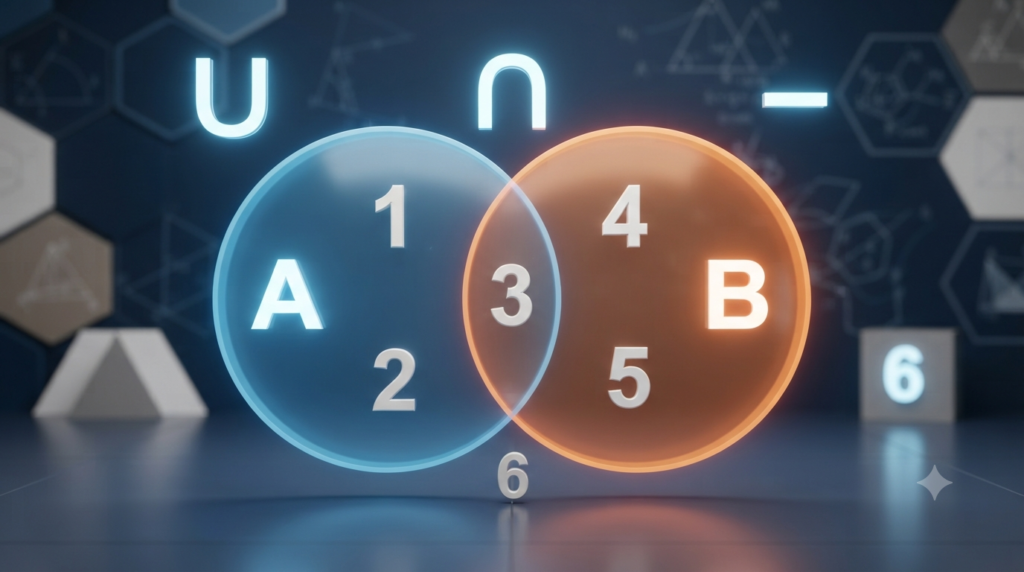
The union symbol is:
∪
For example:
A ∪ B
represents all elements that belong to A, B, or both.
The intersection symbol is:
∩
For example:
A ∩ B
represents the elements common to both sets.
These concepts are useful when describing collections of data and logical conditions.
Functions
A function describes a relationship between inputs and outputs.
For example:
f(x) = x² + 1
Here, f is the function, and x is its input.
If:
x = 3
then:
f(3) = 3² + 1 = 10
Functions are fundamental to computer science. A programming function can similarly accept inputs, perform operations, and produce an output.
Function notation is also used extensively in algorithm analysis.
Sequences and Indexes
A sequence is an ordered list of values.
For example:
a₁, a₂, a₃, …, aₙ
Here, the subscript identifies the position of each element.
For example:
a₁ = 10
means that the first element of the sequence is 10.
Indexes are especially important when working with arrays, lists, strings, and mathematical sequences.
In programming, an index often identifies the location of an element within a data structure.
Summation Notation
The Greek capital letter sigma, Σ, is used to represent a sum.
For example:
Σᵢ₌₁ⁿ i
means:
1 + 2 + 3 + … + n
A more general example is:
Σᵢ₌₁ⁿ aᵢ
which means that all values from a₁ through aₙ are added together.
Summation notation is useful in algorithm analysis, statistics, probability, and mathematical formulas.
Product Notation
The symbol Π is sometimes used to represent repeated multiplication.
For example:
Πᵢ₌₁ⁿ i
means:
1 × 2 × 3 × … × n
Product notation is less common than summation notation in basic computer science, but it can appear in probability, combinatorics, and theoretical computer science.
Factorial
The exclamation mark ! is used to represent factorial.
For a positive integer n:
n! = n × (n − 1) × (n − 2) × … × 2 × 1
For example:
5! = 5 × 4 × 3 × 2 × 1 = 120
Factorials are important in permutations, combinations, probability, and computational complexity.
Absolute Value
The absolute value of a number represents its distance from zero.
It is written using vertical bars:
|x|
For example:
|−7| = 7
and:
|7| = 7
Absolute value is useful in distance calculations, error measurement, optimization, and numerical algorithms.
Logical Notation
Logic is one of the most important mathematical foundations of computer science.
The symbol ¬ means NOT.
For a statement P:
¬P
means “not P.”
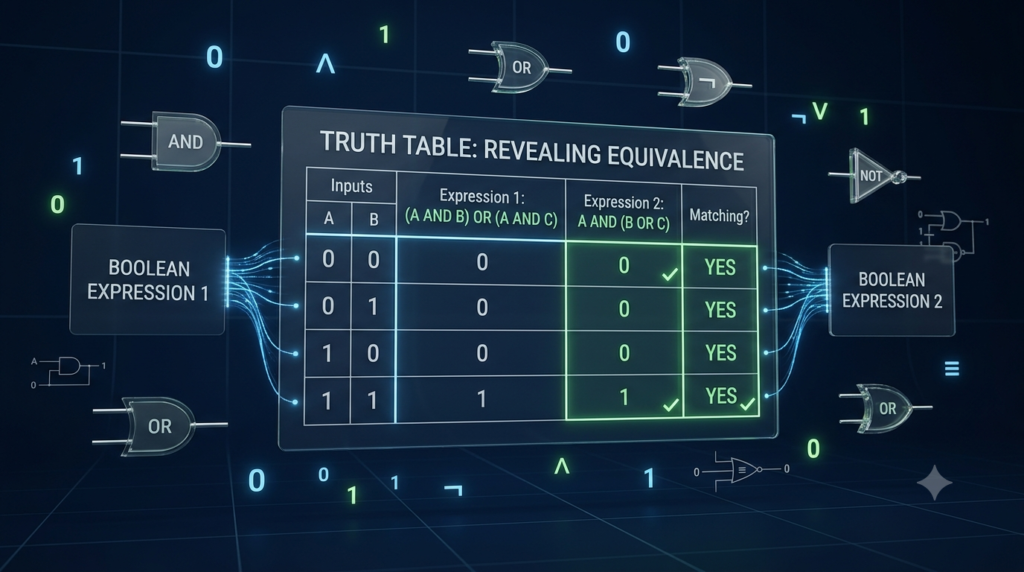
The symbol ∧ means AND.
For example:
P ∧ Q
is true when both P and Q are true.
The symbol ∨ means OR.
For example:
P ∨ Q
is true when at least one of P or Q is true.
The symbol → means implication.
For example:
P → Q
can be read as “if P, then Q.”
The symbol ↔ means logical equivalence or “if and only if” in appropriate contexts.
Logical notation is widely used in algorithms, programming conditions, digital logic, databases, and artificial intelligence.
Quantifiers
Quantifiers are used to describe how broadly a mathematical statement applies.
The symbol ∀ means “for all.”
For example:
∀x ∈ N
means “for every x belonging to the natural numbers.”
The symbol ∃ means “there exists.”
For example:
∃x ∈ N
means “there exists an x belonging to the natural numbers.”
Quantifiers are particularly common in mathematical proofs and theoretical computer science.
Infinity
The symbol ∞ represents infinity.
It does not represent an ordinary number. Instead, it describes something that has no finite limit in the relevant context.
For example:
n → ∞
means that n increases without bound.
Infinity appears frequently when discussing limits, algorithm behavior, mathematical sequences, and complexity.
Asymptotic Notation
Computer science uses special notation to describe how an algorithm behaves as its input becomes large.
The most common forms are:
O(f(n)) — Big-O notation
Ω(f(n)) — Big-Omega notation
Θ(f(n)) — Big-Theta notation
For example:
O(n)
describes linear growth.
O(n²)
describes quadratic growth.
O(log₂ n)
describes logarithmic growth.
O(2ⁿ)
describes exponential growth.
These notations help computer scientists compare algorithms without focusing on exact execution time for a particular machine.
Why Mathematical Notation Matters in Computer Science
Mathematical notation makes computer science concepts shorter, clearer, and more precise.
Consider the statement:
“An algorithm examines every element in a list of n elements.”
This can be represented more compactly when discussing its running time:
O(n)
Similarly, a binary search that repeatedly divides the search space in half can be represented as:
O(log₂ n)
Mathematical notation also helps describe sets, functions, probabilities, graphs, algorithms, logical conditions, data structures, and computational complexity.
Learning the notation is therefore not about memorizing symbols for their own sake. The goal is to understand what each symbol communicates and how it is used in a computer science context.
Common Mathematical Symbols Used in Computer Science
Some frequently encountered symbols include:
| Symbol | Meaning | Example |
|---|---|---|
| = | Equal to / assignment depending on context | x = 5 |
| ≠ | Not equal to | x ≠ 0 |
| < | Less than | x < 10 |
| > | Greater than | x > 10 |
| ≤ | Less than or equal to | x ≤ 10 |
| ≥ | Greater than or equal to | x ≥ 10 |
| ∈ | Is an element of | x ∈ A |
| ∉ | Is not an element of | x ∉ A |
| ⊆ | Subset of | A ⊆ B |
| ∪ | Union | A ∪ B |
| ∩ | Intersection | A ∩ B |
| ∑ | Summation | Σᵢ₌₁ⁿ aᵢ |
| Π | Product | Πᵢ₌₁ⁿ aᵢ |
| √ | Square root | √25 |
| ∞ | Infinity | n → ∞ |
| ∀ | For all | ∀x |
| ∃ | There exists | ∃x |
| ¬ | NOT | ¬P |
| ∧ | AND | P ∧ Q |
| ∨ | OR | P ∨ Q |
| → | Implies | P → Q |
| O | Big-O | O(n) |
| Ω | Big-Omega | Ω(n) |
| Θ | Big-Theta | Θ(n) |
Conclusion
Basic mathematical notation provides an essential language for computer science. Symbols for numbers, variables, comparisons, sets, functions, logarithms, sequences, summations, logic, and algorithmic complexity allow complex ideas to be expressed clearly and efficiently.
You do not need to master advanced mathematics before learning computer science. Start by becoming comfortable with the most common symbols and understanding them in practical contexts. Pay particular attention to comparison operators, variables, sets, functions, exponents, logarithms, logical operators, and asymptotic notation.
As you progress into algorithms, data structures, discrete mathematics, databases, artificial intelligence, and theoretical computer science, you will encounter more mathematical notation. A strong foundation in these basic symbols will make those topics easier to understand and help you read technical explanations, formulas, and algorithms with greater confidence.
FAQs
1. What is mathematical notation in computer science?
Mathematical notation in computer science is a system of symbols, letters, numbers, and expressions used to represent concepts and relationships clearly. It helps describe algorithms, data structures, logical conditions, functions, sets, calculations, and computational complexity. Common examples include =, ≠, <, >, ∈, ∑, √, and O(n). Instead of explaining a mathematical relationship using many words, notation allows the same idea to be expressed in a compact form. Learning basic notation makes technical material easier to read and understand. It is especially useful when studying algorithms, programming, discrete mathematics, probability, statistics, artificial intelligence, and theoretical computer science.
2. Why is mathematical notation important in computer science?
Mathematical notation is important because it provides a precise and compact way to describe computer science concepts. Algorithms often involve relationships, conditions, calculations, and patterns that are easier to express using mathematical symbols. For example, x > 10 clearly represents a comparison, while O(n) describes linear growth in algorithm complexity. Mathematical notation also provides a common language that can be understood across programming languages and countries. Understanding notation helps learners read algorithm explanations, technical documentation, research papers, formulas, and mathematical models. A good foundation in notation can therefore make subjects such as algorithms, data structures, logic, and computer science theory much easier to understand.
3. What are the most common mathematical symbols used in computer science?
Some of the most common mathematical symbols used in computer science are comparison, arithmetic, set, logical, and complexity symbols. Comparison symbols include =, ≠, <, >, ≤, and ≥. Set symbols include ∈, ∉, ⊆, ∪, and ∩. Logical symbols include ¬, ∧, ∨, and →. Other important symbols include √ for square root, Σ for summation, ∞ for infinity, and ! for factorial. Complexity notation commonly uses O, Ω, and Θ. These symbols appear in programming, algorithms, data structures, mathematics, probability, databases, artificial intelligence, and theoretical computer science.
4. What do the symbols <, >, ≤, and ≥ mean in computer science?
The symbols <, >, ≤, and ≥ are comparison operators used to compare values. The symbol < means “less than,” while > means “greater than.” The symbol ≤ means “less than or equal to,” and ≥ means “greater than or equal to.” For example, x < 10 means that x has a value smaller than 10. Similarly, x ≥ 5 means that x is at least 5. These comparisons are important in programming conditions, loops, searching, sorting, algorithms, and decision-making. Programming languages often provide equivalent operators, although their exact syntax may differ.
5. What does ∈ mean in mathematical notation?
The symbol ∈ means “is an element of” or “belongs to.” It is mainly used with sets. For example, if A = {1, 2, 3, 4}, then 3 ∈ A means that 3 is an element of set A. The opposite symbol, ∉, means “is not an element of.” For example, 7 ∉ A means that 7 does not belong to A. Set membership is important in computer science because many problems involve collections of possible values, data items, states, or objects. Understanding ∈ and ∉ makes set notation and mathematical descriptions of algorithms easier to understand.
6. What is function notation in computer science?
Function notation describes a relationship between an input and an output. A common example is f(x) = x² + 1. Here, f represents the function and x represents its input. If x = 3, then f(3) = 10. Functions are fundamental in computer science because they provide a way to describe operations that transform input into output. Programming languages also use functions or methods to perform specific tasks. Mathematical functions are used when analyzing algorithms, defining computational processes, modeling data, and studying relationships. Understanding notation such as f(x), f(n), and f(a, b) is therefore useful for both programming and computer science theory.
7. Why are logarithms such as log₂ n important in computer science?
Logarithms are important because many computer science processes repeatedly divide a problem into smaller parts. The expression log₂ n represents the logarithm of n with base 2. For example, log₂ 8 = 3 because 2³ = 8. Logarithms commonly appear in algorithm analysis. A binary search, for example, repeatedly reduces the search space by about half, giving it a logarithmic running time commonly expressed as O(log₂ n). Logarithmic growth is much slower than linear or quadratic growth as the input becomes large. Understanding logarithms helps learners analyze algorithms, data structures, searching techniques, and computational complexity.
8. What do O(n), Ω(n), and Θ(n) mean?
O(n), Ω(n), and Θ(n) are asymptotic notations used to describe algorithm growth. Big-O notation, written O(f(n)), commonly describes an upper bound on growth. Big-Omega, written Ω(f(n)), describes a lower bound. Big-Theta, written Θ(f(n)), describes a tight asymptotic bound when both upper and lower bounds match. For example, an algorithm that grows proportionally with the number of input elements may have a complexity of O(n). These notations allow computer scientists to compare algorithms based on how their resource requirements grow as input size increases, rather than relying only on actual execution time.
9. What are mathematical sets used for in computer science?
Sets are collections of distinct elements and are widely used to describe groups of objects or possible values. For example, A = {1, 2, 3} represents a set containing three elements. Computer science uses sets in areas such as databases, discrete mathematics, probability, programming language theory, and algorithms. Symbols such as ∈, ⊆, ∪, and ∩ help describe relationships between sets. Set concepts are also useful for understanding data collections and operations such as finding common or unique elements. Learning basic set notation provides an important foundation for more advanced computer science topics, particularly algorithms, logic, and theoretical computer science.
10. How can I learn mathematical notation used in computer science?
The best way to learn mathematical notation is to study common symbols gradually and use them in practical examples. Start with basic arithmetic and comparison symbols such as +, −, =, <, and >. Then learn sets, functions, exponents, logarithms, logical operators, summations, and asymptotic notation. Instead of memorizing symbols without context, understand what each one means and practice reading complete expressions. For example, learn to interpret x ∈ A, f(n) = n², and O(log₂ n) in words. Applying notation while studying algorithms, programming, and data structures will reinforce your understanding and make technical material easier to read.