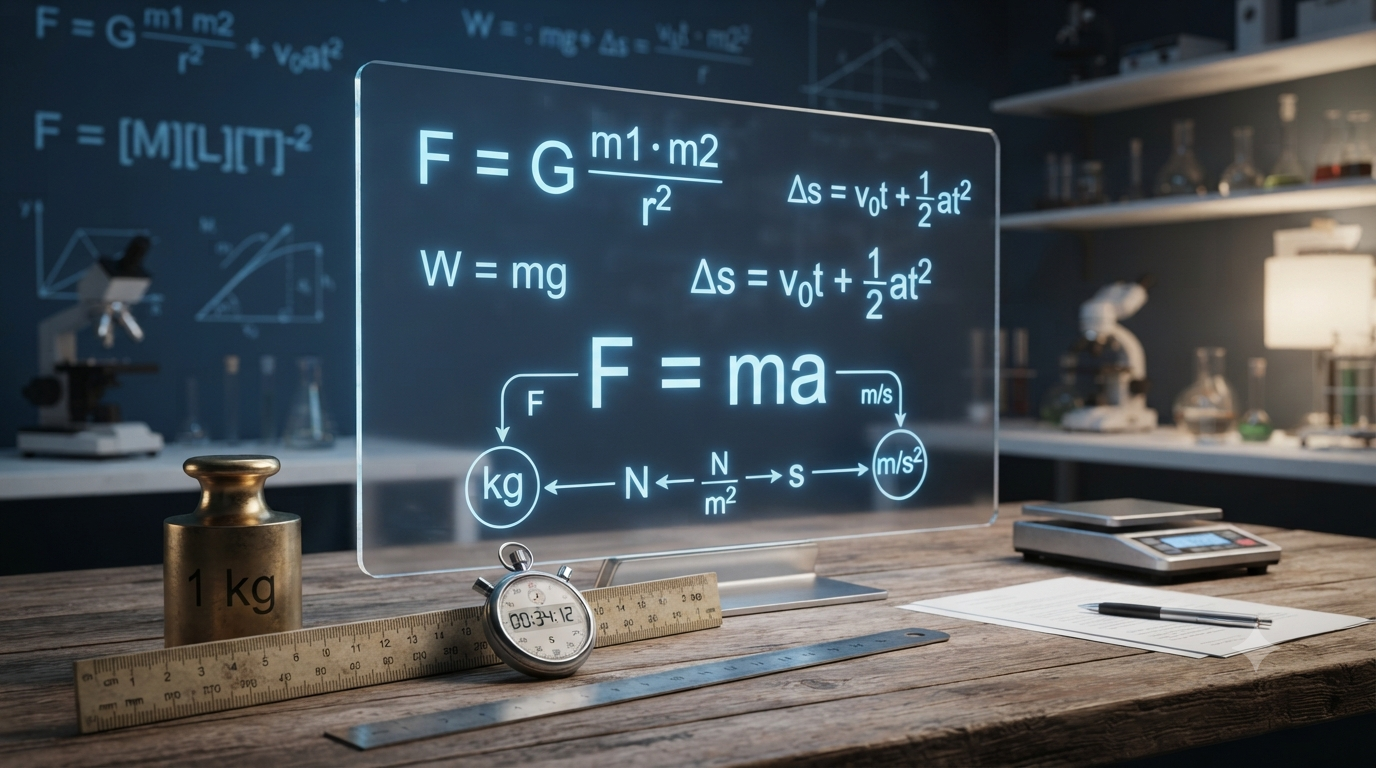
When we use a physics or mathematics formula, we often focus on putting the correct numbers into the equation and calculating the answer. However, there is another important part that can easily be overlooked: the units of the measured quantities must be consistent with the formula. A correct formula with inconsistent units can produce a completely incorrect result, even when the numerical calculation itself is flawless.
Units tell us what a measured number actually represents. For example, 5 m is a length, 5 s is a time, and 5 kg is a mass. The number alone is not enough to describe a physical quantity. When different quantities are combined in a formula, their units must also combine in a mathematically meaningful way.
Unit consistency is therefore not just a formatting rule. It is a basic requirement for obtaining physically meaningful results, checking equations, converting measurements correctly, and avoiding calculation errors.
What Does Unit Consistency Mean?
Unit consistency means using units that are compatible with the mathematical relationship expressed by a formula.
Consider the formula for speed:
v = s/t
where:
v = speed
s = distance
t = time
Suppose a distance is measured as 100 metres and the time is 20 seconds. Then:
v = 100 m / 20 s = 5 m/s
The units naturally become metres per second, which is the correct unit for speed.
Now imagine that the distance is given as 100 metres but the time is given as 2 minutes. We cannot simply calculate:
100 m / 2 min = 50 m/s
The numerical result is not 50 m/s because the time is still measured in minutes. The correct result is:
100 m / 2 min = 50 m/min
If the answer is required in metres per second, the time must first be converted:
2 min = 120 s
Therefore:
v = 100 m / 120 s = 0.833 m/s
The numbers changed because the unit changed. This illustrates why unit consistency matters.
Units Are Part of a Measured Quantity
A measured quantity always contains two important parts: a numerical value and a unit.
For example:
10 m
contains:
Numerical value = 10
Unit = metre
The statement “the length is 10” is incomplete because we do not know whether the length is 10 metres, 10 centimetres, 10 kilometres, or another unit.
This becomes especially important when quantities are substituted into formulas. A formula does not operate only on numbers. It operates on physical quantities, including their units.
For example, consider:
d = vt
If:
v = 20 m/s
and
t = 5 s
then:
d = (20 m/s)(5 s)
The seconds cancel:
d = 100 m
The unit of the answer is therefore metre, which makes sense because the formula calculates distance.
Why Inconsistent Units Cause Incorrect Results
Mathematical operations involving physical quantities follow rules for their units. Multiplication, division, addition, and subtraction cannot be performed carelessly when units are involved.
Suppose we use the formula:
F = ma
where:
F = force
m = mass
a = acceleration
The SI unit of mass is kilogram and the SI unit of acceleration is metre per second squared.
Therefore:
F = kg × m/s²
which gives:
F = kg·m/s²
This combination of units is called a newton (N).
If mass is given in grams and acceleration in kilometres per second squared, directly inserting the numbers without conversion can produce a result that has the wrong magnitude.
For example, suppose:
m = 500 g
and:
a = 2 m/s²
If we incorrectly use 500 as though it were kilograms:
F = 500 × 2 = 1000 N
But 500 g is not 500 kg.
Since:
500 g = 0.5 kg
the correct calculation is:
F = 0.5 × 2 = 1 N
The incorrect unit handling produced an answer that was 1000 times larger than the correct answer.
Addition and Subtraction Require Special Care
Unit consistency is particularly important when quantities are added or subtracted.
Consider:
5 m + 30 cm
We cannot simply add the numerical values:
5 + 30 = 35
because metres and centimetres are different units.
First convert one quantity into the unit of the other.
Since:
30 cm = 0.30 m
we get:
5 m + 0.30 m = 5.30 m
The same principle applies to subtraction.
For example:
2.5 kg − 300 g
Convert 300 g into kilograms:
300 g = 0.3 kg
Therefore:
2.5 kg − 0.3 kg = 2.2 kg
The quantities must be expressed in compatible units before addition or subtraction.
Multiplication and Division Also Depend on Units
When quantities are multiplied or divided, their units are combined according to the same mathematical operations applied to their numerical values.
For example:
Area = length × width
If the length is 5 m and the width is 3 m:
Area = 5 m × 3 m = 15 m²
The unit becomes square metres.
Similarly, for volume:
Volume = length × width × height
If all three dimensions are measured in metres:
Volume = m × m × m = m³
This shows that the resulting unit is determined by the formula itself.
If one dimension were given in centimetres and the others in metres, the measurements should normally be converted into a common unit before calculating.
Unit Consistency Helps Maintain Physical Meaning
A formula represents a relationship between physical quantities. The units on both sides of a valid physical equation must be compatible.
Consider the equation:
s = ut + ½at²
where:
s = displacement
u = initial velocity
a = acceleration
t = time
Look at the units of the first term:
ut = (m/s)(s) = m
Now consider the second term:
at² = (m/s²)(s²) = m
Both terms have the unit metre. Therefore, they can be added:
m + m = m
The right side has the same unit as displacement on the left side.
This is an example of dimensional consistency.
If the terms had incompatible units, the equation would not make physical sense.
Unit Consistency Is Closely Related to Dimensional Analysis
Dimensional analysis is a useful technique for examining the dimensions of physical quantities and checking whether an equation is reasonable.
For example, consider:
v = d/t
Distance has the dimension of length, represented by L, while time has the dimension T.
Therefore:
[v] = [L]/[T] = [LT⁻¹]
So velocity has the dimension:
[LT⁻¹]
This gives us a way to check formulas without knowing the numerical values.
For example, suppose someone proposes the formula:
v = d/t²
Its dimensions would be:
[v] = [L]/[T²] = [LT⁻²]
But velocity should have the dimension [LT⁻¹]. Therefore, the proposed formula cannot represent velocity.
Dimensional analysis can identify many types of errors before any numerical calculation is performed.
SI Units Make Calculations Easier
The International System of Units (SI) provides a standardized system for scientific measurement. Using SI units makes physical calculations much easier because different quantities can be expressed in a common and coherent system.
Some important SI units include:
| Physical Quantity | SI Unit | Symbol |
|---|---|---|
| Length | metre | m |
| Mass | kilogram | kg |
| Time | second | s |
| Temperature | kelvin | K |
| Electric current | ampere | A |
| Amount of substance | mole | mol |
| Luminous intensity | candela | cd |
Derived units are formed from these basic units. For example, acceleration is measured in:
m/s²
and force is measured in:
kg·m/s², or N
Using SI units consistently reduces the chance of mixing incompatible measurement systems.
Unit Conversion Is Essential in Real Calculations
Measurements are not always provided in the units required by a formula. Unit conversion allows us to express the same physical quantity in a different unit without changing its actual value.
For example:
1 km = 1000 m
Therefore:
3.5 km = 3500 m
Similarly:
1 hour = 3600 s
So:
2 hours = 7200 s
Suppose a vehicle travels 72 km in 2 hours. To calculate its speed in metres per second, both quantities should be converted appropriately.
Distance:
72 km = 72,000 m
Time:
2 h = 7200 s
Therefore:
v = 72,000/7200 = 10 m/s
The physical situation has not changed. Only the units used to express the measurements have changed.
Unit Consistency Helps Prevent Large Numerical Errors
A small mistake in unit conversion can create a very large error in the final answer.
For example, kilometres and metres differ by a factor of 1000. Hours and seconds differ by a factor of 3600. Square and cubic units introduce even larger conversion factors.
For area:
1 m² = 10,000 cm²
For volume:
1 m³ = 1,000,000 cm³
This happens because the conversion factor is applied to each dimension.
Therefore, a unit error is not necessarily a small error. It can change an answer by factors of hundreds, thousands, or even millions.
Unit Consistency Can Help Detect Mistakes
Units are also useful as an error-checking tool.
Suppose you calculate acceleration and obtain an answer in metres instead of metres per second squared. That immediately suggests that something went wrong.
Similarly, if you calculate energy but the final unit is kilograms, you should check the calculation.
For example, kinetic energy is given by:
KE = ½mv²
The units are:
kg × (m/s)²
which gives:
kg·m²/s²
This is the unit of energy and is called the joule (J).
If your calculation produces an unrelated unit, the formula, substitution, or conversion should be checked.
A Formula Does Not Remove the Need for Unit Conversion
One common mistake is assuming that because a formula is correct, any numbers can be substituted directly into it.
That is not true.
A formula tells us how physical quantities are related, but the measurements must still be expressed in compatible units.
For example, in:
KE = ½mv²
if mass is given in grams and velocity in kilometres per hour, directly entering those numerical values will not give kinetic energy in joules.
For an answer in SI units, the mass should be converted to kilograms and velocity to metres per second before applying the formula.
The formula remains exactly the same. Only the representation of the measured quantities changes.
How to Make Units Consistent Before Using a Formula
A simple procedure can prevent most unit-related errors.
1. Write the Formula
Start by writing the required equation clearly.
For example:
v = d/t
2. List the Given Quantities
Write each measurement along with its unit.
For example:
d = 5 km
t = 10 min
3. Identify the Required Unit
Decide what unit you want for the final answer.
For example, if the answer should be in m/s, the distance should be in metres and time should be in seconds.
4. Convert the Quantities
Convert the measurements before substitution.
5 km = 5000 m
10 min = 600 s
5. Substitute the Values
Now use the formula:
v = 5000 m / 600 s
6. Calculate and Include the Unit
v = 8.33 m/s
Keeping the units throughout the calculation makes the result easier to verify.
Why Unit Consistency Matters in Science
Unit consistency is essential because science depends on reliable measurements and reproducible calculations. Scientists, engineers, researchers, and students need to be able to compare measurements made in different places and at different times.
Standardized units make this possible.
If one researcher reports a distance in metres and another reports it in kilometres, the measurements can still be compared after conversion. But if units are ignored or incorrectly interpreted, scientific results can become misleading.
Engineering calculations are especially sensitive to unit errors because an incorrect numerical result can affect the design, safety, or performance of a real system.
Conclusion
Units are not optional labels attached to numbers. They are an essential part of measured physical quantities. Whenever a formula involves measured quantities, the units must be consistent so that the mathematical operations produce a physically meaningful result.
For addition and subtraction, quantities must be expressed in compatible units. For multiplication and division, their units must combine correctly according to the formula. Converting measurements into a common system, especially SI units, makes calculations clearer and reduces errors.
Unit consistency also provides a powerful way to check formulas and calculations through dimensional analysis. By carrying units through every step, we can often identify mistakes before they affect the final answer.
The basic rule is simple: before substituting measured values into a formula, check their units, convert them when necessary, and keep the units throughout the calculation. This small habit can prevent major errors and is one of the most useful foundations of scientific problem-solving.
FAQs
1. Why must units be consistent when using a formula?
Units must be consistent because a formula describes a relationship between physical quantities, not just numbers. If different quantities are expressed in incompatible units, the numerical result can be incorrect even when the formula and arithmetic are correct. For example, using kilometres for distance and seconds for time can produce a speed in kilometres per second when metres per second is required. Converting all quantities into compatible units before substitution ensures that the calculation has the correct magnitude and meaning. Consistent units also make it easier to identify mistakes and verify whether the final answer has the expected physical unit.
2. What happens if units are not converted before using a formula?
If units are not converted when necessary, the final answer may have an incorrect numerical value, an incorrect unit, or both. For example, if distance is given in kilometres and time in hours, using their numerical values directly gives speed in kilometres per hour, not metres per second. In some cases, the error can be extremely large because units such as kilometres and metres differ by a factor of 1,000. Therefore, measurements should be converted into compatible units before being substituted into a formula. Keeping the units visible during each calculation step helps prevent these mistakes.
3. Do all quantities in a formula need to have the same units?
No. All quantities do not need to have the same units, but their units must be compatible with the mathematical operations in the formula. For example, in the equation v = d/t, distance and time naturally have different units. Distance may be measured in metres and time in seconds, producing velocity in metres per second. However, if quantities are being added or subtracted, they must have compatible units. For multiplication and division, their units combine according to the formula. The important principle is that the units must produce a physically meaningful result when the formula is evaluated.
4. Why are SI units commonly used in physics formulas?
SI units are commonly used in physics because they provide a standardized and coherent system for scientific measurements. Important quantities such as length, mass, and time are measured in metres, kilograms, and seconds. Many derived units are naturally formed from these base units. For example, acceleration has the unit m/s², while force has the unit kg·m/s², called the newton. Using SI units reduces confusion and makes it easier to compare scientific results. Although formulas can be used with other units, converting measurements to SI units often makes calculations simpler, clearer, and less prone to unit-related errors.
5. Why can’t we directly add quantities with different units?
Quantities with different units cannot normally be added directly because their numerical values do not represent the same unit of measurement. For example, 5 m + 30 cm cannot be calculated as 35 because metres and centimetres are different units. First, one measurement must be converted so both quantities use the same unit. Since 30 cm = 0.30 m, the calculation becomes 5 m + 0.30 m = 5.30 m. The same principle applies to subtraction. Before adding or subtracting physical quantities, convert them into compatible units so that the mathematical operation has a clear physical meaning.
6. Can unit consistency be used to check a physics formula?
Yes. Unit consistency is an important way to check whether a physics formula is dimensionally reasonable. For example, consider s = ut + ½at². Velocity has units of metres per second, so ut has units of metres. Acceleration has units of metres per second squared, so at² also has units of metres. Both terms can therefore be added, and the result has the unit of displacement. If the units on the two sides of an equation are incompatible, the equation cannot be physically correct as written. This method is called dimensional analysis and is widely used in physics.
7. What is the difference between units and dimensions?
A unit is a standardized way of expressing the measurement of a physical quantity, while a dimension describes the fundamental nature of that quantity. For example, metre is a unit of length, while [L] represents the dimension of length. Velocity can be measured in metres per second, kilometres per hour, or other units, but its dimension is always [LT⁻¹]. Similarly, acceleration has the dimension [LT⁻²]. Units can change through conversion, but dimensions remain the same. Understanding this difference helps scientists use dimensional analysis to examine formulas and identify certain types of errors.
8. Why should units be written during calculations?
Writing units during calculations helps track what each number represents and makes errors easier to detect. For example, when calculating distance using d = vt, writing (20 m/s)(5 s) clearly shows that seconds cancel, leaving metres. If the units do not cancel or combine into the expected unit, there may be a mistake in the calculation or conversion. Units also help prevent confusion when several quantities have similar numerical values but different measurement systems. Keeping units throughout the calculation is therefore a simple but powerful habit for solving physics and mathematics problems accurately.
9. Can a unit mistake change the answer by a large amount?
Yes. A unit mistake can sometimes change the answer by a very large factor. For example, one kilometre equals 1,000 metres, so treating a kilometre value as though it were a metre value creates a factor-of-1,000 error. Area and volume conversions can create even larger differences because conversion factors are squared or cubed. For example, 1 m² = 10,000 cm², while 1 m³ = 1,000,000 cm³. This is why unit conversion must be handled carefully, particularly in scientific, engineering, and technical calculations where an incorrect result can have significant consequences.
10. What is the easiest way to ensure unit consistency in a formula?
The easiest method is to follow a few simple steps. First, write the formula and identify every measured quantity. Next, write the numerical value together with its unit. Determine the unit required for the final answer, then convert the given quantities into compatible units. Substitute the values into the formula while keeping the units visible. Perform the calculation and check whether the final unit matches the physical quantity being calculated. For many physics problems, converting measurements into SI units before substitution is a reliable approach. This habit makes calculations clearer and helps catch unit-related errors early.