Physics is often described as the science of discovering the rules that govern nature. These rules are expressed as physical laws, equations, and principles. But how do scientists know that a law actually describes the real world? The answer is experimentation.
An experiment provides a way to compare what a physical law predicts with what nature actually does. Scientists design experiments, make measurements, analyze results, and check whether the observations agree with predictions. If the results repeatedly match the predictions, confidence in the law increases. If they do not, scientists investigate the reason and may need to modify or replace the existing explanation.
What Is a Physical Law?
A physical law is a concise description of a consistent pattern observed in nature. Laws such as Newton’s laws of motion, the law of conservation of energy, and Ohm’s law describe relationships between measurable quantities.
For example, Newton’s second law is commonly written as:
F = ma
This equation predicts how the force acting on an object is related to its mass and acceleration. If scientists know the mass and applied force, they can calculate the expected acceleration.
The important point is that a physical law does not become trustworthy simply because an equation looks logical. Its predictions must agree with observations and experiments.
Experiments Begin With a Question
Most experiments begin with a specific question. A scientist may ask, “Does increasing the force on an object increase its acceleration?” or “Does the current through a resistor change when the voltage changes?”
A good experimental question should involve quantities that can be observed or measured. Scientists then identify what they expect to happen according to an existing law or theory.
For example, suppose an experiment is designed to test the relationship between voltage and current in a resistor. Ohm’s law predicts:
V = IR
If resistance remains constant, increasing the voltage should produce a proportional increase in current. The experiment can test whether this prediction actually occurs.
Making a Prediction
A physical law becomes experimentally testable when it makes a measurable prediction.
Imagine dropping objects near Earth’s surface. According to the equations of motion, an object falling freely should accelerate downward at approximately the same rate, regardless of its mass when air resistance is negligible.
Scientists can use this prediction to design an experiment. They can measure the time taken for an object to fall through a known distance and calculate its acceleration.
The prediction is determined before examining the experimental results. This is important because scientists need to compare an independent prediction with an observation rather than simply adjusting the explanation afterward.
Designing a Controlled Experiment
A carefully designed experiment helps scientists determine whether the law is responsible for the observed result.
Scientists identify variables that may affect the outcome. Usually, one variable is changed while other important conditions are kept as constant as possible.
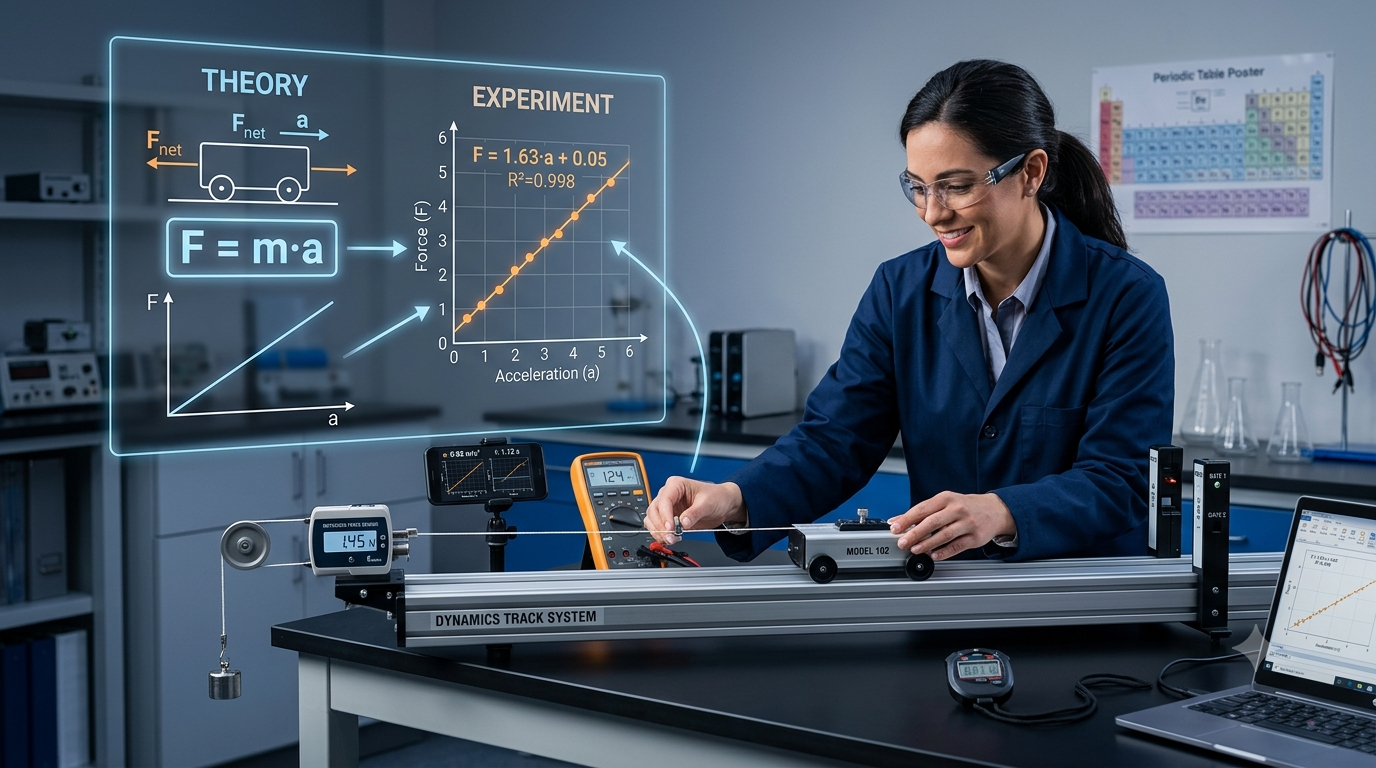
For example, when investigating the relationship between force and acceleration, researchers might change the applied force while keeping the object’s mass constant. They then measure the resulting acceleration.
Repeating the experiment with different forces produces multiple measurements. Instead of relying on a single observation, scientists can look for a consistent pattern.
Measurement Is at the Heart of Testing
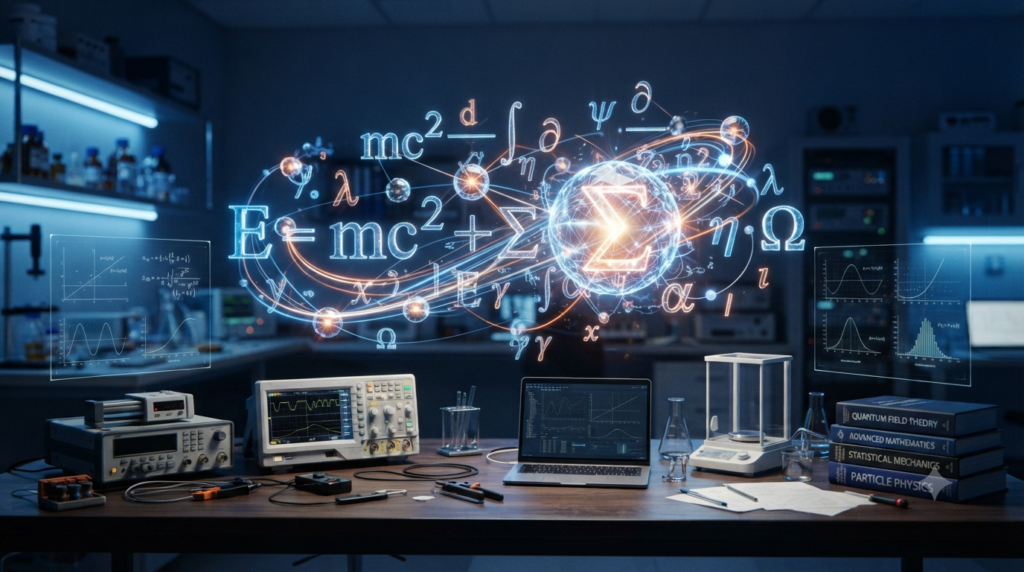
Experiments depend on measurements. Scientists use instruments such as rulers, balances, stopwatches, thermometers, voltmeters, ammeters, and sophisticated sensors to measure physical quantities.
Every measurement has some uncertainty. No real instrument provides infinitely precise information. A stopwatch may have limited resolution, a ruler may have a smallest readable division, and an electronic sensor may have instrumental limitations.
Because of this, experimental results are not expected to match theoretical predictions perfectly. Scientists consider measurement uncertainty when deciding whether an observed difference is significant.
Comparing Predictions With Results
After collecting data, scientists compare the experimental results with the prediction of the physical law.
Suppose a law predicts that an object should accelerate at 9.8 m/s², while an experiment measures values close to that number. Small differences may occur because of air resistance, measurement limitations, friction, or other experimental factors.
Scientists therefore ask whether the difference is consistent with the known uncertainty.
A useful experiment does not simply ask whether the measured number is identical to the predicted number. Instead, it asks whether the experimental evidence is sufficiently consistent with the prediction.
Repeating Experiments Matters
A single experiment is rarely enough to establish strong confidence in a physical law. Scientists repeat measurements to determine whether the result is reproducible.
Repetition helps identify random errors and unusual results. If several independent experiments produce results that agree within expected uncertainties, the evidence becomes stronger.
Different scientists may also perform similar experiments using different equipment and methods. Agreement between independent experiments is especially valuable because it reduces the possibility that the result comes from a particular instrument, procedure, or experimental mistake.
Graphs Help Reveal Physical Relationships
Scientists often use graphs to compare experimental data with theoretical predictions.
For example, if a law predicts that acceleration increases directly with force, researchers can plot force on one axis and acceleration on the other. If the data form a pattern consistent with the predicted relationship, this provides visual evidence supporting the law.
Graphs can also reveal problems. If the experimental points consistently curve away from the predicted relationship, scientists may need to investigate further.
Mathematical analysis can then determine how closely the measurements follow the theoretical model.
Experiments Can Reveal the Limits of a Law
An important feature of physics is that laws often have specific ranges where they work extremely well.
Newtonian mechanics, for example, is highly successful for everyday objects moving at ordinary speeds. However, when objects move extremely close to the speed of light, relativistic effects become important.
This does not mean that Newton’s laws are simply “wrong.” Instead, they provide an excellent approximation under conditions where relativistic effects are negligible.
Experiments help scientists discover these boundaries. When observations repeatedly disagree with an established law under particular conditions, researchers investigate whether a more general theory is required.
Unexpected Results Can Be Valuable
An experiment that disagrees with a prediction is not necessarily a failure. Sometimes unexpected results lead to important discoveries.
If experimental evidence cannot be explained by known measurement errors or experimental limitations, scientists examine the assumptions behind the existing model.
This process has played an important role throughout the history of physics. Differences between predictions and observations have sometimes led to new theories and deeper understanding of nature.
Therefore, experiments do more than confirm what scientists already believe. They can also challenge existing ideas.
Falsification and Scientific Testing
A powerful scientific experiment should allow a prediction to be tested in a meaningful way. If a theory predicts a specific measurable outcome, an experiment can potentially show that the prediction does not occur.
This is one reason scientists value tests that could produce results contrary to their expectations.
For example, if a physical theory predicts that a particular quantity must remain constant under certain conditions, scientists can deliberately search for situations where it might change. If repeated measurements show a reliable violation of the prediction, the theory requires further examination.
This makes experimentation a process of both testing and challenging scientific ideas.
Technology Makes Tests More Precise
Modern experiments can test physical laws with remarkable accuracy. Advanced instruments can detect extremely small changes in distance, time, temperature, voltage, or energy.
Computers also allow scientists to collect enormous amounts of data and compare measurements with theoretical models.
However, better technology does not replace scientific reasoning. Scientists still need to decide what to measure, how to control variables, how to estimate uncertainty, and how to interpret the results.
From Experiment to Confidence
A physical law gains scientific credibility through repeated successful testing. The process usually involves several stages: observe a phenomenon, develop a model or law, make predictions, design experiments, collect measurements, compare results, and repeat the process.
If the predictions continue to agree with observations across many different situations, confidence in the law grows.
But scientific confidence is not the same as absolute proof. Future experiments may reveal conditions where an existing law needs to be extended or replaced by a more general description.
Conclusion
Experiments are one of the most important ways physicists determine whether the laws of physics describe nature accurately. A law makes predictions, while an experiment provides measurable evidence that can be compared with those predictions.
Scientists carefully control variables, make precise measurements, consider uncertainty, repeat experiments, and analyze patterns in the data. When results consistently agree with predictions, the evidence supporting the law becomes stronger. When results disagree, scientists investigate the cause and may discover the limits of the law or develop a better theory.
This continuous relationship between theory and experiment is what makes physics a powerful science. The equations may describe what should happen, but experiments allow nature to provide the final test.