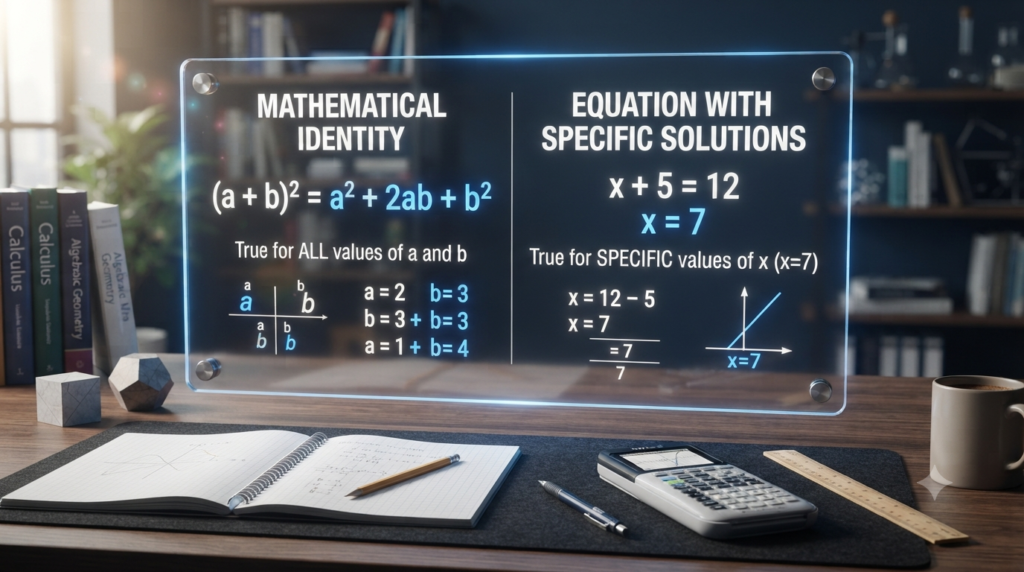
When rearranging an equation, you may have heard the rule: whatever operation you perform on one side, you must perform on the other side as well. This rule is one of the most important ideas in algebra because it keeps an equation balanced and preserves the relationship between its two sides.
At first, this rule can seem like a mechanical step to memorize. But there is a simple reason behind it. An equation states that two expressions have the same value. If you change only one side, the two expressions may no longer be equal. Performing the same valid operation on both sides changes the equation without changing the equality.
Understanding this principle makes it much easier to solve equations, rearrange formulas, isolate variables, and check whether an algebraic transformation is correct.
What Does an Equation Mean?
An equation is a mathematical statement that says two expressions are equal.
For example:
x + 5 = 12
The equals sign tells us that the expression on the left, x + 5, has the same value as the expression on the right, 12.
If x = 7, then:
7 + 5 = 12
So both sides have the same value.
The two sides of an equation can be thought of as being connected by an equality relationship:
Left side = Right side
As long as this relationship remains true, the equation is balanced.
Why Is an Equation Called Balanced?
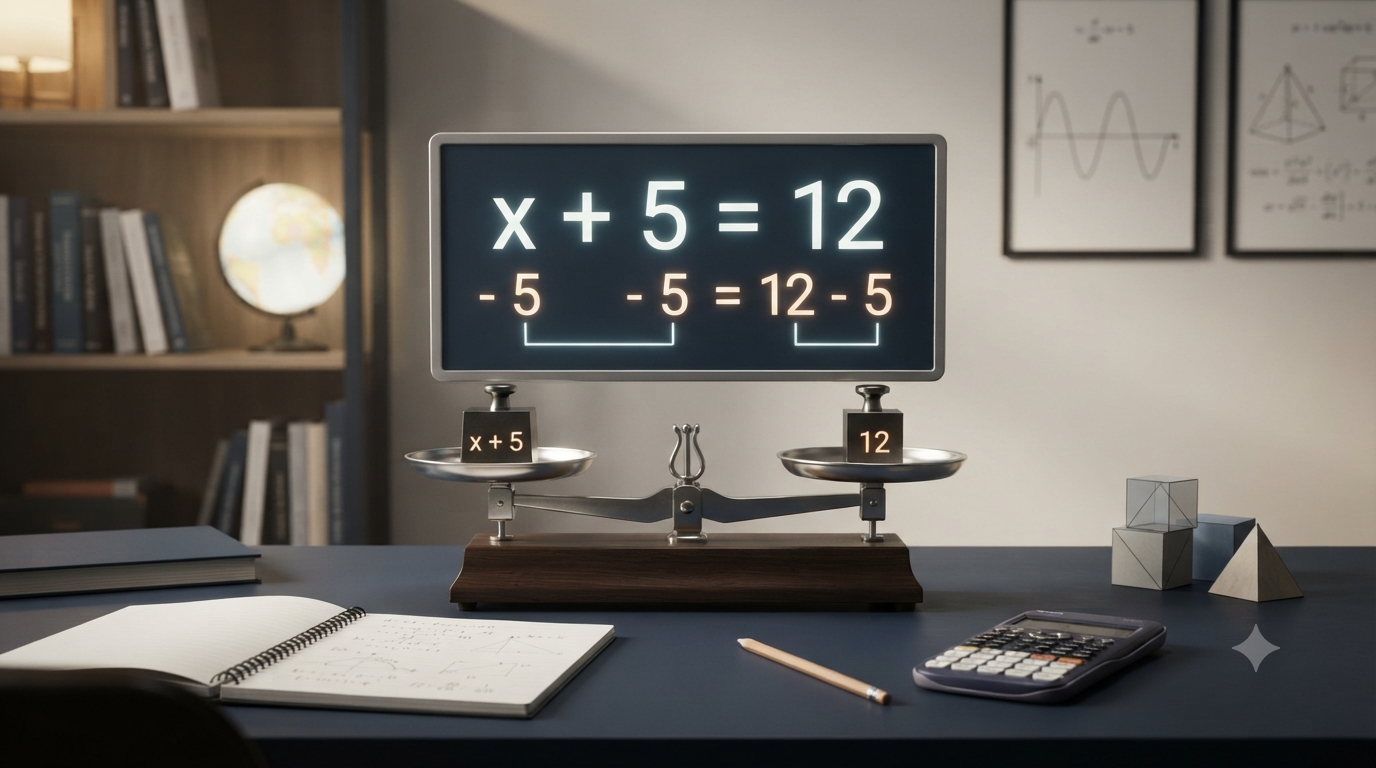
Imagine a balance scale with equal weights on both sides.
If the left side has 5 kg and the right side also has 5 kg, the scale remains level.
Now suppose you add 2 kg only to the left side. The left side becomes 7 kg while the right side remains 5 kg. The scale is no longer balanced.
Mathematical equations work in a similar way.
Consider:
x + 5 = 12
If we subtract 5 from the left side only, we get:
x = 12
This is not generally equivalent to the original equation because we changed only one side.
Instead, subtract 5 from both sides:
x + 5 − 5 = 12 − 5
This gives:
x = 7
The equality has been preserved.
This is the basic idea behind performing the same operation on both sides.
The Equality Relationship
The rule comes directly from the properties of equality.
If:
a = b
then adding the same number c to both sides gives:
a + c = b + c
Similarly, subtracting the same number gives:
a − c = b − c
Multiplying both sides by the same nonzero number gives:
ac = bc
And dividing both sides by the same nonzero number gives:
a ÷ c = b ÷ c
These transformations preserve equality.
They allow us to change the appearance of an equation while keeping its mathematical meaning intact.
Why Can’t We Change Only One Side?
Suppose we have:
x + 4 = 10
We want to remove the +4 from the left side. We can subtract 4 from the left side, but if we do not subtract 4 from the right side, we get:
x = 10
This says x is 10.
But substitute x = 10 into the original equation:
10 + 4 = 10
which becomes:
14 = 10
That statement is false.
The problem is that the operation changed only one side of the equality.
The correct transformation is:
x + 4 − 4 = 10 − 4
Therefore:
x = 6
Now check the answer:
6 + 4 = 10
So the equation remains true.
Rearranging an Equation Is About Preserving Equality
When we rearrange an equation, we are not simply moving numbers from one side to another.
For example:
x + 8 = 20
It is common to say that we “move 8 to the other side” and change its sign:
x = 20 − 8
This is a convenient shortcut, but something important is happening behind that shortcut.
The actual operation is:
x + 8 − 8 = 20 − 8
The +8 and −8 cancel on the left:
x = 12
So the number did not literally jump from one side to the other. We subtracted 8 from both sides and then simplified.
Understanding this prevents many algebra mistakes.
Example: Solving an Equation by Subtraction
Consider:
x + 9 = 17
The variable x is combined with +9. To isolate x, subtract 9 from both sides:
x + 9 − 9 = 17 − 9
Simplify:
x = 8
Check:
8 + 9 = 17
Therefore, the solution is correct.
The important point is that subtracting 9 from both sides preserved the equality.
Example: Solving an Equation by Addition
Consider:
x − 6 = 15
To isolate x, we need to remove −6. The opposite operation is addition.
Add 6 to both sides:
x − 6 + 6 = 15 + 6
Simplify:
x = 21
Check:
21 − 6 = 15
So the equation remains true.
Example: Multiplication
Consider:
x/4 = 7
The variable is divided by 4. To isolate x, multiply both sides by 4:
4 × (x/4) = 7 × 4
The left side simplifies to x:
x = 28
Check:
28/4 = 7
Again, the same operation was performed on both sides.
Example: Division
Consider:
5x = 35
Here, x is multiplied by 5. To isolate x, divide both sides by 5:
5x/5 = 35/5
Therefore:
x = 7
Check:
5 × 7 = 35
The equation is still true.
Why Do Opposite Operations Help?
Rearranging an equation often involves using inverse operations.
An inverse operation reverses another operation.
For example:
Addition and subtraction are inverse operations.
Multiplication and division are inverse operations.
Squaring and taking a square root are related inverse operations under appropriate conditions.
Suppose:
x + 6 = 14
To remove +6, subtract 6.
Suppose:
x − 6 = 14
To remove −6, add 6.
Suppose:
3x = 18
To remove multiplication by 3, divide by 3.
The goal is to isolate the variable while preserving equality.
Rearranging More Complicated Equations
The same principle applies even when an equation contains several terms.
Consider:
2x + 5 = 19
First subtract 5 from both sides:
2x + 5 − 5 = 19 − 5
So:
2x = 14
Now divide both sides by 2:
2x/2 = 14/2
Therefore:
x = 7
Two operations were required, but the principle remained the same: every operation was applied equally to both sides.
Example With Variables on Both Sides
Consider:
3x + 4 = x + 14
There are variables on both sides.
First, subtract x from both sides:
3x − x + 4 = x − x + 14
This gives:
2x + 4 = 14
Now subtract 4 from both sides:
2x + 4 − 4 = 14 − 4
So:
2x = 10
Finally, divide both sides by 2:
x = 5
Check the original equation:
3(5) + 4 = 5 + 14
15 + 4 = 19
19 = 19
The solution works.
What Happens When the Same Operation Is Not Used?
Using different operations on the two sides can change the solution set.
For example:
x + 3 = 10
Suppose we add 2 only to the left:
x + 5 = 10
This is a different equation.
The original equation gives:
x = 7
The altered equation gives:
x = 5
So changing only one side changed the solution.
This shows why the rule is not merely a classroom convention. It is necessary for preserving the original mathematical relationship.
Does the Operation Always Have to Look Identical?
The important idea is that the same mathematical transformation must be applied to both sides.
For example:
2(x + 3) = 14
Dividing both sides by 2 gives:
2(x + 3)/2 = 14/2
Therefore:
x + 3 = 7
We do not necessarily have to write every intermediate step in practical algebra. Once the principle is understood, many steps can be written more compactly.
However, the equality-preserving operation is still happening mathematically.
A Useful Way to Think About It
A helpful question is:
“What am I doing to the left side, and have I done the same thing to the right side?”
For example:
x + 7 = 16
If you subtract 7 on the left, subtract 7 on the right.
If you multiply the left side by 3, multiply the right side by 3.
If you divide the left side by 5, divide the right side by 5, provided the division is valid.
This simple habit can prevent many algebra errors.
Rearranging Formulas Uses the Same Principle
The same concept is used when rearranging scientific and mathematical formulas.
Consider the formula:
v = d/t
Suppose we want to make d the subject.
Multiply both sides by t:
vt = d
Therefore:
d = vt
We performed the multiplication by t on both sides.
Similarly, if we want to make t the subject:
v = d/t
Multiply both sides by t:
vt = d
Then divide both sides by v:
t = d/v
Formula rearrangement is therefore not a separate trick from algebra. It is an application of the same equality principles.
Why This Principle Matters in Science
Scientists and students constantly rearrange equations.
For example, the relationship between speed, distance, and time is:
v = d/t
From this equation, we can derive:
d = vt
and:
t = d/v
Physics formulas, chemistry equations, mathematical relationships, and engineering formulas are frequently rearranged to find an unknown quantity.
If the equality principle is misunderstood, rearranging formulas can easily produce incorrect results.
Understanding why both sides must be treated equally provides a strong foundation for working with formulas in science and mathematics.
Common Mistakes When Rearranging Equations
Changing Only One Side
This is the most basic mistake.
Incorrect:
x + 5 = 12
x = 12
Correct:
x + 5 − 5 = 12 − 5
x = 7
Using the Wrong Inverse Operation
If a number is added, subtraction removes it.
If a number is multiplied, division removes it.
Using the wrong operation will not isolate the variable correctly.
Forgetting to Apply the Operation to Every Term
Consider:
2x + 6 = 18
If you divide by 2, the operation must be applied correctly to the entire side when appropriate.
For example:
(2x + 6)/2 = 18/2
which gives:
x + 3 = 9
Careful use of parentheses helps prevent mistakes.
Dividing by Zero
Division by zero is undefined. Therefore, the rule about dividing both sides applies only when the divisor is nonzero.
For example, from:
2x = 10
we can divide by 2 because 2 is not zero.
The Main Idea in One Sentence
The reason we perform the same operation on both sides of an equation is simple:
An equation represents equality, and applying the same valid operation to both sides preserves that equality.
If:
A = B
then, under the appropriate conditions:
A + C = B + C
A − C = B − C
AC = BC
and:
A/C = B/C
when C is not zero.
These properties allow us to transform equations without changing the solutions.
Conclusion
Performing the same operation on both sides of an equation is essential because an equation represents a relationship of equality. Changing one side without making a corresponding change to the other can destroy that relationship and produce an incorrect equation.
When solving or rearranging an equation, the goal is usually to isolate a variable. We accomplish this by using inverse operations, such as subtraction to undo addition or division to undo multiplication. Every valid operation is applied to both sides so that the equation remains balanced.
Once this principle is understood, algebra becomes less about memorizing rules and more about following a logical process. The next time you rearrange an equation, remember that numbers do not really “move” from one side to another. Instead, mathematical operations are performed on both sides to preserve equality.
FAQs
1. Why must the same operation be performed on both sides of an equation?
The same operation must be performed on both sides because an equation represents equality between two expressions. If both sides have the same value, changing only one side can make them unequal. For example, if x + 5 = 12, subtracting 5 only from the left gives x = 12, which is incorrect. Instead, subtract 5 from both sides: x + 5 − 5 = 12 − 5, giving x = 7. Applying the same valid operation to both sides preserves the equality and keeps the equation equivalent to the original equation. This principle is fundamental to solving and rearranging equations correctly.
2. What does it mean to keep an equation balanced?
Keeping an equation balanced means maintaining the equality between its left and right sides. For example, in x + 4 = 10, both sides have the same value when x = 6. If you subtract 4 from the left side, you must also subtract 4 from the right side. This produces x = 6 and preserves the original relationship. The idea is similar to a balance scale: adding or removing the same amount from both sides keeps the scale level. In algebra, performing equivalent operations on both sides ensures that the equation remains mathematically true.
3. Can you add the same number to both sides of an equation?
Yes. Adding the same number to both sides of an equation preserves equality. For example, consider x − 3 = 8. To isolate x, add 3 to both sides: x − 3 + 3 = 8 + 3. After simplifying, we get x = 11. The original and transformed equations have the same solution. This works because if two quantities are equal, increasing both quantities by the same amount does not change their equality. The same principle can be used with positive numbers, negative numbers, fractions, decimals, or algebraic expressions, provided the operation is mathematically valid.
4. Why do we use inverse operations when solving equations?
Inverse operations are used because they undo other operations and help isolate the unknown variable. Addition is undone by subtraction, while multiplication is undone by division. For example, in 3x = 18, x is multiplied by 3. Dividing both sides by 3 gives x = 6. Similarly, in x + 7 = 15, subtracting 7 from both sides gives x = 8. Using inverse operations allows us to systematically remove operations surrounding the variable. Because the inverse operation must be applied to both sides, equality is preserved throughout the process.
5. What happens if I perform an operation on only one side?
If you perform an operation on only one side, you can change the equality and produce an equation that is not equivalent to the original. For example, start with x + 2 = 9. If you subtract 2 only from the left side, you get x = 9. However, x = 9 does not satisfy the original equation because 9 + 2 = 11, not 9. The correct approach is to subtract 2 from both sides: x + 2 − 2 = 9 − 2, giving x = 7. Therefore, both sides must be treated consistently.
6. Does the same rule apply when rearranging formulas?
Yes. The same equality principle applies when rearranging formulas. For example, consider the formula v = d/t. If you want to make d the subject, multiply both sides by t: vt = d. Therefore, d = vt. If you want to make t the subject, further rearrangement gives t = d/v, assuming v is not zero. Scientific formulas are equations, so they follow the same algebraic rules as ordinary equations. Understanding equality makes it easier to rearrange formulas in physics, chemistry, mathematics, engineering, and other scientific fields without relying only on memorized formula patterns.
7. Is “moving a number to the other side” a real algebraic operation?
“Moving a number to the other side” is a convenient way of describing an algebraic transformation, but the number does not literally move across the equals sign. For example, in x + 5 = 12, we often say that 5 moves to the other side and becomes −5, giving x = 12 − 5. The actual process is to subtract 5 from both sides: x + 5 − 5 = 12 − 5. The shortcut works because subtracting 5 from both sides produces the same result. Understanding the actual operation makes the shortcut easier to use correctly.
8. Can I multiply both sides of an equation by an expression?
Yes, you can multiply both sides by an expression, provided the operation is valid. For example, if x/3 = 5, multiplying both sides by 3 gives x = 15. You can also multiply by algebraic expressions when appropriate. However, you should be careful if the expression could equal zero or if other restrictions are involved. Multiplying both sides by an expression can sometimes introduce complications when working with equations involving fractions or variables in denominators. The important principle remains the same: the multiplication must be applied consistently to both sides.
9. Why is dividing both sides by zero not allowed?
Dividing by zero is not defined in ordinary arithmetic, so an equation cannot be safely rearranged by dividing both sides by zero. For example, if 0x = 5, dividing by 0 is impossible. There is no number x that makes 0x equal 5, so the equation has no solution. When dividing both sides by a variable expression, you must also consider whether that expression could be zero. For example, dividing by x requires knowing that x ≠ 0. Recognizing these restrictions prevents invalid algebraic transformations and helps maintain the correct solution set.
10. How can I check whether my rearranged equation is correct?
You can check a rearranged equation by substituting a valid value into both the original and rearranged forms. For example, suppose the original equation is 2x + 4 = 14 and you rearrange it to x = 5. Substitute x = 5 into the original equation: 2(5) + 4 = 14, so 10 + 4 = 14. The statement is true, confirming the result. You can also perform the algebra again and compare each step. Checking your answer is especially useful when equations contain several operations, fractions, negative numbers, or variables on both sides.