
Chemical formulas are one of the simplest and most useful ways to represent substances in chemistry. Instead of writing the full names of all the elements present in a substance, chemists use short symbols to show which elements are involved. These symbols, combined with numbers and a few rules, allow us to write formulas that communicate the composition of a substance clearly and efficiently.
For example, water is made from hydrogen and oxygen. Its chemical formula is H₂O. The symbols H and O identify the elements, while the small number ₂ tells us that two hydrogen atoms are present for every one oxygen atom. In the same way, carbon dioxide is written as CO₂, sodium chloride as NaCl, and calcium carbonate as CaCO₃.
Understanding how element symbols are used to write chemical formulas is an important foundation for learning chemistry. It helps us understand what substances are made of, how atoms combine, and how chemical equations represent reactions.
What Is an Element Symbol?
An element symbol is a short abbreviation used to represent a chemical element. Most element symbols contain one or two letters.
The first letter of an element symbol is always written as a capital letter. If there is a second letter, it is written in lowercase.
For example:
Hydrogen = H
Oxygen = O
Carbon = C
Nitrogen = N
Sodium = Na
Magnesium = Mg
Calcium = Ca
Chlorine = Cl
Aluminium = Al
The capitalization of element symbols is important. For example, Co represents cobalt, while CO does not represent a single element symbol. C represents carbon and O represents oxygen.
Some element symbols come from English names, while others are based on older or Latin names.
Examples include:
Sodium = Na, from the Latin name natrium
Potassium = K, from the Latin name kalium
Iron = Fe, from the Latin name ferrum
Copper = Cu, from the Latin name cuprum
Silver = Ag, from the Latin name argentum
Gold = Au, from the Latin name aurum
These symbols provide a universal language for identifying elements.
How Element Symbols Represent Atoms
An element symbol can represent an atom of that element.
For example, H represents a hydrogen atom, while O represents an oxygen atom. Similarly, Fe represents an iron atom and Na represents a sodium atom.
When symbols are combined, they can represent substances containing more than one element.
For example:
H₂O
This formula contains the symbols H and O. It tells us that water contains hydrogen and oxygen.
The formula does not simply list the elements. It also communicates the relative number of atoms of each element.
In H₂O:
H represents hydrogen.
O represents oxygen.
The subscript ₂ means two hydrogen atoms.
No subscript after O means one oxygen atom.
Therefore, one molecule of water contains two hydrogen atoms and one oxygen atom.
Why Are Element Symbols Used in Chemical Formulas?
Writing the full names of elements every time would make chemical descriptions long and inconvenient. Element symbols make chemical formulas shorter, clearer, and easier to interpret.
Consider the substance carbon dioxide.
Instead of writing:
Carbon + oxygen + oxygen
chemists write:
CO₂
The formula immediately shows that carbon dioxide contains carbon and oxygen in a specific ratio.
Chemical symbols also make chemistry more universal. A chemical formula such as H₂O can be understood by scientists regardless of the language they speak.
How Symbols Are Combined to Form Chemical Formulas
A chemical formula is formed by placing the appropriate element symbols together.
For example, sodium chloride contains sodium and chlorine.
The symbols are:
Sodium = Na
Chlorine = Cl
Therefore, its formula is:
NaCl
The formula contains one sodium atom and one chlorine atom in the simplest ratio.
Another example is magnesium oxide.
Magnesium = Mg
Oxygen = O
Its formula is:
MgO
The symbols identify the elements, while the absence of a subscript means one atom of each element is represented in the formula.
The Role of Subscripts in Chemical Formulas
Subscripts are small numbers written at the lower right of an element symbol. They tell us how many atoms of that element are present in one molecule or formula unit.
For example:
H₂O
The subscript ₂ applies only to H. Therefore, there are two hydrogen atoms and one oxygen atom.
Consider carbon dioxide:
CO₂
The ₂ belongs to oxygen. Therefore, there is one carbon atom and two oxygen atoms.
Another example is ammonia:
NH₃
This means:
One nitrogen atom
Three hydrogen atoms
If no subscript is written, the number is understood to be one.
For example:
CO
means:
One carbon atom
One oxygen atom
Writing CO₁ is unnecessary because a missing subscript already means one.
Element Symbols and Ratios of Atoms
Chemical formulas also show the ratio in which atoms are present.
For example:
H₂O
The ratio of hydrogen atoms to oxygen atoms is:
2 : 1
For carbon dioxide:
CO₂
The ratio of carbon to oxygen is:
1 : 2
For methane:
CH₄
The ratio of carbon to hydrogen is:
1 : 4
These ratios are important because the identity of a compound depends on which elements are present and how their atoms are combined.
Writing Formulas for Ionic Compounds
Element symbols are especially important when writing formulas for ionic compounds. Ionic compounds are commonly formed between metals and nonmetals.
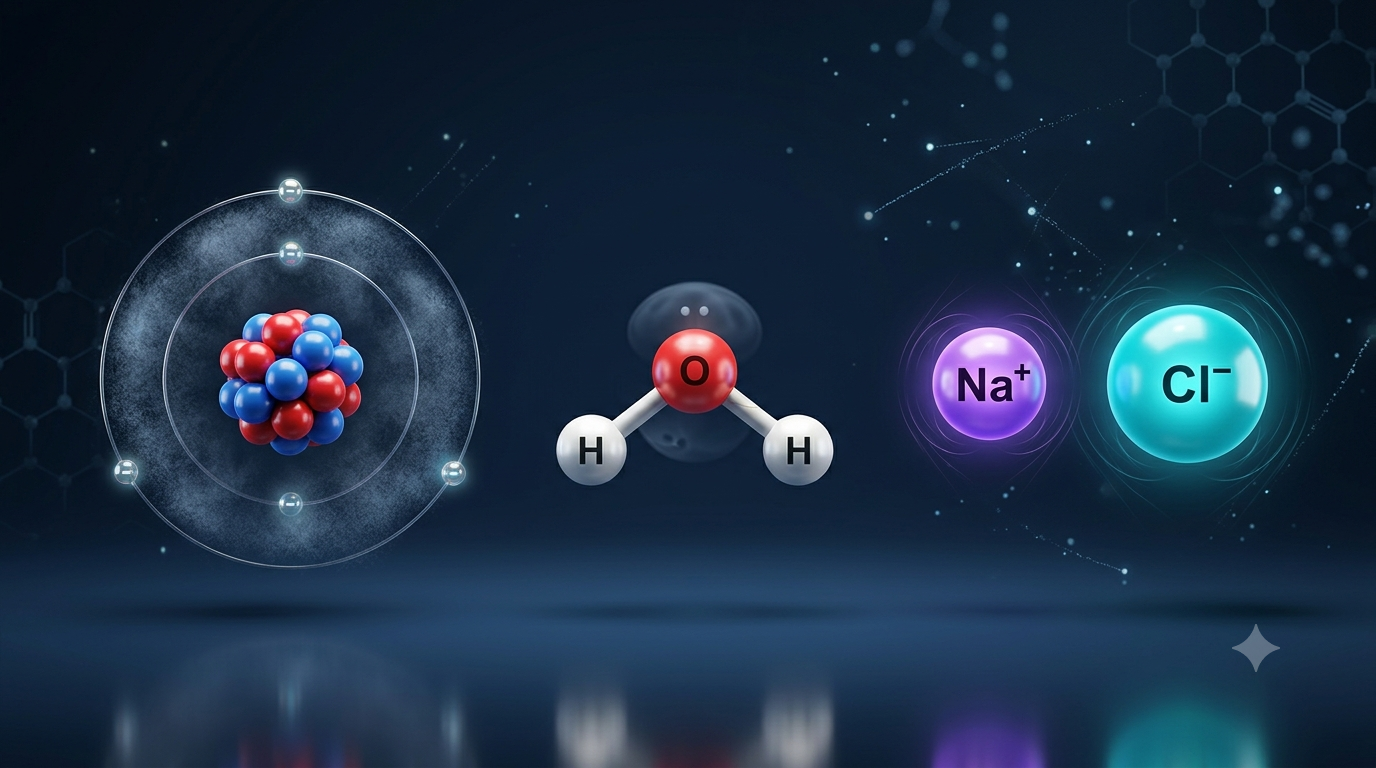
For example, sodium forms the ion Na⁺ and chlorine forms the ion Cl⁻. Their charges balance in a one-to-one ratio, so the formula is:
NaCl
Magnesium forms Mg²⁺, while chlorine forms Cl⁻. Two chloride ions are needed to balance the charge of one magnesium ion.
Therefore:
MgCl₂
The symbols Mg and Cl identify the elements, while the subscript ₂ shows that two chlorine atoms are associated with one magnesium atom in the formula unit.
Another example is calcium chloride:
Ca²⁺ and Cl⁻
The balanced formula is:
CaCl₂
The correct formula therefore depends not only on identifying the elements but also on using the correct ratio of their atoms or ions.
Writing Formulas for Covalent Compounds
Element symbols are also used to represent covalent compounds, in which atoms share electrons.
For example, hydrogen and oxygen can form water:
H₂O
Carbon and oxygen form carbon dioxide:
CO₂
Nitrogen and hydrogen form ammonia:
NH₃
Carbon and hydrogen form methane:
CH₄
In these formulas, the subscripts indicate how many atoms of each element are present in a molecule.
The chemical formula therefore provides information about the composition of the molecule without requiring a detailed drawing of its structure.
The Difference Between Coefficients and Subscripts
It is important to distinguish between a subscript and a coefficient.
A subscript tells us how many atoms of an element are present within one molecule or formula unit.
For example:
2H₂O
The subscript ₂ tells us that one water molecule contains two hydrogen atoms.
The coefficient 2 tells us that there are two water molecules.
Therefore, 2H₂O contains:
4 hydrogen atoms
2 oxygen atoms
This difference becomes especially important when writing and balancing chemical equations.
For example:
2H₂ + O₂ → 2H₂O
The coefficients indicate the number of molecules or formula units, while the subscripts are part of the chemical formulas themselves.
Why Subscripts Must Not Be Changed Randomly
Changing a subscript changes the chemical formula and can change the identity of the substance.
For example:
H₂O
represents water.
If the subscript of hydrogen is changed, the formula becomes a different chemical expression. Therefore, subscripts are not numbers that can be changed simply to make an equation balance.
When balancing a chemical equation, coefficients are changed rather than subscripts.
For example:
2H₂ + O₂ → 2H₂O
The formula H₂O remains unchanged. Only the coefficient is adjusted.
This distinction is one of the most important rules when working with chemical formulas and equations.
Element Symbols in Polyatomic Ions and Compounds
Some compounds contain groups of atoms that behave together as a unit. These groups are called polyatomic ions.
Examples include:
Hydroxide = OH⁻
Nitrate = NO₃⁻
Sulfate = SO₄²⁻
Carbonate = CO₃²⁻
Ammonium = NH₄⁺
Element symbols are used within these groups to show their composition.
For example:
NaOH
contains:
Na = sodium
O = oxygen
H = hydrogen
Calcium carbonate is:
CaCO₃
It contains calcium, carbon, and oxygen.
When more than one polyatomic ion is needed, parentheses may be used.
For example:
Ca(OH)₂
The subscript ₂ outside the parentheses means that there are two hydroxide groups. Therefore, the formula contains one calcium atom, two oxygen atoms, and two hydrogen atoms.
How to Read a Chemical Formula
Reading a chemical formula involves identifying the symbols and interpreting the subscripts.
Consider:
Al₂O₃
The symbols are:
Al = aluminium
O = oxygen
The subscripts tell us:
2 aluminium atoms
3 oxygen atoms
Therefore, the formula represents a substance containing aluminium and oxygen in a 2:3 ratio.
Now consider:
Ca(NO₃)₂
The formula contains:
Ca = calcium
N = nitrogen
O = oxygen
The subscript ₂ outside the parentheses applies to the entire nitrate group.
There is:
1 calcium atom
2 nitrogen atoms
6 oxygen atoms
Understanding how symbols, subscripts, and parentheses work together allows us to determine the composition of more complicated formulas.
Common Mistakes When Using Element Symbols
Several mistakes can occur when writing chemical formulas.
Using Incorrect Capitalization
Element symbols must follow the correct capitalization rules.
Correct:
Na, Mg, Cl, Ca
Incorrect:
NA, mg, cl, ca
Capitalization matters because chemical symbols are standardized.
Forgetting Subscripts
Writing H O instead of H₂O does not communicate the same information. The subscript is necessary to show the correct number of atoms.
Changing Subscripts to Balance Equations
Subscripts should not be changed while balancing a chemical equation. Changing a subscript changes the substance represented by the formula.
Confusing Similar Symbols
Some element symbols can be easy to confuse.
For example:
C = carbon
Ca = calcium
Co = cobalt
Cl = chlorine
Careful attention to capitalization and the second letter is essential.
A Simple Method for Writing Chemical Formulas
A useful approach is to follow these steps:
Identify the elements present in the substance.
Find the correct chemical symbol for each element.
Determine how many atoms or ions of each element are required.
Write the element symbols in the appropriate order.
Add subscripts when more than one atom of an element is required.
Check that the formula represents the correct ratio or charge balance.
Make sure capitalization is correct.
For an ionic compound, charge balance is especially important.
For example, consider aluminium oxide.
Aluminium forms Al³⁺ and oxygen forms O²⁻. The smallest combination that balances the charges contains two aluminium ions and three oxide ions.
Therefore:
Al₂O₃
The formula contains two aluminium atoms and three oxygen atoms.
Why Learning Element Symbols Is Important
Learning element symbols is one of the first steps toward understanding chemistry. Once the symbols are familiar, chemical formulas become much easier to read and write.
Element symbols are used in:
Chemical formulas
Chemical equations
Periodic table discussions
Laboratory work
Chemical calculations
Stoichiometry
Molecular descriptions
Scientific research
They also provide a foundation for understanding concepts such as atomic mass, molar mass, valency, ionic charge, molecular structure, and chemical reactions.
A learner who recognizes common element symbols can quickly understand the basic composition of many substances.
Conclusion
Element symbols provide the basic language used to write chemical formulas. Each symbol identifies a particular element, while subscripts show the number of atoms of that element represented in a molecule or formula unit. By combining symbols according to the correct rules, chemists can represent substances in a short and universally understood form.
Formulas such as H₂O, CO₂, NaCl, MgCl₂, and CaCO₃ demonstrate how a few symbols and numbers can communicate detailed information about the composition of matter. Understanding capitalization, subscripts, coefficients, parentheses, and charge balance makes it easier to write and interpret chemical formulas correctly.
Learning element symbols may seem like a small part of chemistry, but it provides an essential foundation for understanding chemical compounds, reactions, equations, and calculations. Once these symbols become familiar, reading the language of chemistry becomes much more straightforward.
FAQs
1. What is an element symbol in chemistry?
An element symbol is a short abbreviation used to represent a chemical element. It usually contains one or two letters. The first letter is always capitalized, while the second letter, if present, is lowercase. For example, H represents hydrogen, O represents oxygen, C represents carbon, and Na represents sodium. Element symbols are used throughout chemistry to make it easier to identify elements without writing their complete names. They are also combined to create chemical formulas. For example, H₂O uses H for hydrogen and O for oxygen. Learning common element symbols helps make chemical formulas easier to read and understand.
2. How are element symbols used in chemical formulas?
Element symbols are combined to show which elements are present in a substance. For example, water is represented by H₂O, where H represents hydrogen and O represents oxygen. The symbols identify the elements, while the numbers show how many atoms are present. In CO₂, C represents carbon and O represents oxygen, while the subscript ₂ indicates two oxygen atoms. Chemical formulas therefore provide information about the composition of substances in a short form. By learning element symbols and understanding how they are combined, you can read and write many common chemical formulas more easily.
3. What does a subscript mean in a chemical formula?
A subscript is a small number written at the lower right of an element symbol in a chemical formula. It tells you how many atoms of that element are represented. For example, H₂O contains two hydrogen atoms and one oxygen atom. In CO₂, the subscript ₂ means there are two oxygen atoms. If no subscript is written, the number of atoms is understood to be one. Subscripts are important because they communicate the ratio of atoms in a compound. Changing a subscript can change the chemical formula and may represent a completely different substance.
4. Why are element symbols written with capital and lowercase letters?
Element symbols follow a standard capitalization system. The first letter is always uppercase, while the second letter, when present, is lowercase. This rule helps distinguish different elements and prevents confusion. For example, Co represents cobalt, while C represents carbon and O represents oxygen. Similarly, Cl represents chlorine, whereas C and L are not the symbol for chlorine. Writing symbols correctly is essential when creating chemical formulas. An incorrect capital or lowercase letter can change the meaning of a formula. Therefore, learners should always check the correct spelling and capitalization of every element symbol.
5. What does H₂O tell us about water?
The formula H₂O provides information about the composition of water. H represents hydrogen, while O represents oxygen. The subscript ₂ applies only to hydrogen, meaning that each water molecule contains two hydrogen atoms. There is no subscript after O, so one oxygen atom is present. Therefore, the ratio of hydrogen atoms to oxygen atoms in water is 2:1. The formula does not simply identify the elements; it also shows how many atoms of each element are present. This makes H₂O a compact way to communicate important information about the composition of water.
6. What is the difference between a coefficient and a subscript?
A coefficient is a number placed before a chemical formula, while a subscript is a small number written after an element symbol. They provide different information. In 2H₂O, the coefficient 2 means there are two water molecules. The subscript ₂ means each water molecule contains two hydrogen atoms. Therefore, 2H₂O contains four hydrogen atoms and two oxygen atoms in total. Coefficients are commonly changed when balancing chemical equations, but subscripts are part of the chemical formula itself. Changing a subscript can change the substance, so it should not be changed simply to balance an equation.
7. How do element symbols help identify compounds?
Element symbols show which elements are present in a compound. For example, NaCl contains Na, which represents sodium, and Cl, which represents chlorine. CaCO₃ contains calcium, carbon, and oxygen. The symbols provide a concise way to identify the elements without writing their complete names. Subscripts provide additional information about the number of atoms of each element. By reading the symbols and subscripts together, we can determine the basic composition of a compound. This makes chemical formulas an efficient and widely understood method for representing substances in chemistry.
8. How are element symbols used to write ionic compound formulas?
Element symbols are used to identify the ions that make up ionic compounds. The charges of the ions must be balanced when writing the formula. For example, sodium forms Na⁺ and chlorine forms Cl⁻. Their charges balance in a one-to-one ratio, giving NaCl. Magnesium forms Mg²⁺, while chloride is Cl⁻. Two chloride ions are therefore needed for each magnesium ion, producing MgCl₂. The symbols identify the elements, while the subscripts show the required ratio. Understanding element symbols, ionic charges, and charge balance helps you write correct formulas for many ionic compounds.
9. Why should chemical formula subscripts not be changed when balancing equations?
Subscripts are part of a chemical formula and describe the composition of a particular substance. Changing a subscript changes the ratio of atoms and can produce a different chemical substance. When balancing a chemical equation, coefficients are changed instead. For example, the equation 2H₂ + O₂ → 2H₂O is balanced by changing the coefficients, while the formulas H₂ and H₂O remain unchanged. This preserves the identity of the substances involved. Understanding this distinction is essential because changing subscripts during balancing can result in an incorrect chemical equation.
10. Why is learning element symbols important in chemistry?
Learning element symbols is important because they form the basic language used to represent elements and compounds. Symbols are used in chemical formulas, equations, laboratory work, calculations, and scientific communication. Once common symbols such as H, O, C, Na, Cl, Mg, Ca, and N become familiar, it becomes easier to understand formulas and chemical reactions. Element symbols also provide a foundation for learning topics such as valency, ionic charges, molecular formulas, molar mass, and stoichiometry. Becoming comfortable with symbols allows learners to read chemical formulas quickly and understand what substances are made of.
Related Posts
What is the difference between molecular and empirical formulas?
Chemical formulas give us a compact way to describe the composition of substances. Instead of writing the names and numbers […]
Read MoreHow can beginners memorize important chemical formulas without confusion?
Learning chemical formulas can feel confusing when you are just starting chemistry. There may be many formulas to remember, different […]
Read MoreCommon Formulas of Important Organic Compounds
Organic chemistry is the study of carbon-containing compounds and the way their atoms are arranged, bonded, and transformed during chemical […]
Read MoreHow to Find the Elemental Composition of a Compound
Every chemical compound is made from two or more elements combined in definite proportions. Knowing which elements are present and […]
Read MoreWhy Is Displacement Different From Distance?
When we describe the motion of an object, we often want to know how far it has moved. Two important […]
Read MoreWhat Is Force in Physics?
Force is one of the most important ideas in physics. We experience forces every day, even when we do not […]
Read MoreHow to Check Dimensions in a Physics Formula
Physics formulas connect different physical quantities through mathematical relationships. Before using a formula in a calculation, it is useful to […]
Read MoreSubscripts vs Coefficients in Chemical Formulas
Chemical formulas may look like simple combinations of letters and numbers, but every symbol and number has a specific meaning. […]
Read MoreWhat Is Work in Physics?
In everyday life, the word “work” usually means doing something that requires effort. We may say that carrying a heavy […]
Read MoreWhat information can be obtained from a chemical formula?
A chemical formula is a short and powerful way of representing a substance. It uses chemical symbols and numbers to […]
Read MoreWhat Are Derived Units in Physics?
Physics uses measurements to describe everything from the motion of a car to the energy produced by a power plant. […]
Read MoreHow to Determine the Formula of a Compound From Its Name
Knowing the name of a chemical compound is often enough to determine its chemical formula if you understand the rules […]
Read MoreChemical Symbols and Their Role in Chemistry Formulas
Chemistry is often described as the science of matter, but understanding chemistry also means learning how scientists communicate information about […]
Read MoreWhat Is Acceleration in Physics?
Acceleration is one of the most important concepts in physics because it describes how the velocity of an object changes […]
Read MoreSI Unit of Luminous Intensity Candela Explained
Luminous intensity is an important physical quantity used to describe how strongly a light source emits visible light in a […]
Read MoreHow Do Physicists Know Whether a Formula Is Correct?
A formula can look simple on paper, but how do physicists know that it actually describes nature? After all, anyone […]
Read MoreHow to Avoid Sign Errors in Physics Calculations

Physics calculations are not only about choosing the correct formula and putting numbers into it. The signs of physical quantities […]
Read MoreChemical Formula vs Chemical Equation
Chemistry uses symbols, numbers, and formulas to describe substances and chemical changes. Two important ways of representing chemical information are […]
Read MoreCommon Formulas of Acids in Chemistry
Acids are among the most important substances studied in chemistry. They are found in laboratories, foods, medicines, industrial materials, and […]
Read MoreHow Chemical Formulas Represent Substances
Chemical formulas are one of the simplest ways scientists communicate information about matter. A substance may contain millions or billions […]
Read MoreHow to Convert Units Before Using a Physics Formula
Physics formulas help us describe motion, force, energy, pressure, electricity, heat, and many other physical phenomena. However, knowing the correct […]
Read MoreHow to Choose the Right Physics Formula
Physics problems often look difficult because they contain many quantities, symbols, and formulas. However, the biggest challenge is not always […]
Read MoreCommon Mistakes When Using Physics Formulas
Physics formulas help us describe motion, forces, energy, electricity, heat, waves, and many other phenomena using mathematical relationships. A formula […]
Read MoreWork, Energy and Power: Understanding Their Relationship
Work, energy, and power are three closely connected concepts in physics that help us understand how objects move, how forces […]
Read MoreWhy is a subscript different from a coefficient?

When learning chemical formulas, two small numbers can appear next to chemical symbols and look surprisingly similar. One is called […]
Read MoreHow to Avoid Unit Conversion Mistakes in Physics
Unit conversion is one of the most common sources of mistakes in physics. A formula may be correct, the calculation […]
Read MoreWhat Is Dimensional Consistency in Physics?
Physics uses mathematical equations to describe how different physical quantities are related. When scientists write an equation, every quantity in […]
Read MoreHow are chemical formulas used in stoichiometric calculations?
Chemical formulas are one of the most important tools used in chemistry. They tell us which elements are present in […]
Read MoreWhat Is a Chemical Formula in Chemistry?
Chemistry is the study of substances, their properties, and the changes they undergo. To describe these substances clearly, chemists need […]
Read MoreHow to Read and Interpret a Physics Formula
Physics formulas are more than mathematical expressions written in textbooks. They are compact ways of describing how physical quantities are […]
Read More