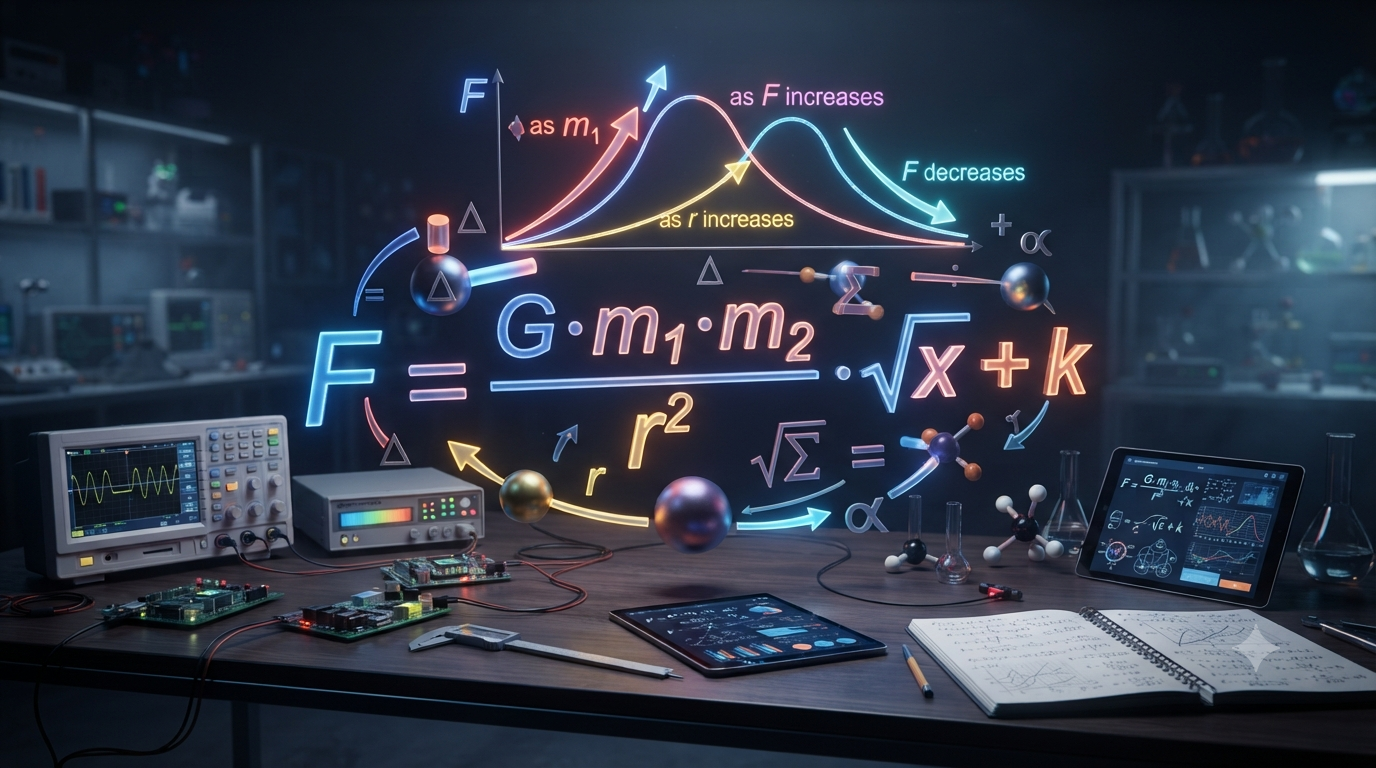
A formula is a mathematical relationship that shows how different quantities are connected. In science and mathematics, formulas help us understand what happens when one quantity changes. If you increase or decrease one variable, the other quantities in the formula may also change, depending on the relationship between them.
For example, consider the formula for speed:
v = s/t
Here, speed depends on distance and time. If the distance increases while the time remains constant, the speed increases. If the time increases while the distance remains constant, the speed decreases. This simple example shows why understanding the effect of changing variables is important.
The effect is not always the same. Some quantities change in the same direction, while others change in the opposite direction. In some formulas, a variable may have a squared, cubed, or higher power, making its effect much stronger. Understanding these relationships allows us to predict changes without calculating every possible value.
What Is a Variable in a Formula?
A variable is a symbol that represents a quantity whose value can change. Variables are usually represented by letters such as x, y, v, t, m, a, or r.
Consider the formula:
A = l × w
where:
A = area
l = length
w = width
Both length and width are variables because their values can change. The area depends on both of them.
If the length changes while the width remains constant, the area changes. Similarly, changing the width affects the area.
A formula therefore does more than provide a calculation. It describes a relationship between quantities.
What Happens When One Variable Changes?
When one variable changes, its effect on another quantity depends on how the variables are connected in the formula.
The first step is to identify which quantities are changing and which quantities are being kept constant.
For example:
y = 3x
If x = 2, then:
y = 3 × 2 = 6
If x = 4, then:
y = 3 × 4 = 12
When x doubles from 2 to 4, y also doubles from 6 to 12.
This happens because y is directly proportional to x in this formula.
However, not every relationship works this way. Consider:
y = 12/x
If x increases from 2 to 4:
y = 12/2 = 6
and
y = 12/4 = 3
Here, doubling x causes y to become half its original value. This is an inverse relationship.
Direct Relationships
A direct relationship occurs when two quantities change in the same direction while other factors remain constant.
A common form is:
y = kx
where k is a constant.
In this relationship:
If x increases, y increases.
If x decreases, y decreases.
If x doubles, y doubles.
If x triples, y triples.
If x is reduced to half, y becomes half.
For example:
d = vt
If velocity remains constant, distance is directly proportional to time.
Suppose a vehicle travels at a constant speed of 20 m/s.
After 5 seconds:
d = 20 × 5 = 100 m
After 10 seconds:
d = 20 × 10 = 200 m
The time has doubled, so the distance has also doubled.
This type of relationship is useful for making predictions. Instead of calculating the entire formula repeatedly, we can determine how a change in one quantity affects another.
Inverse Relationships
An inverse relationship occurs when one quantity increases while another decreases.
A common form is:
y = k/x
Here, the product of x and y remains constant.
For example:
y = 20/x
If x = 2:
y = 10
If x = 4:
y = 5
If x = 10:
y = 2
As x increases, y decreases.
A familiar scientific example is the relationship between speed, distance, and time:
v = s/t
If distance remains constant, increasing the time causes the speed to decrease.
Suppose a person travels 100 km.
In 2 hours:
v = 100/2 = 50 km/h
In 4 hours:
v = 100/4 = 25 km/h
The travel time doubles, while the required average speed becomes half.
The Effect of Squared Variables
Sometimes a variable appears with a power, such as x². In such cases, changing the variable can have a larger effect on the result.
Consider:
A = πr²
This is the formula for the area of a circle.
The radius is squared, so the area does not increase at the same rate as the radius.
If the radius doubles:
r → 2r
then:
A = π(2r)²
A = 4πr²
Therefore, doubling the radius makes the area four times larger.
Similarly:
If the radius triples, the area becomes 9 times larger.
If the radius becomes half, the area becomes one-fourth.
If the radius becomes four times larger, the area becomes 16 times larger.
This is an important example of why the powers of variables in a formula matter.
The Effect of Cubed Variables
A variable can also appear with a power of 3.
For example, the volume of a cube is:
V = a³
where a is the side length.
If the side length doubles:
V = (2a)³
V = 8a³
Therefore, doubling the side length makes the volume eight times larger.
This relationship can be summarized as:
Side ×2 → volume ×8
Side ×3 → volume ×27
Side ×4 → volume ×64
Side ×½ → volume ×⅛
The reason is that the change is raised to the third power.
When Several Variables Are Present
Many formulas contain several variables. In these situations, changing one variable can affect the result while the other variables are kept constant.
Consider Newton’s second law:
F = ma
where:
F = force
m = mass
a = acceleration
If mass remains constant and acceleration doubles, force doubles.
If acceleration remains constant and mass doubles, force also doubles.
But if both mass and acceleration change, their effects combine.
For example, suppose mass doubles and acceleration triples:
F = (2m)(3a)
Therefore:
F = 6ma
The force becomes six times its original value.
This illustrates why it is important to examine each variable separately before considering several changes together.
Variables in the Denominator
A variable in the denominator usually behaves differently from a variable in the numerator.
Consider:
Q = A/B
If A remains constant and B increases, Q decreases.
For example:
Q = 100/B
If B = 5:
Q = 20
If B = 10:
Q = 10
Doubling the denominator reduces the result by half.
This principle appears in many scientific formulas. For example, density is given by:
ρ = m/V
where mass is divided by volume.
If mass remains constant and volume increases, density decreases. If volume decreases, density increases.
Constants Do Not Change
A constant is a quantity that remains fixed in a particular relationship or calculation.
Consider:
C = 2πr
For a given circle, 2π acts as a constant multiplier, while r is the variable.
If the radius doubles, the circumference also doubles.
Constants are important because they determine the scale of the relationship but do not change the direction of the variable relationship.
In:
y = 5x
the number 5 is constant. The value of y changes when x changes, but the factor connecting them remains 5.
A Simple Method for Studying Variable Changes
When you want to understand how changing one variable affects other quantities in a formula, follow a few simple steps.
Step 1: Write the Formula
Start with the complete formula.
For example:
E = mc²
Step 2: Identify the Variable Being Changed
Suppose mass m changes while the speed of light c remains constant.
Step 3: Identify the Power or Position of the Variable
Mass appears to the first power:
m
Therefore, energy changes directly with mass.
Step 4: Keep Other Quantities Constant
Assume c does not change.
Step 5: Determine the New Relationship
If mass doubles:
m → 2m
then:
E → 2E
Therefore, energy doubles.
This method works with many formulas in physics, chemistry, mathematics, and engineering.
Why Keeping Other Variables Constant Matters
It can be difficult to determine the effect of changing one variable if several variables change at the same time.
Consider:
P = F/A
where pressure depends on force and area.
If force increases, pressure increases when area remains constant.
If area increases, pressure decreases when force remains constant.
But if both force and area change, the final effect depends on the relative changes.
For example, if force doubles and area also doubles:
P = 2F/2A
The factors cancel, so pressure remains unchanged.
Therefore, the phrase “all other variables remain constant” is extremely important when studying relationships between variables.
Using Ratios to Predict Changes
Ratios provide a convenient way to understand variable changes.
Suppose:
y = kx²
If x changes from x to 2x, then:
y₂/y₁ = (2x)²/x²
y₂/y₁ = 4
Therefore, y becomes four times larger.
This approach is particularly useful when you want to know the effect of a percentage or multiple change without knowing the actual values of the variables.
For example, if a variable increases by 10% and it appears to the first power, the related quantity may increase by 10% in a direct relationship. If the variable is squared, the effect is stronger and should be calculated using the square of the change factor.
Percentage Changes and Formulas
Changing a variable by a percentage does not always produce the same percentage change in the final quantity.
Consider:
A = πr²
If the radius increases by 10%, the new radius is:
1.1r
The new area becomes:
A₂ = π(1.1r)²
A₂ = 1.21πr²
Therefore, the area becomes 1.21 times the original area, which represents a 21% increase.
This example shows why simply assuming that a 10% change in one variable always causes a 10% change in another quantity can be incorrect.
The structure of the formula determines the actual effect.
Why This Concept Is Important in Science
Understanding variable relationships is essential because scientific formulas describe how real-world quantities behave.
In physics, it helps explain relationships involving force, motion, energy, pressure, electricity, waves, and many other topics.
In chemistry, formulas can describe concentration, gas behavior, reaction rates, and other relationships.
In mathematics, understanding variable dependence helps with algebra, functions, graphs, and equations.
In engineering and technology, these relationships help people predict how changing one design parameter can affect the performance of a system.
Rather than treating formulas as instructions for inserting numbers, it is more useful to understand them as descriptions of relationships.
Common Mistakes When Changing Variables
One common mistake is changing a variable without considering whether it is in the numerator or denominator.
Another mistake is ignoring powers. A squared or cubed variable can produce a much larger change than a variable raised to the first power.
A third mistake is changing several variables at once and assuming that the effect of one variable can still be identified easily.
Another common error is assuming that all variables are directly proportional. Some are inversely proportional, while others have more complicated relationships.
Finally, it is important to distinguish between a variable and a constant. A quantity that is constant in one problem may be variable in another situation.
Conclusion
Changing one variable in a formula can change the other quantities in different ways. The result depends on the mathematical relationship between the variables. A variable in a direct relationship changes in the same direction, while a variable in an inverse relationship changes in the opposite direction. Variables raised to powers such as 2 or 3 can produce much larger changes.
To understand the effect of a change, first identify the variable, examine its position and power in the formula, and keep the other relevant quantities constant. Once these relationships become familiar, formulas become much more than mathematical expressions. They become useful tools for predicting and understanding how quantities behave in the real world.
FAQs
1. What happens when one variable in a formula changes?
When one variable in a formula changes, the value of one or more other quantities may also change. The exact effect depends on the mathematical relationship between the variables. If two quantities are directly related, increasing one generally increases the other, while decreasing one decreases the other. If they are inversely related, increasing one causes the other to decrease. Variables with powers, such as x² or x³, can produce larger changes in the result. To study the effect clearly, change one variable at a time while keeping the other relevant quantities constant.
2. What does it mean to keep other variables constant?
Keeping other variables constant means allowing only one variable to change while all other quantities in the formula remain unchanged. This makes it easier to determine the specific effect of that variable. For example, in the formula F = ma, if you want to study how acceleration affects force, you keep mass constant. If acceleration doubles, force also doubles. Without keeping mass constant, it would be difficult to know whether the change in force was caused by acceleration, mass, or both. This approach is commonly used when studying relationships in mathematics and science.
3. What is a direct relationship between two variables?
A direct relationship occurs when two quantities change in the same direction. If one quantity increases, the other also increases, provided the other relevant variables remain constant. Similarly, if one decreases, the other decreases. A simple example is d = vt. When velocity remains constant, increasing time increases the distance traveled. If the time doubles, the distance also doubles. Direct relationships can often be recognized when a variable appears in the numerator or is multiplied by another quantity. Understanding direct relationships helps you predict how changing one quantity will affect another without performing many separate calculations.
4. What is an inverse relationship between variables?
An inverse relationship occurs when one quantity increases while another decreases, assuming other relevant quantities remain constant. A common mathematical form is y = k/x, where k is constant. For example, the formula v = s/t shows an inverse relationship between speed and time when distance remains fixed. If the travel time doubles, the required speed becomes half as large. Inverse relationships are common in physics and mathematics. They are often recognized when one variable appears in the denominator. Understanding an inverse relationship helps you predict the direction and magnitude of change between connected quantities.
5. How does a squared variable affect another quantity?
A squared variable can cause the result of a formula to change more rapidly. Consider the area of a circle, A = πr². Because radius is squared, doubling the radius does not simply double the area. Instead, the area becomes four times larger. Similarly, tripling the radius makes the area nine times larger. The effect comes from applying the change to the power of 2. Squared relationships appear in many areas of mathematics and science, including geometry, physics, and engineering. Therefore, when analyzing a formula, always check whether the changing variable has a power.
6. What happens when a cubed variable changes?
When a variable is raised to the third power, changes in that variable can have an even larger effect on the result. For example, the volume of a cube is given by V = a³, where a is the side length. If the side length doubles, the new volume is (2a)³, which equals 8a³. Therefore, the volume becomes eight times the original volume. If the side length triples, the volume becomes 27 times larger. Cubed relationships are important when studying volume and other scientific quantities. Recognizing powers in formulas helps you predict changes accurately.
7. Does doubling one variable always double the result?
No. Doubling one variable does not always double the result. The effect depends on how that variable appears in the formula. If the variable has a first power in a direct relationship, doubling it usually doubles the result. However, if the variable is squared, doubling it makes the related quantity four times larger. If it is cubed, the result becomes eight times larger. A variable in the denominator may cause the result to become half as large when the denominator doubles. Therefore, you must examine the complete formula before predicting the effect of a change.
8. How can ratios be used to study changes in formulas?
Ratios provide a simple way to compare the new value of a quantity with its original value. They are especially useful when a variable is multiplied, divided, squared, or cubed. For example, if y = kx² and x doubles, the ratio of the new value to the old value is (2x)²/x² = 4. Therefore, y becomes four times larger. Ratios allow you to understand the effect of a change without always calculating the actual numerical values. This method is useful in mathematics, physics, chemistry, engineering, and many other scientific applications.
9. Why is the position of a variable in a formula important?
The position of a variable tells you how it affects the final quantity. A variable in the numerator generally has a different effect from a variable in the denominator. For example, in ρ = m/V, increasing mass while keeping volume constant increases density. However, increasing volume while keeping mass constant decreases density. Powers also matter. A squared variable produces a different change from a variable raised to the first power. Therefore, when analyzing a formula, examine whether the variable is multiplied, divided, squared, cubed, or involved in another mathematical operation.
10. Why is understanding variable relationships important?
Understanding variable relationships helps you interpret formulas rather than simply substitute numbers into them. It allows you to predict what will happen when a quantity changes. For example, you can determine whether increasing a variable will increase or decrease the result and whether the change will be proportional. This skill is useful in mathematics, physics, chemistry, engineering, and everyday problem-solving. It also makes graphs, equations, and scientific models easier to understand. By identifying direct relationships, inverse relationships, and the effects of powers, you can use formulas more confidently and make meaningful predictions from mathematical relationships.