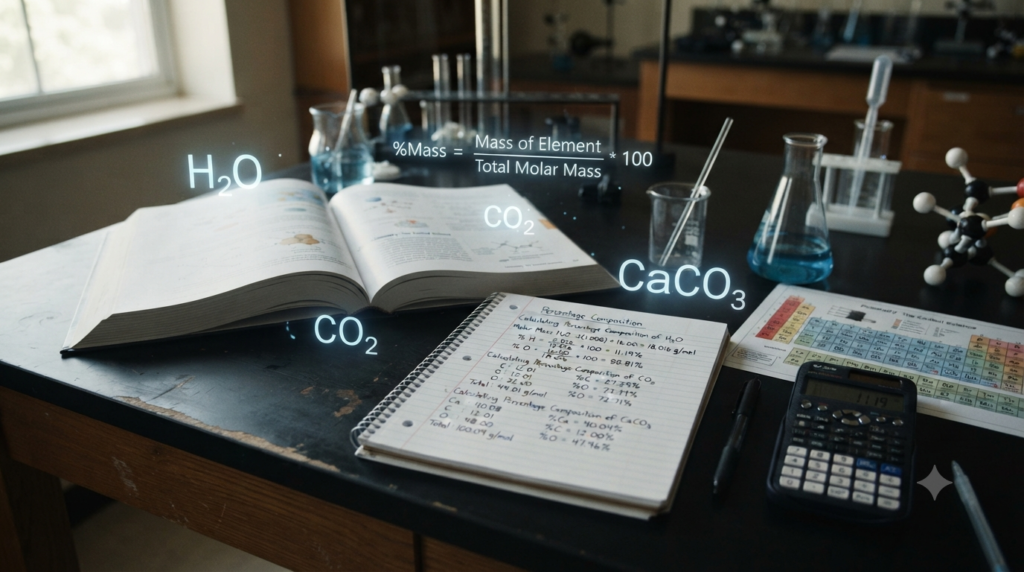
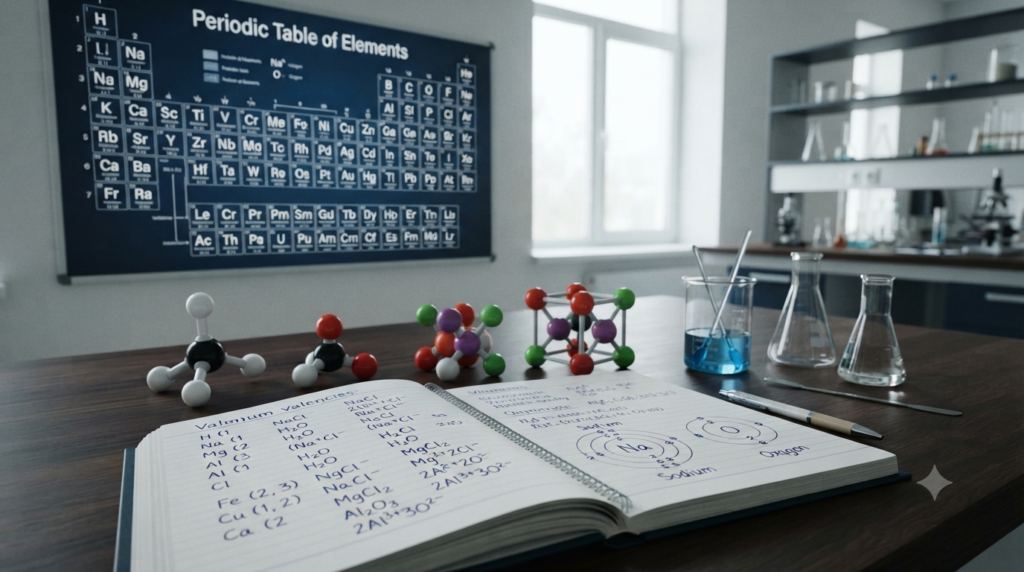
Chemistry is the study of substances, their properties, and the changes they undergo. To describe these substances clearly, chemists need a simple and universal way to represent them. This is where a chemical formula becomes important. A chemical formula uses chemical symbols and numbers to show which elements are present in a substance and, in many cases, how many atoms of each element are involved.
For example, H₂O represents water. It tells us that a water molecule contains hydrogen and oxygen, with two hydrogen atoms for every one oxygen atom. Similarly, CO₂ represents carbon dioxide, which contains one carbon atom and two oxygen atoms. Chemical formulas make it possible to communicate information about substances quickly without writing their full chemical names or descriptions.
What Is a Chemical Formula?
A chemical formula is a symbolic representation of a chemical substance that shows the elements present and their relative numbers or proportions.
A chemical formula is made mainly from chemical symbols and subscripts. Chemical symbols identify the elements, while subscripts indicate how many atoms of an element are represented.
For example:
H₂O
Here, H is the chemical symbol for hydrogen, and O is the chemical symbol for oxygen. The small number ₂ after H means that two hydrogen atoms are present. Since there is no number after O, it represents one oxygen atom.
Therefore:
H₂O = 2 hydrogen atoms + 1 oxygen atom
Chemical formulas are used for elements, compounds, ions, and many other chemical substances.
Why Are Chemical Formulas Important?
Chemical formulas provide a compact way to communicate chemical information. Instead of describing the composition of a substance using several words, chemists can use a short formula.
For example, saying that carbon dioxide contains carbon and oxygen in a ratio of one carbon atom to two oxygen atoms can be represented simply as:
CO₂
Chemical formulas are important because they help us:
Identify the elements present in a substance.
Show the relative number of atoms.
Represent chemical compounds.
Write and balance chemical equations.
Calculate molecular and formula masses.
Understand the composition of substances.
Communicate chemical information internationally.
Because chemical symbols are generally understood worldwide, chemical formulas provide a common language for chemistry.
Parts of a Chemical Formula
A chemical formula can contain several important parts. Understanding these parts makes formulas much easier to read.
Chemical Symbols
Chemical symbols represent individual elements. Most symbols contain one or two letters.
Examples include:
H = Hydrogen
O = Oxygen
C = Carbon
N = Nitrogen
Na = Sodium
Cl = Chlorine
Ca = Calcium
The first letter of an element symbol is always capitalized. If there is a second letter, it is lowercase.
For example, Co represents cobalt, while CO is not the correct symbol for a single element. C represents carbon and O represents oxygen.
Subscripts
A subscript is a small number written at the lower right of a chemical symbol. It tells us how many atoms of that element are represented.
For example:
H₂O
The subscript ₂ applies to hydrogen, so there are two hydrogen atoms. Oxygen has no subscript, which means one oxygen atom is represented.
Consider another example:
CO₂
The formula contains one carbon atom and two oxygen atoms.
If a formula is written as:
N₂O₃
it represents two nitrogen atoms and three oxygen atoms.
Parentheses and Subscripts
Some chemical formulas contain groups of atoms enclosed in parentheses. A subscript outside the parentheses applies to the entire group.
For example:
Ca(OH)₂
The subscript ₂ applies to the entire OH group. Therefore, the formula contains:
1 calcium atom
2 oxygen atoms
2 hydrogen atoms
Parentheses help represent repeating groups of atoms within a compound.
Chemical Formulas of Common Substances
Many familiar substances can be represented using chemical formulas.
| Substance | Chemical Formula |
|---|---|
| Water | H₂O |
| Carbon dioxide | CO₂ |
| Oxygen gas | O₂ |
| Hydrogen gas | H₂ |
| Sodium chloride | NaCl |
| Ammonia | NH₃ |
| Methane | CH₄ |
| Calcium carbonate | CaCO₃ |
These formulas give useful information about the composition of each substance.
For example, CH₄ represents methane. It contains one carbon atom and four hydrogen atoms.
Different Types of Chemical Formulas
Chemical formulas can provide information in different ways. Some formulas show the exact number of atoms in a molecule, while others show the simplest ratio of ions or atoms.
Molecular Formula
A molecular formula shows the actual number of atoms of each element in one molecule of a molecular substance.
For example:
H₂O
shows two hydrogen atoms and one oxygen atom in a water molecule.
Similarly:
C₆H₁₂O₆
represents glucose. One molecule of glucose contains six carbon atoms, twelve hydrogen atoms, and six oxygen atoms.
Empirical Formula
An empirical formula shows the simplest whole-number ratio of the elements in a substance.
For example, glucose has the molecular formula:
C₆H₁₂O₆
Dividing all the subscripts by 6 gives:
CH₂O
Therefore, CH₂O is the empirical formula of glucose.
The molecular formula provides more detailed information than the empirical formula because it gives the actual number of atoms in a molecule.
Formula Units
For ionic compounds, chemists often use the term formula unit rather than molecule. Ionic compounds consist of positively and negatively charged ions arranged in a repeating structure.
For example:
NaCl
represents sodium chloride. It indicates a 1:1 ratio of sodium ions to chloride ions.
Similarly:
CaCl₂
shows a ratio of one calcium ion to two chloride ions.
How to Read a Chemical Formula
Reading a chemical formula becomes easier when you follow a simple process.
Consider:
Al₂(SO₄)₃
First, identify the elements: aluminium, sulfur, and oxygen.
Next, examine the subscripts. The subscript ₂ after Al means there are two aluminium atoms.
The subscript ₃ outside the parentheses means there are three sulfate groups.
Each sulfate group contains one sulfur atom and four oxygen atoms.
Therefore:
Aluminium = 2 atoms
Sulfur = 3 atoms
Oxygen = 12 atoms
The formula therefore gives a detailed picture of the composition of the substance.
Chemical Formula and Chemical Equation
A chemical formula represents a substance, while a chemical equation represents a chemical reaction.
For example, the formula:
H₂O
represents water.
A chemical equation can show water being formed:
2H₂ + O₂ → 2H₂O
In this equation, H₂ represents hydrogen, O₂ represents oxygen, and H₂O represents water.
The numbers placed in front of formulas are called coefficients. They are different from subscripts. A coefficient applies to the entire formula, while a subscript applies to the particular element or group immediately before it.
For example, in 2H₂O, the coefficient 2 means there are two water molecules. Together, they contain four hydrogen atoms and two oxygen atoms.
Chemical Formulas Help Explain Chemical Composition
One of the most useful features of chemical formulas is that they allow us to determine the composition of substances.
Consider calcium carbonate:
CaCO₃
From this formula, we can identify calcium, carbon, and oxygen. The formula shows one calcium atom, one carbon atom, and three oxygen atoms in the formula unit.
Chemical formulas can also help scientists determine relative amounts of elements and calculate chemical quantities. This becomes especially important when studying chemical reactions, laboratory measurements, and the preparation of compounds.
Chemical Formulas Are a Universal Language of Chemistry
Chemistry involves scientists from different countries, languages, and scientific backgrounds. Chemical formulas help overcome language differences by providing a standardized method of representing substances.
Whether a scientist is reading H₂O, CO₂, NaCl, or CH₄, the formula communicates the same basic chemical information regardless of the language used in the surrounding text.
This makes chemical formulas essential in textbooks, research papers, laboratories, medicine, industry, environmental science, and many other fields.
Conclusion
A chemical formula is a concise way of representing the composition of a chemical substance. It uses chemical symbols to identify elements and subscripts to show their relative numbers or proportions. Formulas such as H₂O, CO₂, NaCl, and C₆H₁₂O₆ allow chemists to communicate complex information in a simple form. Understanding chemical formulas is one of the basic skills needed to study chemistry because formulas connect the names of substances with their atomic composition, chemical reactions, and measurable quantities. Once you understand symbols, subscripts, parentheses, and coefficients, reading and interpreting chemical formulas becomes much easier.

FAQs
1. What is a chemical formula in chemistry?
A chemical formula is a short symbolic representation of a chemical substance. It uses chemical symbols to identify the elements present and subscripts to show the number or ratio of atoms. For example, H₂O is the chemical formula for water. It shows that water contains hydrogen and oxygen, with two hydrogen atoms for every one oxygen atom in a molecule. Chemical formulas help chemists communicate information about substances clearly and efficiently. They are used to identify compounds, describe their composition, write chemical equations, calculate relative masses, and understand chemical reactions. Learning to read formulas is an important foundation for studying chemistry.

2. What do chemical symbols in a formula represent?
Chemical symbols in a formula represent the elements that make up a substance. Each element has a unique symbol, usually consisting of one or two letters. For example, H represents hydrogen, O represents oxygen, C represents carbon, and Na represents sodium. In the formula CO₂, C represents carbon and O represents oxygen. The first letter of an element symbol is always capitalized, while a second letter, when present, is lowercase. Chemical symbols allow scientists to represent elements in a universal and concise way. Understanding these symbols is essential for reading chemical formulas, writing compounds, and following chemical equations correctly.
3. What does a subscript mean in a chemical formula?
A subscript is a small number written at the lower right of a chemical symbol or group of symbols. It indicates how many atoms of that element are represented. For example, in H₂O, the subscript ₂ means that two hydrogen atoms are present. Oxygen has no subscript, so one oxygen atom is represented. In CO₂, the subscript ₂ applies to oxygen, giving one carbon atom and two oxygen atoms. Subscripts are important because changing them can change the identity and properties of a substance. Therefore, chemical formulas must be written accurately when describing compounds or chemical reactions.
4. What is the difference between a chemical formula and a chemical equation?
A chemical formula represents a particular substance, while a chemical equation represents a chemical reaction. For example, H₂O is the formula for water. It identifies the composition of water but does not describe a reaction. A chemical equation such as 2H₂ + O₂ → 2H₂O shows hydrogen reacting with oxygen to produce water. The formulas identify the substances involved, while the coefficients indicate their relative amounts in the reaction. Chemical equations also use symbols such as an arrow to show the direction of the reaction. Therefore, formulas are components of chemical equations, but they serve different purposes.
5. What is a molecular formula?
A molecular formula shows the actual number of atoms of each element present in one molecule of a molecular substance. For example, the molecular formula of water is H₂O, meaning one molecule contains two hydrogen atoms and one oxygen atom. Glucose has the molecular formula C₆H₁₂O₆, showing six carbon atoms, twelve hydrogen atoms, and six oxygen atoms in each molecule. Molecular formulas provide more specific information than formulas that only show the simplest ratio of elements. They are useful for understanding molecular composition, calculating molecular mass, and studying how atoms are arranged within chemical substances.
6. What is an empirical formula?
An empirical formula shows the simplest whole-number ratio of the elements in a compound. It does not necessarily show the actual number of atoms in a molecule. For example, glucose has the molecular formula C₆H₁₂O₆. The subscripts can all be divided by 6, giving the empirical formula CH₂O. Therefore, CH₂O represents the simplest ratio of carbon, hydrogen, and oxygen in glucose. Empirical formulas are particularly useful when determining the composition of compounds from experimental data. They can also help calculate molecular formulas when the molar mass of the substance is known.
7. What does a coefficient mean in a chemical formula?
A coefficient is a number placed before a chemical formula in a chemical equation. Unlike a subscript, a coefficient applies to the entire formula. For example, in 2H₂O, the coefficient 2 means there are two units or molecules of water. Each water molecule contains two hydrogen atoms and one oxygen atom, so two water molecules contain four hydrogen atoms and two oxygen atoms. Coefficients are commonly used when balancing chemical equations because they change the number of particles without changing the identity of the substance. Subscripts, in contrast, are part of the chemical formula itself.
8. Why is NaCl written as a chemical formula?
NaCl is the chemical formula for sodium chloride. It contains the symbols Na for sodium and Cl for chlorine. The absence of subscripts indicates a one-to-one ratio of sodium ions to chloride ions. Sodium forms positively charged sodium ions, while chlorine forms negatively charged chloride ions. These oppositely charged ions combine in a repeating ionic structure. Because sodium chloride is an ionic compound, NaCl represents its formula unit rather than a single independent molecule. The formula communicates the simplest ratio of the ions present and provides essential information about the compound’s composition.
9. How can you count atoms in a chemical formula?
To count atoms in a chemical formula, first identify each element and then examine its subscripts. If an element has no subscript, its count is one. For example, H₂O contains two hydrogen atoms and one oxygen atom. If parentheses are present, multiply the subscripts inside the parentheses by the number outside them. For example, Ca(OH)₂ contains one calcium atom, two oxygen atoms, and two hydrogen atoms. When a coefficient is present, multiply the entire formula by that coefficient. Carefully reading subscripts, parentheses, and coefficients allows you to determine the total number of atoms represented.
10. Why are chemical formulas important in chemistry?
Chemical formulas are important because they provide a concise way to communicate the composition of substances. They tell us which elements are present and, depending on the type of formula, the number or simplest ratio of their atoms or ions. Formulas are used throughout chemistry to identify substances, write chemical equations, calculate relative and molecular masses, study reactions, and understand chemical composition. They are also used in medicine, environmental science, materials science, laboratories, and industry. Since chemical symbols are internationally recognized, formulas provide a common scientific language that allows chemists around the world to communicate chemical information accurately.
Related Posts
Percentage to Decimal Converter
Percentage to Decimal Converter Convert any percentage into its decimal form quickly and easily. Enter a percentage below to get […]
Read MoreDecimal to Percentage Converter
Decimal to Percentage Converter Convert any decimal number into a percentage quickly and easily. Enter Decimal Number Percentage Result 0% […]
Read MorePercentage to Fraction Converter
Percentage to Fraction Converter Convert any percentage into a simplified fraction instantly. Enter Percentage (%) % Convert to Fraction Fraction […]
Read MoreFraction to Percentage Converter
Fraction to Percentage Converter Convert any fraction into a percentage quickly and easily. Enter Your Fraction = ? % Convert […]
Read MoreFraction Simplifier
Fraction Simplifier Simplify any fraction to its lowest terms. Numerator Denominator Simplify Swap Reset Simplified Fraction 1 2 Step-by-Step Solution […]
Read MoreDivision Calculator
Division Calculator Divide two numbers and calculate the quotient and remainder instantly. Dividend (First Number) ÷ Divisor (Second Number) Calculate […]
Read MoreMultiplication Calculator
Multiplication Calculator Multiply two numbers instantly using this free online multiplication calculator. First Number × Second Number Calculate Reset Multiplication […]
Read MoreDifference Calculator
Difference Calculator Calculate the absolute difference between two numbers quickly and easily. First Number Second Number Calculate Difference Reset Absolute […]
Read MoreSum Calculator
Sum Calculator Enter two or more numbers to calculate their total sum quickly and easily. Enter Numbers × × + […]
Read MoreMean Median Mode Calculator
Mean Median Mode Calculator Enter a set of numbers to calculate the mean, median, and mode instantly. Enter Your Numbers […]
Read MoreAverage Calculator
Average Calculator Enter your numbers to calculate their average. Enter Numbers 2 numbers 1 × 2 × + Add Number […]
Read MoreProportion Calculator
Proportion Calculator Calculate missing values in direct and inverse proportions quickly and easily. Select Proportion Type Direct Proportion Inverse Proportion […]
Read MoreRatio Calculator
Ratio Calculator Simplify ratios, calculate equivalent ratios, find missing values, and divide amounts using ratios. Simplify Ratio Equivalent Ratio Missing […]
Read MoreDecimal Calculator
Decimal Calculator Ready 0 AC DEL % ÷ 7 8 9 × 4 5 6 − 1 2 3 + […]
Read MoreMathematical Expression Evaluator
Mathematical Expression Evaluator Enter a mathematical expression to calculate its value instantly. Enter Expression Use * for multiplication, / for […]
Read MoreMathematical Expression Simplifier
Mathematical Expression Simplifier Enter a mathematical or algebraic expression to simplify it step by step. Enter your expression Use * […]
Read MoreEquation Result Checker
Equation Result Checker Check whether both sides of a mathematical equation have equal values. Left-hand side (LHS) = Right-hand side […]
Read MoreTrigonometric Identity Checker
Trigonometric Identity Checker Check trigonometric equations, compare both sides, and explore their graphs visually. Select an identity Pythagorean IdentityTangent Quotient […]
Read More