Mathematical formulas are used to express relationships between different quantities in a simple and precise way. However, a formula is not always written in the form needed to solve a particular problem. Sometimes the value we need is located in the middle of a formula, while another quantity is already isolated. In such situations, we need to rearrange or transpose the formula before substituting numerical values.
Mathematical formula rearrangement and transposition involve changing the form of an equation without changing its mathematical meaning. The goal is usually to make a particular variable the subject of the formula. This skill is important in mathematics, physics, chemistry, engineering, and many other scientific fields. Once the basic rules are understood, even complicated formulas can be rearranged systematically.
What Is Mathematical Formula Rearrangement?
Mathematical formula rearrangement is the process of changing the arrangement of an equation so that a different variable or expression becomes isolated.
For example, consider the formula:
a = b + c
If we want to make b the subject, we can rearrange the formula:
b = a − c
The relationship between the quantities has not changed. Only the form of the equation has changed.
Similarly, if:
v = u + at
and we want to find t, we can rearrange it as:
t = (v − u) / a
This is formula rearrangement.
The main purpose is to place the unknown quantity in a form that can be calculated directly.
What Does Transposition Mean in Mathematics?
Transposition is a common term used for moving a term from one side of an equation to the other side by applying the appropriate mathematical operation.
For example:
x + 5 = 12
To isolate x, subtract 5 from both sides:
x = 12 − 5
Therefore:
x = 7
The term +5 appears to move to the other side and become −5. This is often called transposition.
However, it is important to understand that a term does not physically “move” across the equals sign. Instead, the same operation is performed on both sides of the equation. This preserves equality.
Why Is Formula Rearrangement Important?
Formula rearrangement is useful because the same mathematical relationship can be used to find different quantities.
For example, the formula for the area of a rectangle is:
A = l × w
If the area and length are known, we can find the width by rearranging the formula:
w = A / l
If the area and width are known, we can find the length:
l = A / w
The original formula contains the complete relationship, while rearranged versions allow us to calculate different quantities.
Formula rearrangement is especially important when working with formulas in physics. For example:
F = ma
can be rearranged to find mass:
m = F / a
or acceleration:
a = F / m
Therefore, understanding rearrangement allows one formula to solve several types of problems.
The Basic Principle of Transposition
The fundamental principle behind formula rearrangement is the equality principle.
If two expressions are equal, performing the same valid operation on both sides keeps them equal.
For example:
x + 4 = 10
Subtract 4 from both sides:
x + 4 − 4 = 10 − 4
Therefore:
x = 6
Likewise, if:
3x = 15
divide both sides by 3:
3x / 3 = 15 / 3
Therefore:
x = 5
This principle should always be kept in mind when rearranging formulas.
Inverse Operations Used in Formula Rearrangement
Most formula rearrangement depends on using inverse operations.
An inverse operation reverses the effect of another operation.
| Operation | Inverse operation |
|---|---|
| Addition | Subtraction |
| Subtraction | Addition |
| Multiplication | Division |
| Division | Multiplication |
| Squaring | Square root |
| Square root | Squaring |
| Cubing | Cube root |
| Cube root | Cubing |
For example, addition can be undone by subtraction.
x + 8 = 20
Subtract 8:
x = 20 − 8
Similarly, multiplication can be undone by division.
5x = 35
Divide by 5:
x = 35 / 5
Understanding inverse operations makes formula rearrangement much easier.
How to Rearrange a Formula Step by Step
A reliable way to rearrange a formula is to follow a sequence of steps.
Step 1: Identify the Variable You Need
First, determine which variable should become the subject.
For example:
v = u + at
Suppose we need to find a.
The target variable is therefore a.
Step 2: Look at the Operations Around the Variable
In:
v = u + at
the variable a is multiplied by t, and the product at is added to u.
We need to undo these operations in the reverse order.
Step 3: Remove Addition or Subtraction First
Subtract u from both sides:
v − u = at
Now the term containing a is isolated.
Step 4: Remove Multiplication or Division
Since a is multiplied by t, divide both sides by t:
a = (v − u) / t
The required variable is now the subject.
Step 5: Check the Rearranged Formula
Substitute the rearranged expression back into the original equation if necessary.
This helps confirm that no operation was missed.
Simple Examples of Transposition
Consider:
x + y = z
To make x the subject, subtract y from both sides:
x = z − y
To make y the subject:
y = z − x
Now consider:
x − y = z
To make x the subject:
x = z + y
To make y the subject:
y = x − z
The signs change because inverse operations are being applied.
Rearranging Formulas Involving Multiplication
Suppose:
A = bc
If we want b as the subject, divide both sides by c:
b = A / c
If we want c as the subject:
c = A / b
Another example is:
P = IV
where P represents power, I represents current, and V represents voltage.
To find current:
I = P / V
To find voltage:
V = P / I
The same relationship can therefore be used in different forms.
Rearranging Formulas Involving Division
Consider:
v = d / t
where v is speed, d is distance, and t is time.
To make d the subject, multiply both sides by t:
vt = d
Therefore:
d = vt
To make t the subject, divide d by v:
t = d / v
This is a useful example because it shows that division can be removed by multiplication.
Rearranging Formulas With Brackets
Some formulas contain brackets, making rearrangement slightly more involved.
Consider:
A = x(b + c)
Suppose we want to find x.
Divide both sides by (b + c):
x = A / (b + c)
Now consider:
A = 2(x + y)
To find x, first divide both sides by 2:
A / 2 = x + y
Then subtract y:
x = A / 2 − y
The order of operations matters. It is generally easier to remove the outer operation first and then work inward.
Rearranging Formulas With Powers
Formula rearrangement may also involve powers.
For example:
A = x²
To make x the subject, take the square root of both sides:
x = √A
Strictly speaking, when solving over the real numbers:
x = ±√A
because both a positive and negative number can have the same square.
For example:
x² = 25
gives:
x = ±5
In a particular scientific formula, the physical meaning of the variable may restrict which value is appropriate.
Consider another formula:
V = r³
Taking the cube root gives:
r = ∛V
The same idea applies to higher powers.
Rearranging Formulas With Fractions
Fractions can make formulas look more complicated than they actually are.
Consider:
y = (x + a) / b
To find x, multiply both sides by b:
by = x + a
Then subtract a:
x = by − a
Another example is:
p = q / (r + s)
To find q, multiply both sides by (r + s):
q = p(r + s)
To find r, first multiply:
p(r + s) = q
Then divide:
r + s = q / p
Finally:
r = q / p − s
Working one operation at a time reduces mistakes.
Formula Rearrangement in Physics
Formula rearrangement is an essential skill in physics because many physical relationships contain several variables.
For example, the equation for density is:
ρ = m / V
To find mass:
m = ρV
To find volume:
V = m / ρ
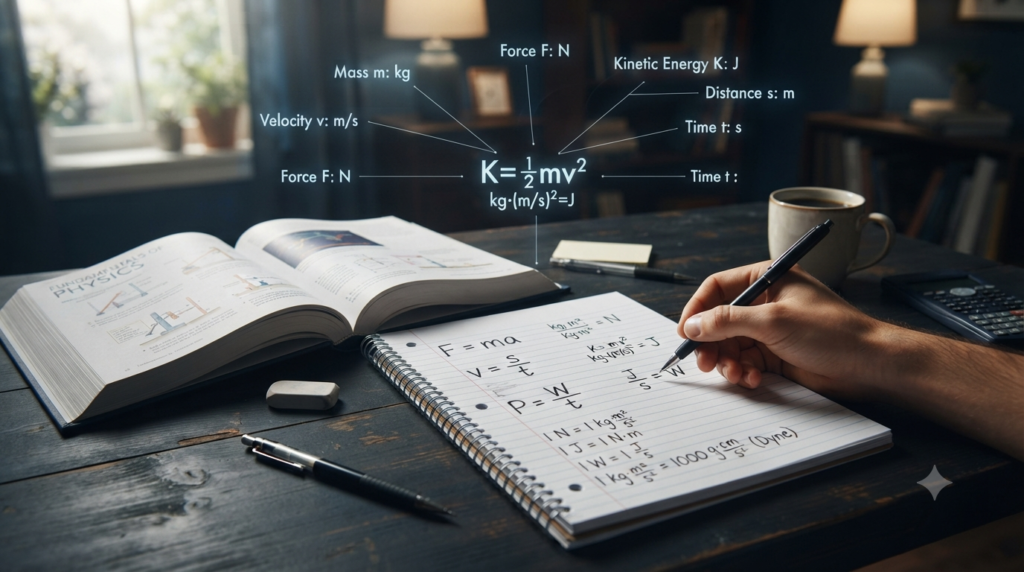
Similarly, the equation for kinetic energy is:
KE = ½mv²
To make m the subject, multiply both sides by 2:
2KE = mv²
Then divide by v²:
m = 2KE / v²
To make v the subject:
2KE = mv²
Divide by m:
2KE / m = v²
Take the square root:
v = √(2KE / m)
These rearrangements allow different unknown quantities to be calculated from the same physical relationship.
Common Mistakes in Formula Transposition
Several common mistakes can occur when rearranging formulas.
Changing a Sign Without Applying an Operation
A common shortcut is to say that a term “moves across the equals sign and changes its sign.” This can be useful as a memory aid, but it can become confusing in complicated equations.
For example:
x + 7 = 15
The correct reasoning is to subtract 7 from both sides, giving:
x = 15 − 7
Understanding the operation is safer than simply memorizing sign changes.
Dividing Only Part of an Expression
Consider:
y = 2(x + 3)
To isolate the bracket, divide the entire right-hand side by 2:
y / 2 = x + 3
It would be incorrect to divide only x by 2.
Ignoring Brackets
Suppose:
A = x(b + c)
The correct rearrangement is:
x = A / (b + c)
Writing x = A/b + c changes the meaning of the formula.
Rearranging and Substituting Too Early
It is often better to rearrange the formula symbolically before inserting numbers.
For example, if:
v = u + at
and acceleration is required, first derive:
a = (v − u) / t
Then substitute the known values.
This makes the calculation clearer and reduces the chance of mixing up the variables.
How to Check a Rearranged Formula
A rearranged formula can be checked by substituting it back into the original equation.
Suppose:
A = lw
and we rearrange it for l:
l = A / w
Substitute this into the original formula:
A = (A / w)w
Therefore:
A = A
The relationship is preserved.
Another useful check is to consider the units or dimensions when working with scientific formulas. A rearranged physics equation should still produce the correct units for the target quantity.
A Useful Strategy for Difficult Formulas
For complicated formulas, avoid trying to rearrange everything mentally in one step.
Instead:
Identify the required variable.
Write the original formula clearly.
Identify the operation closest to the target variable.
Apply the inverse operation to both sides.
Simplify one step at a time.
Keep brackets where necessary.
Continue until the target variable is isolated.
Check the result by substitution or dimensional analysis.
This approach works for simple algebraic equations as well as many scientific formulas.
Rearrangement Versus Solving an Equation
Formula rearrangement and solving an equation are closely related, but they are not exactly the same.
When rearranging a formula, the objective is usually to make one particular variable the subject while keeping other variables as symbols.
For example:
s = ut + ½at²
Rearranging for a gives:
a = 2(s − ut) / t²
When solving an equation numerically, specific values may be given and the objective is to determine the numerical value of the unknown.
For example:
3x + 4 = 19
Solving gives:
x = 5
Therefore, formula rearrangement is mainly about changing the algebraic form, while equation solving may involve finding a specific numerical or symbolic solution.
Importance of Practising Formula Rearrangement
Formula rearrangement becomes easier with practice. The most useful practice is not simply memorizing formulas but understanding the operations that connect the variables.
Start with simple formulas such as:
a = b + c
Then practise formulas involving multiplication and division:
A = lw
After that, move to formulas containing brackets, powers, fractions, and multiple operations.
As your skills improve, you can practise scientific formulas from physics, chemistry, mathematics, and engineering.
The key is to work carefully rather than quickly. Most errors occur because a step is skipped, a bracket is ignored, or an operation is applied to only part of an expression.
Conclusion
Mathematical formula rearrangement and transposition are fundamental algebraic skills used to change the form of a formula while preserving its meaning. The main objective is usually to make a particular variable the subject so that it can be calculated directly.
The process is based on the equality principle and inverse operations. Addition is reversed by subtraction, multiplication by division, and powers by appropriate roots. More complicated formulas can be handled by applying these operations one step at a time.
Once you understand why each step works, formula rearrangement becomes much more than a collection of sign-changing rules. It becomes a logical process that can be applied to mathematical and scientific formulas with confidence.
FAQs
1. What is mathematical formula rearrangement?
Mathematical formula rearrangement is the process of changing the form of a formula so that a different variable becomes the subject. The relationship between the quantities remains unchanged. For example, in the formula A = lw, if we want to find the width, we can rearrange it as w = A/l. Rearrangement is based on applying the same mathematical operation to both sides of an equation. It is widely used in mathematics, physics, chemistry, engineering, and other scientific subjects. Learning this skill makes it easier to use formulas when the required unknown is not already isolated.
2. What is transposition in mathematics?
Transposition is the process of moving a term from one side of an equation to the other by applying the appropriate inverse operation. For example, consider x + 5 = 12. Subtracting 5 from both sides gives x = 12 − 5, so x becomes the subject. Transposition is often described as moving a term across the equals sign and changing its sign, but this is only a convenient shortcut. The actual mathematical process involves performing the same operation on both sides. Understanding this principle is important because it helps prevent mistakes when working with more complicated equations.
3. Why is formula rearrangement important?
Formula rearrangement is important because one formula can be used to calculate different quantities. For example, the formula v = d/t can be rearranged to find distance as d = vt or time as t = d/v. Without rearranging the formula, it may be difficult to calculate a variable that is not already isolated. This skill is particularly useful in physics and other sciences, where formulas commonly contain several variables. Formula rearrangement also strengthens algebraic thinking because it requires an understanding of inverse operations, equality, brackets, powers, fractions, and the relationship between different quantities.
4. What are inverse operations in formula rearrangement?
Inverse operations are mathematical operations that reverse the effect of another operation. They are essential when rearranging formulas. Addition is reversed by subtraction, subtraction by addition, multiplication by division, and division by multiplication. Similarly, squaring can be reversed by taking a square root. For example, if x + 8 = 15, subtracting 8 gives x = 7. If 4x = 20, dividing by 4 gives x = 5. When rearranging a formula, inverse operations are applied to both sides of the equation. Using them systematically helps isolate the required variable without changing the mathematical relationship.
5. How do you rearrange a formula step by step?
To rearrange a formula, first identify the variable you want to make the subject. Next, examine the mathematical operations surrounding that variable. Apply inverse operations to both sides of the equation, usually working from the outside toward the variable. For example, in v = u + at, to find a, first subtract u from both sides: v − u = at. Then divide both sides by t: a = (v − u)/t. Finally, check the result if necessary by substituting it back into the original formula. Working one step at a time makes complicated rearrangements easier to manage.
6. How do you rearrange a formula containing multiplication?
When the required variable is multiplied by another quantity, division can be used to isolate it. For example, consider the formula A = bc. If b is required, divide both sides by c to obtain b = A/c. If c is required, divide both sides by b to obtain c = A/b. The important point is that the division must apply to both sides of the equation. Another example is F = ma. To find mass, divide both sides by acceleration, giving m = F/a. Understanding multiplication and its inverse, division, is fundamental to formula rearrangement.
7. How do you rearrange formulas containing fractions?
Formulas containing fractions can usually be rearranged by applying multiplication or division to both sides. For example, consider v = d/t. To find d, multiply both sides by t, giving d = vt. To find t, multiply by t first to get vt = d, then divide by v to obtain t = d/v. When a fraction contains a bracketed expression, the entire denominator must be considered. For example, y = (x + a)/b can be rearranged to by = x + a, followed by x = by − a. Keeping brackets clear helps avoid incorrect results.
8. How do you rearrange a formula with powers?
A formula containing a power can be rearranged by using the corresponding root. For example, if A = x², taking the square root of both sides gives x = ±√A when working with real numbers. Similarly, if V = r³, taking the cube root gives r = ∛V. When rearranging scientific formulas, the appropriate mathematical meaning of the variable should also be considered. For example, a physical length normally cannot be negative, so only the positive root may be relevant. Powers should be handled carefully, especially when other operations are present in the same formula.
9. What are common mistakes when rearranging formulas?
Common mistakes include changing signs without understanding the operation, applying an operation to only part of an expression, ignoring brackets, and rearranging several steps mentally instead of writing them down. For example, from A = x(b + c), the correct rearrangement is x = A/(b + c). Writing x = A/b + c changes the original relationship. Another common mistake is forgetting that the same operation must be applied to both sides of an equation. To reduce errors, identify the target variable, work through one inverse operation at a time, keep brackets visible, and check the final formula.
10. How can you check whether a rearranged formula is correct?
A rearranged formula can be checked by substituting it back into the original equation. For example, if A = lw is rearranged to l = A/w, substitute this expression for l into the original formula: A = (A/w)w, which simplifies to A = A. This confirms that the rearrangement is consistent. In physics and other sciences, dimensional analysis can also provide a useful check. The units on both sides should remain consistent, and the rearranged formula should produce the expected units for the target variable. Checking your work is especially valuable when formulas contain fractions, brackets, or powers.