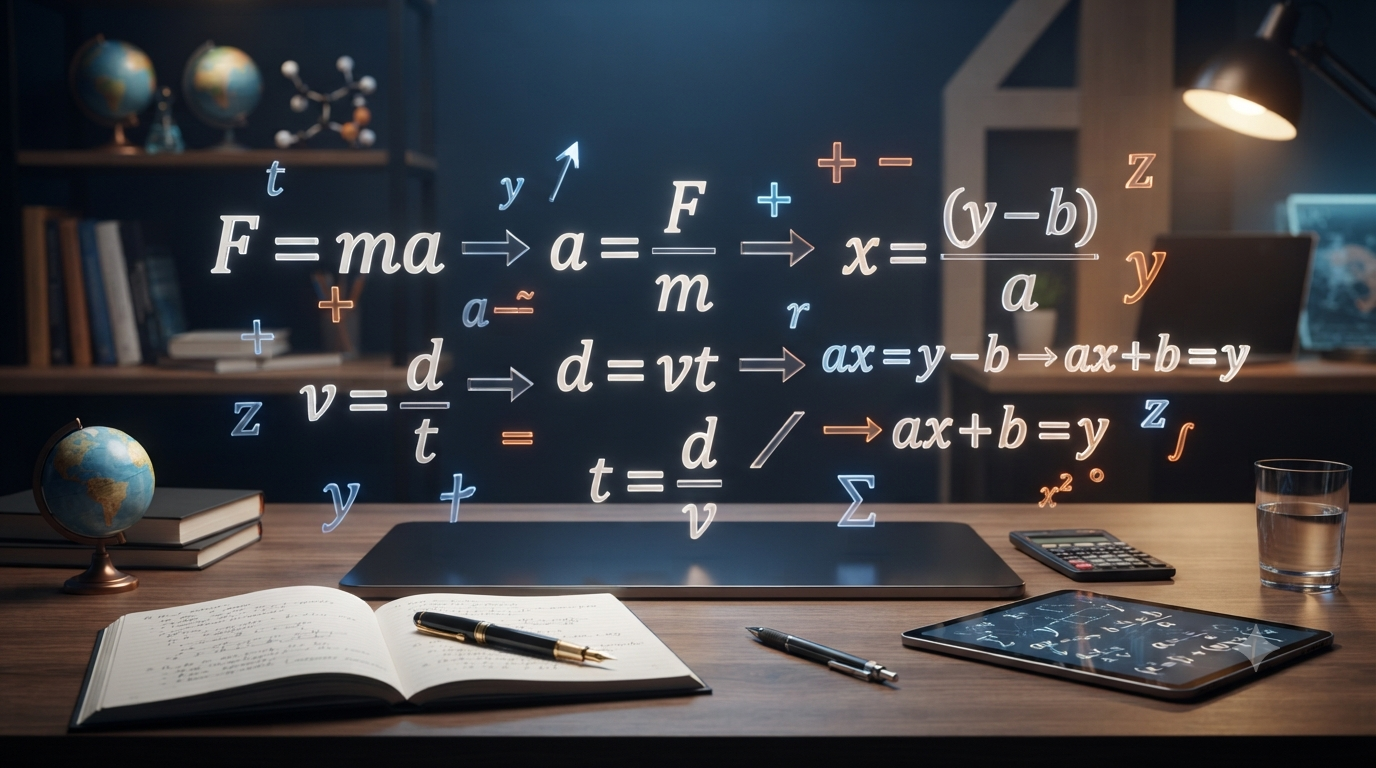
A formula is a compact way of showing a mathematical relationship between quantities. It tells us how one quantity depends on one or more other quantities. Sometimes, the information we need is not already isolated in the formula, so we need to rearrange the formula to make a different variable the subject. This is common in mathematics, physics, chemistry, engineering, and many other areas of science.
Rearranging a formula does not mean changing the relationship between the quantities. Instead, it means using valid mathematical operations to write the same relationship in a different form. The key is to perform equivalent operations correctly on both sides of an equation. Once this principle is understood, even complicated formulas can be rearranged systematically and confidently.
What Does It Mean to Rearrange a Formula?
Consider the formula:
v = d ÷ t
This formula relates velocity, distance, and time.
Suppose we want to find distance instead of velocity. We can rearrange the formula to get:
d = v × t
The formula looks different, but it represents exactly the same relationship.
Similarly, if we want to find time:
t = d ÷ v
All three forms describe the same relationship:
v = d ÷ t
d = v × t
t = d ÷ v
Rearranging a formula means changing its form so that a particular variable is isolated on one side of the equation.
Why Can a Formula Be Rearranged?
A formula is usually written in a form that is convenient for one particular calculation. However, different situations may require different quantities to be calculated.
For example, the formula for the area of a rectangle is:
A = l × w
Here:
A represents area.
l represents length.
w represents width.
If the area and length are known but the width is unknown, the original form is not the most convenient one. We can rearrange it:
w = A ÷ l
If the area and width are known, we can instead use:
l = A ÷ w
The relationship has not changed. Only the subject of the formula has changed.
The Basic Principle of Rearranging a Formula
The most important rule is:
Whatever mathematical operation you perform on one side of an equation, you must perform the same operation on the other side.
This keeps the equation balanced.
For example:
x + 5 = 12
To isolate x, subtract 5 from both sides:
x + 5 − 5 = 12 − 5
Therefore:
x = 7
The same principle applies to formulas, even when they contain several variables.
An equation can be thought of as a balanced relationship. If the same valid operation is applied to both sides, the balance is preserved.
Using Inverse Operations
Rearranging formulas becomes much easier when you understand inverse operations. An inverse operation reverses the effect of another operation.
Some common pairs are:
Addition ↔ Subtraction
Multiplication ↔ Division
Squaring ↔ Square root
Cubing ↔ Cube root
For example, if a variable has 8 added to it:
x + 8 = 15
we subtract 8 to remove it:
x = 15 − 8
If a variable is multiplied by 6:
6x = 30
we divide both sides by 6:
x = 30 ÷ 6
These same ideas are used when rearranging scientific formulas.
Example: Rearranging a Simple Formula
Consider:
F = m × a
This is the formula for force, where:
F is force.
m is mass.
a is acceleration.
Suppose we want to make mass the subject.
The variable m is multiplied by a:
F = m × a
To remove multiplication by a, divide both sides by a:
F ÷ a = (m × a) ÷ a
The a cancels:
m = F ÷ a
Therefore:
m = F/a
If we want acceleration instead:
a = F ÷ m
So the same relationship can be written as:
F = m × a
m = F ÷ a
a = F ÷ m
These equations are equivalent, provided the relevant quantities are defined and the divisions are valid.
Rearranging a Formula with Addition
Consider the formula:
y = x + b
Suppose we want to make x the subject.
The variable b is added to x. The inverse operation of addition is subtraction.
Subtract b from both sides:
y − b = x + b − b
Therefore:
x = y − b
The original and rearranged forms represent the same relationship:
y = x + b
and
x = y − b
The important point is that we did not simply move b to the other side without explanation. We subtracted b from both sides.
Rearranging a Formula with Subtraction
Consider:
P = Q − R
Suppose we want to make R the subject.
We can add R to both sides:
P + R = Q − R + R
Therefore:
P + R = Q
Now subtract P from both sides:
R = Q − P
So:
R = Q − P
is an equivalent form of:
P = Q − R
This example shows why it is useful to work step by step rather than trying to rearrange everything mentally.
Rearranging a Formula with Division
Consider:
p = q ÷ r
Suppose we want to make q the subject.
The variable q is divided by r. The inverse operation is multiplication.
Multiply both sides by r:
p × r = (q ÷ r) × r
The r cancels:
q = p × r
Therefore:
q = pr
Now suppose we want to make r the subject.
Starting with:
p = q ÷ r
Multiply both sides by r:
p × r = q
Then divide both sides by p:
r = q ÷ p
Thus:
r = q/p
Rearranging a Formula with Several Operations
Some formulas require more than one step.
Consider:
y = mx + c
Suppose we want to make x the subject.
First, remove c by subtracting it from both sides:
y − c = mx + c − c
So:
y − c = mx
Now x is multiplied by m. Divide both sides by m:
(y − c) ÷ m = (mx) ÷ m
Therefore:
x = (y − c) ÷ m
or:
x = (y − c)/m
The order matters. We first remove the addition of c, then remove the multiplication by m.
Why Brackets Are Important
Brackets become especially important when rearranging formulas.
For example:
y = ax + b
After subtracting b:
y − b = ax
Dividing by a gives:
x = (y − b)/a
The brackets show that the entire quantity y − b is divided by a.
Without brackets, an expression such as:
y − b/a
would normally mean something different because division is performed before subtraction.
Therefore, using brackets correctly helps preserve the intended mathematical relationship.
Rearranging Formulas Involving Squares
Some formulas contain powers.
Consider:
A = πr²
Suppose we want to find r.
First, divide both sides by π:
A ÷ π = r²
Now take the square root of both sides:
r = √(A ÷ π)
Therefore:
r = √(A/π)
This rearrangement uses two inverse operations:
Division by π is reversed by multiplication by π, or equivalently we divide the equation by π to isolate r².
Squaring is reversed by taking the square root.
When working with square roots, the physical or mathematical context may determine which value is appropriate. For a radius, for example, the positive value is normally used.
Rearranging Formulas with Fractions
Consider:
1/f = 1/u + 1/v
This type of formula requires more care because the unknown may appear inside a fraction.
Suppose we want to make v the subject.
Start with:
1/f = 1/u + 1/v
Subtract 1/u from both sides:
1/f − 1/u = 1/v
Combine the left side:
(u − f)/(fu) = 1/v
Now take the reciprocal of both sides:
v = fu/(u − f)
The exact steps can vary depending on the formula, but the central principle remains the same: use valid operations that preserve equality.
Rearranging Does Not Change the Relationship
A common misunderstanding is that changing a formula changes what it means. It does not, provided the rearrangement is mathematically valid.
For example:
d = vt
and
v = d/t
describe the same relationship between distance, velocity, and time.
If the values are:
v = 10 m/s
and
t = 5 s
then:
d = 10 × 5
d = 50 m
Using the rearranged formula:
v = d/t
we get:
10 = 50/5
which is also true.
The numerical example confirms that both forms describe the same relationship.
The Difference Between Rearranging and Changing a Formula
Rearranging a formula means producing an equivalent form of the original equation.
For example:
F = ma
can be rearranged to:
m = F/a
This is rearrangement.
However, changing:
F = ma
to:
F = m + a
is not rearrangement. It changes the mathematical relationship and is therefore incorrect.
A valid rearrangement must preserve equality.
A Reliable Step-by-Step Method
When rearranging a formula, use the following method.
Step 1: Identify the Variable You Want
Decide which quantity should become the subject.
For example:
P = 2l + 2w
If you need length, identify l as the target variable.
Step 2: Look at What Is Attached to the Variable
Determine whether the variable is:
Added to another quantity
Subtracted from another quantity
Multiplied by another quantity
Divided by another quantity
Raised to a power
Inside a root or fraction
Step 3: Reverse the Operations
Use inverse operations to remove the quantities surrounding the variable.
Step 4: Perform the Same Operation on Both Sides
Never change only one side of an equation.
Step 5: Simplify
Cancel common factors, combine terms, or simplify fractions where appropriate.
Step 6: Check the Result
Substitute simple values into both the original and rearranged formulas. If both produce the same result, the rearrangement is likely correct.
Checking a Rearranged Formula
Checking is one of the best ways to catch mistakes.
Suppose:
F = ma
and we rearrange it as:
a = F/m
Choose:
m = 5 kg
and:
a = 4 m/s²
The original formula gives:
F = 5 × 4
F = 20 N
Now use the rearranged formula:
a = F/m
a = 20/5
a = 4 m/s²
Both forms give consistent results.
This type of substitution is especially useful when working with complicated formulas.
Common Mistakes When Rearranging Formulas
Moving a Term Without Changing Its Operation
Students sometimes say that a term “moves to the other side” and automatically changes its sign or operation. While this shortcut can work in simple cases, it can lead to mistakes.
It is better to think in terms of performing the same operation on both sides.
Forgetting to Apply an Operation to the Whole Side
For example, if:
y = 3x + 6
subtracting 6 gives:
y − 6 = 3x
not:
y = 3x − 6
The operation must be applied correctly to the equation.
Ignoring Brackets
Writing:
x = y − b/a
when the intended result is:
x = (y − b)/a
can completely change the meaning.
Changing Only One Side
An equation remains true only when equivalent operations are applied appropriately to both sides.
Not Checking the Result
A rearrangement can look reasonable while still containing an algebraic mistake. Substitution provides a simple way to verify it.
Why Rearranging Formulas Is Important in Science
Formula rearrangement is not just an algebra skill. It is an important part of scientific problem-solving.
In physics, you may need to rearrange formulas for:
Speed
Acceleration
Force
Work
Power
Pressure
Density
Energy
Electrical quantities
For example, density is commonly written as:
ρ = m/V
From this relationship, we can find mass:
m = ρV
or volume:
V = m/ρ
In chemistry, formulas can be rearranged when working with concentration, density, gas relationships, and other quantitative relationships.
In mathematics, rearranging equations helps solve for unknown variables and understand how different quantities are connected.
Rearranging Formulas Is About Preserving Meaning
The main purpose of rearranging a formula is not simply to make it look different. It is to put the relationship into a form that is useful for a particular problem.
Suppose a formula tells us:
Quantity A = Quantity B × Quantity C
If we know A and B but need C, the original form may not be convenient. Rearranging gives:
Quantity C = Quantity A ÷ Quantity B
The underlying relationship remains unchanged.
This is why equivalent forms are so useful. A single relationship can be expressed in several ways depending on which quantity is known and which quantity needs to be found.
Conclusion
A formula can be rearranged without changing the relationship it represents because algebraic rearrangement uses equivalent mathematical operations. When the same valid operation is applied to both sides of an equation, the equality is preserved.
The most useful strategy is to identify the variable you want, work backward through the operations surrounding it, and use inverse operations step by step. Addition is reversed by subtraction, multiplication by division, and powers by roots. Brackets should be used carefully, especially when a whole expression is being divided or multiplied.
Once you understand that rearranging a formula means rewriting the same relationship in an equivalent form, formulas become much easier to work with. The appearance of the equation may change, but its mathematical meaning remains the same.
FAQs
1. What does it mean to rearrange a formula?
Rearranging a formula means changing its mathematical form so that a different variable becomes the subject while keeping the original relationship unchanged. For example, the formula v = d/t can be rearranged to d = vt or t = d/v. Each form represents the same relationship between velocity, distance, and time. Rearranging is done by using valid mathematical operations, such as addition, subtraction, multiplication, and division. The key rule is that operations must preserve equality. Formula rearrangement is widely used in mathematics, physics, chemistry, and engineering when a different quantity needs to be calculated from known information.
2. Why can a formula be rearranged without changing its meaning?
A formula can be rearranged without changing its meaning because algebraic operations can produce equivalent equations. When the same valid operation is applied to both sides of an equation, the equality remains true. For example, F = ma can be rearranged to m = F/a by dividing both sides by a. Although the formulas look different, they describe exactly the same relationship between force, mass, and acceleration. The rearranged version simply places a different variable in isolation. Therefore, rearranging changes the way a relationship is written, not the relationship itself.
3. What is the most important rule when rearranging a formula?
The most important rule is to maintain equality throughout the rearrangement. In practical terms, any mathematical operation performed on one side of an equation must also be applied appropriately to the other side. For example, if x + 5 = 12, subtracting 5 from both sides gives x = 7. The same principle applies to more complicated formulas. You should avoid thinking of terms as simply “moving” from one side to another. Instead, use inverse operations to remove terms from around the variable you want. This approach makes rearrangement systematic and reduces the chance of algebraic mistakes.
4. What are inverse operations in formula rearrangement?
Inverse operations are mathematical operations that undo the effects of other operations. They are essential when rearranging formulas because they allow you to isolate the desired variable. Addition is reversed by subtraction, subtraction by addition, multiplication by division, and division by multiplication. Squaring can be reversed by taking a square root. For example, in F = ma, the variable m is multiplied by a. Dividing both sides by a isolates m, giving m = F/a. Using inverse operations step by step helps preserve equality while removing the operations surrounding the variable.
5. How do you rearrange a formula to make a different variable the subject?
First, identify the variable you want to make the subject. Then examine the operations connected to that variable and reverse them one at a time using inverse operations. For example, consider y = mx + c and suppose you want x as the subject. First subtract c from both sides: y − c = mx. Then divide both sides by m: x = (y − c)/m. The important thing is to work systematically rather than changing several parts at once. Always simplify the result and, when possible, substitute values to check that the rearranged formula works.
6. Why are brackets important when rearranging formulas?
Brackets are important because they show which terms belong together and which part of an expression is being multiplied or divided. For example, if y = ax + b, rearranging gives x = (y − b)/a. The brackets show that the entire expression y − b is divided by a. Writing x = y − b/a would generally mean something different because division has priority over subtraction. Correct use of brackets therefore helps preserve the intended mathematical relationship. Whenever an entire group of terms is being divided, multiplied, squared, or otherwise operated on, brackets can make the meaning clear.
7. Can every formula be rearranged?
Many formulas can be rearranged algebraically, but the exact process depends on their mathematical structure. Simple formulas involving addition, subtraction, multiplication, and division are usually straightforward to rearrange. Formulas involving powers, roots, fractions, logarithms, or variables appearing in several places may require more advanced algebra. There may also be restrictions, such as a denominator not being allowed to equal zero. A rearranged formula must remain mathematically equivalent under the conditions where the original relationship is defined. Therefore, before rearranging a complicated formula, it is important to understand the operations and restrictions involved.
8. How can you check whether a rearranged formula is correct?
One effective method is to choose suitable values and substitute them into both the original and rearranged formulas. For example, start with F = ma and use m = 5 kg and a = 4 m/s². The original formula gives F = 20 N. If the rearranged formula is a = F/m, substituting F = 20 N and m = 5 kg gives a = 4 m/s². Since both forms produce consistent results, the rearrangement is confirmed for those values. Checking with substitution is a simple way to identify many algebraic errors.
9. What is the difference between rearranging and changing a formula?
Rearranging a formula means producing an equivalent mathematical form that represents the same relationship. Changing a formula means altering its mathematical relationship, which may make it incorrect. For example, F = ma can be rearranged to m = F/a because both equations express the same relationship. However, changing it to F = m + a does not preserve the original relationship. A valid rearrangement uses mathematical operations that maintain equality. The purpose is to isolate a different variable or make the formula more useful for a particular calculation without changing the underlying mathematical or scientific relationship.
10. Why is formula rearrangement important in science?
Formula rearrangement is important because scientific problems do not always provide the quantity needed in the form required by the original formula. For example, the force formula F = ma is useful when force is required, but if acceleration is unknown, it can be rearranged to a = F/m. Similarly, density ρ = m/V can be rearranged to find mass or volume. Scientists, engineers, and students regularly rearrange formulas to solve for unknown quantities. Understanding this skill makes scientific calculations more flexible and helps you focus on the relationship between quantities rather than memorizing many separate formulas.