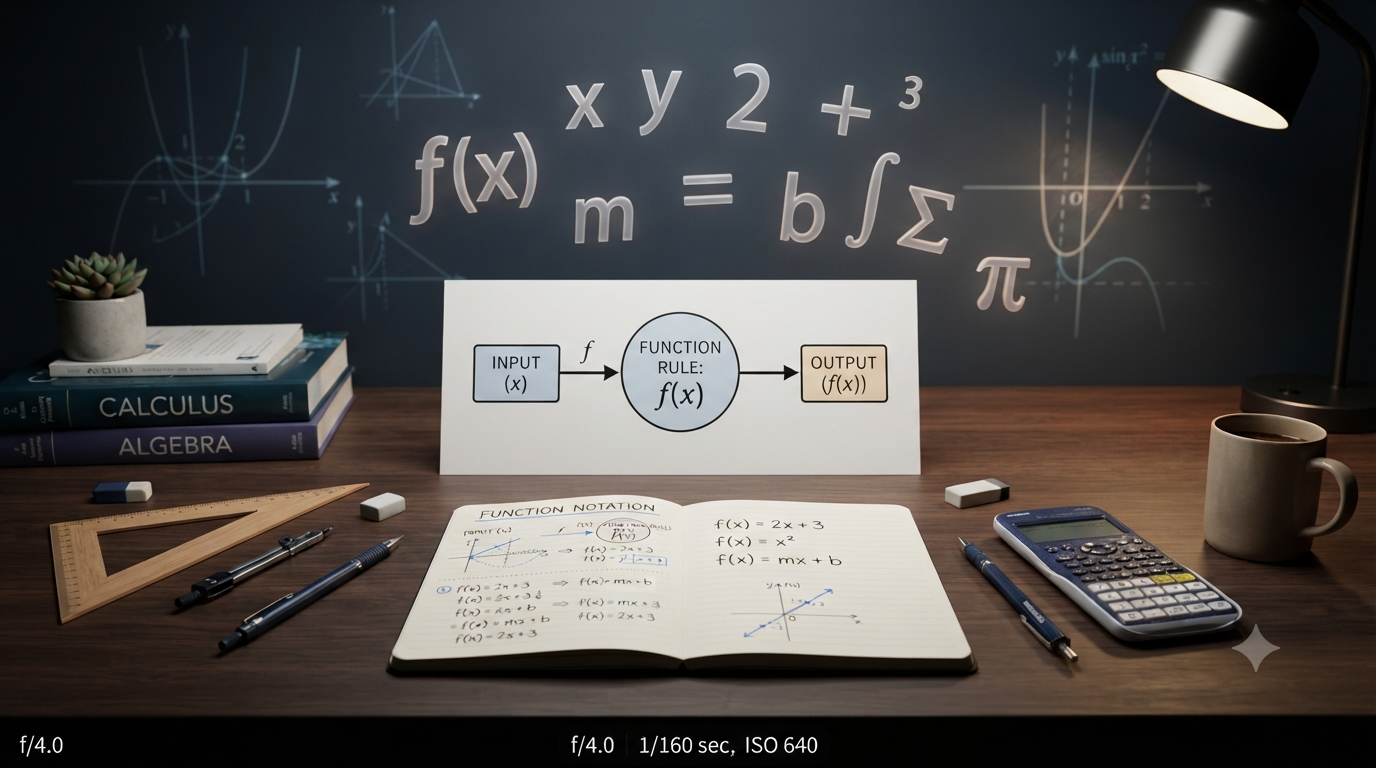
Functions are an important part of mathematics because they help us describe relationships between different quantities. Whenever one quantity depends on another, a function can often be used to represent that relationship. Functions are used throughout algebra, geometry, calculus, statistics, physics, computer science, economics, and many other fields.
A function can be understood as a rule that takes an input and produces exactly one output. For example, imagine a mathematical rule that multiplies a number by 2 and then adds 3. If the input is 4, the output will be 11. This relationship can be written using function notation as [f(x)=2x+3].
Function notation makes mathematical relationships easier to write, read, evaluate, and combine. In addition to understanding notation, it is important to know how to substitute values into functions, identify the domain and range, and work with common function formulas. This article explains function notation and basic function formulas in a simple and systematic way.
What Is a Function?
A function is a relationship between two sets of values in which each input is associated with exactly one output.
The input is commonly represented by [x], while the output is represented by [f(x)]. The function itself provides a rule that determines the output from the input.
For example, consider the function [f(x)=2x+3].
This means that the function takes a value of [x], multiplies it by 2, and then adds 3.
If the input is [x=4], then:
[f(4)=2(4)+3]
[f(4)=8+3]
[f(4)=11]
Therefore, when the input is 4, the output is 11.
A function can be represented in several ways, including an equation, table, graph, mapping diagram, or verbal description. These different forms can describe the same mathematical relationship.
Understanding Function Notation
Function notation is a special way of writing a function and its output.
The most common form is [f(x)], which is read as “f of x.”
For example:
[f(x)=3x+5]
Here, [f] is the name of the function, [x] represents the input, and [f(x)] represents the output produced by the function.
The expression [3x+5] is the rule used to calculate the output.
It is important to understand that [f(x)] does not mean that [f] is multiplied by [x]. Instead, it means the value of function [f] when the input is [x].
A function can have different names. For example:
[g(x)=x^2+4]
[h(x)=5x-2]
[p(x)=x^3]
The letter used to name the function does not change the basic idea.
How to Evaluate a Function
Evaluating a function means finding its output for a particular input.
Suppose the function is:
[f(x)=4x-7]
To find [f(3)], replace every occurrence of [x] with 3.
[f(3)=4(3)-7]
[f(3)=12-7]
[f(3)=5]
Therefore, [f(3)=5].
The same method can be used for positive numbers, negative numbers, fractions, and decimals.
For example, suppose:
[f(x)=x^2+2x+1]
To find [f(-2)], substitute -2 for [x]:
[f(-2)=(-2)^2+2(-2)+1]
[f(-2)=4-4+1]
[f(-2)=1]
Therefore, [f(-2)=1].
When substituting negative values, parentheses should be used to avoid mistakes.
Input and Output of a Function
The value placed into a function is called the input. The value obtained after applying the function rule is called the output.
For example, consider:
[f(x)=3x+1]
If the input is 2:
[f(2)=3(2)+1]
[f(2)=7]
Here, 2 is the input and 7 is the output.
The relationship can be shown as:
[Input → Function Rule → Output]
For this example:
[2 → 3x+1 → 7]
Thinking of a function as an input-output machine is a useful way to understand the concept.
Function Formula
A function formula gives the rule that connects an input to an output.
A general function can be written as:
[f(x)=expression]
For example:
[f(x)=2x+3]
[f(x)=x^2-5]
[f(x)=3x^2+2x-1]
[f(x)=1/x]
[f(x)=√x]
Each formula describes a different relationship between the input and output.
The formula allows us to calculate the output for any input that belongs to the function’s domain.
Domain and Range
The domain of a function is the set of values that can be used as inputs.
The range is the set of values that can be produced as outputs.
For example, consider the function:
[f(x)=x+4]
If all real numbers are allowed as inputs, then the domain consists of all real numbers. The range is also all real numbers because every real input produces a real output.
Some functions, however, have restrictions.
Consider:
[f(x)=1/x]
The value [x=0] cannot be used because division by zero is undefined. Therefore, zero is excluded from the domain.
Now consider:
[f(x)=√x]
When working with real numbers, the expression under the square root cannot be negative. Therefore, the domain is [x≥0].
Understanding domain restrictions is an important part of working with function formulas.
Linear Function Formula
A linear function is one of the simplest and most commonly used types of functions.
Its general form is:
[f(x)=mx+b]
Here, [m] represents the slope and [b] represents the y-intercept.
For example:
[f(x)=3x+4]
In this function, the slope is 3 and the y-intercept is 4.
If [x=2]:
[f(2)=3(2)+4]
[f(2)=10]
Linear functions are useful for describing relationships that change at a constant rate. For example, a fixed hourly payment, a constant travel rate, or a quantity increasing by the same amount at regular intervals can often be represented using a linear function.
Quadratic Function Formula
A quadratic function contains a squared variable and generally has the form:
[f(x)=ax^2+bx+c]
where [a], [b], and [c] are constants, and [a≠0].
For example:
[f(x)=2x^2+3x-1]
is a quadratic function.
To evaluate it at [x=2]:
[f(2)=2(2)^2+3(2)-1]
[f(2)=8+6-1]
[f(2)=13]
The graph of a quadratic function is called a parabola. Quadratic functions are important in algebra, geometry, physics, and many real-world mathematical models.
Constant Function
A constant function produces the same output for every input.
Its general form is:
[f(x)=c]
where [c] is a constant.
For example:
[f(x)=7]
Regardless of the input:
[f(1)=7]
[f(5)=7]
[f(-10)=7]
The output is always 7.
The graph of a constant function is a horizontal line.
Identity Function
An identity function returns the same value that was given as the input.
Its formula is:
[f(x)=x]
For example:
[f(3)=3]
[f(-5)=-5]
[f(0)=0]
The identity function is particularly useful in understanding transformations and other types of functions.
Polynomial Function
A polynomial function contains variables raised to non-negative integer powers.
A general polynomial function can be written as:
[f(x)=a_nx^n+a_(n-1)x^(n-1)+…+a_1x+a_0]
For example:
[f(x)=x^3+2x^2-5x+1]
is a polynomial function.
Linear and quadratic functions are also polynomial functions. The highest power of the variable determines the degree of the polynomial.
For example:
[f(x)=4x+1]
is a first-degree polynomial, while:
[f(x)=2x^2+3x+1]
is a second-degree polynomial.
Adding Functions
Two functions can be added together to create a new function.
Suppose:
[f(x)=2x+3]
and:
[g(x)=x-1]
The sum is written as:
[(f+g)(x)=f(x)+g(x)]
Substituting the two functions:
[(f+g)(x)=(2x+3)+(x-1)]
Simplifying:
[(f+g)(x)=3x+2]
Therefore, the sum of the two functions is [3x+2].
Subtracting Functions
Functions can also be subtracted.
The difference is written as:
[(f-g)(x)=f(x)-g(x)]
Using:
[f(x)=2x+3]
and:
[g(x)=x-1]
we get:
[(f-g)(x)=(2x+3)-(x-1)]
Carefully removing the parentheses:
[(f-g)(x)=2x+3-x+1]
Therefore:
[(f-g)(x)=x+4]
Parentheses are particularly important when subtracting functions because the signs of the terms inside the second function must be handled correctly.
Multiplying Functions
The product of two functions is obtained by multiplying their outputs.
The formula is:
[(fg)(x)=f(x)g(x)]
For example, if:
[f(x)=2x+3]
and:
[g(x)=x-1]
then:
[(fg)(x)=(2x+3)(x-1)]
Expanding the expression:
[(fg)(x)=2x^2+x-3]
Thus, the product function is:
[(fg)(x)=2x^2+x-3]
Dividing Functions
The quotient of two functions can be written as:
[(f/g)(x)=f(x)/g(x)]
Using the same functions:
[f(x)=2x+3]
[g(x)=x-1]
we get:
[(f/g)(x)=(2x+3)/(x-1)]
The denominator cannot be zero. Therefore, [x=1] is excluded from the domain of this quotient function.
This is an important example of how combining functions can introduce domain restrictions.
Composition of Functions
Function composition means applying one function to the output of another function.
The notation is:
[(f∘g)(x)=f(g(x))]
This means that [g(x)] is evaluated first, and its result becomes the input of [f].
Suppose:
[f(x)=2x+1]
and:
[g(x)=x+3]
Then:
[(f∘g)(x)=f(g(x))]
Since [g(x)=x+3], substitute it into [f]:
[f(x+3)=2(x+3)+1]
Simplifying:
[f(x+3)=2x+7]
Therefore:
[(f∘g)(x)=2x+7]
The order of composition matters. In general:
[f(g(x))≠g(f(x))]
The two compositions must be calculated separately unless there is a specific reason they produce the same result.
Finding an Unknown Input
Sometimes a function’s output is known, but the input is unknown.
Suppose:
[f(x)=3x+2]
and the output is 14.
We can write:
[3x+2=14]
Subtract 2 from both sides:
[3x=12]
Divide by 3:
[x=4]
Therefore, an input of 4 produces an output of 14.
This type of problem is useful for understanding inverse functions and solving equations involving functions.
Functions and Ordered Pairs
A function can also be represented using ordered pairs.
An ordered pair has the form:
[(x,f(x))]
The first value represents the input, and the second value represents the output.
For example, if:
[f(x)=2x+1]
and [x=3], then:
[f(3)=7]
The corresponding ordered pair is:
[(3,7)]
A collection of ordered pairs can be used to create a table of values or plot a graph.
Functions and Graphs
A function can be represented visually using a graph.
The input values are normally placed on the horizontal x-axis, while the output values are placed on the vertical y-axis.
For example, for:
[f(x)=2x+1]
an input of 3 produces an output of 7, giving the point:
[(3,7)]
By plotting several input-output pairs, we can see the shape and behavior of the function.
One common way to determine whether a graph represents a function is the vertical line test. If a vertical line intersects a graph at more than one point, the graph does not represent a function of x because the same input would have more than one output.
Common Mistakes in Function Notation
Function notation is simple once its meaning is understood, but several mistakes are common.
The first mistake is interpreting [f(x)] as multiplication. It represents the value of function [f] at input [x].
Another common mistake is substituting a negative number incorrectly. For example, if:
[f(x)=x^2]
then:
[f(-3)=(-3)^2=9]
Parentheses make the substitution clear.
A third mistake is confusing [f(2)] with [f(x)+2]. The first expression asks for the function’s output when the input is 2, while the second expression adds 2 to the function expression.
It is also important to use parentheses correctly when adding or subtracting functions.
Why Function Notation Is Important
Function notation gives mathematics a compact and organized language for describing relationships.
Instead of repeatedly writing a long description such as “the output obtained when the input is x,” we can simply write [f(x)].
Function notation also makes it easier to evaluate functions, compare different functions, combine functions, describe transformations, and study graphs.
Functions are used in many practical situations. A function can represent the distance traveled over time, the cost of purchasing items, the growth of a population, the temperature of an object, or the relationship between physical quantities.
The same basic ideas continue into advanced mathematics. Algebraic functions, trigonometric functions, exponential functions, logarithmic functions, derivatives, integrals, and differential equations all rely on a solid understanding of functions.
Conclusion
Function notation is a fundamental concept in mathematics that provides a clear way to describe the relationship between an input and an output. The notation [f(x)] represents the output of a function when [x] is used as the input.
To work effectively with functions, it is important to understand how to evaluate a function, identify its domain and range, and recognize common formulas such as linear, quadratic, constant, identity, and polynomial functions.
Functions can also be added, subtracted, multiplied, divided, and composed to create new mathematical relationships. These operations make functions powerful tools for solving problems and modeling real-world situations.
A strong understanding of function notation and basic function formulas provides an important foundation for further study in algebra, calculus, science, and many other areas where mathematical relationships need to be described and analyzed.
FAQs
1. What is function notation in mathematics?
Function notation is a way of writing a function and showing the relationship between its input and output. The most common notation is [f(x)], which is read as “f of x.” Here, [f] is the name of the function, [x] is the input, and [f(x)] represents the output. For example, if [f(x)=2x+3], then the function rule says to multiply the input by 2 and add 3. To find the output when [x=4], substitute 4 for x: [f(4)=2(4)+3=11]. Function notation makes it easier to evaluate, combine, graph, and study mathematical functions.
2. What does f(x) mean in a function?
[f(x)] means the value or output of a function named [f] when [x] is used as the input. It does not mean that [f] is multiplied by [x]. For example, consider [f(x)=3x+2]. If the input is 5, then [f(5)=3(5)+2=17]. Therefore, the output is 17. The letter [f] is simply the name assigned to the function. Other letters can also be used, such as [g(x)] or [h(x)]. Understanding that [f(x)] represents an output is essential for correctly reading and evaluating functions in algebra and more advanced areas of mathematics.
3. How do you evaluate a function?
To evaluate a function, substitute the given input value for the variable in the function formula and simplify the resulting expression. For example, suppose [f(x)=4x-5]. To find [f(3)], replace [x] with 3: [f(3)=4(3)-5]. Simplifying gives [f(3)=12-5=7]. Therefore, the value of the function at 3 is 7. When the input is negative, use parentheses during substitution. For example, if [f(x)=x^2+1], then [f(-2)=(-2)^2+1=5]. Evaluating functions is one of the most basic and important skills needed when working with function notation.
4. What is the domain of a function?
The domain of a function is the complete set of input values for which the function is defined. Some functions allow every real number as an input, while others have restrictions. For example, the function [f(x)=x+2] can accept every real number, so its domain is all real numbers. However, the function [f(x)=1/x] cannot accept [x=0] because division by zero is undefined. Similarly, for [f(x)=√x], the domain is [x≥0] when working with real numbers because the square root of a negative number is not a real number. Identifying domain restrictions is important when evaluating functions.
5. What is the range of a function?
The range of a function is the set of all possible output values produced by the function for inputs in its domain. For example, consider [f(x)=x+3]. If the domain consists of all real numbers, the range is also all real numbers because every real input produces a real output. In contrast, consider [f(x)=x^2]. For real inputs, the smallest possible output is 0, so the range is [y≥0]. The range therefore depends on both the function formula and its domain. Understanding the range helps describe what output values a function can produce.
6. What is the formula for a linear function?
The general formula for a linear function is [f(x)=mx+b], where [m] represents the slope and [b] represents the y-intercept. The slope describes how much the output changes when the input increases by one unit. The y-intercept is the output when [x=0]. For example, in [f(x)=2x+5], the slope is 2 and the y-intercept is 5. If [x=3], then [f(3)=2(3)+5=11]. Linear functions produce straight-line graphs and are commonly used to represent relationships involving a constant rate of change, such as fixed rates, costs, and simple motion.
7. What is the formula for a quadratic function?
The general formula for a quadratic function is [f(x)=ax^2+bx+c], where [a], [b], and [c] are constants and [a≠0]. The presence of the squared term [x^2] distinguishes a quadratic function from a linear function. For example, [f(x)=2x^2+3x-1] is a quadratic function. To evaluate it at [x=2], substitute 2 into the formula: [f(2)=2(2)^2+3(2)-1=13]. The graph of a quadratic function is a parabola. Quadratic functions are widely used in algebra, geometry, physics, and mathematical models involving quantities that change nonlinearly.
8. What is a constant function?
A constant function is a function that produces the same output for every input in its domain. Its general formula is [f(x)=c], where [c] is a constant. For example, consider [f(x)=6]. No matter which input is selected, the output remains 6. Therefore, [f(2)=6], [f(10)=6], and [f(-4)=6]. The graph of a constant function is a horizontal line because the output does not change as the input changes. Constant functions are among the simplest functions and are useful for understanding how functions behave when there is no change in the output.
9. What is function composition?
Function composition is the process of applying one function to the output of another function. It is written as [(f∘g)(x)=f(g(x))]. The function [g] is evaluated first, and its output is then used as the input of [f]. For example, suppose [f(x)=2x+1] and [g(x)=x+3]. Then [(f∘g)(x)=f(g(x))]. Substituting [g(x)] into [f] gives [f(x+3)=2(x+3)+1=2x+7]. Therefore, [(f∘g)(x)=2x+7]. The order of functions matters because, in general, [f(g(x))] and [g(f(x))] do not produce the same result.
10. Why are function formulas important in mathematics?
Function formulas are important because they provide a clear mathematical rule for connecting inputs and outputs. A formula allows us to calculate an output for a particular input without creating a separate list of values for every possible input. For example, [f(x)=2x+3] immediately tells us how the output changes with the input. Functions are used to model many real-world relationships, including distance and time, costs, population changes, temperature, and physical quantities. Understanding basic function formulas also prepares learners for advanced topics such as graphing, transformations, inverse functions, limits, derivatives, and integrals.