
How to Write Formulas Using Ionic Charges

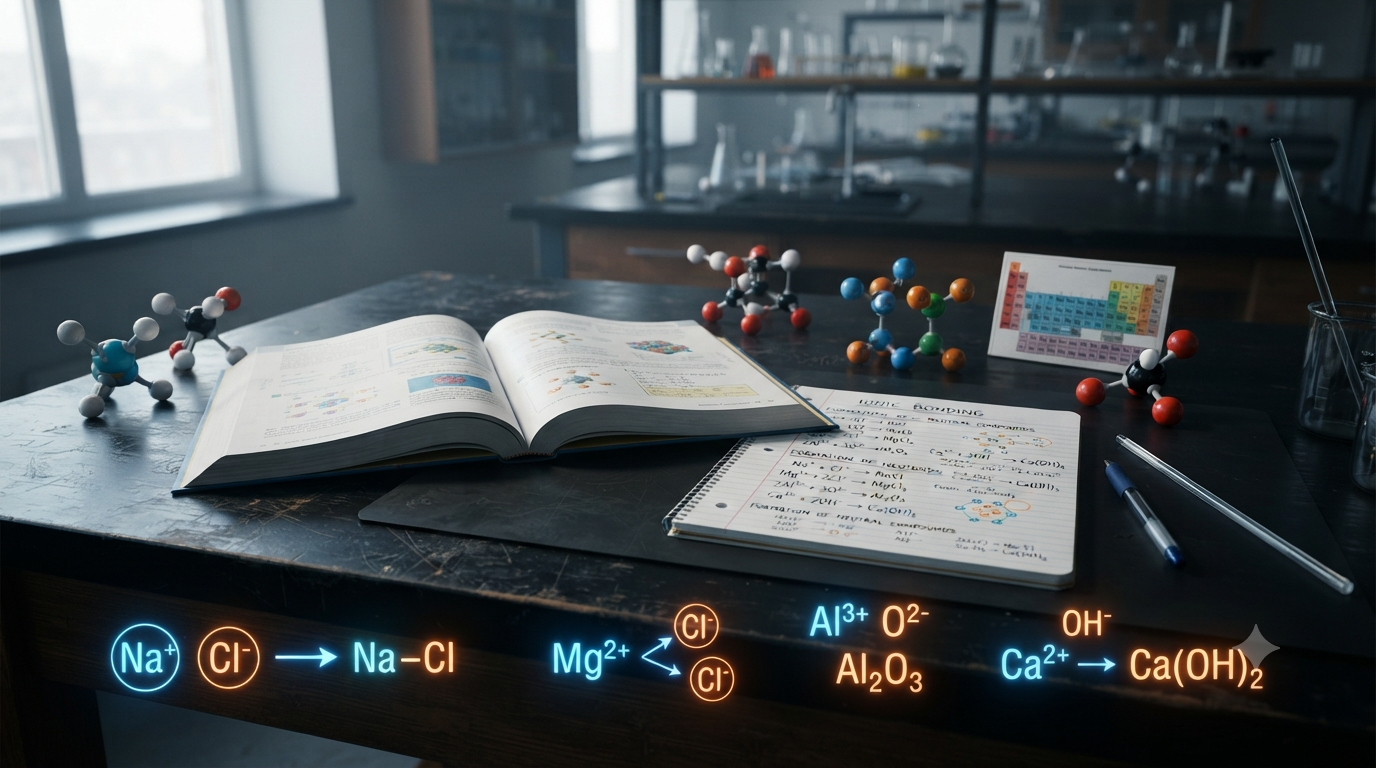
Chemistry study scene showing ionic charges, chemical symbols, and balanced formulas for writing ionic compounds

Writing chemical formulas becomes much easier when you understand how ions combine and how their charges are balanced. An ionic compound is formed when positively charged ions, called cations, combine with negatively charged ions, called anions. Because an ionic compound is electrically neutral, the total positive charge must balance the total negative charge.

For example, sodium forms a Na⁺ ion, while chlorine forms a Cl⁻ ion. One sodium ion balances one chloride ion, so their formula is NaCl. However, when the charges are different, you need more than one ion of one or both elements. Calcium forms Ca²⁺ and chlorine forms Cl⁻, so two chloride ions are needed to balance one calcium ion. The resulting formula is CaCl₂.

Learning how to use ionic charges helps you write formulas for many common ionic compounds accurately and quickly.

What Are Ionic Charges?

Atoms can gain or lose electrons to become ions. An ion is an atom or group of atoms that carries an electrical charge.

When an atom loses electrons, it usually becomes positively charged. These positively charged ions are called cations. Metals commonly form cations.

For example:

  • Sodium → Na⁺

  • Magnesium → Mg²⁺

  • Calcium → Ca²⁺

  • Aluminum → Al³⁺

When an atom gains electrons, it usually becomes negatively charged. These negatively charged ions are called anions. Nonmetals commonly form anions.

Examples include:

  • Chloride → Cl⁻

  • Oxide → O²⁻

  • Sulfide → S²⁻

  • Nitride → N³⁻

The charge tells you how many electrons have been lost or gained. It also helps determine the ratio in which ions must combine.

Why Do Ionic Compounds Need Balanced Charges?

Ionic compounds are electrically neutral overall. This means the positive and negative charges in the formula must cancel each other.

Consider magnesium chloride.

Magnesium forms Mg²⁺, which has a charge of +2. Chloride forms Cl⁻, which has a charge of −1.

One Mg²⁺ ion has a total charge of +2, while one Cl⁻ ion has a charge of −1. Therefore, two chloride ions are needed:

Mg²⁺ + 2Cl⁻ → MgCl₂

The total charge is:

+2 + (2 × −1) = 0

Therefore, MgCl₂ is electrically neutral.

Step 1 Identify the Ions

The first step is to identify the positive and negative ions in the compound.

For example, suppose you need to write the formula for calcium oxide.

Calcium forms the cation Ca²⁺.

Oxygen forms the anion O²⁻.

So the ions are:

Ca²⁺ and O²⁻

Once you know the ions and their charges, you can determine the correct ratio.

Step 2 Write the Cation First

In an ionic compound, the positive ion is written first, followed by the negative ion.

For example:

  • Sodium chloride → NaCl

  • Magnesium oxide → MgO

  • Calcium sulfide → CaS

  • Aluminum oxide → Al₂O₃

The cation always comes before the anion in the chemical formula.

Step 3 Write Their Charges

Write the charge of each ion above or beside its symbol while working out the formula.

For example, for aluminum oxide:

Al³⁺ and O²⁻

The charges are +3 and −2.

The formula must contain enough aluminum and oxygen ions to make the total charge zero.

Step 4 Find the Smallest Ratio That Balances the Charges

This is the most important step.

For aluminum oxide, aluminum has a +3 charge and oxide has a −2 charge.

One Al³⁺ gives +3.

One O²⁻ gives −2.

These charges do not cancel.

The smallest common total charge is 6.

Two aluminum ions give:

2 × (+3) = +6

Three oxide ions give:

3 × (−2) = −6

The charges cancel:

+6 + (−6) = 0

Therefore, the formula is:

Al₂O₃

The subscripts show how many ions are present in the simplest ratio.

Using the Criss Cross Method

A commonly used shortcut for writing ionic formulas is the criss cross method.

In this method, the numerical value of each ion’s charge becomes the subscript of the other ion.

For example, consider calcium chloride.

Calcium:

Ca²⁺

Chloride:

Cl⁻

Cross the charge numbers:

Ca₂? Actually, the 2 from calcium becomes the subscript of chloride, while the 1 from chloride becomes the subscript of calcium.

The formula becomes:

CaCl₂

The charge signs are not written as subscripts. Only the numerical values are used.

Another example is aluminum oxide:

Al³⁺ and O²⁻

Crossing the numbers gives:

Al₂O₃

This method is useful, but it is important to understand that it works because the resulting ratio balances the charges.

Simplify the Subscripts When Necessary

After using the criss cross method, always check whether the subscripts can be simplified.

For example:

Ca²⁺ and O²⁻

Criss crossing gives:

Ca₂O₂

However, both subscripts can be divided by 2.

Ca₂O₂ → CaO

Therefore, the correct formula is:

CaO

The final formula should represent the simplest whole-number ratio of ions.

Examples With Equal Charges

When the positive and negative ions have charges of equal magnitude, they combine in a one-to-one ratio.

Sodium Chloride

Sodium:

Na⁺

Chloride:

Cl⁻

The charges are +1 and −1.

Therefore:

NaCl

Magnesium Oxide

Magnesium:

Mg²⁺

Oxide:

O²⁻

The charges are +2 and −2.

Therefore:

MgO

Calcium Sulfide

Calcium:

Ca²⁺

Sulfide:

S²⁻

Therefore:

CaS

In each case, one positive ion balances one negative ion.

Examples With Different Charges

When the charges are different, you need to determine the correct number of ions.

Magnesium Chloride

Mg²⁺ and Cl⁻

Two chloride ions are required for one magnesium ion.

Formula:

MgCl₂

Charge check:

+2 + 2(−1) = 0

Sodium Oxide

Na⁺ and O²⁻

Two sodium ions are needed for one oxide ion.

Formula:

Na₂O

Charge check:

2(+1) + (−2) = 0

Aluminum Sulfide

Al³⁺ and S²⁻

The smallest balanced combination contains two aluminum ions and three sulfide ions.

Formula:

Al₂S₃

Charge check:

2(+3) + 3(−2) = 0

Writing Formulas With Polyatomic Ions

Not all ions are single atoms. Some ions contain two or more atoms chemically bonded together and carry an overall charge. These are called polyatomic ions.

Common polyatomic ions include:

  • Hydroxide → OH⁻

  • Nitrate → NO₃⁻

  • Sulfate → SO₄²⁻

  • Carbonate → CO₃²⁻

  • Phosphate → PO₄³⁻

  • Ammonium → NH₄⁺

The same charge-balancing principle is used with these ions.

For example, calcium nitrate contains:

Ca²⁺ and NO₃⁻

Two nitrate ions are required to balance one calcium ion.

Formula:

Ca(NO₃)₂

Notice the parentheses around NO₃. They are necessary because the entire polyatomic ion is repeated twice.

When Should Parentheses Be Used?

Parentheses are used when a polyatomic ion needs a subscript greater than one.

For example:

Ca²⁺ and OH⁻

Two hydroxide ions are needed.

The formula is:

Ca(OH)₂

The subscript 2 applies to the entire OH group.

Without parentheses, CaOH₂ would not correctly show two hydroxide ions.

However, if only one polyatomic ion is needed, parentheses are not necessary.

For example:

Na⁺ and NO₃⁻

The formula is:

NaNO₃

Not:

Na(NO₃)

Writing Formulas With Transition Metals

Some metals can form more than one type of ion. Transition metals are common examples.

Iron can form:

Fe²⁺

and

Fe³⁺

Therefore, the charge must be specified when naming a compound.

For example, iron(II) chloride contains Fe²⁺ and Cl⁻.

Two chloride ions are needed:

FeCl₂

Iron(III) chloride contains Fe³⁺ and Cl⁻.

Three chloride ions are needed:

FeCl₃

The Roman numeral in the name tells you the charge of the metal ion.

Checking an Ionic Formula

After writing a formula, it is useful to check the charges.

Ask yourself three questions:

  1. What is the charge of the cation?

  2. What is the charge of the anion?

  3. Do the total positive and negative charges equal zero?

For example, consider aluminum oxide:

Al₂O₃

Aluminum:

2 × +3 = +6

Oxygen:

3 × −2 = −6

Total:

+6 + (−6) = 0

Therefore, the formula is balanced.

Common Mistakes to Avoid

One common mistake is writing the charges as part of the final chemical formula. Charges are useful when working out the formula, but they are normally not written in the formula of a neutral ionic compound.

For example, calcium chloride should be:

CaCl₂

not:

Ca²⁺Cl⁻

Another mistake is forgetting to simplify subscripts. If your calculation produces Ca₂O₂, simplify it to CaO.

You should also avoid changing the chemical symbols themselves. Subscripts tell you how many atoms or ions are present, while changing a symbol would represent a different element.

Another important mistake is using parentheses incorrectly. Parentheses are needed when a polyatomic ion appears more than once, such as Ca(NO₃)₂. They are not needed when the polyatomic ion appears only once, such as NaNO₃.

A Simple Method to Remember

You can use the following sequence whenever you need to write an ionic formula:

Identify → Write → Balance → Simplify → Check

First, identify the cation and anion.

Next, write their chemical symbols and charges.

Then determine the smallest number of each ion required to make the total charge zero.

After that, simplify the subscripts if they have a common factor.

Finally, check that the total positive and negative charges cancel.

For example:

Al³⁺ + O²⁻

Balance the charges:

2 Al³⁺ = +6

3 O²⁻ = −6

Therefore:

Al₂O₃

This process works for a wide range of ionic compounds.

Practice Examples

Try writing the formulas for these compounds using ionic charges:

  • Potassium bromide

  • Calcium fluoride

  • Magnesium nitride

  • Aluminum sulfide

  • Sodium oxide

  • Barium chloride

  • Calcium hydroxide

  • Aluminum sulfate

The key is to identify the ions before writing the formula.

For example, potassium forms K⁺ and bromide forms Br⁻. Their charges balance in a one-to-one ratio, so potassium bromide is KBr.

Magnesium forms Mg²⁺ and nitride forms N³⁻. The smallest balanced combination contains three magnesium ions and two nitride ions:

Mg₃N₂

For calcium hydroxide, calcium is Ca²⁺ and hydroxide is OH⁻. Two hydroxide ions are required:

Ca(OH)₂

These examples show why knowing common ionic charges is an important part of writing chemical formulas.

Conclusion

Writing ionic formulas is mainly a process of balancing charges. The formula of an ionic compound must contain ions in a ratio that produces an overall charge of zero. Start by identifying the cation and anion, write their charges, determine the smallest whole-number ratio, and then write the chemical formula using subscripts. The criss cross method can make this process faster, but checking the total charges helps confirm that the formula is correct. For compounds containing polyatomic ions, remember to use parentheses when more than one complete polyatomic ion is required. With regular practice, ionic charges become a simple and reliable way to write chemical formulas.

FAQs

1. What are ionic charges?

Ionic charges are the electrical charges carried by ions after atoms gain or lose electrons. An ion that loses electrons becomes positively charged and is called a cation. An ion that gains electrons becomes negatively charged and is called an anion. For example, sodium forms Na⁺, while chlorine forms Cl⁻. Ionic charges are important because they help determine how ions combine to form electrically neutral ionic compounds. When writing an ionic formula, the total positive charge must balance the total negative charge. Understanding common ionic charges makes it easier to write correct chemical formulas and understand the composition of ionic compounds.

2. Why must ionic charges be balanced when writing formulas?

Ionic charges must be balanced because an ionic compound is electrically neutral overall. The positive charges contributed by cations must equal the negative charges contributed by anions. For example, magnesium forms Mg²⁺ and chloride forms Cl⁻. One magnesium ion has a +2 charge, so two chloride ions with −1 charges are needed. The formula is therefore MgCl₂. Its total charge is +2 + 2(−1) = 0. If the charges were not balanced, the formula would not represent a neutral ionic compound. Charge balancing is therefore the main principle used when determining the correct ratio of ions.

3. How do you write an ionic formula step by step?

To write an ionic formula, first identify the cation and anion and determine their charges. Write the cation first and the anion second. Next, find the smallest whole-number ratio that makes the total positive and negative charges equal. You can use the criss cross method as a shortcut, then simplify the subscripts if necessary. For example, aluminum is Al³⁺ and oxide is O²⁻. Two aluminum ions provide +6, while three oxide ions provide −6. Therefore, the formula is Al₂O₃. Finally, check that the total charge of the formula is zero.

4. What is the criss cross method for ionic formulas?

The criss cross method is a shortcut used to determine the subscripts in an ionic formula. First, write the symbols and charges of the two ions. Then use the numerical value of the charge on one ion as the subscript of the other ion. For example, calcium is Ca²⁺ and chloride is Cl⁻. The 2 becomes the subscript of chlorine, while the 1 is usually not written. This gives CaCl₂. The method should always be followed by a charge check. If both subscripts have a common factor, they should be simplified to the lowest whole-number ratio.

5. Why are subscripts important in ionic formulas?

Subscripts show how many atoms or ions of each element are present in a chemical formula. They are especially important for balancing ionic charges. For example, MgCl₂ contains one magnesium ion and two chloride ions. The subscript 2 shows that two chloride ions are required to balance the +2 charge of magnesium. A missing subscript means one atom or ion is present. Subscripts should not be confused with ionic charges. Charges describe the electrical state of individual ions, while subscripts describe the ratio of ions in the compound. Changing a subscript can change the compound itself.

6. When should you use parentheses in ionic formulas?

Parentheses are used when a polyatomic ion appears more than once in an ionic compound. A polyatomic ion is a group of atoms carrying an overall charge, such as OH⁻, NO₃⁻, or SO₄²⁻. For example, calcium hydroxide contains Ca²⁺ and OH⁻. Two hydroxide ions are required, so the formula is Ca(OH)₂. The parentheses show that the subscript 2 applies to the entire hydroxide ion. If only one polyatomic ion is present, parentheses are not normally needed. For example, sodium nitrate is NaNO₃ because only one nitrate ion is required.

7. How do you write formulas for compounds containing polyatomic ions?

First, identify the cation, the polyatomic anion, and their charges. Then balance the charges just as you would with single-atom ions. If more than one polyatomic ion is required, place the ion in parentheses before adding the subscript. For example, aluminum sulfate contains Al³⁺ and SO₄²⁻. Two aluminum ions provide +6, while three sulfate ions provide −6. Therefore, the formula is Al₂(SO₄)₃. The parentheses indicate that three complete sulfate ions are present. The same process can be applied to compounds containing hydroxide, nitrate, carbonate, phosphate, and other polyatomic ions.

8. What happens when both ions have the same charge magnitude?

When the positive and negative ions have charges with equal magnitude, they usually combine in a one-to-one ratio. For example, sodium has a +1 charge and chloride has a −1 charge. One Na⁺ balances one Cl⁻, giving NaCl. Similarly, magnesium oxide contains Mg²⁺ and O²⁻. Their charges cancel in a one-to-one ratio, so the formula is MgO rather than Mg₂O₂. The simplest whole-number ratio should always be used. Therefore, when the charges are equal and opposite, no numerical subscripts are normally needed in the final ionic formula.

9. How do you write formulas for transition metal compounds?

Transition metals can form ions with different charges, so their charge must be identified before writing the formula. The charge is often shown by a Roman numeral in the compound’s name. For example, iron(II) chloride contains Fe²⁺ and Cl⁻. Two chloride ions are needed, giving FeCl₂. Iron(III) chloride contains Fe³⁺ and Cl⁻, so three chloride ions are required, giving FeCl₃. The Roman numeral II indicates a +2 charge, while III indicates a +3 charge. Once the correct ionic charge is known, the formula can be written using the normal charge-balancing process.

10. How can you check whether an ionic formula is correct?

You can check an ionic formula by calculating the total positive and negative charges. The two totals should be equal in magnitude and opposite in sign, producing an overall charge of zero. For example, Al₂O₃ contains two Al³⁺ ions and three O²⁻ ions. The aluminum ions contribute +6, while the oxide ions contribute −6. Therefore, the total charge is zero, confirming the formula. Also check that the subscripts are in the simplest whole-number ratio and that polyatomic ions use parentheses when necessary. This final charge check helps catch common mistakes in ionic formulas.

Related Posts

Leave a Comment

Your email address will not be published. Required fields are marked *

Scroll to Top