Lines are one of the most basic and important concepts in geometry. They help us understand shapes, angles, patterns, and the arrangement of objects around us. We can observe line relationships in railway tracks, building structures, windows, roads, books, and many other everyday objects. Although all lines are straight in geometry, they can have different relationships depending on their direction and the way they meet.
Three important types of line relationships are parallel lines, perpendicular lines, and intersecting lines. Parallel lines never meet, perpendicular lines intersect at right angles, and intersecting lines cross at a common point. Understanding these differences makes it easier to study angles, triangles, quadrilaterals, coordinate geometry, and other mathematical topics. In this article, we will explore the definitions, properties, symbols, formulas, examples, and real-life applications of these three types of lines.
What Is a Line in Geometry?
A line is a straight path that extends infinitely in both directions. It has no endpoints and no thickness. Although we draw lines using pencils and rulers, a mathematical line represents an ideal straight path that continues without ending.
A line can be named using any two distinct points on it. For example, a line passing through points A and B can be called line AB.
A line is different from a line segment and a ray. A line segment has two endpoints, while a ray begins at one endpoint and continues infinitely in one direction. A complete line extends infinitely in both directions.
Understanding these differences is important because the relationships between parallel, perpendicular, and intersecting lines are usually studied using complete lines, although similar relationships can also occur between line segments and rays.
Understanding Parallel Lines
What Are Parallel Lines?
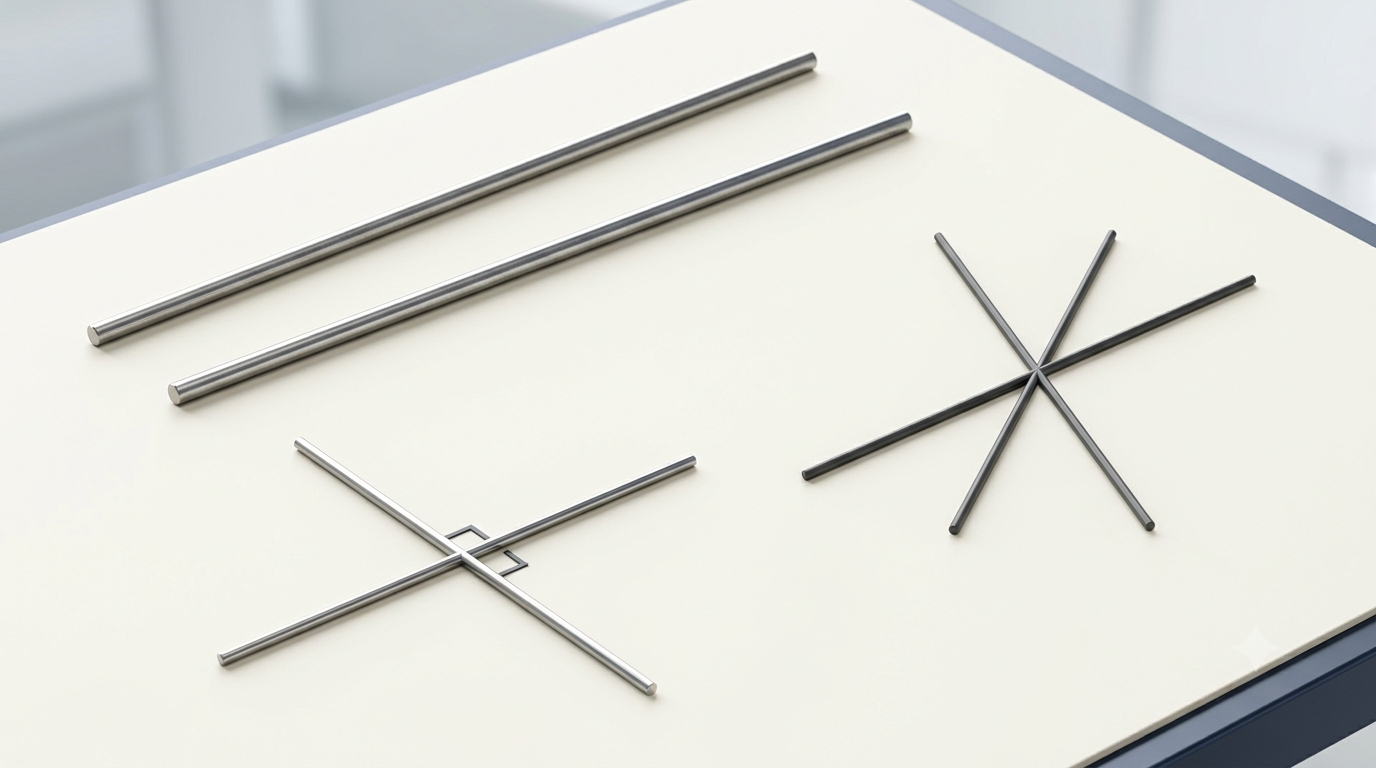
Parallel lines are two distinct lines in the same plane that never meet, even when extended infinitely in either direction. They remain the same perpendicular distance apart throughout their lengths.
For example, imagine the opposite edges of a rectangular sheet of paper. The two opposite edges run in the same direction and do not meet when extended. They provide a simple example of parallel lines.
The symbol used to represent parallel lines is ∥.
Formula and notation
AB ∥ CDThis means that line AB is parallel to line CD.
Important Properties of Parallel Lines
Parallel lines have several properties that help us recognize them and solve geometry problems.
1. Parallel lines never intersect
The defining property of parallel lines is that they never meet at any point when extended infinitely in the same plane.
2. The distance between parallel lines remains constant
The perpendicular distance between two parallel lines is the same at every point. If the distance between two straight lines changes, they are not parallel.
3. Parallel lines have the same direction
Parallel lines run in the same direction. In coordinate geometry, two distinct nonvertical parallel lines have equal slopes.
Formula
m₁ = m₂Here, m₁ and m₂ represent the slopes of the two lines.
For example, if one line has a slope of 3 and another line also has a slope of 3, the lines are parallel if they are distinct.
Vertical lines can also be parallel. Two different vertical lines have the same direction, even though their slopes are undefined.
4. Parallel lines do not form intersection angles
Since parallel lines never meet, they do not form angles with each other at an intersection point.
Examples of Parallel Lines in Everyday Life
Parallel lines can be observed in many familiar objects and structures.
The opposite edges of a rectangular sheet of paper.
The horizontal lines printed on ruled notebooks.
The two long rails of a straight railway track in an ideal geometric model.
The opposite sides of a rectangle.
The vertical edges of a properly aligned rectangular window.
These examples help us recognize parallel lines in everyday life. However, real objects may not be perfectly parallel because of construction errors, deformation, or the perspective from which they are viewed.
Parallel Lines in Coordinate Geometry
Coordinate geometry uses numbers and equations to describe the positions and directions of lines.
A straight line can be written in slope-intercept form.
Formula
y = mx + cIn this formula:
y represents the vertical coordinate.
x represents the horizontal coordinate.
m represents the slope of the line.
c represents the y-intercept, where the line crosses the y-axis.
Consider these two equations:
Example
y = 2x + 3
Both lines have a slope of 2, but their y-intercepts are different. Therefore, they represent distinct parallel lines.
This method is useful when identifying parallel lines from equations instead of relying only on a diagram.
Understanding Perpendicular Lines
What Are Perpendicular Lines?
Perpendicular lines are two lines that intersect at an angle of exactly 90 degrees. They form four right angles around their intersection point.
The symbol ⊥ is used to represent perpendicular lines.
For example, the adjacent sides of a square meet at right angles. This makes them perpendicular to each other.
Formula and notation
AB ⊥ CDThis means that line AB is perpendicular to line CD.
Important Properties of Perpendicular Lines
1. They intersect at 90 degrees
The most important property of perpendicular lines is that the angle between them is exactly 90 degrees.
Formula
θ = 90°Here, θ represents the angle between the two lines.
2. They form four right angles
When two complete lines intersect perpendicularly, they form four angles, each measuring 90 degrees.
Formula
90° + 90° + 90° + 90° = 360°The sum of the angles around the intersection point is 360 degrees.
3. Their slopes have a special relationship
In coordinate geometry, two perpendicular nonvertical lines have slopes that are negative reciprocals of each other.
Formula
m₁ × m₂ = -1For example, if one line has a slope of 2, a perpendicular line has a slope of -½.
Calculation
m₁ = 2
Since the product of the slopes is -1, the two lines are perpendicular.
This rule applies when both slopes are defined. A vertical line is perpendicular to a horizontal line, whose slope is zero.
4. They help create right angles in geometric shapes
Perpendicular lines are important in the construction of squares, rectangles, right-angled triangles, and many other geometric figures.
Examples of Perpendicular Lines in Everyday Life
Perpendicular lines can be found in several familiar objects.
The adjacent sides of a square.
The adjacent sides of a rectangle.
The horizontal and vertical edges of a properly aligned book.
Two walls meeting at a right angle in a rectangular room.
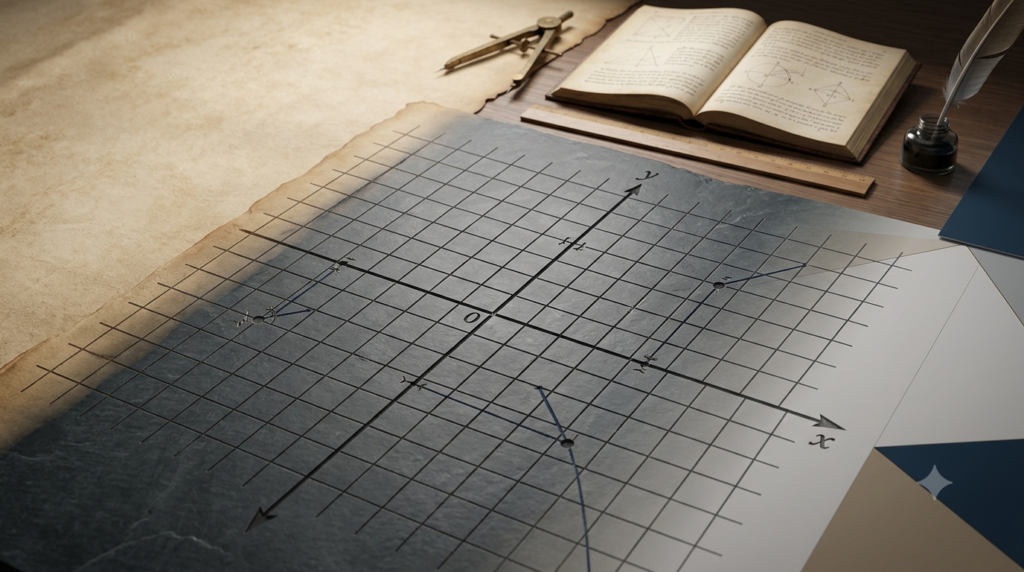
The horizontal and vertical axes of a Cartesian coordinate system.
The horizontal beam and vertical support of a right-angled frame.
These examples show why perpendicular relationships are useful in architecture, engineering, construction, and design.
Perpendicular Lines in Coordinate Geometry
Suppose a line has the following equation:
Example
y = 3x + 2Its slope is 3. A line perpendicular to it must have a slope of -⅓.
One possible perpendicular line is:
y = -⅓x + 4The product of the slopes is:
3 × (-⅓) = -1Therefore, the lines are perpendicular.
Notice that the y-intercept does not determine whether two lines are perpendicular. The relationship between their slopes is the important factor.
Understanding Intersecting Lines
What Are Intersecting Lines?
Intersecting lines are two distinct lines that cross at a common point. This common point is called the point of intersection.
Intersecting lines can meet at different angles. They may form acute angles, obtuse angles, or right angles. When two intersecting lines form right angles, they are also perpendicular lines.
For example, two roads crossing at a junction can be represented as intersecting lines. Depending on the angle at which they cross, they may or may not be perpendicular.
Notation
Line AB and line CD intersect at point P.Point P belongs to both lines.
Important Properties of Intersecting Lines
1. They share a common point
Two distinct intersecting lines in a plane meet at exactly one point.
2. They form four angles
When two complete lines cross, they form four angles around their point of intersection.
These angles are related to one another in important ways that help us solve geometry problems.
3. Vertically opposite angles are equal
Vertically opposite angles are the angles directly opposite each other when two lines intersect. They always have equal measures.
For example, if one angle measures 60 degrees, the angle directly opposite it also measures 60 degrees.
Formula
∠1 = ∠3
Here, angles 1 and 3 form one vertically opposite pair, while angles 2 and 4 form the other pair.
4. Adjacent angles in a linear pair add up to 180 degrees
Adjacent angles share a common vertex and one common arm. When two adjacent angles form a straight line, their measures add up to 180 degrees.
Formula
∠1 + ∠2 = 180°For example, if one angle measures 125 degrees, the adjacent angle can be calculated as follows.
Calculation
180° - 125° = 55°Therefore, the adjacent angle measures 55 degrees.
5. They can form different types of angles
Intersecting lines may form acute, obtuse, or right angles.
An acute angle measures less than 90 degrees.
A right angle measures exactly 90 degrees.
An obtuse angle measures more than 90 degrees but less than 180 degrees.
The angles formed depend on the directions of the two lines.
Examples of Intersecting Lines in Everyday Life
Examples of intersecting lines include:
Two roads crossing at a junction.
The crossed blades of an open pair of scissors.
Two straight sticks arranged in an X shape.
Crossing lines in geometric artwork.
Two straight lines drawn across each other on paper.
These examples demonstrate that intersecting lines do not always meet at right angles.
Intersecting Lines in Coordinate Geometry
Coordinate geometry allows us to find the exact point where two lines intersect.
Consider the following equations:
Example
y = x + 1
To find the intersection point, set the two expressions for y equal to each other.
Calculation
x + 1 = -x + 5
Now substitute x = 2 into the first equation.
y = 2 + 1
Therefore, the intersection point is:
P = (2, 3)The slopes of the two lines are 1 and -1.
1 × (-1) = -1Since their slopes are negative reciprocals, the lines are not only intersecting but also perpendicular.
This example shows how algebra can be used to identify the intersection point and determine the relationship between two lines.
Difference Between Parallel, Perpendicular, and Intersecting Lines
Although these three types of lines are related, they have different properties. Comparing them makes it easier to understand their differences.
| Property | Parallel Lines | Perpendicular Lines | Intersecting Lines |
|---|---|---|---|
| Do they meet? | No | Yes | Yes |
| Number of intersection points | Zero | One | One for two distinct lines in a plane |
| Angle at intersection | No intersection angle | 90° | Not necessarily 90° |
| Slope relationship | Equal slopes for distinct nonvertical lines | Product of slopes is -1 when both are defined | Different slopes when both are defined |
| Symbol | ∥ | ⊥ | No single universal symbol |
| Example | Opposite sides of a rectangle | Adjacent sides of a square | Two crossing roads |
An important point to remember is that perpendicular lines are a special type of intersecting line. All perpendicular lines intersect, but not all intersecting lines are perpendicular.
For example, two lines crossing at 45 degrees are intersecting lines, but they are not perpendicular because the angle between them is not 90 degrees.
Similarly, parallel lines remain separate and never intersect when considered as complete lines in the same plane.
How to Identify Different Types of Lines
You can identify parallel, perpendicular, and intersecting lines by observing their directions, measuring their angles, or comparing their equations.
Step 1: Check Whether the Lines Meet
First, examine the two lines.
If they never meet and remain the same distance apart, they are parallel.
If they cross at a common point, they are intersecting lines.
Step 2: Measure the Angle
If the lines intersect, determine the angle between them. A protractor can be used when working with a drawing.
If the angle is exactly 90 degrees, the lines are perpendicular.
If the angle is not 90 degrees, the lines are intersecting but not perpendicular.
Step 3: Compare Their Slopes
When the equations of two lines are available, their slopes provide a useful method for identifying their relationship.
For two distinct nonvertical parallel lines:
m₁ = m₂For two perpendicular lines with defined slopes:
m₁ × m₂ = -1If the slopes are different, the lines intersect at one point in the Euclidean plane, provided both are distinct and nonvertical.
Vertical lines require special consideration because their slopes are undefined. Two distinct vertical lines are parallel, while a vertical line and a horizontal line are perpendicular.
These methods help you identify line relationships accurately in both diagrams and algebraic problems.
The Role of Lines in Geometric Shapes
Parallel and perpendicular lines are important when studying different geometric shapes.
Squares
A square has four equal sides and four right angles. Its opposite sides are parallel, while its adjacent sides are perpendicular.
Rectangles
A rectangle has four right angles. Its opposite sides are parallel, and its adjacent sides are perpendicular.
Parallelograms
A parallelogram has two pairs of opposite parallel sides. However, adjacent sides are not necessarily perpendicular. They meet at right angles only when the parallelogram is a rectangle or a square.
Triangles
A triangle may contain perpendicular sides when it is a right-angled triangle. In this case, two sides meet at an angle of 90 degrees.
A triangle does not have parallel sides because each pair of its sides meets at a vertex.
Coordinate Grids
A standard Cartesian coordinate grid contains horizontal and vertical lines. All distinct horizontal grid lines are parallel to one another, and all distinct vertical grid lines are parallel to one another.
Every horizontal line is perpendicular to every vertical line.
These relationships make coordinate grids useful for plotting points, drawing graphs, measuring distances, and solving geometric problems.
Real-Life Applications of These Lines
The concepts of parallel, perpendicular, and intersecting lines are useful in many practical fields.
Architecture and Construction
Architects use parallel lines when planning walls, windows, floors, and other structural elements. Perpendicular lines help create right-angled corners and properly aligned structures.
Accurate alignment improves the appearance, stability, and functionality of buildings.
Road and Railway Design
Road layouts often contain parallel lane markings and intersecting streets. Some road junctions meet at right angles, while others cross at different angles.
Railway tracks are designed with carefully controlled spacing between rails, and railway crossings require specialized engineering.
Engineering and Manufacturing
Machines frequently contain components that must be parallel or perpendicular to one another. Correct alignment helps moving parts fit together and operate efficiently.
Engineers use these geometric relationships when designing frames, tools, machines, and mechanical systems.
Art and Graphic Design
Artists use parallel lines to create patterns, repetition, and visual balance. Intersecting lines can form geometric designs, while perpendicular lines help create structured layouts.
These relationships are also useful in technical drawings and architectural illustrations.
Computer Graphics
Computer graphics uses lines to construct shapes, grids, objects, and diagrams. Parallel and perpendicular relationships are especially important in technical drawings, computer-aided design, and digital modelling.
These applications demonstrate how basic geometry connects mathematical concepts with real-world activities.
Common Mistakes to Avoid
When learning about these line relationships, it is important to understand a few common mistakes.
Mistake 1: Assuming every pair of intersecting lines is perpendicular
Intersecting lines can meet at many different angles. They are perpendicular only when they form right angles of 90 degrees.
Mistake 2: Assuming parallel lines eventually meet
In Euclidean geometry, parallel lines in the same plane never meet, even when extended infinitely.
Mistake 3: Confusing parallel lines with perpendicular lines
Parallel lines never intersect, while perpendicular lines cross at right angles.
Mistake 4: Forgetting that perpendicular lines are intersecting lines
Perpendicular lines belong to the broader category of intersecting lines. Their special characteristic is the 90-degree angle.
Mistake 5: Applying the slope rule without checking its conditions
The rule m₁ × m₂ = -1 applies when both perpendicular lines have defined slopes. Vertical and horizontal lines must be considered separately.
Mistake 6: Judging line relationships only by appearance
A diagram may not be drawn to scale. When exact relationships matter, use geometric markings, angle measurements, or equations instead of relying only on visual appearance.
Conclusion
Parallel, perpendicular, and intersecting lines are fundamental concepts in geometry. Parallel lines remain equally distant and never meet, perpendicular lines intersect at right angles, and intersecting lines share a common point but do not necessarily form 90-degree angles.
Understanding their definitions, properties, symbols, and slope relationships helps us solve mathematical problems and recognize geometric patterns. These concepts are also important in architecture, engineering, construction, road design, and computer graphics.
By learning how to identify these lines and distinguish their properties, we can build a strong foundation for studying angles, triangles, quadrilaterals, coordinate geometry, and more advanced mathematical topics.
FAQs
1. What are parallel lines in geometry?
Parallel lines are two distinct straight lines in the same plane that never meet, even when extended infinitely in either direction. They maintain a constant perpendicular distance from each other and have the same direction. For example, the opposite sides of a rectangle are parallel. In coordinate geometry, two distinct nonvertical parallel lines have equal slopes. Parallel lines are represented by the symbol ∥. Understanding parallel lines is important when studying geometric shapes, angles, and coordinate systems. They are also useful in architecture, engineering, construction, and technical drawing, where maintaining consistent direction and spacing is essential.
2. What are perpendicular lines, and how can we identify them?
Perpendicular lines are two straight lines that intersect at an angle of exactly 90 degrees. They form four right angles around their intersection point. A simple example is the meeting of two adjacent sides of a square. The symbol ⊥ represents perpendicular lines. In coordinate geometry, two perpendicular lines with defined slopes satisfy the relationship m₁ × m₂ = -1. A vertical line and a horizontal line are also perpendicular. You can identify perpendicular lines by checking for a right-angle marking in a diagram, measuring the angle with a protractor, or comparing their slopes when equations are available.
3. What are intersecting lines?
Intersecting lines are two distinct straight lines that meet at a common point. This common point is called the point of intersection. When two complete lines intersect in a plane, they form four angles around the intersection point. These angles may be acute, obtuse, or right angles, depending on how the lines cross. For example, two roads crossing at a junction can represent intersecting lines. If the lines meet at 90 degrees, they are also perpendicular. Intersecting lines are important in geometry because they help us understand angle relationships, solve mathematical problems, and study shapes and coordinate graphs.
4. What is the main difference between parallel and perpendicular lines?
The main difference is the way the lines relate to each other. Parallel lines never meet when extended infinitely in the same plane and maintain a constant perpendicular distance. Perpendicular lines intersect at exactly 90 degrees and form four right angles. For example, the opposite sides of a rectangle are parallel, while its adjacent sides are perpendicular. Their slopes also have different relationships. Distinct nonvertical parallel lines have equal slopes, whereas perpendicular lines with defined slopes have a product of -1. Recognizing these differences helps students identify line relationships in geometric diagrams, coordinate graphs, and everyday objects.
5. Are all intersecting lines perpendicular?
No, not all intersecting lines are perpendicular. Intersecting lines meet at a common point, but the angle between them does not have to be 90 degrees. For example, two lines crossing at an angle of 45 degrees are intersecting lines, but they are not perpendicular. Perpendicular lines are a special type of intersecting line that forms four right angles. To determine whether intersecting lines are perpendicular, check whether their angle is exactly 90 degrees. You can use a protractor, a right-angle marking, or the slopes of their equations. This distinction is essential for understanding geometric relationships correctly.
6. What is the symbol for parallel and perpendicular lines?
The symbol for parallel lines is ∥, while the symbol for perpendicular lines is ⊥. For example, AB ∥ CD means that line AB is parallel to line CD. Similarly, AB ⊥ CD means that line AB is perpendicular to line CD. These symbols make geometric statements shorter and easier to understand. Parallel lines never meet in the same plane, whereas perpendicular lines intersect at right angles. Intersecting lines do not have one universally used symbol comparable to these two. Learning these notations helps students read geometry diagrams, understand mathematical explanations, and communicate line relationships accurately.
7. How can slopes help identify parallel and perpendicular lines?
The slope of a line describes its steepness and direction on a coordinate plane. It can be used to identify whether two lines are parallel or perpendicular. Two distinct nonvertical parallel lines have equal slopes. For example, lines with slopes 2 and 2 are parallel if they have different intercepts. Two perpendicular lines with defined slopes have slopes that are negative reciprocals of each other. For instance, slopes of 2 and -½ satisfy the perpendicularity rule because 2 × (-½) = -1. Vertical lines have undefined slopes, so vertical and horizontal lines must be handled separately.
8. Where can we find parallel, perpendicular, and intersecting lines in everyday life?
These line relationships appear in many everyday objects and structures. Parallel lines can be seen in the opposite edges of a rectangular book, ruled notebook lines, and railway tracks in an ideal model. Perpendicular lines appear where the adjacent sides of a square meet or where horizontal and vertical edges form a right angle. Intersecting lines can be observed at road junctions, in crossed scissors, and in X-shaped patterns. These examples show how geometry relates to the world around us. Architects, engineers, designers, and builders use these relationships to create accurate structures, organize layouts, and solve practical design problems.
9. What is the relationship between parallel lines and geometric shapes?
Parallel lines play an important role in the properties of many geometric shapes. A rectangle has two pairs of opposite parallel sides, and its adjacent sides are perpendicular. A square also has two pairs of opposite parallel sides, with all adjacent sides meeting at right angles. A parallelogram has two pairs of opposite parallel sides, although its adjacent sides are not necessarily perpendicular. These relationships help us classify shapes and understand their properties. Recognizing parallel sides is particularly useful when studying quadrilaterals, calculating angles, identifying geometric patterns, and solving problems involving area, perimeter, and coordinate geometry.
10. Why are parallel, perpendicular, and intersecting lines important in mathematics?
Parallel, perpendicular, and intersecting lines provide the foundation for understanding many important geometric concepts. They help explain angle relationships, the properties of polygons, and the arrangement of points and lines on coordinate planes. Parallel lines are useful when studying transversals and corresponding angles, while perpendicular lines are essential for understanding right angles and right-angled triangles. Intersecting lines help us calculate unknown angles and determine where two linear equations meet. Beyond mathematics, these concepts are applied in architecture, engineering, construction, computer graphics, and technical drawing. Learning their properties develops spatial reasoning and prepares students for more advanced geometry.