Momentum is one of the most useful ideas in physics for understanding how objects move and how their motion changes. A fast-moving truck, a slowly rolling ball, and a stationary book all have different amounts of momentum. But what happens when a force acts on an object? How does pushing, pulling, braking, or hitting an object change its momentum?
The answer is closely connected to Newton’s second law of motion. A force does not simply make an object move. More precisely, a net force changes the momentum of an object. The amount of change depends on the force applied and the time for which it acts.
What Is Momentum?
Momentum is a measure of the motion possessed by an object. It depends on two things: the object’s mass and its velocity.
The mathematical expression for momentum is:
p = mv
where p is momentum, m is mass, and v is velocity.
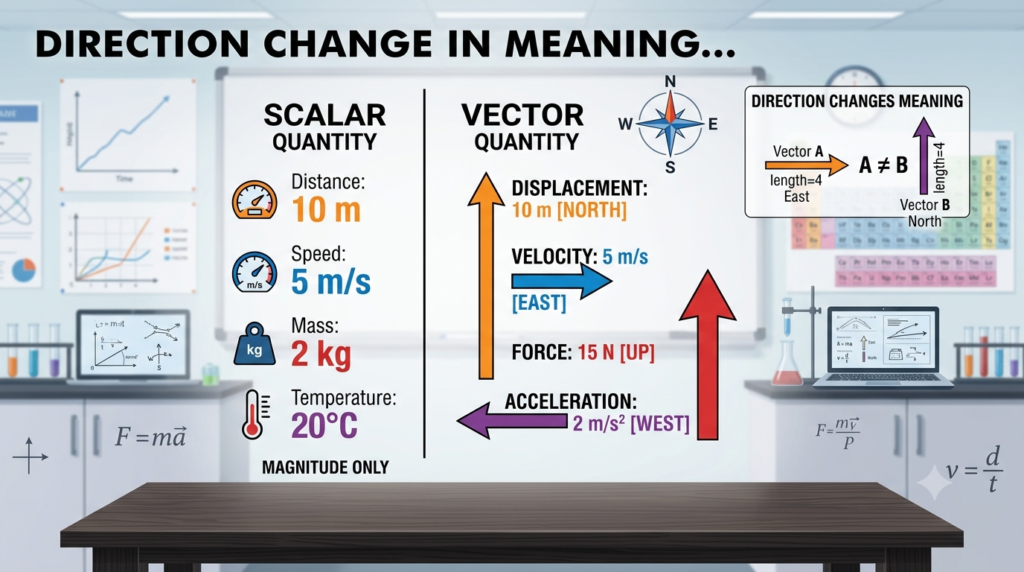
Because velocity has both magnitude and direction, momentum is also a vector quantity. This means that the direction of momentum matters.
For example, a 2 kg ball moving at 5 m/s has a momentum of 10 kg·m/s in the direction of its motion. If the same ball moves at 5 m/s in the opposite direction, its momentum has the same magnitude but the opposite direction.
A stationary object has zero momentum because its velocity is zero.
What Does Force Do?
A force is a push or pull that can change an object’s motion. When a net force acts on an object, it causes the object’s momentum to change.
This relationship is expressed by Newton’s second law in its general form:
F = Δp / Δt
This means that the net force on an object is equal to the rate at which its momentum changes with time.
Rearranging the equation gives:
Δp = FΔt
This equation provides a simple way to understand how force changes momentum.
The change in momentum depends on two main factors:
A larger force produces a greater change in momentum when acting for the same amount of time. Similarly, a force acting for a longer time produces a greater change in momentum.
Understanding Impulse
The product of force and the time over which it acts is called impulse.
Impulse = Force × Time
Therefore:
J = FΔt = Δp
Impulse is important because it directly measures the change in momentum.
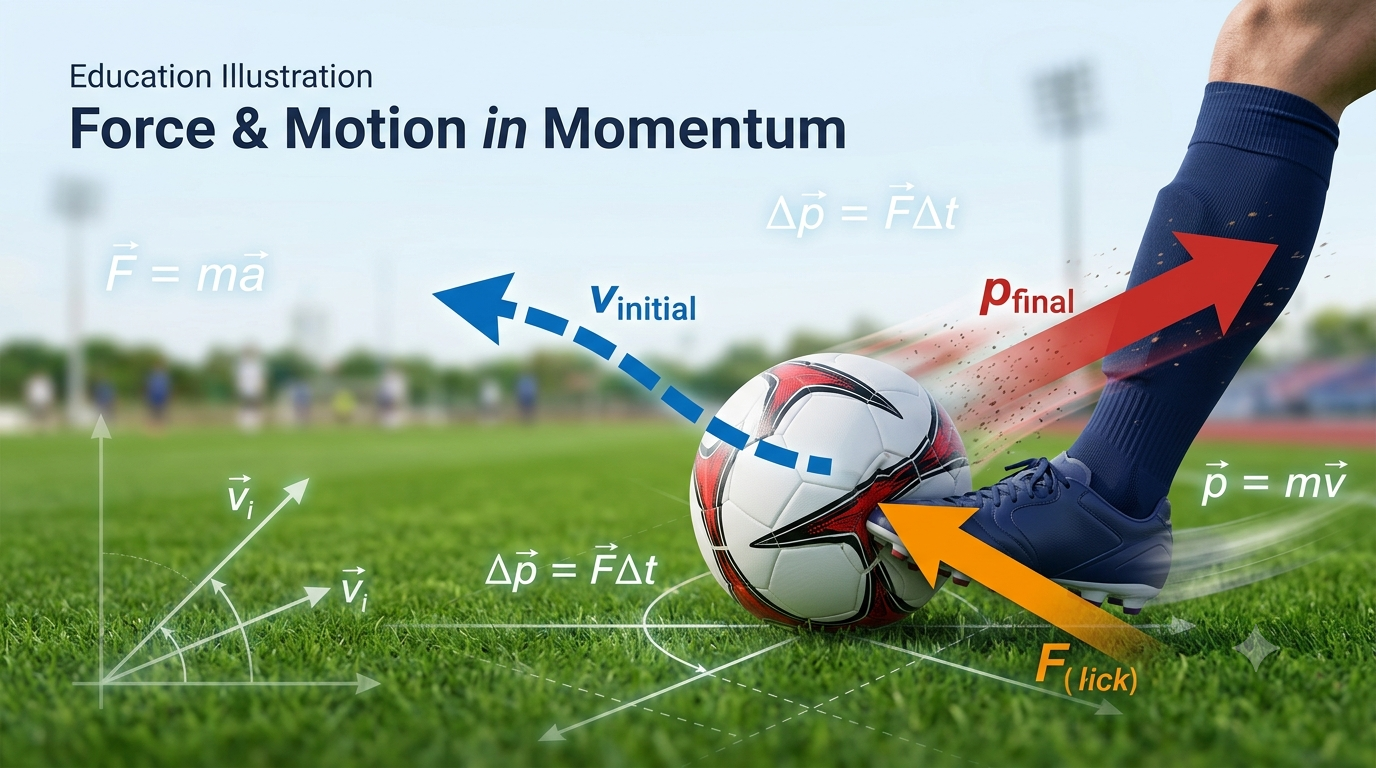
Imagine hitting a stationary football with your foot. Your foot applies a force to the ball for a short period. During that time, the ball’s momentum changes from zero to a value determined by its mass and final velocity.
The stronger the kick, the greater the force. If the contact time also remains the same, a stronger kick produces a larger change in momentum.
A Simple Example
Suppose a 2 kg object is initially moving at 3 m/s. Its initial momentum is:
p₁ = mv = 2 × 3 = 6 kg·m/s
Now suppose a net force acts on the object and increases its velocity to 8 m/s.
Its final momentum becomes:
p₂ = 2 × 8 = 16 kg·m/s
Therefore, the change in momentum is:
Δp = p₂ − p₁
Δp = 16 − 6 = 10 kg·m/s
The force has increased the object’s momentum by 10 kg·m/s.
Notice that the force did not directly determine the final momentum by itself. Instead, it produced a change in momentum over a certain period of time.
Force Can Increase Momentum
One common effect of force is to increase an object’s speed in the direction it is already moving.
Consider a cyclist traveling forward. If the cyclist pedals harder, the driving force increases the cyclist’s forward momentum.
If the mass remains constant, increasing momentum means increasing velocity.
For example, if a 60 kg cyclist and bicycle system changes velocity from 5 m/s to 8 m/s, the momentum changes from:
p₁ = 60 × 5 = 300 kg·m/s
to:
p₂ = 60 × 8 = 480 kg·m/s
The change in momentum is therefore 180 kg·m/s.
The forward force responsible for this change has increased the system’s momentum.
Force Can Decrease Momentum
A force can also reduce momentum.
Braking a moving car is a good example. The car has momentum while moving, but the braking force acts opposite to its direction of motion. As a result, the car’s velocity decreases and its momentum becomes smaller.
Suppose a 1,000 kg car travels at 20 m/s. Its momentum is:
p = 1,000 × 20 = 20,000 kg·m/s
When the car comes to rest, its final momentum is zero.
Therefore, the change in momentum is:
Δp = 0 − 20,000 = −20,000 kg·m/s
The negative sign indicates that the change in momentum is opposite to the car’s original direction.
This is why the direction of force is important.
Force Can Change the Direction of Momentum
A force does not always have to increase or decrease an object’s speed. It can also change the direction of its momentum.
Imagine a ball moving around a curved path. Even if its speed remains constant, its velocity continuously changes direction. Since momentum depends on velocity, the momentum also changes direction.
Therefore, the ball is experiencing a change in momentum.
This is an important point because it shows that an object can have acceleration even when its speed remains constant. A change in velocity means a change in momentum, and a net force is responsible for that change.
For circular motion, the force directed toward the center of the circular path continuously changes the direction of the object’s momentum.
What Happens When Force Acts for a Longer Time?
The time during which a force acts can make a major difference.
Suppose the same force is applied to two identical objects. If the force acts on the first object for one second and the second object for three seconds, the second object experiences three times as much impulse, assuming the force remains constant.
Since impulse equals change in momentum, the second object’s momentum changes three times as much.
This principle is especially useful when designing safety equipment.
Why Airbags Reduce Injuries
Airbags provide a practical example of the relationship between force, time, and momentum.
During a collision, a passenger’s momentum must change significantly as the vehicle stops. The change in momentum may be similar whether or not an airbag is present.
However, an airbag increases the time over which the passenger’s momentum changes.
From:
F = Δp / Δt
if the same change in momentum occurs over a longer time, the average force is smaller.
This is one reason airbags can reduce the severity of injuries during collisions.
The same principle applies to padded sports equipment, helmets, crash barriers, and other protective systems.
Catching a Ball
The same idea can be seen when catching a fast-moving ball.
If you hold your hands rigidly while catching the ball, the ball’s momentum changes over a very short time. This produces a relatively large force on your hands.
If you move your hands backward while catching the ball, you increase the time taken to bring the ball to rest. The same overall change in momentum occurs over a longer period, reducing the average force.
This is why athletes often “give” with their hands when catching fast-moving balls.
Force and Momentum in Collisions
Collisions provide another clear example of momentum changing because of force.
When two objects collide, each object exerts a force on the other. These forces act for a short period and produce changes in the objects’ momenta.
For an isolated system, the total momentum before the collision equals the total momentum after the collision. This is known as the law of conservation of momentum.
For example, when a moving billiard ball strikes a stationary ball, the force during the collision changes the momentum of both balls. One ball loses some momentum while the other gains momentum.
Although the individual momenta change, the total momentum of the system remains constant when external forces are negligible.
Why Net Force Matters
It is important to remember that it is the net force that changes an object’s momentum.
An object may have several forces acting on it at the same time. Gravity, friction, tension, air resistance, and applied forces can all contribute.
If these forces balance each other, the net force is zero. In that situation, the object’s momentum does not change.
For example, a book resting on a table experiences gravity downward and an upward normal force from the table. These forces balance, so the book’s momentum remains zero.
If an unbalanced force is applied, its momentum can change.
The Key Relationship
The connection between force and momentum can be summarized in one equation:
Δp = FΔt
This equation tells us something deeper than simply saying that force causes acceleration.
A force changes momentum. The amount of change depends on both the strength of the force and how long it acts.
A force can:
The effect depends on the direction of the force relative to the object’s motion.
Final Thoughts
Force and momentum are closely connected concepts that help explain everyday motion. Whenever a net force acts on an object, its momentum changes. A stronger force produces a greater change in momentum for the same time interval, while a longer interaction time produces a greater change for the same force.
This relationship explains why a football accelerates when kicked, why brakes slow down vehicles, why a bat can send a ball flying, and why airbags and helmets can reduce forces during collisions.
Understanding Δp = FΔt provides a powerful way to connect Newton’s laws with real-world motion. Instead of thinking of force only as something that makes objects accelerate, we can view force more generally as something that changes momentum. This perspective makes many familiar events—from catching a ball to surviving a collision—much easier to understand.