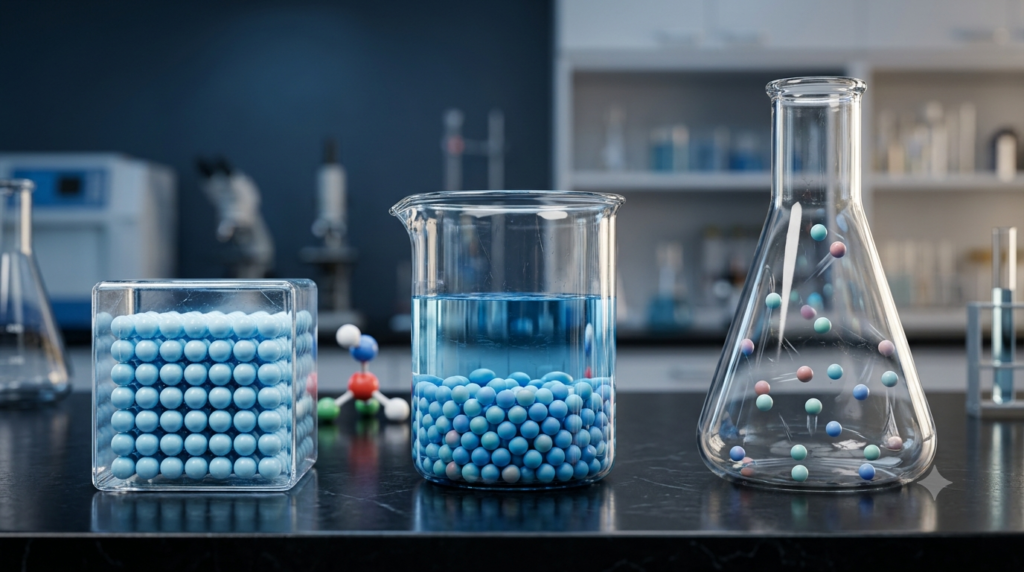
Everything around us is made of matter. The air we breathe, the water we drink, the food we eat, and the objects we use every day are all forms of matter. Although these substances may look different, they are made from tiny particles such as atoms and molecules. To understand the composition of matter, scientists classify substances into three important categories: elements, compounds, and mixtures.
These three categories help us understand what substances are made of, how their particles are arranged, and how they behave during physical and chemical changes. For example, oxygen is an element, water is a compound, and air is a mixture. Although all three contain particles, their compositions and properties are different.
In this article, we will explore elements, compounds, and mixtures with simple explanations, everyday examples, important differences, and methods used to separate mixtures.
What Is an Element?
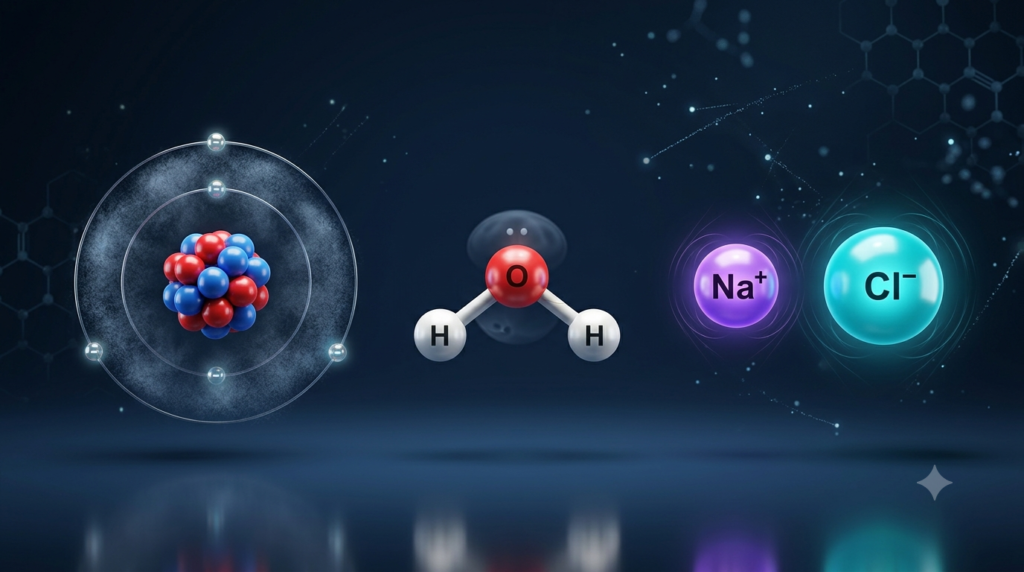
An element is a pure substance made up of only one type of atom. Each element contains atoms with the same number of protons in their nuclei. This number is called the atomic number, and it determines the identity of the element.
Elements are the basic building blocks of ordinary chemical substances. Scientists have identified 118 officially recognized chemical elements, including naturally occurring elements and elements produced artificially in laboratories.
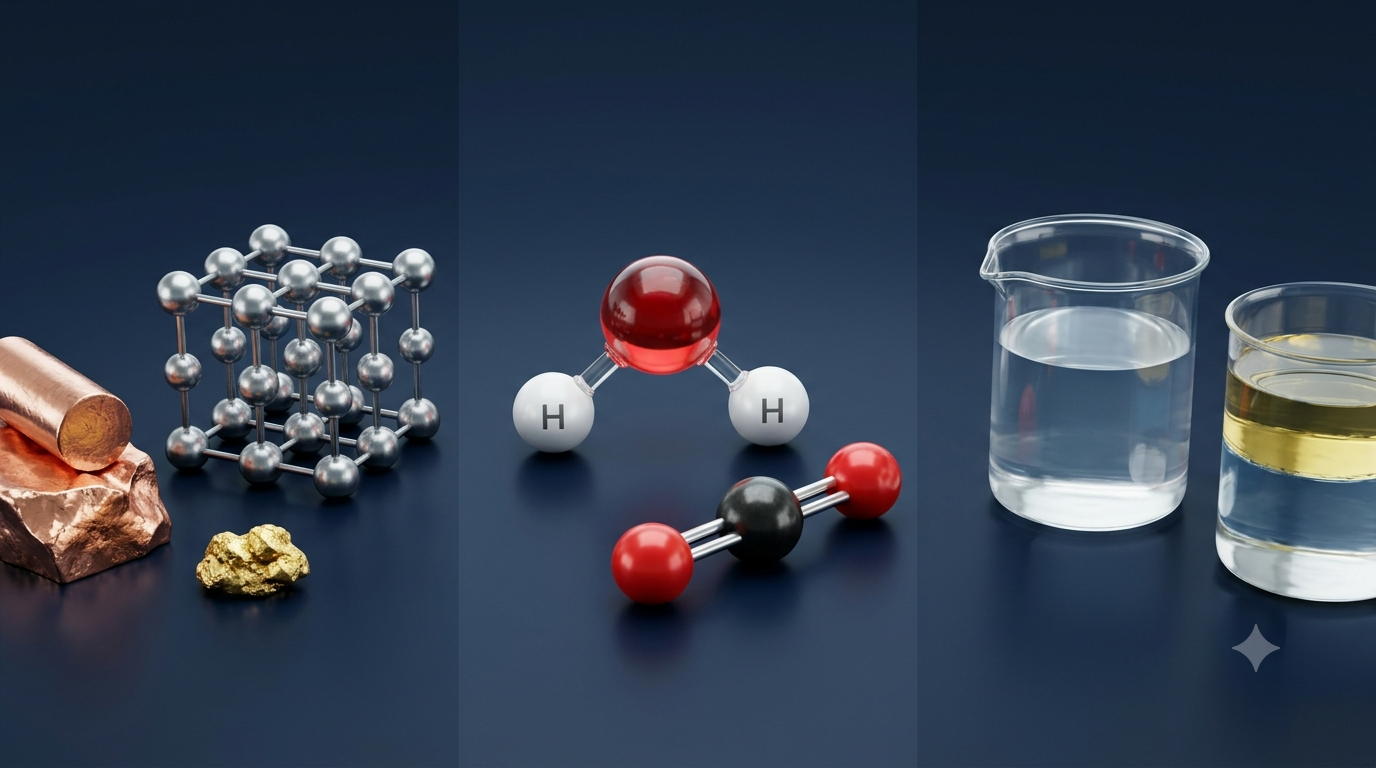
Examples of common elements include hydrogen, oxygen, carbon, iron, copper, gold, and helium.
Characteristics of Elements
Elements have several important characteristics.
One type of atom: An element contains atoms with the same atomic number.
Pure substance: A pure sample of an element is not a combination of different chemical substances.
Cannot be broken down chemically: An element cannot be converted into simpler substances by ordinary chemical reactions.
Unique properties: Each element has its own physical and chemical properties.
Chemical symbols: Every element has a symbol, usually consisting of one or two letters.
For example, the chemical symbol for oxygen is O, hydrogen is H, carbon is C, and iron is Fe.
An element may exist as individual atoms or as molecules containing atoms of the same element. For example, helium normally exists as individual atoms, while oxygen gas commonly exists as molecules containing two oxygen atoms.
Examples of Elements in Everyday Life
Oxygen: Oxygen is an essential element for aerobic respiration in humans and many other organisms. Oxygen gas commonly exists as O₂, meaning each molecule contains two oxygen atoms.
Iron: Iron is a metal used in buildings, machinery, tools, and vehicles. It is also an essential component of hemoglobin, which helps transport oxygen in human blood.
Copper: Copper is widely used in electrical wiring because it conducts electricity effectively. It is also used in plumbing and electronic equipment.
Gold: Gold is a valuable metal used in jewelry, electronic components, and certain specialized applications. It resists corrosion under many ordinary conditions.
Carbon: Carbon is present in living organisms and many everyday materials. Diamond and graphite are different forms of carbon, even though both are made from the same element.
Hydrogen: Hydrogen is the lightest chemical element. It is found in water and many organic compounds and is also used in several industrial processes.
Can an Element Exist as a Molecule?
Yes. An important point is that an element does not always consist of single, separate atoms.
For example, oxygen gas contains O₂ molecules, and nitrogen gas commonly contains N₂ molecules. Each molecule contains atoms of only one element.
Ozone, represented by O₃, is another form of oxygen. Its molecules contain three oxygen atoms instead of two.
Therefore, an element is identified by the type of atom it contains, not by whether its atoms exist individually or in molecules.
What Is a Compound?
A compound is a pure substance formed when atoms of two or more different elements combine chemically in a definite proportion.
When elements form a compound, their atoms become chemically bonded. The resulting substance generally has properties different from those of the elements from which it was formed.
For example, water is a compound made from hydrogen and oxygen. Hydrogen is a highly flammable gas, while oxygen supports combustion. However, water has very different properties and is commonly used to extinguish many types of fires.
This example shows that a compound is not simply a physical combination of its elements. Chemical bonding produces a substance with its own characteristics.
Characteristics of Compounds
Different elements: A compound contains atoms of at least two different elements.
Chemical bonding: Its constituent atoms are chemically bonded.
Fixed composition: A pure compound has a definite chemical composition.
New properties: Its properties generally differ from those of its constituent elements.
Chemical separation: Its constituent elements can be separated only through suitable chemical reactions or processes, not by ordinary physical separation methods.
Chemical formula: A compound is represented by a chemical formula showing which elements it contains and their relative numbers of atoms.
For example, the chemical formula H₂O represents water. It shows that each water molecule contains two hydrogen atoms and one oxygen atom.
Examples of Compounds in Everyday Life
Water (H₂O): Water consists of hydrogen and oxygen chemically bonded in a fixed ratio. It is essential for life and is used for drinking, cooking, cleaning, and many industrial processes.
Carbon dioxide (CO₂): Carbon dioxide contains carbon and oxygen. It is produced during respiration and combustion and is used by plants during photosynthesis.
Common salt (NaCl): Sodium chloride contains sodium and chlorine in a fixed ratio. Sodium is a highly reactive metal, and chlorine gas is toxic under ordinary exposure conditions, but sodium chloride is the main component of common table salt.
Ammonia (NH₃): Ammonia contains nitrogen and hydrogen. It is widely used in the production of fertilizers and in various industrial applications.
Methane (CH₄): Methane is a compound containing carbon and hydrogen. It is the main component of natural gas and is used as a fuel.
Calcium carbonate (CaCO₃): Calcium carbonate is found in materials such as limestone, chalk, and marble. It is also an important component of many seashells.
Understanding Chemical Formulas
A chemical formula communicates the composition of a substance through element symbols and numerical subscripts.
The following examples show how to interpret some common formulas.
<pre> Water: H₂O Carbon dioxide: CO₂ Ammonia: NH₃ Methane: CH₄ Calcium carbonate: CaCO₃ </pre>
In H₂O, the subscript 2 indicates that each water molecule contains two hydrogen atoms. Oxygen has no written subscript, so one oxygen atom is understood.
Similarly, CO₂ contains one carbon atom and two oxygen atoms per molecule.
These formulas describe the composition of each substance. They do not, by themselves, show the complete three-dimensional structure of the molecules.
Why Do Compounds Have Different Properties?
When elements react chemically, their atoms form new chemical arrangements. The resulting compound has its own structure and properties.
Consider sodium chloride. Sodium metal reacts vigorously with water, while chlorine is a poisonous gas. Yet sodium chloride, when pure, is a stable ionic compound commonly used as table salt.
The properties of a compound depend on factors such as its chemical bonding, structure, and the interactions between its particles.
This is why knowing the properties of the individual elements does not allow us to predict every property of the compound accurately.
What Is a Mixture?
A mixture is formed when two or more substances are combined physically without necessarily forming new chemical bonds between their constituent substances.
The substances in a mixture are called its components. These components may be elements, compounds, or both.
Unlike a pure compound, a mixture does not need to have a fixed composition. Its components can be present in different proportions.
For example, air is a mixture containing nitrogen, oxygen, argon, carbon dioxide, and other gases in varying amounts. The exact composition can change depending on the location and environmental conditions.
Similarly, sugar dissolved in water forms a mixture. The amount of sugar can be increased or decreased without changing sugar into a new compound.
Characteristics of Mixtures
Two or more substances: A mixture contains at least two substances physically combined.
Variable composition: The proportions of its components can change.
Components retain their identities: The components generally retain their chemical identities and characteristic properties.
Physical separation: Components can often be separated using physical methods such as filtration, evaporation, distillation, or magnetic separation.
No single chemical formula: A mixture does not have one fixed chemical formula representing all its components.
May be uniform or non-uniform: Mixtures can be homogeneous or heterogeneous.
Mixtures are extremely common in daily life. Food, beverages, soil, air, seawater, and many construction materials are examples.
Examples of Mixtures in Everyday Life
Air: Air is a mixture of several gases, mainly nitrogen and oxygen, along with argon, carbon dioxide, and other components. These gases are not chemically bonded together simply because they are present in the same sample of air.
Saltwater: Saltwater is formed by dissolving salt in water. The salt and water retain their chemical identities, and the salt can be recovered through suitable separation processes.
Soil: Soil contains different materials, including mineral particles, organic matter, water, air, and living organisms. Its composition varies from one location to another.
Fruit salad: A fruit salad combines different fruits without chemically converting them into one new substance. Individual pieces can usually be identified and separated by hand.
Brass: Brass is an alloy made mainly of copper and zinc. Its composition can vary depending on the intended application. Although brass appears uniform in many samples, it is still a mixture rather than a compound with a single fixed chemical formula.
Tea: Prepared tea is a mixture of water and dissolved substances extracted from tea leaves. Depending on how it is prepared, it may also contain milk, sugar, or suspended particles.
Types of Mixtures
Mixtures are commonly classified into two main types: homogeneous mixtures and heterogeneous mixtures.
Homogeneous Mixtures
A homogeneous mixture has a uniform composition throughout the sample at the scale being considered. Its components are distributed evenly, and different portions generally have the same composition.
Examples include:
Salt dissolved completely in water.
Sugar dissolved completely in water.
Air that is well mixed.
Many solutions of alcohol and water.
Certain metal alloys, such as uniform samples of brass.
Saltwater is a useful example. After salt dissolves completely, a small sample taken from one part of the solution has approximately the same composition as a sample taken from another part, provided the solution is well mixed.
Homogeneous mixtures are often called solutions. A solution may contain a solid, liquid, or gas dissolved in another substance.
For example, carbon dioxide dissolved in water forms a solution, and air is a mixture of gases.
Heterogeneous Mixtures
A heterogeneous mixture has a non-uniform composition. Its different components or regions may be distinguishable, either with the naked eye or using a microscope or other instruments.
Examples include:
Oil and water.
Sand mixed with water.
Soil.
A mixture of iron filings and sulfur powder.
Vegetable salad.
In a mixture of oil and water, the liquids form separate layers under ordinary conditions because they are largely immiscible. In sand and water, the sand does not dissolve and can settle to the bottom.
Heterogeneous mixtures can have different compositions in different regions. However, not every heterogeneous mixture has components that are easily visible without magnification.
Difference Between Homogeneous and Heterogeneous Mixtures
A homogeneous mixture is generally uniform throughout, whereas a heterogeneous mixture has a non-uniform composition.
For example, properly prepared saltwater is homogeneous, while muddy water containing suspended soil particles is heterogeneous.
The distinction depends on the scale and conditions of observation. Some mixtures that look uniform to the naked eye may contain different microscopic phases.
Difference Between Elements, Compounds, and Mixtures
Elements, compounds, and mixtures are related because they describe different ways matter can be organized. However, they differ in composition, bonding, properties, and methods of separation.
| Feature | Element | Compound | Mixture |
|---|---|---|---|
| Composition | One type of atom | Two or more elements chemically combined | Two or more substances physically combined |
| Proportion | Defined by the element’s identity | Fixed composition for a pure compound | Variable composition |
| Chemical bonding | May contain bonded atoms of the same element | Contains chemical bonds between different elements | Components do not have to be chemically bonded to one another |
| Properties | Characteristic properties of the element | Usually different from those of its constituent elements | Components generally retain their chemical identities |
| Separation | Cannot be broken down chemically into simpler substances | Can be decomposed through suitable chemical reactions | Often separated by physical methods |
| Representation | Chemical symbol | Chemical formula | No single fixed chemical formula |
| Examples | Iron, oxygen, copper | Water, carbon dioxide, sodium chloride | Air, saltwater, soil |
One important distinction is that a compound has a fixed composition, while a mixture can have different proportions of its components.
For example, pure water always has the same chemical composition. Saltwater, however, can contain a small amount of salt or a much larger amount, depending on how it is prepared.
How Can Mixtures Be Separated?
Since the components of a mixture generally retain their chemical identities, they can often be separated using differences in their physical properties. The appropriate method depends on the nature of the mixture.
Filtration
Filtration separates an insoluble solid from a liquid using a porous material called a filter.
For example, sand mixed with water can be separated by pouring the mixture through filter paper. The sand remains on the filter, while the water passes through.
Filtration is widely used in laboratories, water treatment, and many industrial processes. However, it does not remove every dissolved substance from water.
Evaporation
Evaporation can be used to recover a dissolved solid from a solution when the solvent is removed.
For example, salt can be obtained from saltwater by allowing the water to evaporate under suitable conditions.
This method is useful when recovering the solid is more important than collecting the evaporated solvent. Heating must be controlled when the substance is sensitive to heat.
Distillation
Distillation separates substances based on differences in their boiling behavior and volatility.
During distillation, a liquid mixture is heated so that vapor forms. The vapor is then cooled and condensed into liquid.
For example, distillation can be used to obtain water from a saltwater solution. The water vapor is condensed and collected, while most of the dissolved salt remains behind.
Fractional distillation is particularly useful for separating mixtures of liquids with different boiling ranges, such as the components of crude oil.
Magnetic Separation
Magnetic separation uses a magnet to remove magnetic materials from a mixture.
For example, iron filings can be separated from sand using a magnet. The iron responds to the magnetic field, while ordinary sand does not respond in the same way.
This technique is used in recycling, mineral processing, and industrial material separation.
Chromatography
Chromatography separates components according to how differently they interact with a moving phase and a stationary phase.
For example, paper chromatography can separate some of the colored substances present in ink. As a solvent moves through the paper, different substances travel different distances.
Chromatography is useful in chemistry, biology, food testing, and forensic investigations.
Separating Mixtures by Hand
Some mixtures contain large, easily identifiable components that can be separated manually.
For example, stones can be removed from rice, and different pieces of fruit can be picked out of a fruit salad.
This method is simple but becomes impractical when the particles are too small or the quantities are too large.
Can Elements and Compounds Be Separated?
Elements and compounds differ in how their constituents can be separated.
A mixture of iron filings and sulfur powder can be separated physically using a magnet, provided the iron is accessible and the separation conditions are suitable.
However, when iron and sulfur react chemically to form iron sulfide, a new compound is produced. The resulting compound cannot be separated into iron and sulfur simply by using a magnet under ordinary conditions. A suitable chemical process would be required.
Similarly, water cannot be separated into hydrogen and oxygen by ordinary filtration or evaporation. Electrolysis can decompose water into hydrogen and oxygen gases by using electrical energy and appropriate equipment.
This comparison highlights a fundamental difference between physical mixing and chemical combination.
Is Every Pure Substance an Element?
No. A pure substance may be either an element or a compound.
A pure element contains one type of atom, while a pure compound contains two or more elements chemically combined in a fixed composition.
For example, pure copper is an element, whereas pure water is a compound.
Both are pure substances, but their chemical compositions are different.
A pure substance has a characteristic composition and properties under specified conditions. A mixture, by contrast, contains multiple substances whose proportions may vary.
Can a Compound and a Mixture Look the Same?
Yes. Appearance alone is not always enough to determine whether a material is a compound or a mixture.
For example, pure water and saltwater can both appear clear and colorless. Nevertheless, pure water is a compound, while saltwater is a mixture.
Likewise, brass may look like a uniform metal even though it contains more than one element.
To classify a substance correctly, it is necessary to understand its composition and how its components are combined rather than relying only on its appearance.
Common Misconceptions About Elements, Compounds, and Mixtures
All Molecules Are Compounds
This statement is incorrect. Some molecules contain atoms of only one element.
For example, O₂ is a molecule but not a compound because it contains only oxygen atoms. H₂O is both a molecule and a compound because it contains hydrogen and oxygen chemically bonded together.
All Mixtures Are Heterogeneous
This is also incorrect. Mixtures can be homogeneous or heterogeneous.
Saltwater is homogeneous when the salt is completely dissolved and the solution is uniform. A mixture of oil and water is heterogeneous under ordinary conditions.
Compounds Can Be Separated by Filtration
Ordinary filtration separates certain physical components of mixtures. It cannot separate the hydrogen and oxygen in water because those elements are chemically combined in the compound.
A Mixture Always Contains Visible Components
Many mixtures appear completely uniform. Air, saltwater, and many alloys do not show clearly distinguishable components to the naked eye.
Therefore, a uniform appearance does not necessarily mean that a substance is a pure compound.
Every Chemical Formula Represents a Compound
Not every chemical formula represents a compound. Symbols such as Fe represent an element, and formulas such as O₂ represent molecules of an element.
A formula such as CO₂ represents a compound because it contains more than one element chemically combined.
Conclusion
Elements, compounds, and mixtures are three fundamental categories that help us understand the composition of matter. An element consists of one type of atom, a compound contains different elements chemically combined in a fixed proportion, and a mixture contains two or more substances physically combined in variable proportions.
Examples from everyday life make these differences easier to understand. Oxygen and iron are elements, water and sodium chloride are compounds, and air and saltwater are mixtures. Mixtures may be homogeneous or heterogeneous and can often be separated using physical methods such as filtration, evaporation, distillation, and chromatography.
Understanding these categories provides a foundation for studying chemistry and explaining the behavior of materials around us. Once you can distinguish between an element, a compound, and a mixture, it becomes easier to understand chemical reactions, solutions, separation techniques, and the composition of everyday substances.
FAQs
1. What is the main difference between an element, a compound, and a mixture?
An element is a pure substance containing only one type of atom, such as iron or oxygen. A compound is a pure substance formed when two or more different elements chemically combine in a fixed proportion, such as water (H₂O). A mixture contains two or more substances physically combined without necessarily forming new chemical bonds, such as air or saltwater. Elements cannot be broken down chemically into simpler substances, while compounds can be decomposed through suitable chemical reactions. Mixtures can often be separated using physical methods. These differences help scientists classify substances and understand their composition.
2. What are five examples of elements, compounds, and mixtures?
Five examples of elements are hydrogen, oxygen, carbon, iron, and copper. Each contains atoms with the same atomic number. Five examples of compounds are water (H₂O), carbon dioxide (CO₂), sodium chloride (NaCl), ammonia (NH₃), and methane (CH₄). These substances contain different elements chemically combined in fixed proportions. Five examples of mixtures are air, saltwater, soil, fruit salad, and brass. Their components are physically combined, and their proportions can vary. These examples demonstrate that everyday materials can be classified according to their composition and whether their constituent substances are chemically bonded together.
3. Why is water a compound and not a mixture?
Water is classified as a compound because hydrogen and oxygen are chemically bonded in a fixed proportion. Each water molecule contains two hydrogen atoms and one oxygen atom, represented by the formula H₂O. The properties of water are different from those of hydrogen and oxygen in their elemental forms. Water cannot be separated into hydrogen and oxygen through ordinary physical methods such as filtration or evaporation. However, it can be decomposed through electrolysis under suitable conditions. In contrast, saltwater is a mixture because salt and water retain their chemical identities and can be separated using appropriate physical processes.
4. What is the difference between homogeneous and heterogeneous mixtures?
A homogeneous mixture has a uniform composition throughout the sample at the scale being considered. Its components are distributed evenly, as in properly prepared saltwater or a well-mixed sample of air. A heterogeneous mixture has a non-uniform composition, meaning different regions may contain different proportions of its components. Examples include oil mixed with water, sand mixed with water, and soil. Homogeneous mixtures often appear as a single phase, whereas heterogeneous mixtures may contain multiple phases. However, appearance alone is not always sufficient to classify a material. Examining its composition and structure provides a more reliable understanding of the mixture.
5. Can elements be separated into simpler substances?
An element cannot be broken down into simpler substances through ordinary chemical reactions. It consists of atoms with the same atomic number, which determines the element’s identity. For example, pure copper cannot be chemically decomposed into a simpler substance while remaining an ordinary chemical process. However, elements can exist in different physical forms or combine with other elements to produce compounds. Nuclear reactions can transform one element into another by changing an atom’s nucleus, but this is different from ordinary chemical decomposition. The inability to decompose an element chemically is one of its most important defining characteristics.
6. How can mixtures be separated into their components?
Mixtures can often be separated by taking advantage of differences in the physical properties of their components. Filtration separates insoluble solids from liquids, while evaporation can recover dissolved solids from solutions. Distillation separates substances based on differences in their boiling behavior and volatility. Magnetic separation can remove magnetic materials, such as iron filings, from suitable mixtures. Chromatography separates substances according to their different interactions with stationary and moving phases. Handpicking is useful when the components are large and easily distinguishable. The best separation method depends on the mixture’s composition, the properties of its components, and which substances need to be recovered.
7. Is air an element, a compound, or a mixture?
Air is a mixture because it contains several gases that are physically combined. Its major components are nitrogen and oxygen, along with argon, carbon dioxide, water vapor, and other gases in smaller amounts. These components are not chemically bonded to one another simply because they occupy the same space. The composition of air can vary with location, altitude, humidity, and environmental conditions. Air is generally considered a homogeneous mixture when its gases are well mixed. Its components can be separated using appropriate physical techniques, including specialized industrial processes such as fractional distillation of liquefied air.
8. What is the difference between a molecule and a compound?
A molecule is a group of two or more atoms chemically bonded together. These atoms may belong to the same element or to different elements. For example, an oxygen molecule (O₂) contains two oxygen atoms, so it is a molecule but not a compound. A water molecule (H₂O) contains hydrogen and oxygen atoms, making water both a molecular substance and a compound. However, not every compound consists of separate molecules. Sodium chloride, for example, forms an ionic crystal structure rather than individual NaCl molecules under ordinary solid-state conditions. Therefore, molecules and compounds are related but not identical concepts.
9. Can a substance look uniform and still be a mixture?
Yes, a mixture can appear completely uniform even though it contains more than one substance. Saltwater is a common example because dissolved salt is distributed throughout the water, making the solution look like a single liquid. Air also appears uniform under ordinary conditions, although it contains several gases. Brass is another example of a mixture because it contains copper and zinc, even though a uniform sample may look like a single metal. Therefore, visual appearance alone cannot reliably distinguish a pure substance from a mixture. Understanding the material’s composition and the nature of its components is necessary for accurate classification.
10. Why is it important to understand elements, compounds, and mixtures?
Understanding elements, compounds, and mixtures provides a foundation for learning chemistry and explaining the composition of everyday materials. It helps students understand chemical reactions, the formation of compounds, the properties of solutions, and the separation of substances. These concepts are also important in industries such as medicine, food processing, water treatment, environmental science, and materials manufacturing. For example, water purification relies on separating unwanted substances from water, while chemical manufacturing often involves producing compounds from elements or other compounds. Learning these basic classifications makes it easier to understand more advanced topics, including atomic structure, chemical bonding, reactions, and analytical chemistry.