
In chemistry, substances are often represented using chemical formulas. A chemical formula tells us which elements are present and, in many cases, the ratio in which their atoms or ions are combined. When we study ionic compounds, however, we need a special term to describe the simplest ratio of ions present in the substance. This is called a formula unit.
The idea of formula units is especially important when studying compounds such as sodium chloride, magnesium oxide, calcium chloride, and potassium bromide. These substances do not consist of separate molecules in the same way that water or carbon dioxide does. Instead, their particles form large, repeating arrangements called crystal lattices. The formula unit represents the simplest whole-number ratio of ions in that arrangement.
Understanding formula units makes it easier to interpret chemical formulas, write formulas for ionic compounds, calculate formula mass, and understand how ions combine to form electrically neutral substances.
What Is a Formula Unit?
A formula unit is the simplest whole-number ratio of ions represented by the chemical formula of an ionic compound.
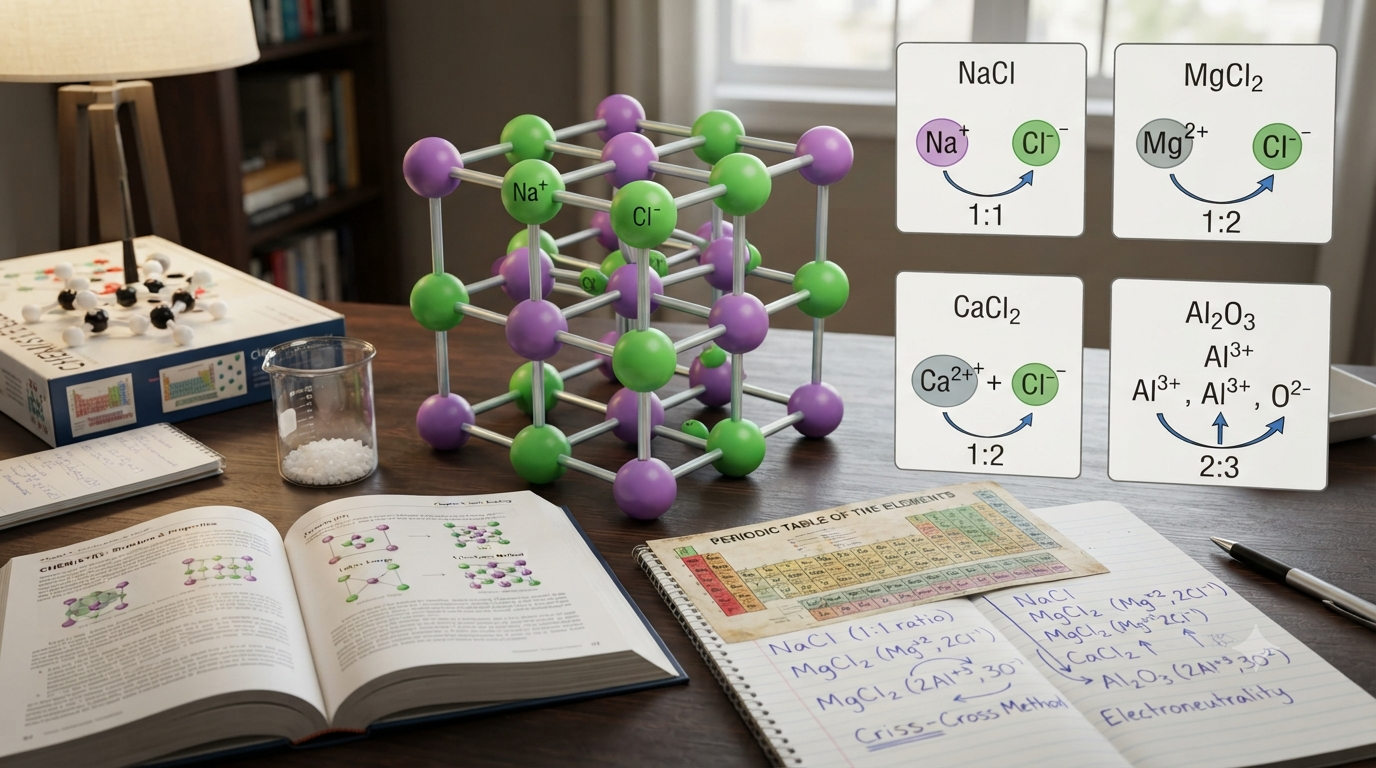
For example, sodium chloride has the chemical formula NaCl. Sodium forms Na⁺ ions, while chlorine forms Cl⁻ ions. One Na⁺ ion combines with one Cl⁻ ion, giving a 1:1 ratio. Therefore, NaCl represents one formula unit of sodium chloride.
Similarly, magnesium chloride has the formula MgCl₂. Magnesium forms Mg²⁺ ions, while chlorine forms Cl⁻ ions. Two chloride ions are needed to balance the charge of one magnesium ion.
Mg²⁺ + 2Cl⁻ → MgCl₂
The formula unit of magnesium chloride therefore represents the simplest ratio of 1 magnesium ion to 2 chloride ions.
The important point is that a formula unit does not necessarily describe one individual molecule. Instead, it gives the simplest ratio of ions present in an ionic compound.
Why Are Formula Units Used for Ionic Compounds?
To understand why formula units are used, we first need to look at how ionic compounds are structured.
Ionic compounds are usually formed when positively charged ions, called cations, and negatively charged ions, called anions, attract each other. These oppositely charged ions arrange themselves in an organized three-dimensional structure.
For example, solid sodium chloride does not contain separate NaCl molecules floating independently. Instead, Na⁺ and Cl⁻ ions are arranged repeatedly throughout a crystal lattice.
Because there is no single, independent NaCl molecule in the solid crystal, chemists use the term formula unit rather than molecule.
The formula NaCl tells us that the ratio of sodium ions to chloride ions is 1:1.
Likewise:
MgO represents a 1:1 ratio of Mg²⁺ and O²⁻ ions.
CaCl₂ represents a 1:2 ratio of Ca²⁺ and Cl⁻ ions.
Al₂O₃ represents a 2:3 ratio of Al³⁺ and O²⁻ ions.
The formula gives the simplest ratio needed to produce an electrically neutral compound.
Formula Unit vs Molecule
Formula units and molecules are related to chemical formulas, but they are not the same thing.
A molecule is an independent group of atoms held together by covalent bonds. For example, water has the formula H₂O. One water molecule contains two hydrogen atoms covalently bonded to one oxygen atom.
Carbon dioxide, CO₂, also exists as individual molecules. Each molecule contains one carbon atom and two oxygen atoms.
Ionic compounds are different. Their ions form extended structures rather than separate molecular units.
For example:
H₂O → molecule
CO₂ → molecule
NaCl → formula unit
MgO → formula unit
CaCl₂ → formula unit
This distinction is important because saying that sodium chloride contains “NaCl molecules” can give the wrong picture of its structure. The more accurate description is that sodium chloride contains Na⁺ and Cl⁻ ions arranged in a crystal lattice, with NaCl representing their simplest ratio.
How Does a Formula Unit Show Ion Ratios?
The subscripts in an ionic chemical formula tell us the ratio of ions.
Consider calcium chloride:
CaCl₂
The absence of a subscript after Ca means there is one calcium ion. The subscript 2 after Cl means there are two chloride ions.
Therefore:
CaCl₂ = 1 Ca²⁺ : 2 Cl⁻
The total positive charge is:
1 × (+2) = +2
The total negative charge is:
2 × (−1) = −2
The charges cancel:
+2 + (−2) = 0
Therefore, CaCl₂ is electrically neutral.
The formula unit represents this simplest neutral ratio.
Examples of Formula Units
Several common ionic compounds can be understood by examining their formula units.
Sodium Chloride
Sodium chloride has the formula:
NaCl
Na⁺ has a +1 charge, and Cl⁻ has a −1 charge.
Therefore:
1 Na⁺ : 1 Cl⁻
The formula unit contains sodium and chloride ions in a 1:1 ratio.
Magnesium Oxide
Magnesium oxide has the formula:
MgO
Mg²⁺ has a +2 charge, while O²⁻ has a −2 charge.
Therefore:
1 Mg²⁺ : 1 O²⁻
The charges balance directly.
Calcium Chloride
Calcium chloride has the formula:
CaCl₂
Ca²⁺ has a +2 charge, while Cl⁻ has a −1 charge.
Therefore, two chloride ions are needed:
1 Ca²⁺ : 2 Cl⁻
The total charge is zero.
Aluminum Oxide
Aluminum oxide has the formula:
Al₂O₃
Al³⁺ ions have a +3 charge, while O²⁻ ions have a −2 charge.
Two aluminum ions give:
2 × (+3) = +6
Three oxide ions give:
3 × (−2) = −6
The charges cancel.
Therefore:
2 Al³⁺ : 3 O²⁻
The formula unit is Al₂O₃.
How Are Formula Units Determined?
Formula units are determined by finding the simplest ratio of ions that produces an electrically neutral compound.
A useful method is to follow these steps:
Step 1: Identify the Ions
First, determine the positive and negative ions present.
For calcium chloride:
Ca²⁺ and Cl⁻
Step 2: Identify Their Charges
Calcium has a +2 charge, while chloride has a −1 charge.
Step 3: Balance the Charges
Two chloride ions are required to balance one calcium ion.
Ca²⁺ + 2Cl⁻ → CaCl₂
Step 4: Write the Simplest Ratio
The ratio is:
1 Ca²⁺ : 2 Cl⁻
Therefore, CaCl₂ is the formula unit.
This process ensures that the total positive and negative charges are equal.
Formula Units and Electrical Neutrality
One of the most important ideas behind formula units is electrical neutrality.
An ionic compound must have an overall charge of zero. This means the total positive charge from the cations must equal the total negative charge from the anions.
For example, consider aluminum oxide, Al₂O₃.
Two Al³⁺ ions provide:
2 × +3 = +6
Three O²⁻ ions provide:
3 × −2 = −6
Therefore:
+6 + −6 = 0
The compound is electrically neutral.
The formula unit Al₂O₃ shows the smallest whole-number ratio that achieves this balance.
Formula Units and Chemical Formulas
A chemical formula does more than name the elements present. For ionic compounds, it also communicates the relative number of ions.
For example:
KBr
means:
1 K⁺ : 1 Br⁻
MgCl₂
means:
1 Mg²⁺ : 2 Cl⁻
Al₂O₃
means:
2 Al³⁺ : 3 O²⁻
The subscripts are therefore extremely important. They should not be treated as decorative numbers. They provide information about the composition of the compound.
Changing a subscript changes the identity of the compound.
For example, MgCl₂ and MgCl are not interchangeable formulas. MgCl₂ represents the neutral ionic compound formed from Mg²⁺ and Cl⁻ ions in a 1:2 ratio.
Formula Unit and Formula Mass
The concept of formula units is also important when calculating the formula mass of ionic compounds.
Formula mass is the sum of the atomic masses of all atoms represented in one formula unit.
For example, sodium chloride has the formula NaCl. Its formula mass is calculated by adding the atomic masses of sodium and chlorine.
For magnesium chloride:
MgCl₂
the formula mass includes:
1 magnesium atom
2 chlorine atoms
Therefore:
Formula mass = atomic mass of Mg + 2 × atomic mass of Cl
The term “formula mass” is commonly used for ionic compounds because the formula represents a formula unit rather than an individual molecule.
Formula Units and Moles
Formula units are also used when discussing amounts of ionic substances.
A mole of an ionic compound contains an enormous number of formula units. One mole contains approximately 6.022 × 10²³ formula units.
For example, one mole of NaCl contains approximately 6.022 × 10²³ formula units of NaCl.
Each formula unit represents the 1:1 ratio of Na⁺ and Cl⁻ ions. Therefore, one mole of NaCl contains equal numbers of sodium ions and chloride ions.
Similarly, one mole of CaCl₂ contains:
1 mole of Ca²⁺ ions
2 moles of Cl⁻ ions
This relationship is useful in stoichiometry and chemical calculations.
Formula Units in Ionic Crystal Structures
The arrangement of ions in a crystal lattice helps explain why the idea of a formula unit is useful.
Imagine a repeating three-dimensional pattern containing positive and negative ions. The entire crystal may contain an enormous number of ions. However, the chemical formula provides a simple way to describe the overall composition.
For sodium chloride, the crystal contains many Na⁺ and Cl⁻ ions arranged in a repeating pattern. The formula NaCl summarizes that arrangement by giving the simplest ratio of the two ions.
Thus, the formula unit is not necessarily a physical “piece” that can be separated from the crystal. It is a convenient chemical representation of the simplest ion ratio.
Common Mistakes About Formula Units
Several common misunderstandings can make formula units confusing.
Mistake 1: Thinking Every Chemical Formula Represents a Molecule
Not every chemical formula represents a molecule.
Molecular substances such as H₂O and CO₂ consist of molecules, while ionic compounds such as NaCl and MgO are represented using formula units.
Mistake 2: Ignoring Subscripts
The subscripts tell us the ratio of ions or atoms.
In CaCl₂, the 2 means two chloride ions are associated with each calcium ion in the simplest ratio.
Mistake 3: Changing Subscripts When Balancing Charges
When writing an ionic formula, subscripts must produce the simplest neutral ratio. They should not be changed randomly.
For example, Al³⁺ and O²⁻ combine as:
Al₂O₃
not AlO or Al₃O₂.
Mistake 4: Calling an Ionic Compound a Collection of Molecules
It is more accurate to describe solid ionic compounds as extended crystal lattices of ions. Their formulas represent formula units rather than separate molecules.
Why Are Formula Units Important in Chemistry?
Formula units provide a simple way to understand the composition of ionic compounds. They connect several important chemical concepts, including ions, charge balance, chemical formulas, crystal structures, formula mass, moles, and stoichiometry.
When you understand formula units, a chemical formula such as CaCl₂ becomes more meaningful. Instead of simply memorizing the formula, you can recognize that it represents one calcium ion for every two chloride ions in the simplest neutral ratio.
This understanding becomes particularly useful when writing ionic formulas from ion charges. It also helps when calculating the amount of a substance involved in a chemical reaction.
Conclusion
A formula unit is the simplest whole-number ratio of ions represented by the chemical formula of an ionic compound. It is used because ionic compounds generally form extended crystal lattices rather than separate molecules.
For example, NaCl represents a 1:1 ratio of Na⁺ and Cl⁻ ions, while CaCl₂ represents a 1:2 ratio of Ca²⁺ and Cl⁻ ions. The subscripts in a formula show how many ions are required to balance the total positive and negative charges.
Formula units are therefore more than simple symbols on a page. They provide a compact way to describe the composition of ionic substances and form an important foundation for understanding chemical formulas, formula mass, moles, and stoichiometry.
FAQs
1. What is a formula unit in chemistry?
A formula unit is the simplest whole-number ratio of ions represented by the chemical formula of an ionic compound. Ionic compounds usually form large crystal lattices rather than separate molecules, so the term formula unit is used to describe their composition. For example, sodium chloride has the formula NaCl, which represents a 1:1 ratio of sodium ions, Na⁺, and chloride ions, Cl⁻. Calcium chloride, CaCl₂, represents a 1:2 ratio of calcium ions to chloride ions. Formula units are important because they show how ions combine to form an electrically neutral compound and help us understand chemical formulas, formula mass, moles, and stoichiometric calculations.
2. Why are formula units used for ionic compounds?
Formula units are used for ionic compounds because these substances generally do not exist as separate molecules in their solid state. Instead, positively charged and negatively charged ions form a repeating three-dimensional crystal lattice. A chemical formula represents the simplest ratio of those ions within the structure. For example, NaCl does not describe one independent NaCl molecule in a crystal. It represents a 1:1 ratio of Na⁺ and Cl⁻ ions. Similarly, MgCl₂ represents one Mg²⁺ ion for every two Cl⁻ ions. Therefore, the term formula unit gives a more accurate description of the composition of an ionic compound.
3. What is the difference between a formula unit and a molecule?
A formula unit represents the simplest ratio of ions in an ionic compound, while a molecule is an independent group of atoms held together by covalent bonds. For example, water, H₂O, exists as individual molecules, with each molecule containing two hydrogen atoms and one oxygen atom. Carbon dioxide, CO₂, also consists of individual molecules. Sodium chloride, NaCl, is different because its ions form an extended crystal lattice. Therefore, NaCl is described using a formula unit rather than a molecule. Understanding this difference helps explain why terms such as molecular mass and formula mass are used differently for molecular and ionic substances.
4. How does a formula unit show the ratio of ions?
A formula unit shows the ratio of ions through the subscripts written in the chemical formula. For example, CaCl₂ contains one calcium ion and two chloride ions in the simplest ratio. Calcium forms Ca²⁺, while chloride forms Cl⁻. Two chloride ions provide a total charge of −2, which balances the +2 charge of one calcium ion. Therefore, CaCl₂ represents a 1:2 ratio of calcium ions to chloride ions. Similarly, Al₂O₃ represents two Al³⁺ ions and three O²⁻ ions. The subscripts are therefore important because they communicate the relative numbers of ions required to produce an electrically neutral ionic compound.
5. Why must a formula unit have an overall neutral charge?
An ionic compound must have an overall electrical charge of zero because positive and negative charges balance each other. The formula unit represents the simplest ratio of ions that produces this neutrality. For example, magnesium forms Mg²⁺ and chlorine forms Cl⁻. One Mg²⁺ ion has a +2 charge, so two Cl⁻ ions, each with a −1 charge, are needed. The resulting formula is MgCl₂. Its total charge is +2 + (−2) = 0. If the charges were not balanced, the formula would not correctly represent a neutral ionic compound. Charge balance is therefore a fundamental principle when writing formula units.
6. How do you determine the formula unit of an ionic compound?
To determine a formula unit, first identify the cation and anion and their charges. Then find the smallest whole-number ratio that makes the total positive and negative charges equal. For example, aluminum forms Al³⁺ and oxygen forms O²⁻. The smallest common charge is 6. Two Al³⁺ ions provide +6, while three O²⁻ ions provide −6. Therefore, the formula unit is Al₂O₃. Another example is calcium chloride. Ca²⁺ requires two Cl⁻ ions to balance its charge, giving CaCl₂. This method helps you write correct ionic formulas without simply memorizing individual compounds.
7. Is NaCl a molecule or a formula unit?
NaCl is represented as a formula unit when referring to solid sodium chloride. Sodium chloride forms a crystal lattice in which Na⁺ and Cl⁻ ions are arranged in a repeating pattern. There are not separate NaCl molecules distributed throughout the solid in the same way that water contains individual H₂O molecules. The formula NaCl represents the simplest 1:1 ratio of sodium ions to chloride ions in the lattice. Therefore, it is more accurate to say that NaCl represents a formula unit of sodium chloride. This distinction is important when studying ionic structures, chemical formulas, and the properties of ionic compounds.
8. What is the relationship between formula units and formula mass?
Formula units are directly connected to the calculation of formula mass. Formula mass is the total of the atomic masses represented in one formula unit of an ionic compound. For example, MgCl₂ contains one magnesium atom and two chlorine atoms in its formula. Therefore, its formula mass is calculated by adding the atomic mass of magnesium to twice the atomic mass of chlorine. The term formula mass is preferred for ionic compounds because their formulas represent formula units rather than independent molecules. Formula mass is useful for converting between the mass of an ionic substance and the amount of that substance in chemical calculations.
9. How many formula units are present in one mole of an ionic compound?
One mole of an ionic compound contains approximately 6.022 × 10²³ formula units. This number is known as Avogadro’s constant. For example, one mole of sodium chloride contains approximately 6.022 × 10²³ formula units of NaCl. Each formula unit represents one Na⁺ ion for every Cl⁻ ion. For calcium chloride, one mole contains approximately 6.022 × 10²³ formula units of CaCl₂. Because each formula unit contains one calcium ion and two chloride ions, one mole of CaCl₂ corresponds to one mole of calcium ions and two moles of chloride ions. This relationship is essential in stoichiometric calculations.
10. Why are formula units important in chemistry?
Formula units are important because they provide a simple way to describe the composition of ionic compounds. They show the simplest whole-number ratio of ions and help explain how positive and negative charges balance. Formula units are also useful when writing ionic formulas, calculating formula mass, determining mole relationships, and solving stoichiometry problems. For example, CaCl₂ immediately tells us that the compound contains calcium and chloride ions in a 1:2 ratio. Understanding formula units also prevents confusion between ionic compounds and molecular substances. Once this concept is clear, many chemical formulas become easier to interpret and use in calculations.
Related Posts
What Is a Reference Point in Physics?
In physics, we often describe where an object is, how it moves, or how far it has traveled. But to […]
Read MoreWhat Is Dimensional Consistency in Physics?
Physics uses mathematical equations to describe how different physical quantities are related. When scientists write an equation, every quantity in […]
Read MoreFormula Units vs Molecules in Chemistry
Chemistry uses formulas to describe the substances that make up the world around us. When we see formulas such as […]
Read MoreSI Unit of Electric Current Ampere Explained
Electric current is one of the most important physical quantities in electricity and magnetism. Whenever electric charge moves through a […]
Read MoreWhat Is Momentum in Physics?
Momentum is one of the fundamental concepts in physics used to describe the motion of an object. It helps us […]
Read MoreHow to Calculate Molar Mass From a Chemical Formula
Molar mass is one of the most useful concepts in chemistry because it connects the microscopic world of atoms and […]
Read MoreThe Seven SI Base Units Explained with Examples

Every measurement in science needs a standard unit. Without standard units, it would be difficult to compare measurements made by […]
Read MoreHow can chemical formulas be used to understand chemical reactions?
Chemical reactions are processes in which substances change into new substances. We can observe some reactions through changes in color, […]
Read MoreHow to Write Formulas for Molecular Compounds
Writing the formula of a molecular compound is an important skill in chemistry. A chemical formula tells us which elements […]
Read MoreHow to Memorize Important Chemistry Formulas Effectively
Chemistry involves many formulas, symbols, equations, and chemical relationships. At first, remembering them can feel difficult because a single topic […]
Read MoreHow to Check Whether a Chemical Formula Is Correct
A chemical formula is a short way of representing a substance using chemical symbols and numbers. It tells us which […]
Read MoreSI Unit of Length Metre and Its Modern Definition
Length is one of the most basic quantities measured in science. Whether we measure the distance between two cities, the […]
Read MoreCommon Formulas of Important Inorganic Compounds
Inorganic compounds are found everywhere around us, from table salt and baking soda to fertilizers, minerals, medicines, cleaning products, and […]
Read MoreSI Base Units and Their Symbols Explained
Science depends on measurement. Whether scientists are studying the motion of a spacecraft, the temperature of a material, the mass […]
Read MoreWhat information can be obtained from a chemical formula?
A chemical formula is a short and powerful way of representing a substance. It uses chemical symbols and numbers to […]
Read MoreHow to Build a Basic Chemistry Formula Reference Sheet
Chemistry involves many formulas, symbols, equations, names, and relationships that are useful for solving problems and understanding chemical reactions. As […]
Read MoreWhen Should You Simplify Chemical Formula Ratios?
Chemical formulas are more than collections of symbols and numbers. They show which elements are present in a substance and, […]
Read MoreHow Does Physics Explain the Natural World?
Physics is one of the most powerful ways humans try to understand the natural world. From the motion of planets […]
Read MoreWhy does every physical quantity need a unit?
Imagine someone tells you that a table is “2” long. Does that tell you how long the table actually is? […]
Read MoreWhat Is Dimensional Analysis in Physics?
Physics is full of equations, measurements, and mathematical relationships. But how can we know whether an equation makes physical sense? […]
Read MoreHow to Calculate Formula Mass From a Chemical Formula
Formula mass is an important concept in chemistry because it connects a chemical formula with the masses of the atoms […]
Read MoreHow to Solve Physics Formula Based Problems
Physics formula-based problems become much easier when you understand what a formula means and how to use it correctly. Many […]
Read MoreDifferent Forms of Energy Explained
Energy is one of the most important ideas in science. It is involved in almost everything that happens around us, […]
Read MoreSI Unit of Mass Kilogram and Why It Is the Base Unit
Mass is one of the most important physical quantities in physics. It tells us how much matter an object contains […]
Read MoreHow Chemical Formulas Relate to the Mole Concept
Chemistry often uses symbols, numbers, and formulas to describe substances that cannot be seen directly. A chemical formula tells us […]
Read MoreWhat does a subscript mean in a chemical formula?

A chemical formula is a short way of showing what a substance is made of. Instead of writing the names […]
Read MoreHow are chemical formulas used in stoichiometric calculations?
Chemical formulas are one of the most important tools used in chemistry. They tell us which elements are present in […]
Read MoreHow to Calculate Percentage Composition From a Formula
Percentage composition is a useful concept in chemistry that tells us how much of each element is present in a […]
Read MoreWhat Is Valency in Chemistry?
Valency is one of the basic concepts in chemistry that helps us understand how atoms combine with one another to […]
Read MoreHow to Read Subscripts in Chemical Formulas
Chemical formulas are a simple way to represent substances using symbols and numbers. When you look at a formula such […]
Read More