
Chemistry becomes much easier when you understand how chemical formulas represent substances. A chemical formula is a short way of showing which elements are present in a substance and how many atoms of each element are involved. From simple compounds such as water and carbon dioxide to more complex substances such as calcium carbonate and sulfuric acid, formulas provide important information about chemical composition.
For beginners, learning chemistry formulas is not simply about memorizing symbols. It is more useful to understand what each symbol, subscript, and coefficient means and how formulas are constructed. Once these basics are clear, you can write formulas, identify elements, count atoms, calculate formula masses, and understand chemical equations more confidently.
This guide introduces essential chemistry formulas that beginners commonly encounter. It covers elements, common compounds, acids, bases, salts, oxides, molecular formulas, ionic formulas, and some important formulas used in basic chemistry calculations.
What Is a Chemical Formula?
A chemical formula is a symbolic representation of a chemical substance. It uses the symbols of elements and numerical subscripts to show the composition of the substance.
For example:
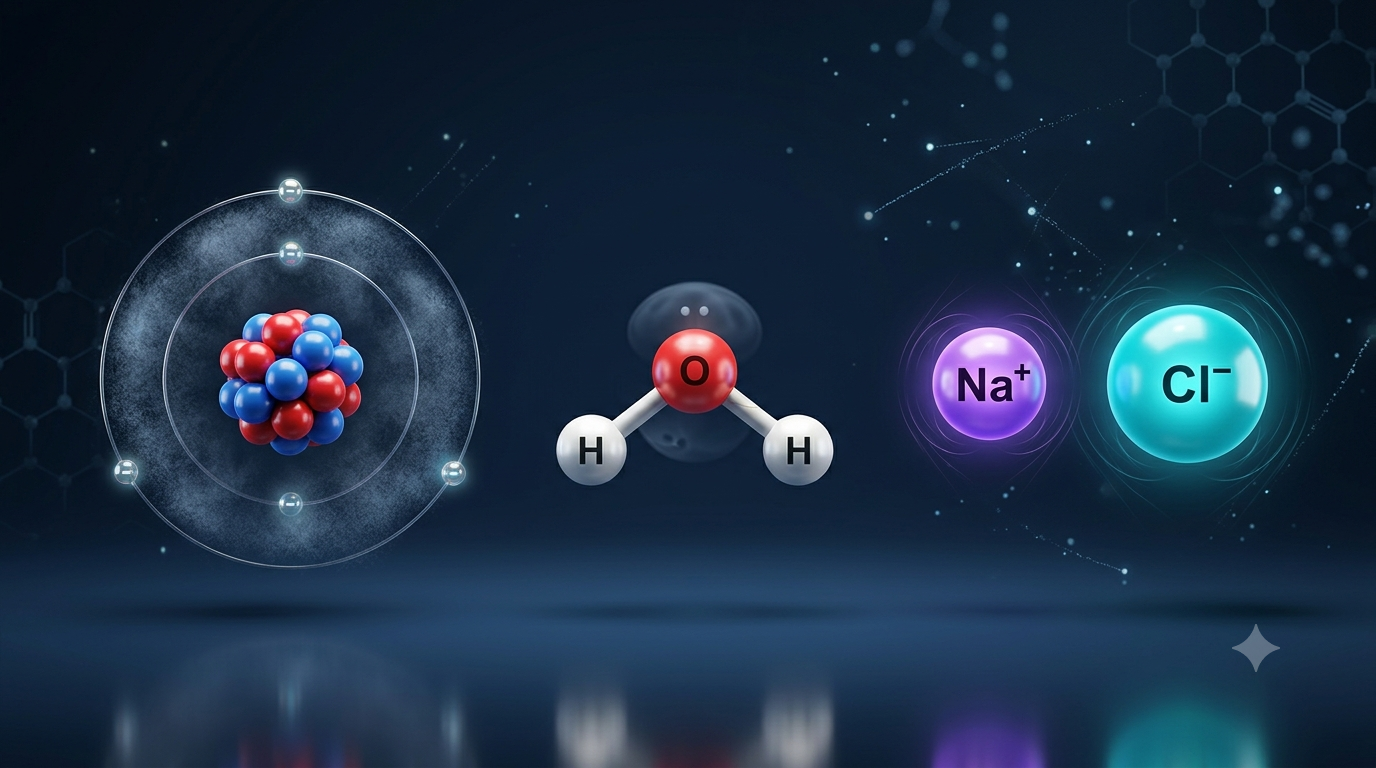
H₂O
The formula for water contains hydrogen (H) and oxygen (O). The subscript ₂ means that two hydrogen atoms are present for every one oxygen atom.
Similarly:
CO₂
This formula represents carbon dioxide. It contains one carbon atom and two oxygen atoms.
A chemical formula therefore gives information about the elements present and their relative numbers of atoms.
Why Are Chemistry Formulas Important?
Chemical formulas are one of the basic languages of chemistry. They allow scientists and learners to describe substances without writing their full names repeatedly.
Formulas help you:
Identify the elements in a compound.
Determine the number of atoms in a formula.
Understand the composition of substances.
Write and balance chemical equations.
Calculate molecular mass or formula mass.
Determine the ratio of ions in ionic compounds.
Recognize acids, bases, salts, and oxides.
Understand chemical reactions and stoichiometry.
Learning common formulas also makes it easier to read chemistry textbooks, laboratory instructions, equations, and scientific information.
Chemical Symbols Used in Formulas
Before learning compounds, it is important to recognize common element symbols.
Some frequently used elements include:
Hydrogen — H
Helium — He
Carbon — C
Nitrogen — N
Oxygen — O
Fluorine — F
Sodium — Na
Magnesium — Mg
Aluminium — Al
Silicon — Si
Phosphorus — P
Sulfur — S
Chlorine — Cl
Potassium — K
Calcium — Ca
Iron — Fe
Copper — Cu
Zinc — Zn
Silver — Ag
Gold — Au
Mercury — Hg
Lead — Pb
Notice that element symbols may contain one or two letters. The first letter is always capitalized, while the second letter, when present, is lowercase.
For example, Co represents cobalt, while CO would represent carbon and oxygen separately.
Understanding Subscripts in Chemical Formulas
A subscript is a small number written after an element symbol. It tells you how many atoms of that element are represented.
Consider:
H₂O
There are two hydrogen atoms and one oxygen atom.
Another example is:
NH₃
This formula contains one nitrogen atom and three hydrogen atoms.
If no subscript is written, the number is understood to be one.
Therefore:
NaCl
contains one sodium atom and one chlorine atom in its simplest formula ratio.
Common Molecular Formulas
Molecular formulas are commonly used for substances made of molecules. Some important examples are:
| Substance | Formula |
|---|---|
| Water | H₂O |
| Hydrogen | H₂ |
| Oxygen | O₂ |
| Nitrogen | N₂ |
| Chlorine | Cl₂ |
| Carbon dioxide | CO₂ |
| Carbon monoxide | CO |
| Ammonia | NH₃ |
| Methane | CH₄ |
| Ethane | C₂H₆ |
| Ethene | C₂H₄ |
| Ethyne | C₂H₂ |
Several elemental substances naturally exist as diatomic molecules. Common examples include hydrogen (H₂), nitrogen (N₂), oxygen (O₂), fluorine (F₂), chlorine (Cl₂), bromine (Br₂), and iodine (I₂).
Common Ionic Compound Formulas
Ionic compounds are generally formed from positive ions and negative ions. Their formulas show the simplest whole-number ratio of the ions.
Some common ionic compounds are:
Sodium chloride — NaCl
Magnesium chloride — MgCl₂
Calcium chloride — CaCl₂
Sodium oxide — Na₂O
Magnesium oxide — MgO
Calcium oxide — CaO
Aluminium oxide — Al₂O₃
Potassium chloride — KCl
Sodium sulfide — Na₂S
Calcium sulfide — CaS
For example, sodium forms the ion Na⁺ and chlorine forms Cl⁻. One sodium ion balances one chloride ion, giving:
NaCl
Calcium commonly forms Ca²⁺, while chloride forms Cl⁻. Two chloride ions are therefore required to balance one calcium ion:
CaCl₂
Understanding ion charges is essential for writing ionic formulas correctly.
Common Acids and Their Formulas
Acids are an important group of chemical substances. Many common acids have simple formulas that beginners should learn.
Some important examples include:
Hydrochloric acid — HCl
Sulfuric acid — H₂SO₄
Nitric acid — HNO₃
Carbonic acid — H₂CO₃
Phosphoric acid — H₃PO₄
Acetic acid — CH₃COOH
For example, sulfuric acid has the formula:
H₂SO₄
It contains two hydrogen atoms, one sulfur atom, and four oxygen atoms.
Acetic acid, commonly associated with vinegar, has the formula:
CH₃COOH
Its molecular formula can also be written as C₂H₄O₂.
Common Bases and Their Formulas
Bases are another important group of substances. Many familiar bases are metal hydroxides.
Common examples include:
Sodium hydroxide — NaOH
Potassium hydroxide — KOH
Calcium hydroxide — Ca(OH)₂
Magnesium hydroxide — Mg(OH)₂
Aluminium hydroxide — Al(OH)₃
Ammonia — NH₃
The hydroxide ion is represented by:
OH⁻
When more than one hydroxide ion is needed in a formula, parentheses are used.
For example:
Ca(OH)₂
The subscript ₂ applies to the entire hydroxide group. Therefore, this formula contains one calcium atom, two oxygen atoms, and two hydrogen atoms.
Common Salts and Their Formulas
Salts are an important class of compounds. They can be produced through different chemical reactions, including reactions between acids and bases.
Some common salts include:
Sodium chloride — NaCl
Potassium nitrate — KNO₃
Sodium carbonate — Na₂CO₃
Sodium bicarbonate — NaHCO₃
Calcium carbonate — CaCO₃
Copper sulfate — CuSO₄
Magnesium sulfate — MgSO₄
Ammonium chloride — NH₄Cl
Sodium bicarbonate is commonly known as baking soda and has the formula:
NaHCO₃
Calcium carbonate has the formula:
CaCO₃
It is found in substances such as limestone, marble, and chalk.
Common Oxide Formulas
Oxides are compounds in which oxygen is combined with another element.
Some common oxides include:
Carbon dioxide — CO₂
Carbon monoxide — CO
Sulfur dioxide — SO₂
Sulfur trioxide — SO₃
Magnesium oxide — MgO
Calcium oxide — CaO
Aluminium oxide — Al₂O₃
Iron(II) oxide — FeO
Iron(III) oxide — Fe₂O₃
Copper(II) oxide — CuO
The formula Fe₂O₃, for example, represents iron(III) oxide. It contains two iron atoms and three oxygen atoms in the formula unit.
Common Polyatomic Ions
Some ions contain several atoms joined together and carry an overall charge. These are called polyatomic ions.
Important examples include:
| Polyatomic ion | Formula | Charge |
|---|---|---|
| Hydroxide | OH⁻ | −1 |
| Nitrate | NO₃⁻ | −1 |
| Nitrite | NO₂⁻ | −1 |
| Sulfate | SO₄²⁻ | −2 |
| Sulfite | SO₃²⁻ | −2 |
| Carbonate | CO₃²⁻ | −2 |
| Bicarbonate | HCO₃⁻ | −1 |
| Phosphate | PO₄³⁻ | −3 |
| Ammonium | NH₄⁺ | +1 |
These ions are important because they appear in many common chemical formulas.
For example, calcium has a charge of +2 and nitrate has a charge of −1. Two nitrate ions are required for every calcium ion:
Ca(NO₃)₂
The parentheses show that the subscript ₂ applies to the complete nitrate ion.
How to Write Ionic Formulas Using Charges
One useful beginner skill is learning how to construct formulas from ion charges.
Suppose you want to write the formula for aluminium oxide.
Aluminium commonly forms:
Al³⁺
Oxygen commonly forms:
O²⁻
The total positive and negative charges must balance. The smallest combination is two aluminium ions and three oxide ions:
Al₂O₃
The total charge is:
2 × (+3) = +6
3 × (−2) = −6
Therefore, the overall compound is electrically neutral.
This charge-balancing method is useful for many ionic compounds.
Understanding Coefficients in Chemical Equations
A coefficient is a number written in front of a chemical formula. It is different from a subscript.
For example:
2H₂O
The coefficient 2 means there are two water molecules.
Each H₂O molecule contains two hydrogen atoms and one oxygen atom. Therefore, 2H₂O contains:
4 hydrogen atoms
2 oxygen atoms
Changing a coefficient changes the number of molecules or formula units represented. Changing a subscript changes the identity or composition of the substance.
For example:
H₂O is water.
Changing it to H₂O₂ gives hydrogen peroxide, which is a different substance.
Formulas Used for Counting Atoms
Learning to count atoms from formulas is an important chemistry skill.
Consider:
Al₂(SO₄)₃
The formula contains:
2 aluminium atoms
3 sulfur atoms
12 oxygen atoms
The subscript 3 outside the parentheses applies to every atom inside the sulfate group.
For sulfur:
1 × 3 = 3 sulfur atoms
For oxygen:
4 × 3 = 12 oxygen atoms
Therefore, the total number of atoms is:
2 + 3 + 12 = 17 atoms
This type of counting becomes especially useful when studying chemical equations and stoichiometry.
Common Formulas for Basic Chemistry Calculations
Chemical formulas are also used in several important calculations.
Density
Density is calculated using:
Density = Mass / Volume
The common symbols are:
ρ = m/V
where ρ represents density, m represents mass, and V represents volume.
Moles
The number of moles can be calculated using:
n = m/M
where:
n = number of moles
m = mass of the substance
M = molar mass
Number of Particles
The number of particles can be related to the number of moles using Avogadro’s constant:
N = nNₐ
where N is the number of particles, n is the number of moles, and Nₐ is Avogadro’s constant.
Avogadro’s constant is approximately:
6.022 × 10²³ mol⁻¹
Molarity
Molarity describes the concentration of a solution.
M = n/V
where M is molarity, n is the amount of solute in moles, and V is the volume of solution in litres.
These formulas become increasingly important as you move from basic chemistry to quantitative chemistry.
Molecular Formula and Empirical Formula
A molecular formula shows the actual number of atoms of each element in a molecule.
For example:
C₆H₁₂O₆
is the molecular formula of glucose.
An empirical formula shows the simplest whole-number ratio of the atoms.
For glucose:
C₆H₁₂O₆
can be simplified to:
CH₂O
Therefore, C₆H₁₂O₆ is the molecular formula, while CH₂O is its empirical formula.
The two formulas provide different levels of information about the composition of a substance.
Chemical Formula vs Chemical Equation
A chemical formula represents a substance, while a chemical equation represents a chemical reaction.
For example:
H₂O
represents water.
A reaction can be represented as:
2H₂ + O₂ → 2H₂O
This equation shows hydrogen reacting with oxygen to form water.
The coefficients indicate the relative amounts of the substances involved in the reaction. The subscripts remain part of each substance’s chemical formula.
A Simple Strategy for Learning Chemistry Formulas
Beginners do not need to memorize hundreds of formulas at once. A better approach is to learn them in groups.
Start with common element symbols such as H, O, C, N, Na, Mg, Al, Cl, K, and Ca.
Then learn common ions and their charges, especially:
Na⁺, K⁺, Mg²⁺, Ca²⁺, Al³⁺, Cl⁻, OH⁻, NO₃⁻, SO₄²⁻, CO₃²⁻, PO₄³⁻
Next, practice common compounds such as H₂O, CO₂, NH₃, NaCl, CaCO₃, HCl, H₂SO₄, NaOH, and Ca(OH)₂.
Finally, practice writing formulas from compound names and identifying names from formulas.
The goal should be understanding rather than memorizing isolated symbols.
Common Chemistry Formulas Beginners Should Know
Here is a useful quick-reference list:
Water — H₂O
Carbon dioxide — CO₂
Carbon monoxide — CO
Ammonia — NH₃
Methane — CH₄
Sodium chloride — NaCl
Calcium chloride — CaCl₂
Magnesium oxide — MgO
Aluminium oxide — Al₂O₃
Calcium carbonate — CaCO₃
Sodium carbonate — Na₂CO₃
Sodium bicarbonate — NaHCO₃
Hydrochloric acid — HCl
Sulfuric acid — H₂SO₄
Nitric acid — HNO₃
Phosphoric acid — H₃PO₄
Sodium hydroxide — NaOH
Potassium hydroxide — KOH
Calcium hydroxide — Ca(OH)₂
Copper sulfate — CuSO₄
Conclusion
Chemical formulas are the foundation of much of chemistry. They provide a compact way to describe the elements and proportions present in substances and help us understand chemical reactions, calculations, and material composition. For beginners, the most important step is to understand the meaning of element symbols, subscripts, coefficients, ion charges, parentheses, and chemical groups.
Start with common elements and simple compounds, then gradually learn acids, bases, salts, oxides, and polyatomic ions. Practice reading formulas as well as writing them. Once these basic patterns become familiar, more advanced topics such as chemical equations, stoichiometry, molar calculations, and solution chemistry become much easier to understand.
FAQs
1. What is a chemical formula?
A chemical formula is a symbolic representation of a chemical substance. It shows which elements are present and how many atoms of each element are included. For example, H₂O represents water and contains two hydrogen atoms and one oxygen atom. Similarly, CO₂ represents carbon dioxide, containing one carbon atom and two oxygen atoms. Chemical formulas make it easier to describe substances without writing their complete names. They are used throughout chemistry to identify compounds, calculate molecular or formula mass, understand chemical composition, and represent substances in chemical equations. Learning to read and interpret formulas is one of the first important steps in studying chemistry.
2. Why are chemical formulas important in chemistry?
Chemical formulas are important because they provide concise information about the composition of substances. A formula tells us which elements are present and their relative numbers of atoms or ions. For example, CaCl₂ shows that calcium chloride contains calcium and chlorine in a one-to-two ratio. Chemical formulas are also essential when writing chemical equations, calculating molar masses, determining the number of atoms, and studying stoichiometry. They help scientists communicate chemical information clearly and consistently. For beginners, understanding formulas creates a strong foundation for learning more advanced topics such as chemical reactions, acids and bases, solutions, and quantitative chemistry.
3. What does a subscript mean in a chemical formula?
A subscript is a small number written after an element symbol or chemical group. It indicates how many atoms of that element are present in the formula. For example, H₂O contains two hydrogen atoms and one oxygen atom because there is no subscript after O. In CO₂, the subscript ₂ indicates two oxygen atoms. When a subscript appears outside parentheses, it applies to the entire group inside them. For example, Ca(OH)₂ contains two hydroxide groups. Understanding subscripts is important because changing a subscript can change the identity and properties of a chemical substance.
4. What is the difference between a chemical formula and a chemical equation?
A chemical formula represents a particular substance, while a chemical equation represents a chemical reaction involving one or more substances. For example, H₂O is the chemical formula for water. In contrast, 2H₂ + O₂ → 2H₂O represents a reaction in which hydrogen and oxygen form water. Chemical equations use coefficients to show the relative amounts of substances involved in the reaction. Subscripts are part of the formulas and describe the composition of individual substances. Understanding this difference helps beginners avoid confusing coefficients with subscripts when reading and balancing chemical equations.
5. How can beginners learn chemistry formulas easily?
Beginners can learn chemistry formulas more effectively by understanding patterns instead of trying to memorize everything at once. Start by learning common element symbols such as H, O, C, N, Na, Mg, Ca, and Cl. Next, learn frequently used ion charges and common polyatomic ions such as OH⁻, NO₃⁻, SO₄²⁻, and CO₃²⁻. Then practice common compounds such as H₂O, CO₂, NaCl, CaCO₃, HCl, and NaOH. Regularly practice writing formulas from chemical names and identifying names from formulas. Understanding why a formula has particular subscripts makes memorization easier and improves your ability to construct unfamiliar ionic formulas.
6. What are some common chemistry formulas beginners should know?
Beginners should become familiar with formulas of frequently encountered substances. Important examples include water (H₂O), carbon dioxide (CO₂), ammonia (NH₃), methane (CH₄), sodium chloride (NaCl), calcium carbonate (CaCO₃), sodium bicarbonate (NaHCO₃), hydrochloric acid (HCl), sulfuric acid (H₂SO₄), nitric acid (HNO₃), sodium hydroxide (NaOH), and calcium hydroxide [Ca(OH)₂]. These examples cover several important categories, including molecular compounds, ionic compounds, acids, bases, and salts. Learning these formulas helps beginners recognize common chemical substances and provides useful practice for understanding subscripts, ion charges, parentheses, and chemical composition.
7. How are ionic compound formulas written?
Ionic compound formulas are written by combining positive and negative ions in a ratio that produces an electrically neutral compound. First, identify the ions and their charges. For example, calcium forms Ca²⁺ and chloride forms Cl⁻. One calcium ion requires two chloride ions to balance the charges, producing CaCl₂. Similarly, aluminium forms Al³⁺ and oxide forms O²⁻. The smallest balanced combination is Al₂O₃. The resulting formula represents the simplest whole-number ratio of ions. Learning common ion charges and practicing charge balancing helps beginners write ionic formulas accurately without relying entirely on memorization.
8. What are acids, bases, and salts in terms of formulas?
Acids, bases, and salts are important groups of chemical substances with characteristic formulas. Common acids include hydrochloric acid (HCl), sulfuric acid (H₂SO₄), and nitric acid (HNO₃). Common bases include sodium hydroxide (NaOH), potassium hydroxide (KOH), and calcium hydroxide [Ca(OH)₂]. Salts include sodium chloride (NaCl), calcium carbonate (CaCO₃), and copper sulfate (CuSO₄). Their formulas provide information about their chemical composition. Recognizing common patterns can help beginners identify these substances. However, chemical classification involves more than simply looking at a formula, so formulas should be studied together with their chemical properties and behavior.
9. What is the difference between a molecular formula and an empirical formula?
A molecular formula shows the actual number of atoms of each element in one molecule, while an empirical formula shows the simplest whole-number ratio of those atoms. For example, glucose has the molecular formula C₆H₁₂O₆. Dividing all the subscripts by their common factor of six gives the empirical formula CH₂O. Therefore, C₆H₁₂O₆ provides the actual molecular composition, while CH₂O gives only the simplest ratio. Some substances have molecular and empirical formulas that are identical, while others have different formulas. Understanding this distinction becomes particularly useful when studying chemical composition and quantitative chemistry.
10. How are chemical formulas used in chemistry calculations?
Chemical formulas provide the information needed for many chemistry calculations. They can be used to determine the number of atoms in a compound, calculate molecular or formula mass, find molar mass, and perform stoichiometric calculations. For example, the formula H₂O tells us that each water molecule contains two hydrogen atoms and one oxygen atom. By using atomic masses, the formula can also be used to calculate the molar mass of water. Chemical formulas are therefore more than symbolic labels. They provide quantitative information that connects the microscopic composition of substances with measurable quantities used in laboratory and theoretical chemistry.
Related Posts
Chemical Formula vs Chemical Equation
Chemistry uses symbols, numbers, and formulas to describe substances and chemical changes. Two important ways of representing chemical information are […]
Read MoreHow to Rearrange Physics Formulas Correctly
Physics formulas are often written in a particular form to make calculations easier, but the required form of a formula […]
Read MoreHow to Study Physics Formulas Step by Step
Physics formulas are an important part of learning physics, but simply memorizing them is not enough. A formula represents a […]
Read MoreHow to Read and Understand Chemistry Formulas
Chemistry formulas may look like a collection of letters, numbers, and symbols, but they are actually a simple language used […]
Read MoreWhat Is the Meaning of Formula Units in Chemistry?
In chemistry, substances are often represented using chemical formulas. A chemical formula tells us which elements are present and, in […]
Read MoreHow Chemical Formulas Are Used in Chemical Calculations
Chemical formulas are one of the most useful tools in chemistry. They provide a compact way to represent substances and […]
Read MoreScalar vs Vector Quantities: Key Differences
In physics, we use physical quantities to describe measurable properties such as mass, time, speed, force, and velocity. However, not […]
Read MoreMolar Mass vs Molecular Mass vs Formula Mass
Chemistry uses several terms to describe the mass of substances, and three of them often cause confusion: molar mass, molecular […]
Read MoreHow to Convert Units in Physics
Unit conversion is one of the most important skills in physics. Measurements are expressed using units such as metres, kilometres, […]
Read MoreHow to Use Chemical Formulas in Stoichiometry
Stoichiometry is one of the most useful parts of chemistry because it helps us understand the quantitative relationships between substances […]
Read MoreWhat Is Physics? Definition, Meaning, Scope and Importance
Physics is one of the fundamental branches of science that helps us understand how the natural world works. From the […]
Read MoreSI Unit of Length Metre and Its Modern Definition
Length is one of the most basic quantities measured in science. Whether we measure the distance between two cities, the […]
Read MoreWhat Is Pressure in Physics?
Pressure is one of the most common physical quantities we experience in everyday life, even though we may not always […]
Read MoreHow Does Physics Explain the Natural World?
Physics is one of the most powerful ways humans try to understand the natural world. From the motion of planets […]
Read MoreWhat does a subscript mean in a chemical formula?
A chemical formula is a short way of showing what a substance is made of. Instead of writing the names […]
Read MoreHow to Read and Interpret a Physics Formula
Physics formulas are more than mathematical expressions written in textbooks. They are compact ways of describing how physical quantities are […]
Read MoreHow to Write Simple Chemical Formulas
Chemical formulas are a simple way to represent substances using symbols and numbers. Instead of writing the full name of […]
Read MoreHow to Avoid Sign Errors in Physics Calculations
Physics calculations are not only about choosing the correct formula and putting numbers into it. The signs of physical quantities […]
Read MoreWhat Is Measurement in Physics?
Measurement is one of the most important foundations of physics. Almost every idea in physics is connected to measurement in […]
Read MoreHow to Know Which Physics Formula to Use
Physics problems often seem difficult not because the mathematics is complicated, but because it can be hard to decide which […]
Read MoreWhat Is Energy in Physics?
Energy is one of the most important ideas in physics. We use the word “energy” in everyday life when talking […]
Read MoreHow Chemical Formulas Represent Fixed Composition
A chemical formula is much more than a short name for a substance. It gives important information about what a […]
Read MoreWhat Is a Reference Point in Physics?
In physics, we often describe where an object is, how it moves, or how far it has traveled. But to […]
Read MoreHow Chemical Formulas Show the Composition of Compounds
Everyday substances are made from atoms, but atoms rarely exist alone. They usually combine with other atoms to form molecules, […]
Read MoreWhat Are Chemistry Formulas and Why Are They Important?
Chemistry is the science of substances, their properties, and the changes they undergo. To describe these substances clearly, chemists use […]
Read MoreHow Does Force Affect the Motion of an Object?
Force is one of the most important ideas in physics because it helps explain why objects start moving, stop moving, […]
Read MoreHow to Calculate Formula Mass From a Chemical Formula
Formula mass is an important concept in chemistry because it connects a chemical formula with the masses of the atoms […]
Read MoreCommon Formulas of Important Inorganic Compounds
Inorganic compounds are found everywhere around us, from table salt and baking soda to fertilizers, minerals, medicines, cleaning products, and […]
Read MoreWhy Is Displacement Different From Distance?
When we describe the motion of an object, we often want to know how far it has moved. Two important […]
Read MoreHow can you identify the elements present in a formula?
A chemical formula is a short way of showing what a substance is made of. Instead of writing the complete […]
Read More