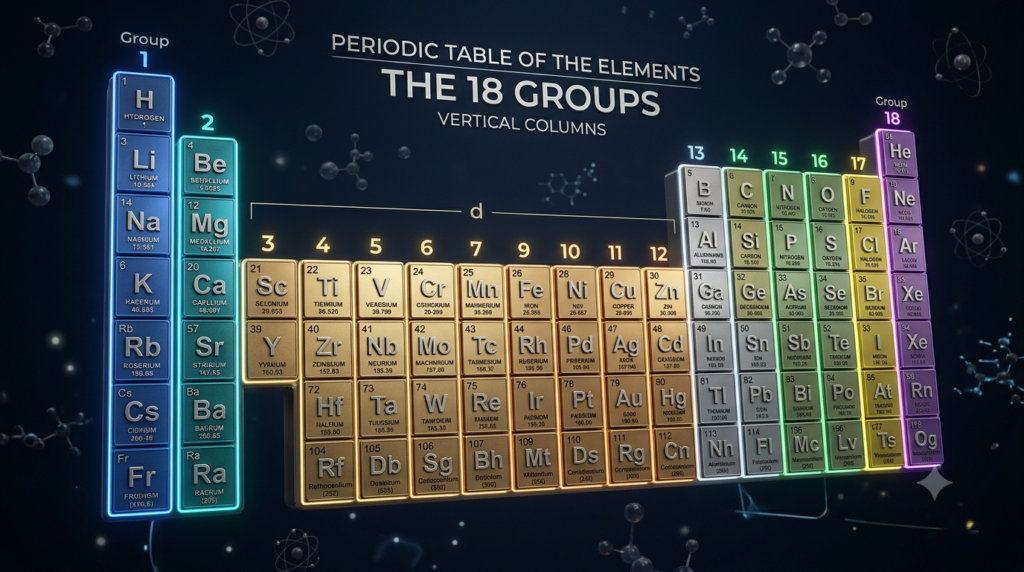
The periodic table is one of the most important achievements in the history of chemistry. It organizes all known chemical elements in a systematic way, making it easier to understand their properties, relationships, and behavior. Today, students, scientists, and researchers use the periodic table as an essential reference in chemistry. However, the development of this organized system was the result of many years of scientific research and discoveries.
One of the most important scientists behind the development of the periodic table was Dmitri Mendeleev, a Russian chemist who made a groundbreaking contribution to the classification of chemical elements. In 1869, he introduced a periodic table that arranged elements according to their atomic masses and chemical properties. His most remarkable achievement was that he left gaps for elements that had not yet been discovered and successfully predicted their properties.
Mendeleev’s work changed the way scientists understood chemical elements and their relationships. His periodic table became the foundation of the modern periodic table used today.
Who Was Dmitri Mendeleev?
Dmitri Ivanovich Mendeleev was a Russian chemist best known for developing one of the earliest successful periodic tables of chemical elements. He was born on February 8, 1834, in Tobolsk, Siberia, Russia.
Mendeleev developed an interest in science at an early age. Despite facing financial difficulties and personal challenges during his childhood, he continued his education and eventually became a respected scientist.
He studied chemistry and became a professor at Saint Petersburg University. During his academic career, he conducted research on various scientific subjects, including chemistry, chemical properties, and the classification of elements.
At that time, scientists had already discovered several chemical elements, but there was no widely accepted system for organizing them. Mendeleev recognized that elements showed repeating patterns in their chemical properties and worked to develop a logical arrangement.
His research eventually led to the publication of his periodic table in 1869, which became one of the most influential developments in chemistry.
The Scientific Background Before Mendeleev
Before Mendeleev developed his periodic table, scientists had discovered many chemical elements. However, these elements were studied separately, and there was no complete system to explain their relationships.
Chemists understood that some elements shared similar physical and chemical properties. For example, lithium, sodium, and potassium were reactive metals with several similar characteristics.
Scientists attempted to organize elements into groups based on their properties, atomic masses, and other characteristics. Several important contributions helped prepare the way for Mendeleev’s work.
Early Attempts to Classify Elements
Some important scientific developments before Mendeleev included:
1. Döbereiner’s Triads (1829)
German chemist Johann Wolfgang Döbereiner observed that certain elements could be grouped into sets of three, known as triads. The elements in each group had similar chemical properties.
For example, lithium, sodium, and potassium formed one such group. He also observed that the atomic mass of the middle element was approximately the average of the other two.
Although this idea worked for a limited number of elements, it could not classify all known elements.
2. Newlands’ Law of Octaves (1865)
English chemist John Newlands arranged elements in increasing order of atomic mass. He observed that every eighth element often showed similar chemical properties.
He compared this repeating pattern to musical octaves and called it the Law of Octaves.
However, this arrangement was not suitable for all known elements and became less effective as more elements were included.
3. Other Scientific Research
Other scientists also investigated relationships between atomic masses and chemical properties. Their research helped establish the idea that elements could be arranged according to a repeating pattern.
These earlier discoveries provided an important scientific foundation for Mendeleev’s periodic table.
How Did Mendeleev Develop the Periodic Table?
Mendeleev began working on the classification of elements while preparing a chemistry textbook called Principles of Chemistry.
He needed a systematic way to present information about the known elements, including their atomic masses and chemical properties.
To understand the relationships between elements, he collected information about their properties and compared them carefully.
He arranged the elements in increasing order of atomic mass and examined how their chemical properties changed.
During this process, he noticed that elements with similar chemical properties appeared at regular intervals. This observation helped him recognize a repeating pattern.
Mendeleev organized elements with similar characteristics into the same groups. Unlike some earlier classification attempts, he did not follow atomic mass blindly. When the chemical properties of an element suggested that it belonged in a particular group, he adjusted the arrangement accordingly.
In 1869, he presented his periodic classification of the elements. This achievement marked a major turning point in the development of modern chemistry.
Mendeleev’s Periodic Law
One of Mendeleev’s most important scientific contributions was the formulation of the original periodic law.
According to Mendeleev’s periodic law:
The physical and chemical properties of elements are periodic functions of their atomic masses.
This means that when elements are arranged in increasing order of atomic mass, their physical and chemical properties repeat at regular intervals.
For example, elements with similar chemical properties appeared in the same groups in his periodic table.
This principle helped scientists understand that the properties of elements were not random. Instead, they followed a recognizable pattern.
Although Mendeleev’s original periodic law was based on atomic mass, modern chemistry uses atomic number as the basis of the periodic law.
Main Features of Mendeleev’s Periodic Table
Mendeleev’s periodic table introduced several important features that made the classification of elements more systematic.
1. Arrangement According to Increasing Atomic Mass
Mendeleev generally arranged elements in increasing order of their atomic masses.
He studied the atomic masses of known elements and placed them in a sequence that revealed repeating patterns in their properties.
This arrangement helped identify relationships between elements that were not obvious when they were studied separately.
2. Elements with Similar Properties Were Placed Together
One of the main principles of Mendeleev’s table was grouping elements with similar chemical properties.
For example, lithium, sodium, and potassium were placed in the same group because they shared similar chemical characteristics.
This arrangement made it easier to compare elements and understand their chemical behavior.
3. Formation of Groups and Periods
Mendeleev arranged elements into horizontal rows and vertical columns.
Groups: Vertical columns containing elements with similar chemical properties.
Periods: Horizontal rows showing a progression in the properties of elements.
His arrangement helped establish the basic structural idea behind the periodic table used today.
4. Empty Spaces for Undiscovered Elements
One of the most remarkable features of Mendeleev’s periodic table was that he deliberately left empty spaces.
He believed that some elements had not yet been discovered but would eventually be identified.
Instead of placing elements incorrectly just to fill every position, he kept gaps where the periodic pattern suggested missing elements should exist.
5. Prediction of Unknown Elements
Mendeleev used the properties of surrounding elements to predict the characteristics of undiscovered elements.
He estimated their atomic masses and physical and chemical properties.
Several of these predictions were later confirmed through scientific discoveries, providing strong evidence for the usefulness of his periodic classification.
Mendeleev’s Prediction of Undiscovered Elements
Mendeleev’s ability to predict undiscovered elements is considered one of his greatest scientific achievements.
When he arranged the known elements, he noticed that certain positions in the periodic pattern were missing.
He believed that these gaps represented elements that had not yet been discovered.
He even estimated the properties of some of these missing elements based on the properties of neighboring elements.
Three of his most successful predictions were related to elements later named scandium, gallium, and germanium.
1. Prediction of Gallium
Mendeleev predicted the existence of an element that he called eka-aluminium.
He estimated several of its properties, including its atomic mass and density.
In 1875, French chemist Paul-Émile Lecoq de Boisbaudran discovered a new element and named it gallium.
The properties of gallium were remarkably close to Mendeleev’s predictions.
This discovery provided important support for his periodic table.
2. Prediction of Scandium
Mendeleev predicted another missing element that he called eka-boron.
He estimated its atomic mass and other characteristics.
In 1879, Swedish chemist Lars Fredrik Nilson discovered scandium.
Its properties were consistent with Mendeleev’s earlier predictions.
This discovery further demonstrated the accuracy of his scientific approach.
3. Prediction of Germanium
Mendeleev also predicted an element called eka-silicon.
He estimated its atomic mass, density, and several chemical properties.
In 1886, German chemist Clemens Winkler discovered a new element and named it germanium.
The properties of germanium closely matched the characteristics predicted by Mendeleev.
These discoveries demonstrated that his periodic table could do more than organize known elements. It could also help scientists predict the existence and properties of elements that had not yet been discovered.
How Mendeleev Handled Problems in Atomic Mass Order
Although Mendeleev generally arranged elements according to increasing atomic mass, he sometimes changed their positions to maintain groups of elements with similar chemical properties.
For example, tellurium has a greater atomic mass than iodine, but Mendeleev placed tellurium before iodine.
This arrangement was based on their chemical properties rather than a strict atomic mass sequence.
At the time, scientists did not fully understand the internal structure of atoms or the importance of atomic number.
Later research showed that the periodic table should be arranged according to increasing atomic number, which explains such apparent exceptions.
Mendeleev’s willingness to prioritize chemical similarities was an important strength of his classification system.
Limitations of Mendeleev’s Periodic Table
Mendeleev’s periodic table was a major scientific achievement, but it was not perfect. As scientists discovered more elements and learned more about atomic structure, some limitations became clear.
1. Uncertain Position of Hydrogen
Hydrogen has properties similar to both alkali metals and halogens.
It can lose an electron like alkali metals and gain an electron like halogens.
Because of these different characteristics, its position in the periodic table was not completely clear.
2. Anomalous Pairs of Elements
Some elements did not follow the increasing atomic mass order.
Examples include:
Argon and potassium
Cobalt and nickel
Tellurium and iodine
Mendeleev placed these elements according to their chemical properties, even when their atomic masses suggested a different order.
3. No Proper Position for Isotopes
Isotopes are atoms of the same element that have the same atomic number but different mass numbers.
When isotopes were discovered, scientists realized that arranging elements strictly according to atomic mass could not explain why different isotopes of the same element belonged to the same position.
4. Position of Rare Earth Elements
The rare earth elements, particularly the lanthanides, were difficult to accommodate within Mendeleev’s original arrangement.
As more elements were discovered, their classification required further development.
Despite these limitations, Mendeleev’s periodic table provided an extremely valuable foundation for later scientific discoveries.
How the Modern Periodic Table Improved Mendeleev’s Work
The modern periodic table developed from Mendeleev’s original classification, with important improvements made through later scientific research.
One of the most significant contributions came from English physicist Henry Moseley in 1913.
Through his experiments involving X-rays, Moseley demonstrated that the properties of elements were related to their atomic numbers rather than their atomic masses.
The modern periodic law states:
The physical and chemical properties of elements are periodic functions of their atomic numbers.
Atomic number represents the number of protons in the nucleus of an atom.
The modern periodic table arranges elements in increasing order of atomic number.
It contains:
7 horizontal periods.
18 vertical groups.
118 officially recognized elements.
Separate lanthanide and actinide series, generally displayed below the main body of the table.
This modern arrangement solves many problems associated with Mendeleev’s original table while preserving its central idea of periodicity.
Other Important Contributions of Dmitri Mendeleev
Although Mendeleev is most famous for his work on the periodic table, he also contributed to several other areas of science.
1. Research in Chemistry
Mendeleev conducted extensive research on the physical and chemical properties of substances.
His work helped improve the scientific understanding of chemical compounds and their behavior.
2. Chemistry Textbooks
He wrote Principles of Chemistry, an influential textbook that helped explain important chemical concepts.
His efforts to organize chemical knowledge contributed to the development of his periodic classification.
3. Research on Liquids and Solutions
Mendeleev also studied the properties of liquids and solutions.
His research included investigations into the relationship between the composition and physical properties of different substances.
4. Contributions to Metrology
Mendeleev was interested in measurement standards and scientific accuracy.
He later became involved in work related to metrology, the science of measurement, and helped promote reliable measurement practices in Russia.
His scientific interests extended beyond the classification of chemical elements.
Why Is Dmitri Mendeleev Important in Chemistry?
Dmitri Mendeleev is considered one of the most influential chemists in history because his work transformed the way chemical elements were understood and organized.
Before his periodic table, scientists had difficulty identifying a clear relationship between the properties of different elements.
Mendeleev introduced a systematic classification that revealed repeating patterns and helped explain similarities between elements.
His predictions of undiscovered elements demonstrated that the periodic table could be used as a scientific tool for making new discoveries.
His work also provided a foundation for future scientists to investigate atomic structure, chemical bonding, and periodic properties.
Even though the modern periodic table differs from his original arrangement, the basic principle of organizing elements according to repeating properties remains central to chemistry.
Conclusion
Dmitri Mendeleev made one of the greatest contributions to the development of modern chemistry through his periodic classification of chemical elements. In 1869, he introduced a periodic table based mainly on increasing atomic masses and similarities in chemical properties. His most remarkable achievement was leaving gaps for undiscovered elements and accurately predicting several of their properties.
Although his original periodic table had some limitations, later discoveries and scientific improvements helped develop the modern periodic table based on atomic number. His work established the foundation for understanding the relationships between chemical elements and remains an essential part of chemistry education today.
Mendeleev’s contribution demonstrates how careful observation, scientific reasoning, and the recognition of patterns can lead to discoveries that transform an entire field of science.
FAQs
1. Who was Dmitri Mendeleev?
Dmitri Mendeleev was a Russian chemist best known for developing one of the earliest successful periodic tables of chemical elements. He was born on February 8, 1834, in Tobolsk, Siberia, Russia. In 1869, he introduced a periodic classification that arranged elements mainly according to increasing atomic mass and similarities in their chemical properties. His work helped scientists understand the relationships between different elements. One of his greatest achievements was predicting the existence and properties of elements that had not yet been discovered. His periodic table became the foundation of the modern periodic table used in chemistry today.
2. What was Dmitri Mendeleev’s contribution to the periodic table?
Dmitri Mendeleev’s main contribution was developing a systematic arrangement of chemical elements in 1869. He arranged the known elements mainly according to increasing atomic mass and placed elements with similar chemical properties in the same groups. He also left empty spaces for elements that had not yet been discovered and predicted their properties. Several of these predictions were later confirmed through scientific discoveries. His work helped establish the periodic relationship between chemical elements and provided the foundation for the modern periodic table. Mendeleev’s classification transformed the way scientists studied and understood the elements.
3. When did Dmitri Mendeleev create the periodic table?
Dmitri Mendeleev introduced his periodic classification of chemical elements in 1869. While preparing his chemistry textbook, Principles of Chemistry, he studied the atomic masses and chemical properties of known elements. He noticed that certain properties repeated when elements were arranged in a particular order. Based on this observation, he developed a systematic table that grouped elements with similar characteristics. His periodic classification was an important scientific achievement because it also included gaps for undiscovered elements. The year 1869 is therefore considered a major milestone in the history of the periodic table and modern chemistry.
4. What is Mendeleev’s periodic law?
Mendeleev’s periodic law states that the physical and chemical properties of elements are periodic functions of their atomic masses. This means that when elements are arranged in increasing order of atomic mass, similar properties appear at regular intervals. Mendeleev used this principle to classify elements into groups and periods. His periodic law helped scientists recognize repeating patterns in the behavior of chemical elements. However, modern chemistry uses atomic number instead of atomic mass as the basis for periodic classification. This improved principle is known as the modern periodic law and forms the foundation of today’s periodic table.
5. Why did Mendeleev leave gaps in his periodic table?
Mendeleev left gaps in his periodic table because he believed that some chemical elements had not yet been discovered. While arranging the known elements, he noticed that certain positions were missing from the repeating pattern of chemical properties. Instead of placing elements incorrectly, he deliberately kept empty spaces for these unknown elements. He also predicted their approximate atomic masses and other physical and chemical properties. Later discoveries of gallium, scandium, and germanium confirmed several of his predictions. These successful predictions demonstrated the accuracy and scientific importance of his periodic classification.
6. Which elements did Mendeleev successfully predict?
Mendeleev successfully predicted the properties of three important elements: gallium, scandium, and germanium. Before their discovery, he gave them temporary names based on their expected positions in his periodic table. He called them eka-aluminium, eka-boron, and eka-silicon, respectively. Gallium was discovered in 1875, scandium in 1879, and germanium in 1886. Their physical and chemical properties closely matched his predictions. These discoveries provided strong evidence that his periodic table was scientifically useful. His ability to predict undiscovered elements remains one of the most remarkable achievements in the history of chemistry.
7. What were the main features of Mendeleev’s periodic table?
Mendeleev’s periodic table arranged known elements mainly according to increasing atomic mass. Elements with similar chemical properties were placed in the same vertical groups, while horizontal rows represented periods. One important feature was the use of empty spaces for undiscovered elements. He also predicted the properties of several missing elements using the characteristics of neighboring elements. When necessary, he adjusted the order of certain elements to maintain similarities in chemical properties. These features made his classification more useful than earlier attempts and established important principles that influenced the development of the modern periodic table.
8. What were the limitations of Mendeleev’s periodic table?
Although Mendeleev’s periodic table was a major scientific achievement, it had several limitations. The position of hydrogen was uncertain because it showed similarities with both alkali metals and halogens. Some elements, such as tellurium and iodine, did not follow increasing atomic mass order. The table also could not properly explain the position of isotopes because isotopes of the same element have different mass numbers. Additionally, the arrangement of rare earth elements was difficult. These limitations were gradually resolved through later scientific discoveries, particularly the introduction of atomic number as the basis for arranging elements.
9. How did Henry Moseley improve Mendeleev’s periodic table?
Henry Moseley improved the periodic classification of elements through his experiments in 1913. He demonstrated that the properties of elements were related to their atomic numbers rather than their atomic masses. Atomic number represents the number of protons present in the nucleus of an atom. This discovery provided the scientific explanation for the unusual positions of certain elements in Mendeleev’s table. Scientists could now arrange elements in increasing order of atomic number. This led to the modern periodic law and helped establish the arrangement of the modern periodic table used in chemistry today.
10. Why is Dmitri Mendeleev called the father of the periodic table?
Dmitri Mendeleev is widely known as the father of the periodic table because he developed one of the most successful early systems for classifying chemical elements. His 1869 periodic table organized elements according to their atomic masses and chemical properties. More importantly, he left gaps for undiscovered elements and accurately predicted several of their characteristics. These predictions were later confirmed by scientific discoveries. His classification revealed repeating patterns in the properties of elements and provided a foundation for modern chemistry. Although other scientists also contributed to the development of the periodic table, Mendeleev’s work remains especially influential.